

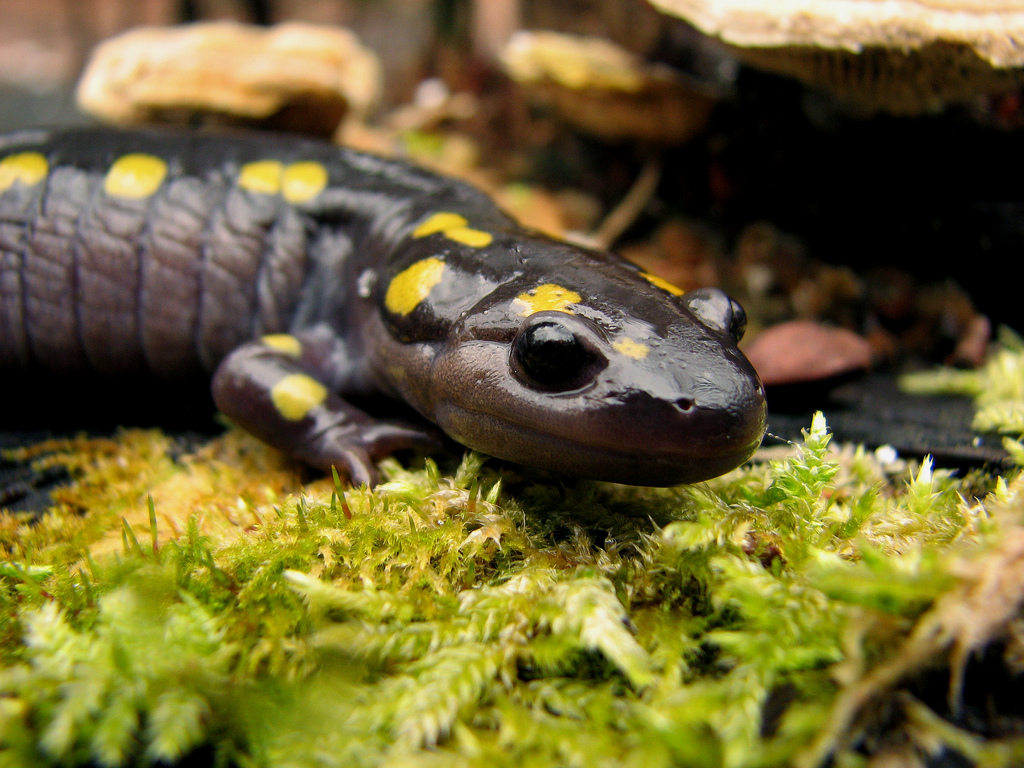
The spotted salamander, or Ambystoma maculatum, makes its home throughout the Eastern United States and Southern Canada. Unlike other salamanders, the spotted salamander is part of an incredible partnership that overrides the whole food-chain thingy; it has a bright partnership with the sun.
To be more precise, the solar power salamander relies on sun-harnessing algae within its eggs. As the young salamanders develop within an egg they release waste materials which the algae feeds on. The algae in turn photosynthesizes sunlight, releasing oxygen and glucose which aids an embryo in its development. In this way, the algae and salamanders engage in a highly beneficial, symbiotic relationship. The algae live a carefree life chilling with an unborn salamander, while the unborn salamander gets its own perpetual energy power supply as a roommate.
The scientific realm has known about, or at least hypothesized about solar powered salamanders since before the 20th century. Biologist Henry Orr had speculated on the abnormal relationship between the algae and salamanders after observing single celled algae colonizing salamander eggs within hours of them being laid in shallow waters. Over 100 years later, scientists have proof that this particular salamander is truly radiant.
Spotted salamanders aren’t the only non-plant species that use photosynthesis to live and grow. In fact:
Many other animals, from sponges to sea slugs pull the same trick. Corals are animals but have algae living in them that use sunlight to make sugar. One species of hornet can convert sunlight into electricity. There are also suggestions that aphids can harness sunlight, although most biologists are unconvinced.
The spotted salamander is the first vertebrate scientists have discovered to directly depend on photosynthesis for nourishment. It might be the photosynthesis of another life form, but it is still a direct form of photosynthetic exploitation and dependency.
I wonder if one day we’ll power our cities, homes, and personal devices with stores of algae. Remind me of the skin suits from a story by Stephen Baxter, “The Ghost Pit.”
Sources:
http://eol.org/pages/1048181/overview
http://jeb.biologists.org/content/216/3/452
http://www.newscientist.com/article/dn23090-zoologger-the-first-solarpowered-vertebrate.html
http://www.jstor.org/discover/10.2307/1931088?uid=3739320&uid=2&uid=4&sid=21102050285923
http://www.newscientist.com/article/mg20827901.100-light-diet-animals-that-eat-sunshine.html
http://www.newscientist.com/article/dn16124-solarpowered-sea-slug-harnesses-stolen-plant-genes.html
http://www.newscientist.com/article/dn19709-zoologger-the-solarpowered-electric-hornet.html
http://www.newscientist.com/article/dn22195-aphids-may-be-first-photosynthesising-animal.html
 Wondergressive