


A couple of weeks ago the New York Times published a short article on how all genetically modified (GM) products sold in Whole Foods Market would have to be labeled as such by 2018. I was pleasantly surprised to see that the editorial board both agreed that a private entity is free to require whatever labels it desires while also denouncing the need for expensive mandatory labeling in other stores throughout America.
The organic food movement, and the labels that go with it, has been surging in popularity for over the past decade. Although some of its tenets, like promoting local produce, are relatively benign and sensical, others are much more pernicious. The most dangerous of these is the completely unsubstantiated idea that GM foods are harmful for a variety of dubious reasons, like that they are less healthy than organic foods or that the pesticides and herbicides used to grow conventional crops are harming humans. The general vibe I get from more militant organic foodies is that GM food is inherently untrustworthy, cannot help feed a growing population, and that it is actively destroying the planet. The fervor I’ve witnessed for these beliefs borders on religious.
For all the vitriol and the-end-is-nigh rhetoric, the bad rap that GM foods gets is entirely a fabrication, the product of campaigns of misinformation by groups like Greenpeace, Friends of the Earth, and Navdanya.
In reality, GMOs are actually extremely beneficial for multiple reasons. For one, they cost less than organic products to the consumer. They also are genetically resistant to chemicals like glyphosate, an herbicide commercially sold as Round Up. This means that farmers no longer have to use other chemicals that are at least three times as toxic as Round Up and stay in the environment about twice as long. This lack of toxicity also helps reduce topsoil erosion by up to 90%. GM crops also allow for more food to be grown on any given acre of land, which helps reduce deforestation.
In September of last year, Stanford University released a meta-analysis of over 200 studies on the effects of conventional and organic foods to determine the nutritiousness and safety of GM products for humans.
“They concluded that fruits and vegetables labeled organic were, on average, no more nutritious than their conventional counterparts, which tend to be far less expensive. Nor were they any less likely to be contaminated by dangerous bacteria like E. coli.
The researchers also found no obvious health advantages to organic meats.
Conventional fruits and vegetables did have more pesticide residue, but the levels were almost always under the allowed safety limits, the scientists said. The Environmental Protection Agency sets the limits at levels that it says do not harm humans.”
These findings should come as no shock as they confirm what many other scientific bodies have already discovered. The National Academy of Sciences noted in a 2004 report that
“no adverse health effects attributed to genetic engineering have been documented in the human population.”
The World Health Organization reports that
“GM foods currently available on the international market have passed risk assessments and are not likely to present risks for human health. In addition, no effects on human health have been shown as a result of the consumption of such foods by the general population in the countries where they have been approved.”
In 2010 the European Commission finished a decade’s worth of research over the GM debate, concluding that
“there is, as of today, no scientific evidence associating GMOs with higher risks for the environment or for food and feed safety than conventional plants and organisms.”
Genetically modified food is simply not the boogeyman many want people to believe it is.
In response to the Stanford study, Roger Cohen penned an op-ed in the Times entitled The Organic Fable in which he gleefully celebrated its findings. His stance and exasperation with the organic movement directly mirrors my own:
“Organic has long since become an ideology, the romantic back-to-nature obsession of an upper middle class able to afford it and oblivious, in their affluent narcissism, to the challenge of feeding a planet whose population will surge to 9 billion before the middle of the century and whose poor will get a lot more nutrients from the two regular carrots they can buy for the price of one organic carrot.”
When groups like Greenpeace denigrate and demonize GM products, they are purposefully denying the incredible things GMOs have accomplished and how many millions of lives they have saved by instead greenwashing the issue with pro-organic propaganda.
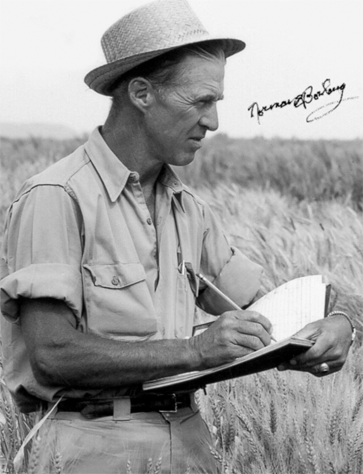
Norman Borlaug provides perhaps my favorite story about the astounding successes of genetically modifying crops. In 1968 Paul Ehrlich published his bestseller, The Population Bomb, in which he predicted that hundreds of millions of people in Southeast Asia would soon starve as the land simply couldn’t provide enough calories to maintain the growing multitudes. Borlaug and his team, however, were already hard at work developing and introducing a special type of high-yield dwarf wheat to the region. The crop was naturally resistant to many pests and diseases and allowed farmers to double or even triple their harvest. Later, a special high-yield variety of rice was developed, spreading the cornucopia across all of Asia.
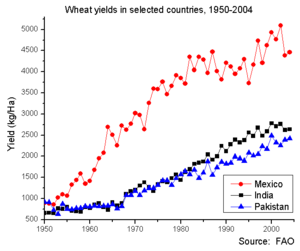
For all of his work, Borlaug was awarded the 1970 Nobel Peace Prize. A modern-day saint, he is credited with saving as many as one billion lives from famine and starvation.
In modern times, a GM crop named Golden Rice has been developed over the past 30 years to combat Vitamin A deficiency. This malady kills an estimated 650,000 children under the age of five every year. Despite Golden Rice’s potential to drastically alleviate this tragedy, groups like Greenpeace and Dr. Vandana of Navdanya have not only opposed, but have also consistently delayed the implementation of this breakthrough, maintaining that Golden Rice poses an unnecessary danger to human health and to local farmers through crop contamination.
I am not explicitly against organics or the local food movement; what people purchase and what they eat is none of my business. However, I am strongly opposed to the knee-jerk reactions of some people and organizations that not only classify all GM products as being harmful, but who also lobby to make them illegal for other people to use or benefit from.
People should be free to choose whatever food or technology that they see fit. No well-fed person should sit in their armchair and actively campaign against crops that could drastically improve, or even save the lives of people who might want to cultivate them.
Good on The New York Times for realizing that mandated GM labeling is an onerously expensive and pointless intrusion on private retailers who don’t desire to do so voluntarily. Hopefully supporters of both organic and conventional products can realize that making food more costly only exacerbates problems both at home and around the world.
Sadly, however, I fear that the anti-GM movement has a reflexive, animistic attitude towards food that they deem to be “impure.” For my desire to see billions of sated stomachs in the coming decades, I hope I’m wrong.
Sources:
http://www.nytimes.com/2013/03/15/opinion/why-label-genetically-engineered-food.html?_r=1&
http://www.greenpeace.org/international/en/
http://www.foe.co.uk/resource/press_releases/gm_crops_not_answer_to_food_challenges_03012013.html
http://www.navdanya.org/campaigns/gmo-free
http://www.agweb.com/assets/import/files/ao273f.pdf
http://annals.org/article.aspx?articleid=1355685
http://www.nap.edu/catalog.php?record_id=10977
http://www.who.int/foodsafety/publications/biotech/20questions/en/
http://europa.eu/rapid/press-release_IP-10-1688_en.htm
http://www.nytimes.com/2012/09/07/opinion/roger-cohen-the-organic-fable.html?_r=0
http://www1.umn.edu/news/features/2006/UR_84946_REGION1.html
http://www.project-syndicate.org/commentary/the-costs-of-opposing-gm-foods-by-bj-rn-lomborg
http://online.sfsu.edu/rone/GEessays/goldenricehoax.html
http://www.theawarenessparty.com/?page_id=2925
http://www.dallasobserver.com/2002-12-05/news/green-giant/
 Wondergressive