

This is a continuation of a three part series of articles on the art of tattoo. I’ve chosen this as a topic in order to help decide whether or not I will get a tattoo myself. Click to read Part 1 and Part 3.
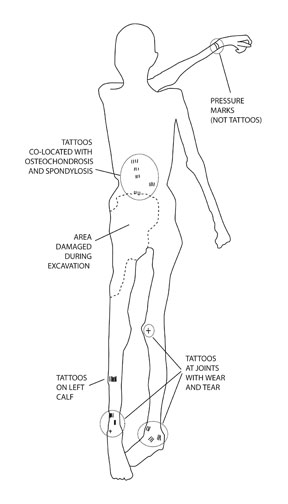
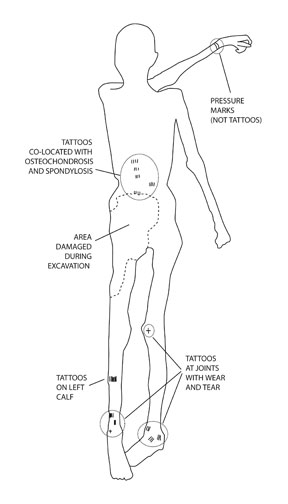
Tattoos have been around for a long long time. The earliest known case of inktitude was found in 1992 on the mummified and extremely frozen corpse of Otzi the Iceman. The Iceman’s tattoos are strangely in line with common acupuncture nodes and are likely to be more than decorative.
While most tattoos are ornamental in nature, the tattoos found on Otzi’s body were in the form of simple stripes or crosses. They were also found in places that would normally be covered by hair or clothing. Since such non-ornamental tattoos had previously been found in similar locations on mummies in Siberia and South America, some researchers speculated that the lines on Otzi’s body were of therapeutic importance.
The arts of tattoo and acupuncture often intersect and have aided each other in spreading to a global audience. Other mummies with these holistically rad skin decals have been found through the world.
Trade routes spread ideas as well as goods. Routes such as the silk road were vitally important in sharing skin tapestries.
During the expansion of the roman empire tattoos went from being an acceptable art form worn by soldiers to an anti christian sentiment and therefore banned.
Among the Greek and Romans, tattoos were used to mark someone as belonging to a certain religious sect, or as the owner of slaves. Tattoos were even used as a form of punishment to mark criminals. When a dynasty of Macedonian Greek monarchs riles Egypt, the pharaoh Ptolemy IV (221-205 B.C.) evidently had been tattooed with ivy leaves to symbolize his devotion to Dionysus, the Greek god of wine. The tattoo fashion was then taken up by Roman soldiers and utilized across the Roman Empire until the spread of Christianity, when tattoos were banned by the Emperor Constantine (A.D. 306-373).
Both of these empires had a heck of a lot of pull on the world around them. When trade routes shifted from land to sea, tattoos became a symbol of the traveler and of nobility.
Tattoos became popular in Britain after Captain James Cook made his trip to Tahiti, which is about 1,500 miles from Samoa. Broken shells were the tattoo needles of choice in Tahiti. Cook made the practice popular amont sailors before British elites started wearing them. King George V sported a dragon tattoo, and King Edward VII was decorated with a Christian cross. From this point onward, the tattoo became a sign of nobility in Britain.
The bridge from antiquity to modern tattooing really happened in 1891 when Samual O’Reilly patented the electric tattooing machine. Since then, the art of tattooing has spread like dermal wildfire. As I’m not really sure what dermal wildfire is, I’ll leave that to your imagination.
Stay tuned for the part three of my cultural examination of tattoos. I’ll be investigating the long-term psychological effects of having a tattoo!
Sources and Additional Information:
Other Wondergressive Links:
Tattoo Quest (Part 1): Tattoos of Southeast Asia
Tattoo Quest (Part 3): Significance of Tattoos in the 20th and 21st Century
AI Proscribes Better Treatment than Doctors
 Wondergressive