


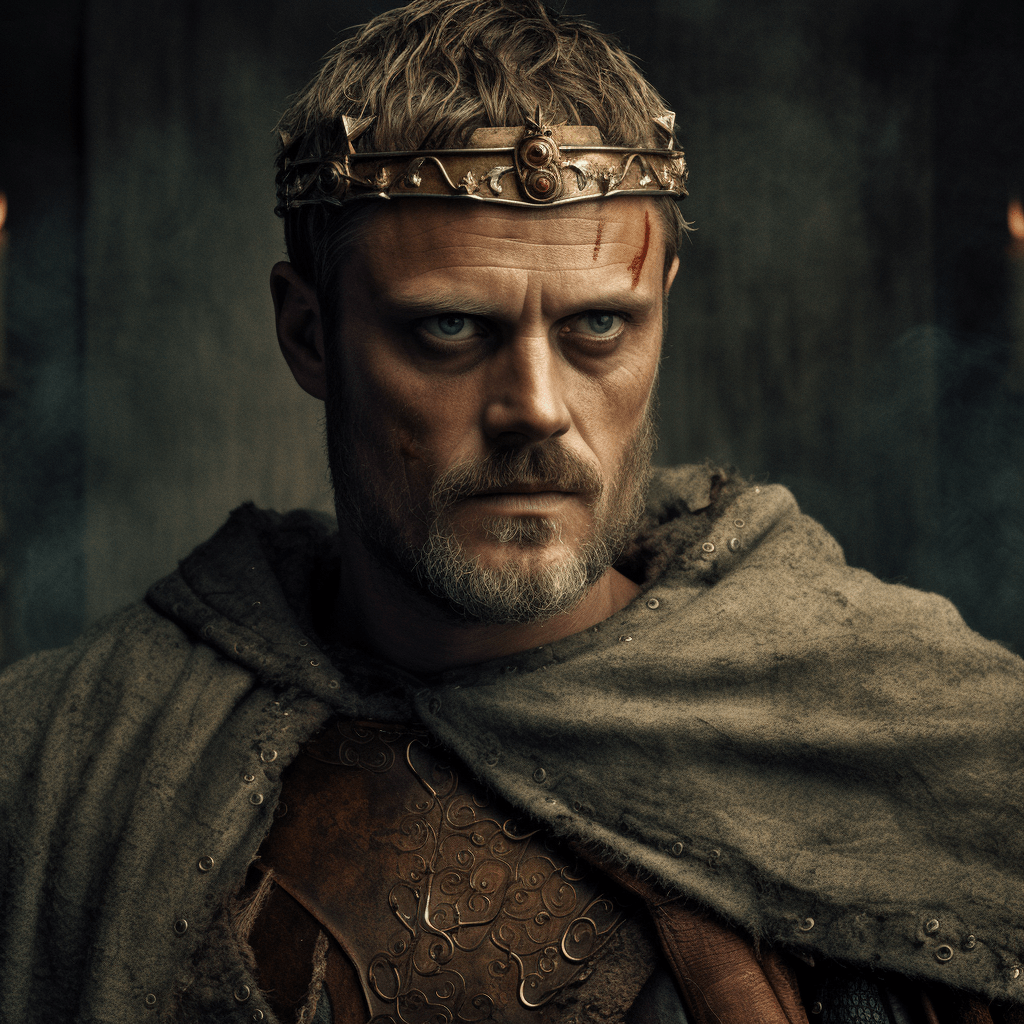
King Arthur, the legendary ruler said to have led Britain against Saxon invaders during the late 5th and early 6th centuries, stands as one of the most enduring figures of folklore and literature. His story, embellished by centuries of retelling, has produced a rich tapestry of myth and legend. But who was the real King Arthur? This question has intrigued historians, archaeologists, and lovers of myth alike, sparking debates and investigations that have endured for centuries.
The Arthurian legend as we know it today, complete with the Round Table, the Holy Grail, and characters like Merlin, Guinevere, and Lancelot, is primarily a product of medieval romance literature. The figure of Arthur first emerged in historical texts, such as the “Historia Brittonum” (History of the Britons) from the 9th century and the “Annales Cambriae” (Annals of Wales) from the 10th century. These documents reference a heroic figure named Arthur, attributing to him great military victories against invading forces, though they do not denote him as a king.
The definitive image of Arthur as a chivalrous king was largely shaped by Geoffrey of Monmouth in his pseudohistorical work “Historia Regum Britanniae” (History of the Kings of Britain) in the 12th century. Geoffrey’s Arthur was a wise, noble, and victorious monarch who conquered much of Europe but fell tragically in battle, promising to return in Britain’s hour of greatest need. His portrayal, interwoven with elements of mythology and folklore, would deeply influence later Arthurian literature and the broader Western cultural imagination.
Despite the rich tradition of Arthurian lore, evidence for the existence of the historical King Arthur is elusive. No contemporary historical records from the supposed time of Arthur’s reign conclusively mention him. Some scholars posit that Arthur may have been a composite character, a symbolic figurehead created from the exploits of several real-life warlords. Others suggest he could have been a Roman-affiliated military leader named Artorius, or a shadowy figure of oral folklore eventually committed to text by early historians.
In the absence of clear historical evidence, archaeology has often been turned to in the search for Arthur. Sites such as Tintagel Castle in Cornwall, Cadbury Castle in Somerset, and Glastonbury Abbey have been linked to Arthur through legend and historical speculation. However, while these sites reveal fascinating insights into Dark Age Britain and the formation of Arthurian legend, none have provided definitive proof of Arthur’s existence.
The quest for the real King Arthur, then, is less a concrete search for an individual figure and more an exploration of cultural memory, folklore, and national identity. Arthur, whether as a legendary king, a folk hero, or a symbol of idealized leadership and chivalry, has been deeply woven into the fabric of British and Western cultural consciousness. His story reflects societal ideals of bravery, justice, and nobility, while also grappling with themes of betrayal, fallibility, and the transience of glory.
Furthermore, Arthur’s legendary return serves as a beacon of hope, a promise of resilience and restoration in times of despair. This enduring aspect of the Arthurian legend continues to resonate, reflecting our collective longing for heroes who can guide us through the tumult of our times.
Despite the lack of concrete historical evidence, the pursuit of the real King Arthur remains a captivating endeavor. It takes us beyond the quest for an individual, leading us into a rich labyrinth of myths, legends, and histories. In the process, it reveals the power of stories to shape our understanding of the past, to embody our ideals and aspirations, and to inspire us in the present.
In a sense, the real King Arthur may lie not in the elusive historical figure, but in the enduring resonance of his legend. He is an embodiment of societal ideals, a reflection of the cultural psyche, and a character that has grown and transformed with every retelling of his tale. Arthur represents a shared heritage and mythology, a narrative that spans across centuries and continues to captivate audiences today.
Some might argue that the search for the historical Arthur, while fascinating, is less important than acknowledging the cultural impact of the Arthurian legend. Whether or not there was a ‘real’ King Arthur is almost beside the point. What is undeniable is the lasting influence of the Arthurian narrative and its ability to encapsulate a spectrum of human experiences and ideals.
The real King Arthur, then, exists in our collective imagination. He is a symbol of heroism and leadership, a character marked by both triumph and tragedy. He is the focus of a story that has been told and retold, reimagined and reinvented, for over a thousand years. His tale is one of the enduring narratives of Western culture, a saga that continues to inspire, intrigue, and provoke thought.
Ultimately, the quest for the real King Arthur illuminates the incredible power of narrative and mythology. It demonstrates how stories, passed down through generations, can shape our understanding of history, inform our values, and stimulate our imaginations. As we delve into the enigma of King Arthur, we do not just uncover a legend or a historical mystery, but a reflection of our own cultural identity and heritage.
As we move further into the 21st century, the tale of King Arthur continues to captivate, inspire and evoke curiosity. His narrative, interwoven with our cultural fabric, challenges us to seek out our heroes, to understand our past, and to continue the timeless tradition of storytelling. And so, the quest for the real King Arthur endures, a testament to the enduring power of myth, the mystery of history, and our ceaseless fascination with the unknown.
 Wondergressive