

The apocalypse has been a subject of fascination and trepidation for humankind since ancient times, echoed through myths, religion, and now in the age of science, through a plethora of potential cataclysmic events. This article aims to explore different ways the world, as we know it, could potentially end.
Extraterrestrial Impacts
One of the most well-known cataclysmic events is an asteroid or comet impact, similar to the one believed to have caused the extinction of the dinosaurs 66 million years ago. NASA continually tracks “Near-Earth Objects” (NEOs) to mitigate this risk, but an unanticipated or massive enough impact could result in severe climate changes, fires, tsunamis, and eventual mass extinction.
Super-Volcano Eruption
Super-volcanoes, though fewer in number, pose a substantial risk. An eruption of a super-volcano, like the one at Yellowstone National Park, would eject a vast amount of ash and sulfur compounds into the atmosphere. This could cause a significant drop in global temperatures, affecting photosynthesis and leading to a “volcanic winter.”
Pandemic Outbreak
Pandemics have repeatedly altered the course of human history. A highly infectious and lethal pathogen could potentially wipe out a significant portion of the human population, leading to societal collapse. Recent events, like the COVID-19 pandemic, serve as a reminder of our vulnerability to biological threats.
Nuclear War
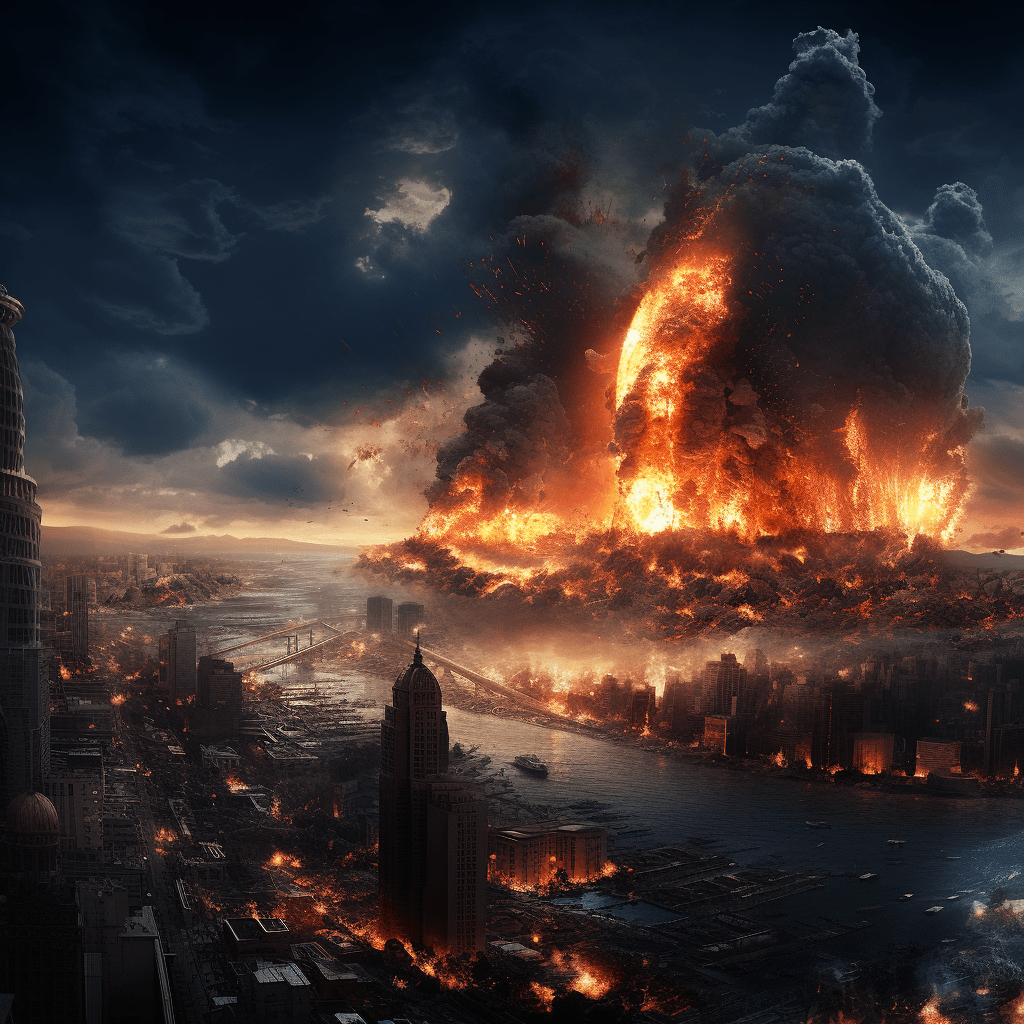
The advent of nuclear weapons introduced a new potential path to global destruction. A full-scale nuclear war would not just cause immediate devastation in the involved areas but would also lead to a nuclear winter, with widespread famine and disease potentially leading to human extinction.
Artificial Intelligence
The rapid progress in Artificial Intelligence (AI) has sparked concerns about it potentially posing an existential risk to humanity. If not properly controlled, a superintelligent AI could act contrary to human interests and could even become impossible to stop.
Climate Change
Human-induced climate change is a slow-moving catastrophe that we’re currently living through. Rising temperatures, melting ice caps, rising sea levels, and extreme weather conditions could render the planet inhospitable. While it’s a gradual process, the cumulative effects could be as disastrous as any sudden cataclysmic event.
Cosmic Threats
Our planet exists in a cosmic shooting gallery. Threats such as gamma-ray bursts from collapsing stars, nearby supernovas, or even the movement of our solar system through dangerous areas of the galaxy could potentially end life on Earth.
Alien Invasion
While this scenario resides firmly in the realm of science fiction, we cannot entirely rule out the possibility of hostile extraterrestrial life aiming to destroy or overtake our planet.
The Sun’s Life Cycle
In about 5 billion years, our sun will enter the final phase of its lifecycle. It will expand into a red giant, engulfing the inner planets and rendering Earth uninhabitable long before it even reaches us.
Conclusion
While these scenarios can seem alarming, it’s important to remember that they are largely based on our current understanding and many involve a degree of speculation. Moreover, knowledge of these potential threats enables us to prepare, mitigate, and potentially prevent these cataclysmic events. For instance, advancements in science allow us to track near-Earth objects, work towards sustainable living to combat climate change, and maintain international peace treaties to prevent nuclear war. Understanding potential threats is the first step towards safeguarding our planet’s future, ensuring that the end remains a topic of intriguing speculation rather than an imminent reality.
 Wondergressive