


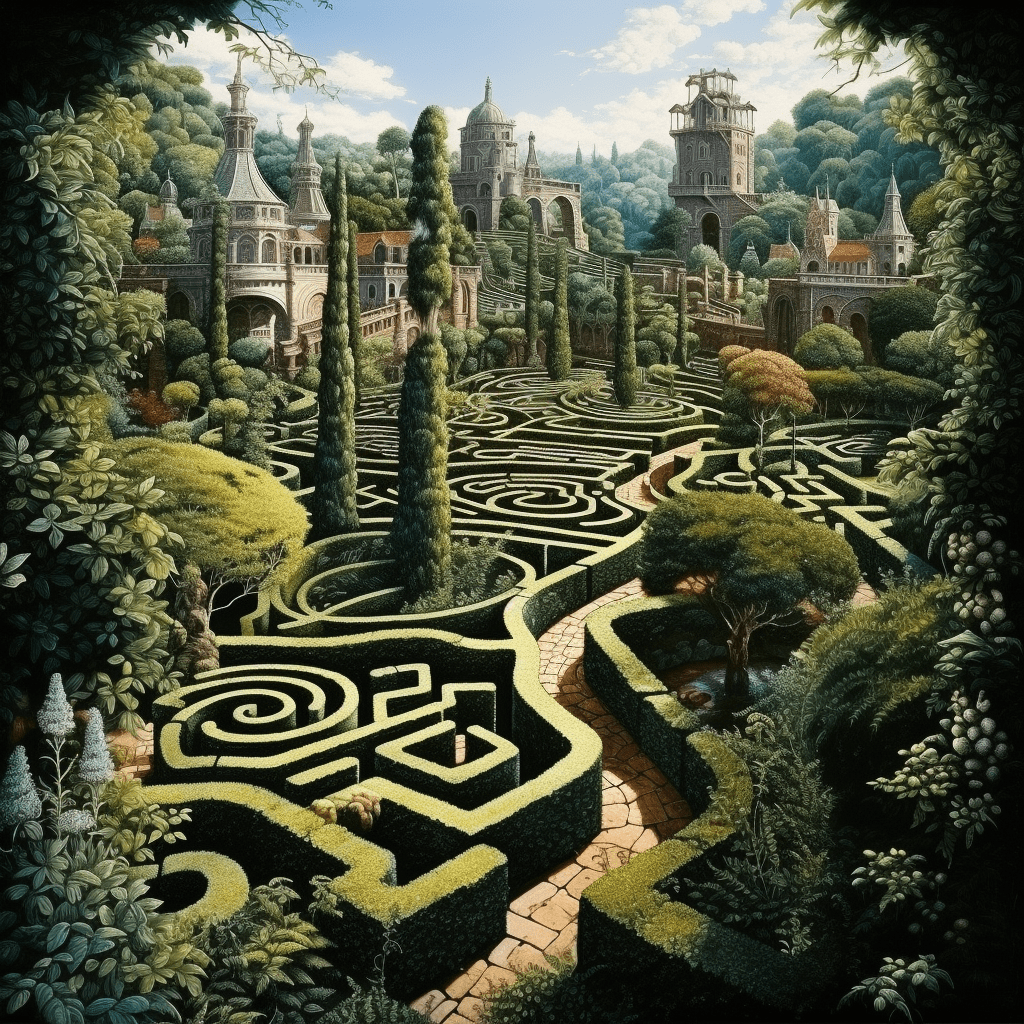
“The Garden of Forking Paths” is a short story by Argentine writer Jorge Luis Borges, first published in 1941 as part of his collection “Ficciones”. This metafictional narrative, loaded with philosophical and literary complexity, navigates through a maze of time, multiple realities, and the intricate relationship between authorship and narrative.
The Story
The story, set during World War I, revolves around the protagonist, Yu Tsun, a Chinese spy working for Germany. The narrative unfolds as Yu Tsun tries to convey crucial information to his German overlords, pursued relentlessly by an Englishman, Captain Richard Madden. Yu Tsun’s only hope to communicate the information lies in an unconventional strategy: to murder a person whose name is identical to the information, thus ensuring its publication in the newspapers.
This simple plot, however, is an entry point into a convoluted tale of infinite possibilities and realities, symbolized through the ‘garden of forking paths’.
The Labyrinth of Time
The labyrinth is a recurring motif in Borges’s works, and in “The Garden of Forking Paths”, it manifests as a metaphor for time. Ts’ui Pên, Yu Tsun’s ancestor, leaves an unfinished novel and an ‘invisible labyrinth.’ Yu Tsun interprets this labyrinth as the novel itself.
In Borges’s hands, the ‘garden’ becomes a symbol for a nonlinear, or ‘forking’ concept of time. Instead of a single path, the past and future diverge and converge, leading to an infinite web of possibilities.
Quantum Interpretations
In the context of modern physics, Borges’s narrative becomes strikingly relevant. His forking paths bear resemblance to the quantum theory concept of a multiverse, where all possible outcomes of an event occur in separate, parallel universes. Borges’s garden, therefore, can be seen as an early, imaginative exploration of this quantum interpretation.
The Intricacy of Authorship and Narrative
Borges brilliantly blurs the boundaries between reality and fiction, questioning the nature of authorship and narrative. Ts’ui Pên’s unfinished novel, the very garden of forking paths, is not just a story within a story but also a commentary on how narratives are created.
By including multiple possible outcomes in his novel, Ts’ui Pên defies the conventions of storytelling, where a single linear narrative typically prevails. This raises questions about the nature of reality itself, further blurred by the duality of Ts’ui Pên as both a character in the story and the author of the forking paths.
Conclusion
“The Garden of Forking Paths” continues to inspire and provoke deep thought about time, reality, and the nature of storytelling. Its significance lies not only in its complex narrative structure but also in its ability to engage readers in philosophical contemplation. By transforming the concept of time into a labyrinth of infinite possibilities and by blurring the boundaries of fiction and reality, Borges leaves us pondering our own paths through the garden of life.
 Wondergressive