


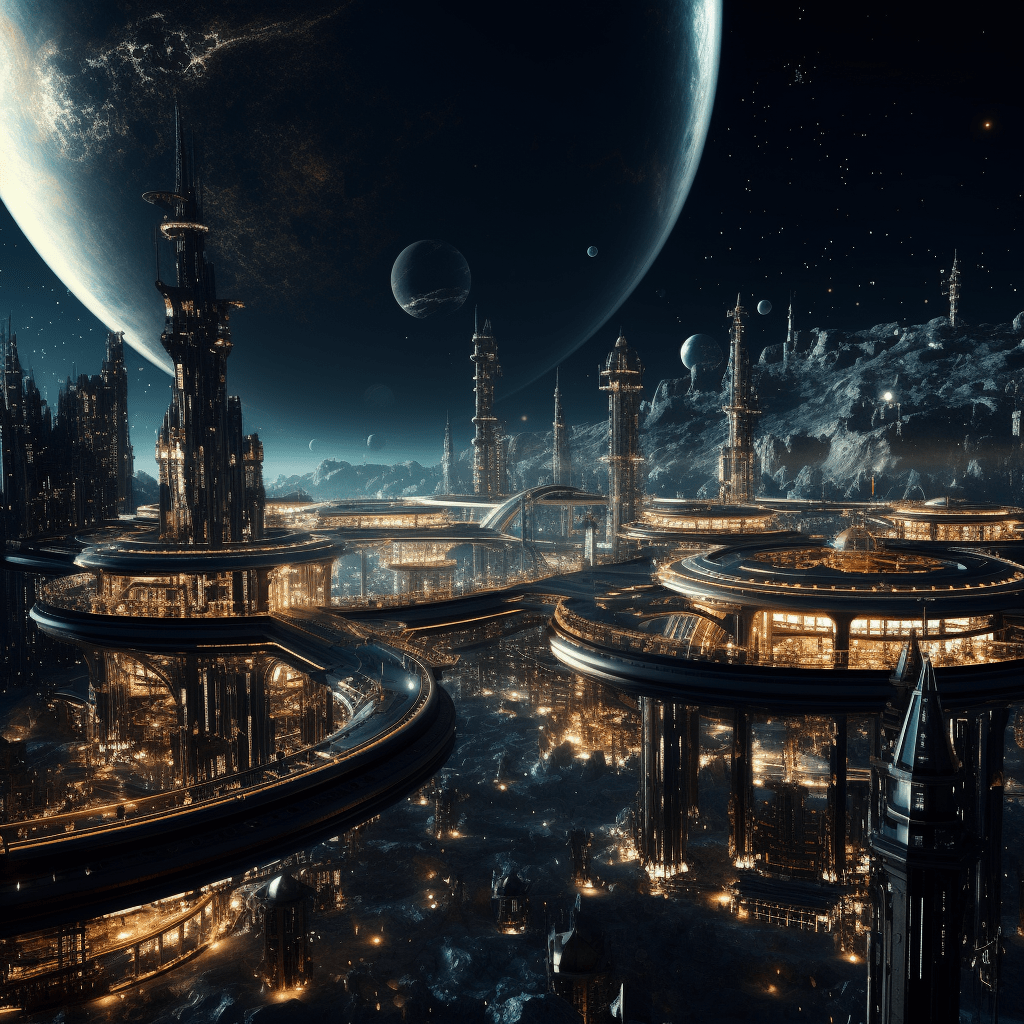
Science Fiction has long been a medium for authors to explore what it means to be human, set against fantastic and often dystopian backdrops of space exploration, artificial intelligence, time travel, and more. Here, we delve into ten of the most impactful masterwork sci-fi novels that have shaped and redefined the genre.
1. “Dune” by Frank Herbert
Frank Herbert’s “Dune” is more than just a novel – it’s a universe. Set on the desert planet of Arrakis, “Dune” explores complex themes of power, religion, ecology, and human evolution. Its deep world-building, epic scope, and exploration of human potential make it an enduring classic.
2. “1984” by George Orwell
George Orwell’s “1984” is a chilling prophecy about a dystopian future under an authoritarian regime. This tale of surveillance, doublethink, and perpetual war has become a cautionary metaphor in modern culture, highlighting the dangerous potentials of totalitarianism and technology misuse.
3. “Neuromancer” by William Gibson
“Neuromancer”, the novel that coined the term ‘cyberspace’, is a cornerstone of cyberpunk literature. William Gibson paints a futuristic world of hackers, artificial intelligence, and multinational corporations, examining how these elements could intertwine and affect societal structure.
4. “The Left Hand of Darkness” by Ursula K. Le Guin
Ursula K. Le Guin’s “The Left Hand of Darkness” breaks boundaries in its exploration of gender and sexuality. Set on a planet whose inhabitants have no fixed gender, Le Guin uses this premise to examine societal norms and human relationships in a unique light.
5. “Foundation” by Isaac Asimov
Isaac Asimov’s “Foundation” series is a masterwork of grand ideas and intricate plotting. Drawing inspiration from the fall of the Roman Empire, Asimov weaves a tale of a galactic empire’s decline and the efforts of a group of scientists to preserve knowledge for the future.
6. “Snow Crash” by Neal Stephenson
Neal Stephenson’s “Snow Crash” is a whirlwind blend of cyberpunk culture, Sumerian myth, and a satirical take on America’s corporate and consumerist culture. Its hyperactive and dense narrative has made it a landmark in post-cyberpunk literature.
7. “The Stars My Destination” by Alfred Bester
Alfred Bester’s “The Stars My Destination” is a quintessential space opera, centered around Gully Foyle, a man obsessed with revenge. Its exploration of teleportation, societal class division, and personal transformation creates a thrilling and thought-provoking narrative.
8. “The War of the Worlds” by H.G. Wells
H.G. Wells’ “The War of the Worlds” is an enduring classic that set the stage for alien invasion narratives. Its themes of British imperialism, human survival, and the fragility of civilization have left an indelible mark on the genre.
9. “A Canticle for Leibowitz” by Walter M. Miller Jr.
Walter M. Miller Jr.’s “A Canticle for Leibowitz” is a post-apocalyptic novel that traces humanity’s rise and fall through the lens of a Catholic monastery. It provides a compelling commentary on the cyclical nature of history, the relationship between church and state, and the enduring struggle between faith and reason.
10. “Hyperion” by Dan Simmons
Dan Simmons’ “Hyperion” is a science fiction epic that weaves together seven pilgrims’ tales in a narrative structure reminiscent of Chaucer’s “The Canterbury Tales.” The novel’s blend of space opera, time travel, and philosophical introspection makes it an unforgettable journey.
Conclusion
These ten masterwork sci-fi novels have transcended time and continue to resonate with readers today. They have fearlessly pushed the boundaries of the genre, weaving narratives that explore societal issues, human nature, and our place in the cosmos. Each novel stands as a testament to the power of science fiction as a vehicle for examining our world and speculating about future possibilities.
 Wondergressive