


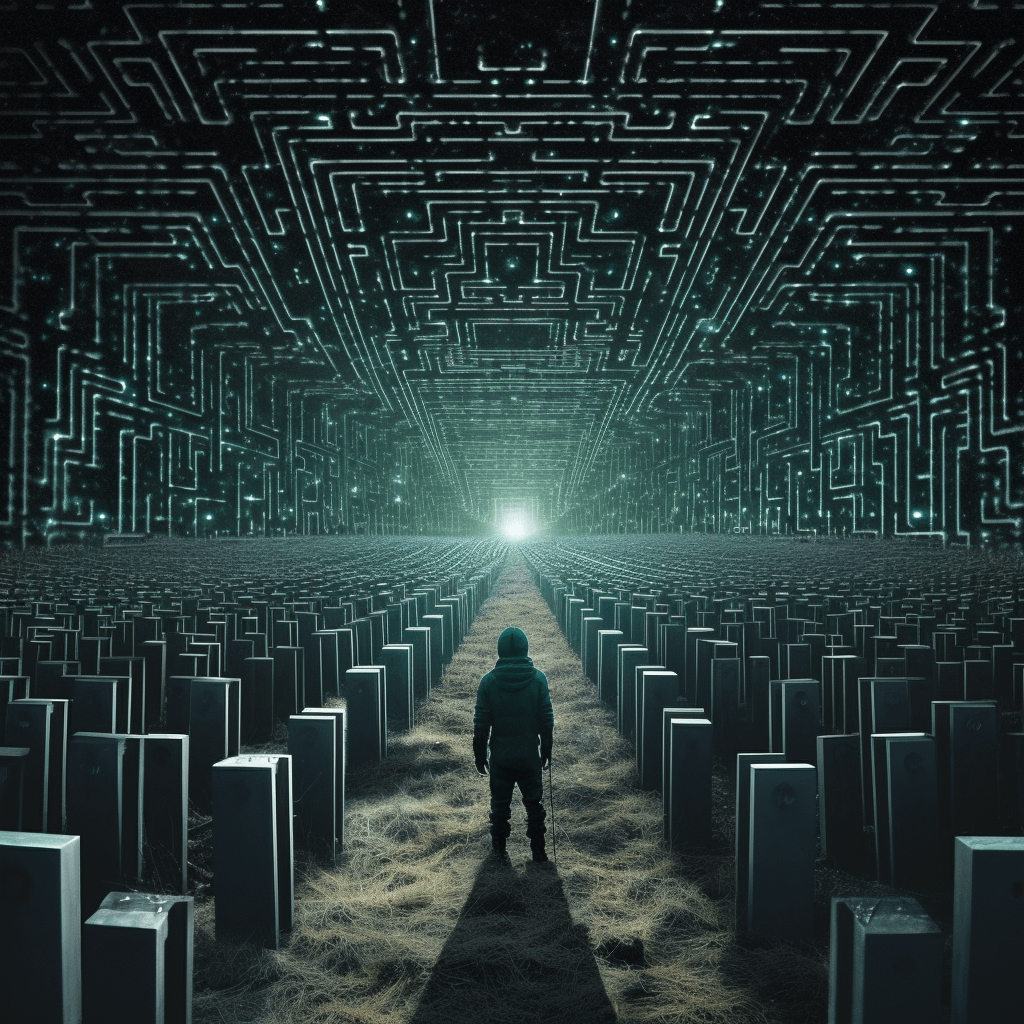
The vast expanse of the cosmos, with its billions of galaxies, stars, and planets, has long been a source of fascination and study for humanity. We’ve built massive telescopes, sent astronauts to the moon, and robots to other planets. But what if all this, the entire concept of space, were a grand illusion? Some theories suggest that what we perceive as the “final frontier” may not exist as we believe it does.
The Perception of Space
The perception of space is one of the primary components of our consciousness. We exist in three-dimensional space and perceive time as the fourth dimension. However, various philosophies, from ancient Vedantic thoughts to modern cognitive science, have argued that our perception of reality is a construct of our minds. What we perceive as “space” could be nothing more than an elaborate illusion created by our consciousness.
Quantum Entanglement: Defying Space
Quantum entanglement, one of the key principles of quantum mechanics, proposes an “action at a distance” that seems to defy the very notion of space. When two particles are entangled, a change in the state of one particle instantly affects the other, regardless of the distance between them. This phenomenon, which Einstein referred to as “spooky action at a distance,” poses significant challenges to our understanding of space and suggests a level of interconnectedness that contradicts our conventional perception of reality.
Holographic Universe Theory
The holographic principle, proposed by physicist Leonard Susskind, suggests that all the information in our three-dimensional universe may be encoded on a two-dimensional surface, like a holographic film. This means that our perception of depth and space might be an illusion, much like the apparent depth in a 3D movie or a hologram.
Simulation Theory
Elon Musk and other thinkers have popularized the idea that we might be living in a sophisticated computer simulation. In this scenario, what we perceive as space is merely part of the simulated reality created by advanced technology. While this theory is highly speculative, it cannot be conclusively debunked using our current understanding and technology.
Critique of These Theories
It’s essential to balance the intrigue of these theories with a dose of scientific skepticism. While they offer alternative perspectives on space, they also raise many unanswered questions. For example, the simulation theory is untestable by our current scientific methods, making it a philosophical idea rather than a scientific theory.
Moreover, while quantum entanglement is a well-established phenomenon, its interpretation is still debated among physicists. It doesn’t necessarily imply that space is an illusion but suggests that space may not be as straightforward as our everyday experience would suggest.
The holographic principle, while fascinating, is a theoretical concept that has not been empirically verified. It is a tool in theoretical physics to better understand black holes and quantum gravity, but it’s far from an accepted explanation of our universe.
 Wondergressive