


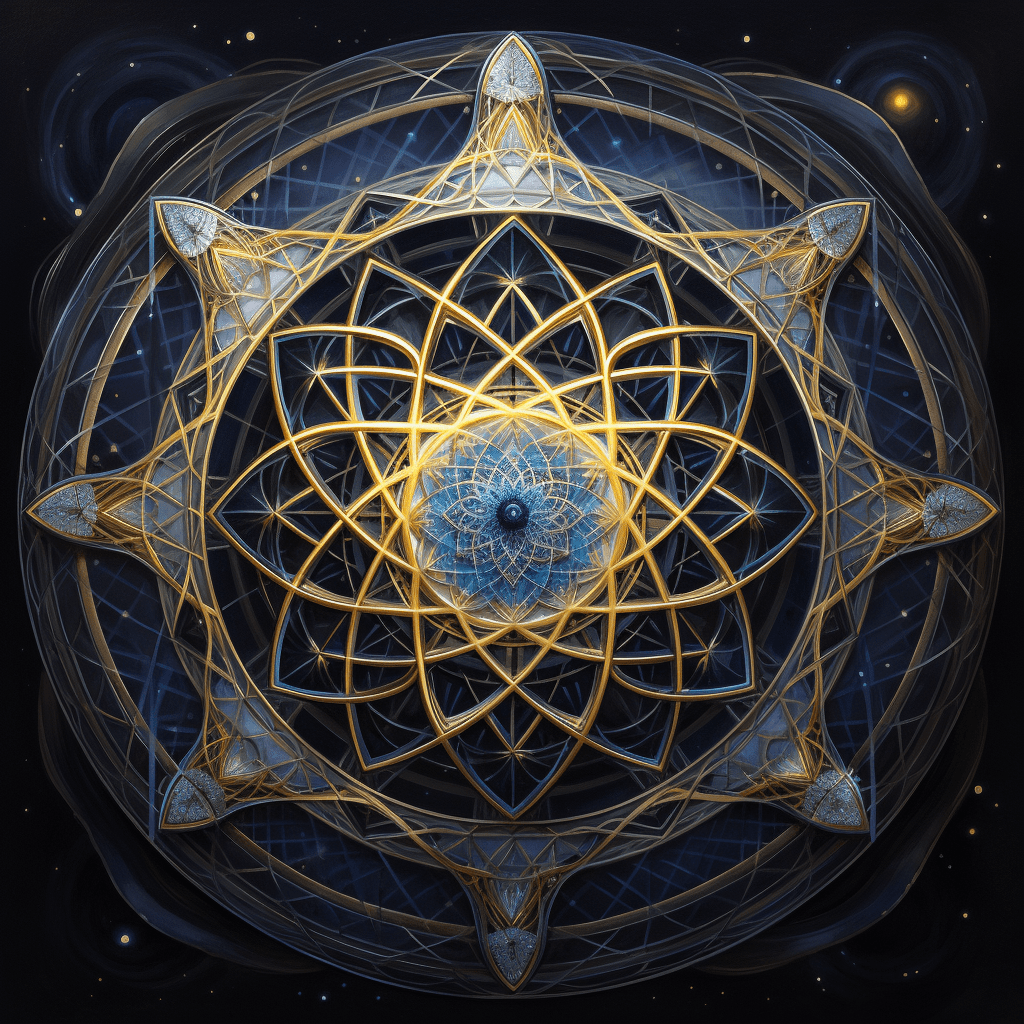
Sacred Geometry is a term that describes the geometrical laws that create everything in existence. This spiritual concept focuses on the belief that the universe and its creations revolve around geometric patterns that are not only aesthetically pleasing but are also inherently meaningful.
Unfolding the Mysteries of Sacred Geometry
Sacred Geometry postulates that universal patterns, sacred or divine in nature, govern the design and construction of everything in our reality. It suggests that the universe is a network of interconnected patterns and shapes, reflecting the interconnectedness of all beings.
Key geometric symbols in sacred geometry include the circle, representing unity and wholeness, and the spiral, signifying growth and evolution. Other essential elements are the “Flower of Life,” “Seed of Life,” and the “Golden Ratio” or Phi, all embodying critical principles about the nature and interconnectedness of all life.
The Flower of Life and Seed of Life
The Flower of Life is a geometrical figure composed of multiple evenly spaced, overlapping circles arranged to form a flower-like pattern with a sixfold symmetry, akin to a hexagon. The ‘Seed of Life’, a simpler design involving seven overlapping circles, forms the core of the ‘Flower of Life’.
These intricate patterns are found in many ancient cultures worldwide, from Egyptian temples to ancient synagogues. They are thought to depict fundamental aspects of space and time.
The Golden Ratio: A Divine Proportion
The Golden Ratio, represented by the Greek letter Phi (φ), approximates to 1.618. It’s found throughout nature, architecture, art, and even our own bodies, leading many to attribute a divine or cosmic significance to this ratio. For example, the Parthenon, in Greece, is considered aesthetically perfect due to its use of the Golden Ratio in its construction.
Sacred Geometry in Nature
Patterns found in nature often adhere to principles of sacred geometry. This is seen in the symmetry of flowers, the spiral of galaxies, and the honeycomb patterns created by bees. This symmetry is thought to illustrate the inherent beauty and balance in nature and its link to the divine.
Sacred Geometry and Spirituality
In spirituality, sacred geometry is used in the planning and construction of religious structures such as churches, temples, mosques, religious monuments, altars, and tabernacles. It’s also found in sacred spaces like temenoi, sacred groves, village greens, and holy wells. Sacred geometry principles of symmetry and proportion are also found in music, art, and architecture.
Significance in Modern Times
Today, sacred geometry’s influence is evident in architecture, design, and art. It also influences holistic health practices, wherein it’s believed that understanding these divine patterns can lead to healing and a greater understanding of oneself and the universe. In meditation and yoga, sacred geometry is often invoked for spiritual enhancement.
The Reality Behind the Mystique
Scientifically, the principles of sacred geometry can be explained through the laws of physics and mathematics that govern our world. Yet, these patterns’ ubiquitous presence, from the tiniest molecules to the vast cosmos, suggests a deeper significance.
While some may dismiss sacred geometry as mystical pseudoscience, others see it as a genuine area of study that scrutinizes the very fabric of our reality. It invites us to observe the world more closely and appreciate the inherent balance and beauty of creation.
In conclusion, whether viewed through a spiritual, scientific, or artistic lens, sacred geometry presents an intriguing perspective that encourages us to question our understanding of the universe and our place within it. And who knows? Perhaps the key to decoding the universe’s deepest mysteries lies hidden within these sacred patterns.
 Wondergressive