


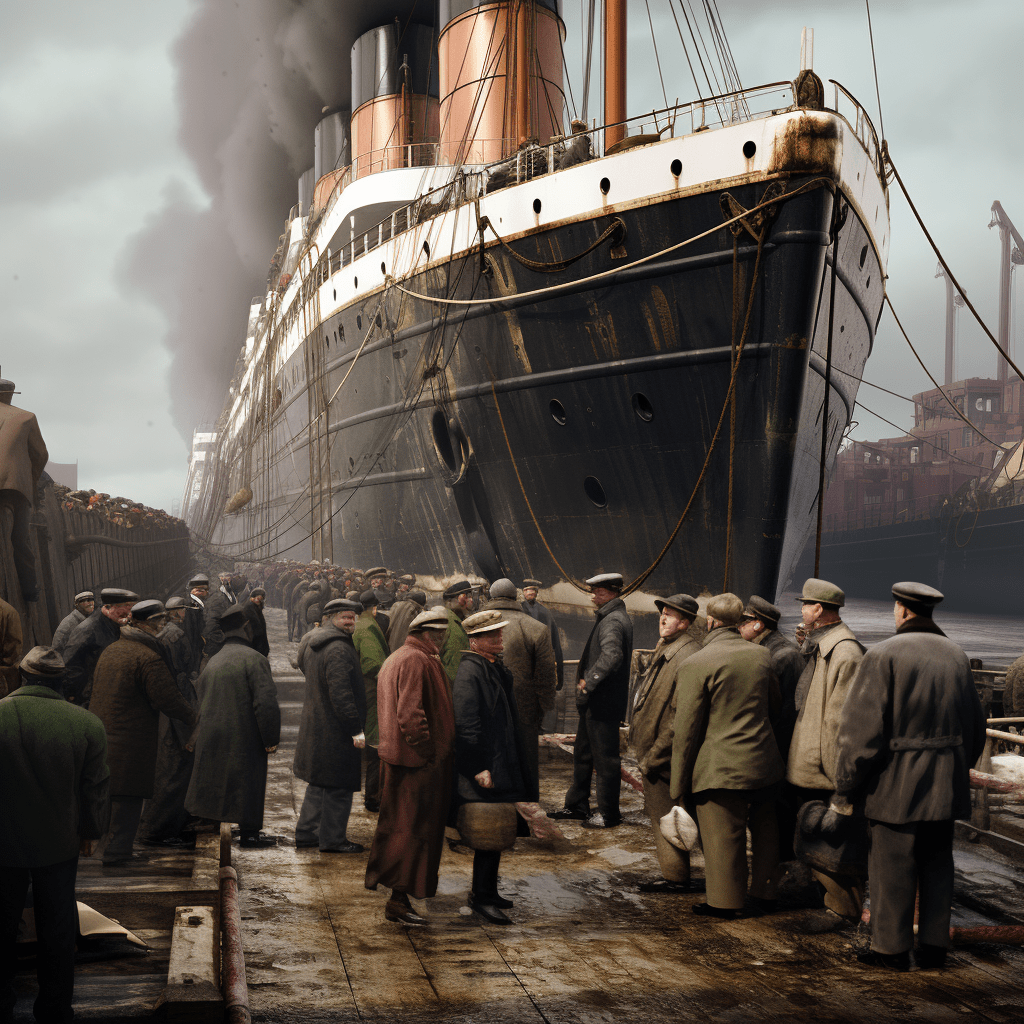
In the early morning hours of April 15, 1912, the RMS Titanic supposedly sank to the bottom of the North Atlantic Ocean after striking an iceberg during its maiden voyage from Southampton to New York City. Over 1,500 passengers and crew members tragically lost their lives. This event has since become a pillar of maritime history, immortalized in books, documentaries, and blockbuster films. However, an intriguing counter-theory suggests that the ship that actually sank was not the Titanic but its sister ship, the RMS Olympic.
The Titanic and Olympic: A Case of Mistaken Identity?
The Titanic was one of three “Olympic class” liners built by the Harland and Wolff shipyard for the White Star Line, the others being the RMS Olympic and the HMHS Britannic. Conspiracy theorists suggest that the two ships, the Titanic and Olympic, were switched in a scheme to save the White Star Line from impending financial disaster.
The RMS Olympic, launched a year before the Titanic, had been involved in a number of accidents, the most notable being a collision with the HMS Hawke in 1911. These accidents caused significant damage and led to expensive repairs and disruptions in the shipping schedule. According to the theory, White Star Line, faced with increasing financial pressures, switched the two vessels in a well-planned insurance scam. The “damaged” Olympic would be sunk, and the insurance money would cover the losses.
Key Indicative Evidence
Several pieces of evidence are presented by proponents of this theory.
Differences in Window Placement
Firstly, close examination of photographs of the two ships reveals slight differences in the number and placement of the portholes on the forecastle deck. While the Olympic had 16, the Titanic had 14. However, in images of the supposed Titanic before her maiden voyage, 16 portholes can be seen, suggesting that the ship readying to sail was actually the Olympic.
The Mismatched Propeller
Secondly, there are photos from 1912 showing the Titanic with a three-bladed central propeller. But in the wreckage at the bottom of the Atlantic, the central propeller has four blades, which was a known feature of the Olympic.
Discrepancies in the Shipwreck
Moreover, the name “Titanic” appears only three times on the wreckage: on the bell, on a plaque in the bridge, and on the stern. Each could have been replaced as part of a swap. The name on the stern seems to have been attached over the original nameplate, as indicated by an odd bulge in the hull. Also, the wreck shows signs of being in seawater for a shorter time than expected if it were the Titanic.
Contradictions and Skepticism
Of course, skeptics point out several contradictions to this theory. For instance, the significant structural differences between the two ships would have made a switch extremely difficult to pull off without detection. Additionally, the insurance money received by the White Star Line for the Titanic was insufficient to cover the loss of the ship, let alone to profit from such a risky venture.
Conclusion
While this alternative theory has not been universally accepted, it offers an intriguing perspective on a historical event that we thought we knew well. Regardless of its veracity, the Titanic-Olympic switch theory reminds us of the importance of questioning accepted narratives and highlights the fascinating, complex world of maritime history. As new research methodologies and technologies emerge, perhaps one day we will definitively solve the mystery of the unsinkable Titanic.
 Wondergressive