


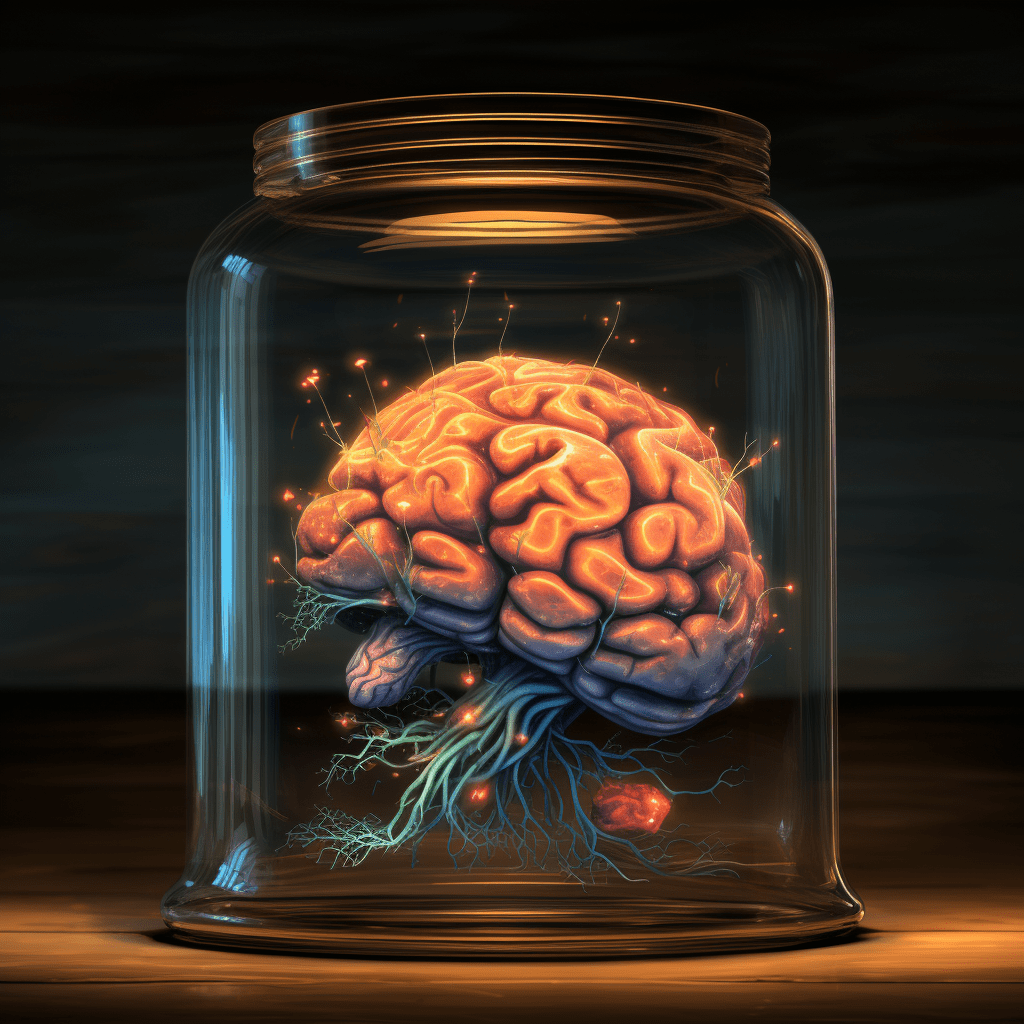
The “brain in a jar” or “brain in a vat” theory is a captivating topic that taps into our fascination with the nature of reality. It’s an age-old thought experiment that explores the philosophical concept of skepticism, the idea that we cannot truly trust our senses.
An Overview of the Brain in a Jar Theory
Originating in the field of philosophy, the ‘brain in a vat’ theory poses that it is theoretically possible that we might merely be brains in a vat, wired up to a computer that feeds us all our sensory inputs, causing us to perceive a simulated reality. This proposition, while seemingly outlandish, serves as a crucial building block for discussions on reality, knowledge, and perception.
A Philosophical Perspective: Descartes and the External World
Rene Descartes, a 17th-century French philosopher, explored a similar concept in his infamous thought experiment involving an “evil demon” that manipulates our senses to present a false reality. His philosophies underpin the skepticism found in the brain in a jar theory, leading to the well-known phrase “Cogito, ergo sum” – “I think, therefore I am.”
Technological Angle: The Matrix and Virtual Reality
The brain in a jar theory has also found its way into modern culture, most famously represented in the 1999 science fiction film “The Matrix”. The central theme of the film is the idea of a simulated reality, strikingly similar to the ‘brain in a vat’ theory.
Moreover, the evolution of virtual reality technology adds another dimension to this theory. With VR, we have begun to create simulated environments that can deceive our senses, blurring the line between what’s real and what’s not.
Neuroscience and Perception
Neuroscience has added weight to the brain in a jar theory by illuminating how our brains process sensory information. The study of phantom limb syndrome, for example, reveals how the brain can perceive experiences that aren’t physically real. Furthermore, research into hallucinations and altered states of consciousness also demonstrates the brain’s ability to fabricate sensory experiences.
Can We Prove We Are Not Brains in a Jar?
Philosopher Hilary Putnam devised a counter-argument, stating that if we were merely brains in a vat, we wouldn’t be able to meaningfully refer to ‘real’ vats, or ‘real’ brains, therefore making the statement “we are brains in a vat” self-refuting.
Conclusion: Questioning the Nature of Reality
The ‘brain in a jar’ theory, while seemingly absurd, opens up compelling discussions around the nature of perception and reality. Although we may never definitively prove or disprove this theory, its existence challenges us to remain skeptical of our perceptions and stimulates dialogue about the human experience.
Whether we are indeed brains in jars, living in a simulation, or merely the product of an incredibly complex series of cosmic events, our perception of reality is uniquely our own – a testament to the marvels of consciousness and human cognition.
 Wondergressive