

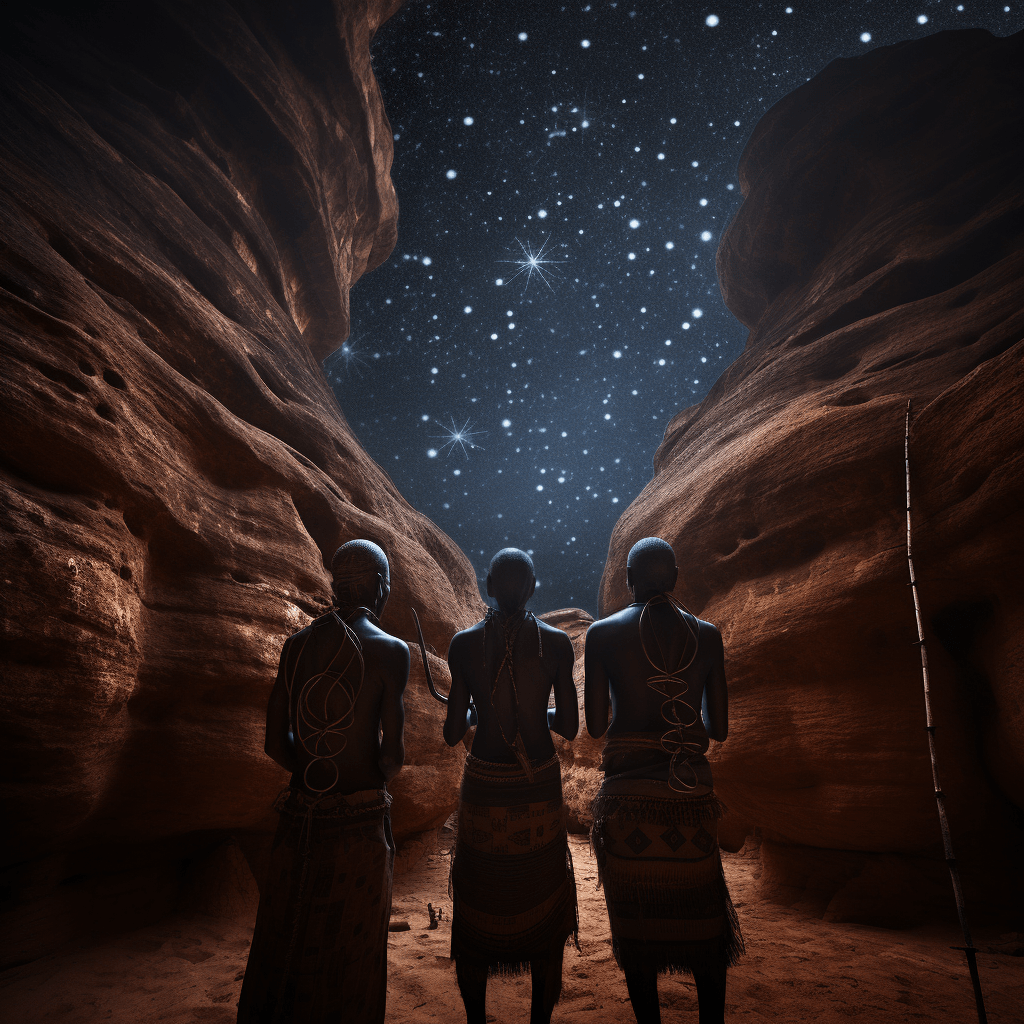
The Dogon Tribe, an ethnic group primarily residing in the arid, rocky highland region of Bandiagara in Mali, has long been a subject of intrigue and fascination among anthropologists and archaeologists alike. Known for their complex cosmology and detailed, accurate astronomical knowledge that appears to predate modern science, the Dogon Tribe’s wisdom continues to elicit both curiosity and debate.
The Dogon’s Astronomical Prowess
The Dogon Tribe’s deep understanding of astronomy, as documented by French anthropologists Marcel Griaule and Germaine Dieterlen in the 1930s and 40s, is nothing short of extraordinary. According to Griaule and Dieterlen’s findings, the Dogon possessed intricate knowledge of celestial bodies, including specifics about the Sirius star system, that were unconfirmed by modern science until many years later.
For instance, the Dogon mythology speaks of Sirius B, a dwarf star orbiting the Sirius star, which is invisible to the naked eye and was not detected by modern astronomers until the 19th century. The Dogon’s accounts extend even further, accurately describing the star’s tiny size yet immense weight, its elliptical orbit, and the 50-year orbital period. All of these facts are in alignment with modern astronomy’s understanding of Sirius B.
Ancient Wisdom or Ancient Aliens?
Given the detailed and accurate nature of the Dogon’s astronomical knowledge, questions inevitably arise: how could a tribe, lacking modern scientific instruments, acquire such specific information about the cosmos?
One controversial theory put forth by authors like Robert Temple in his book “The Sirius Mystery” suggests that the Dogon might have been visited by extraterrestrial beings from the Sirius star system, who bestowed upon them their astronomical knowledge. However, this theory, often associated with ancient astronaut hypotheses, has received considerable criticism for lack of empirical evidence and for exoticizing and misunderstanding Dogon culture and history.
Cultural Interpretations and Symbolism
A more grounded interpretation sees the Dogon’s astronomical wisdom as a testament to humanity’s ancient observational capabilities. It’s possible that over centuries of careful sky-watching, aided by the clear, unpolluted skies of their homeland, the Dogon could have accumulated their knowledge.
Additionally, the Dogon’s cosmological beliefs are deeply integrated into their culture and spirituality. Their astronomical knowledge isn’t just scientific information, but a part of their religious beliefs and mythologies, filled with rich symbolism. For instance, Sirius, to the Dogon, is associated with the concept of creation and is symbolized in various ceremonies and rituals.
The Dogon Tribe: A Window into Human Capability
The Dogon Tribe’s astronomical wisdom showcases the incredible potential of human observation and understanding. Rather than ascribing their knowledge to extraterrestrial origins, it is essential to view it in a broader context of human intellectual history.
Research into the Dogon and other indigenous cultures with profound astronomical knowledge can provide valuable insights into how our ancestors understood the world around them, reminding us that sophisticated scientific inquiry isn’t the sole preserve of the modern world. While the source of the Dogon’s astronomical knowledge may remain a subject of debate, the tribe’s intellectual legacy undeniably expands our perception of human capability.
By probing deeper into these narratives, we may not only unravel secrets of our past but also possibly steer future research into the night skies that continue to enthral us. The Dogon’s deep connection with the cosmos serves as a reminder of the universe’s profound mystery and our enduring desire to comprehend our place within it.
 Wondergressive