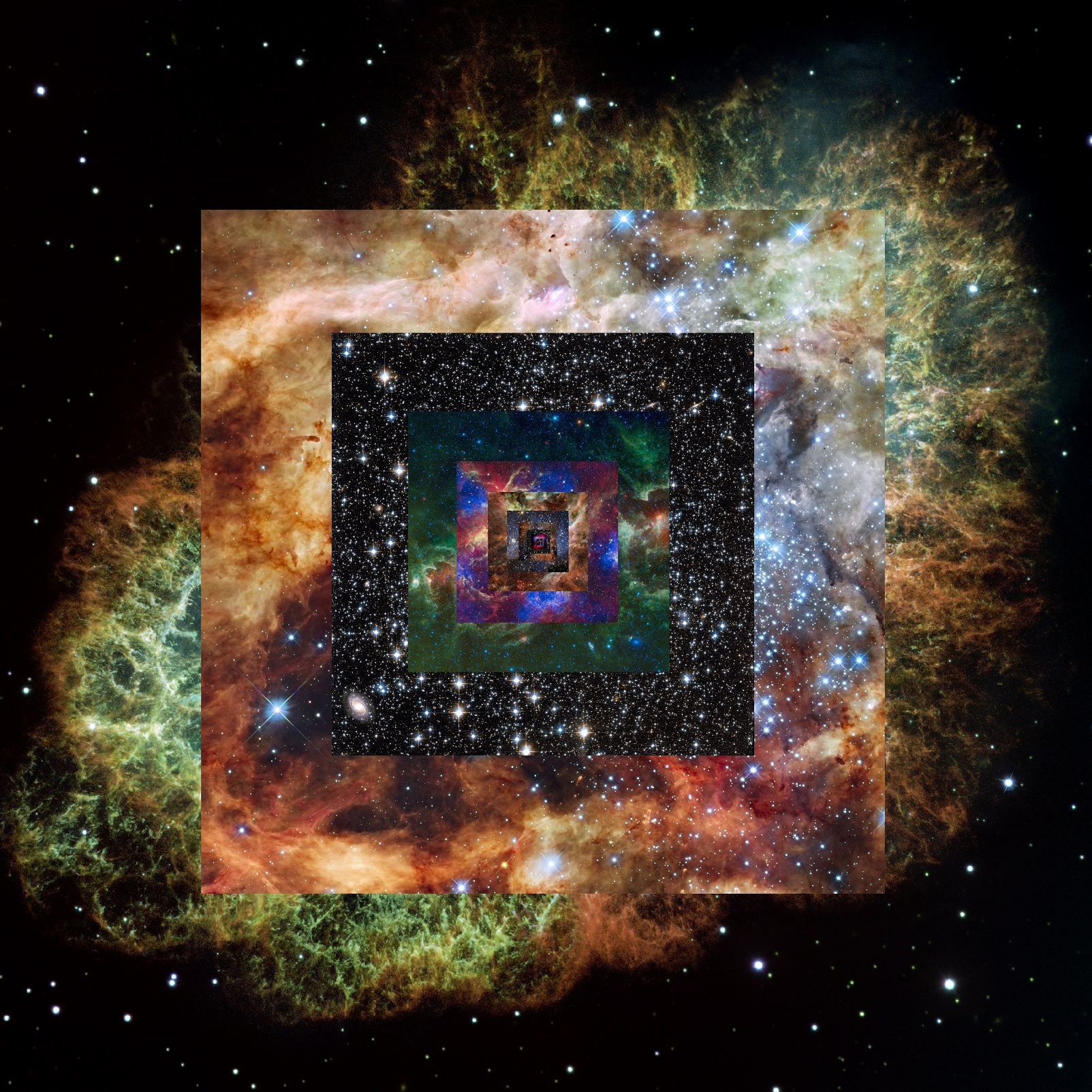


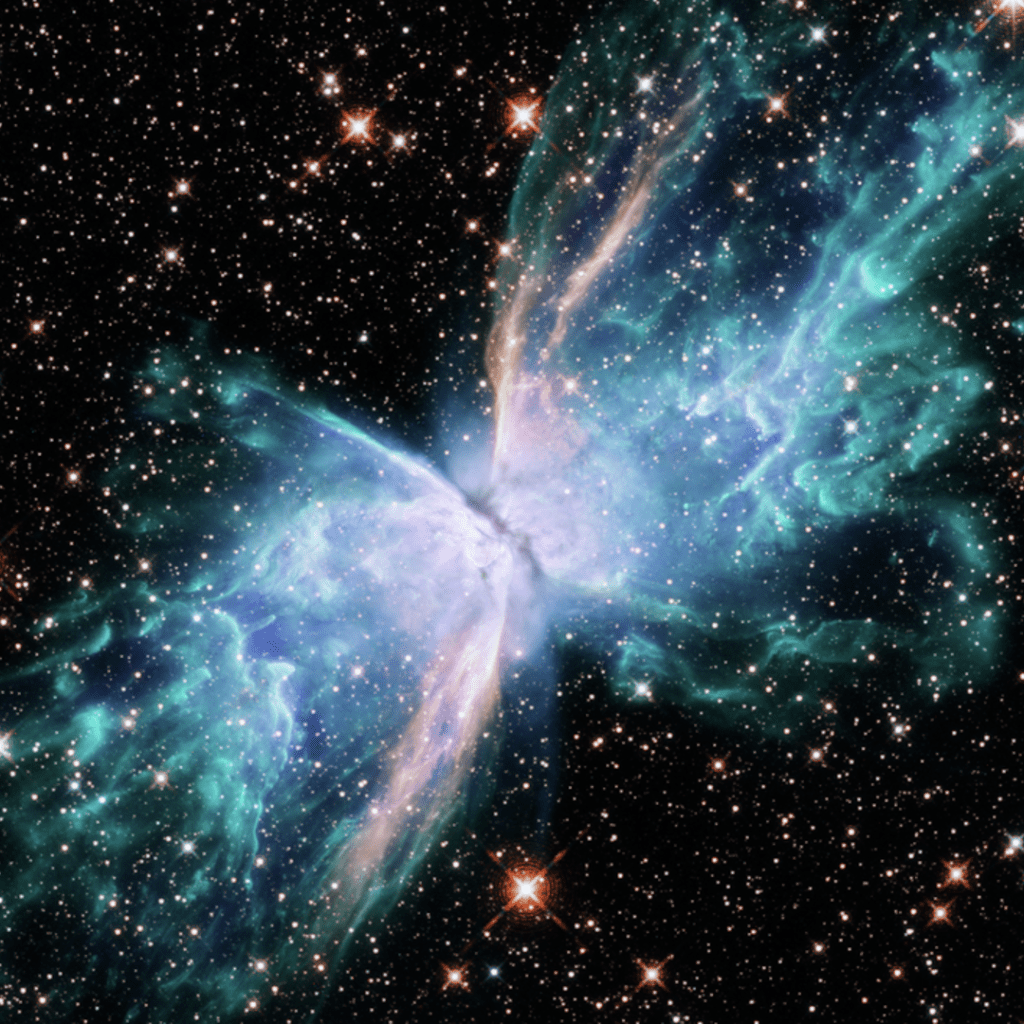
The universe unfolds its mysteries in magnificent ways, none as spectacular as the Cosmic Butterfly. This theoretical celestial phenomenon, shrouded in mythos and scientific speculation, is said to be the manifestation of cosmic energy patterns or ripples in the fabric of spacetime.
The Birth of the Cosmic Butterfly
The Cosmic Butterfly concept sprouts from quantum physics and string theory. In essence, it proposes that energy at the quantum level could create vibrations or resonances that, under the right conditions, might manifest as large-scale phenomena in the universe. These phenomena could mirror the exquisite symmetry and patterns we observe in a butterfly.
Imagine a butterfly-shaped pattern that spans light-years across the cosmos, with “wings” composed of dust and gas that light up from the energy of nearby stars or cosmic phenomena. Such a formation would not only be a stunning spectacle but also a testament to the intricate patterns that govern our universe.
Evidence and Observations
You might wonder if such a phenomenon has been observed. Indeed, it has. In 2009, the Hubble Space Telescope captured images of the “Butterfly Nebula” (NGC 6302). With an estimated temperature exceeding 250,000 degrees Celsius, the dying central star of this planetary nebula has a luminosity about five times the size of our sun. The nebula’s shape mirrors the wings of a butterfly, thus fitting the imagery and theme of our cosmic butterfly.
In addition, the “Ant Nebula” (Menzel 3), observed by the NASA/ESA Hubble Space Telescope, exhibits patterns that remind some observers of the antennae and thorax of a butterfly, offering yet another cosmic echo of earthly biology.
Understanding the Cosmic Butterfly
So, is there a deeper connection between these stunning celestial phenomena and the Cosmic Butterfly theory? The jury is still out. Scientists grapple with the idea of whether these shapes are mere coincidences or hold more profound implications.
It could be argued that the patterns observed are manifestations of the Cosmic Butterfly at a grand cosmic scale. This perspective resonates with the holographic principle in theoretical physics, suggesting that information about a volume of space can be thought of as encoded on a boundary to the region.
In other words, just as the design on a butterfly’s wings might tell us about its genetic makeup, these cosmic patterns might contain encoded information about the universe’s fundamental properties. By studying these celestial formations, we could unlock new understandings about quantum mechanics, string theory, and the very nature of reality.
Implications and Future Research
The Cosmic Butterfly concept, while currently theoretical, may be an intriguing new avenue for scientific discovery. By bridging the realms of the microscopic and macroscopic, it offers an exciting lens through which to explore the cosmos.
Scientists hope to utilize more powerful telescopes, like the upcoming James Webb Space Telescope, to search for more “butterfly” patterns across the universe. Further observations may solidify or dispel the cosmic butterfly’s validity, contributing valuable insights to our understanding of the universe’s workings.
Conclusion
Whether or not the Cosmic Butterfly is an actual manifestation of quantum phenomena on a grand scale, its allure is undeniable. The concept invites us to think about the universe in new ways, drawing connections between the beauty we observe on Earth and the majestic spectacle of the cosmos. It serves as a fascinating reminder that the mysteries of the universe are as endless as they are beautiful.
 Wondergressive