

The Aztec civilization, with its enigmatic cosmology and fascinating rituals, stands as a formidable example of a complex society that had profound ideas about the origins of the universe and the gods that inhabited it. In their intriguing theogeny, the Aztecs sought to explain and understand their world, leaving behind a tapestry of mythological narratives and spiritual traditions that continue to captivate researchers and enthusiasts to this day.
The Sacred Narrative of Creation
Perhaps one of the most compelling aspects of Aztec theogeny lies in its narrative of creation. According to Aztec cosmogony, the universe underwent four major cycles or “Suns”, each associated with a different deity and culminating in a cataclysmic event.
For instance, the First Sun, presided over by Tezcatlipoca, the Smoking Mirror, ended when jaguars devoured all living creatures. Quetzalcoatl, the Feathered Serpent, ruled the Second Sun, which concluded with a great wind that transformed beings into monkeys. The Rain God Tlaloc took charge of the Third Sun, that finished in a rain of fire, while his sister Chalchiuhtlicue, the Goddess of Rivers and Lakes, led the Fourth Sun, terminated by a disastrous flood.
Deities and Humans: A Complex Relationship
Evidence from a variety of sources, including the Codex Borbonicus, a pre-Columbian pictorial manuscript, reveals the complex relationship between the Aztecs and their deities. The Aztecs believed that the gods had sacrificed themselves to bring the world and the humans into existence. As such, they felt obligated to reciprocate through blood sacrifices, a practice that seems gruesome to modern sensibilities but was regarded as an essential part of life and survival by the Aztecs.
The Fifth Sun and the Role of Humanity
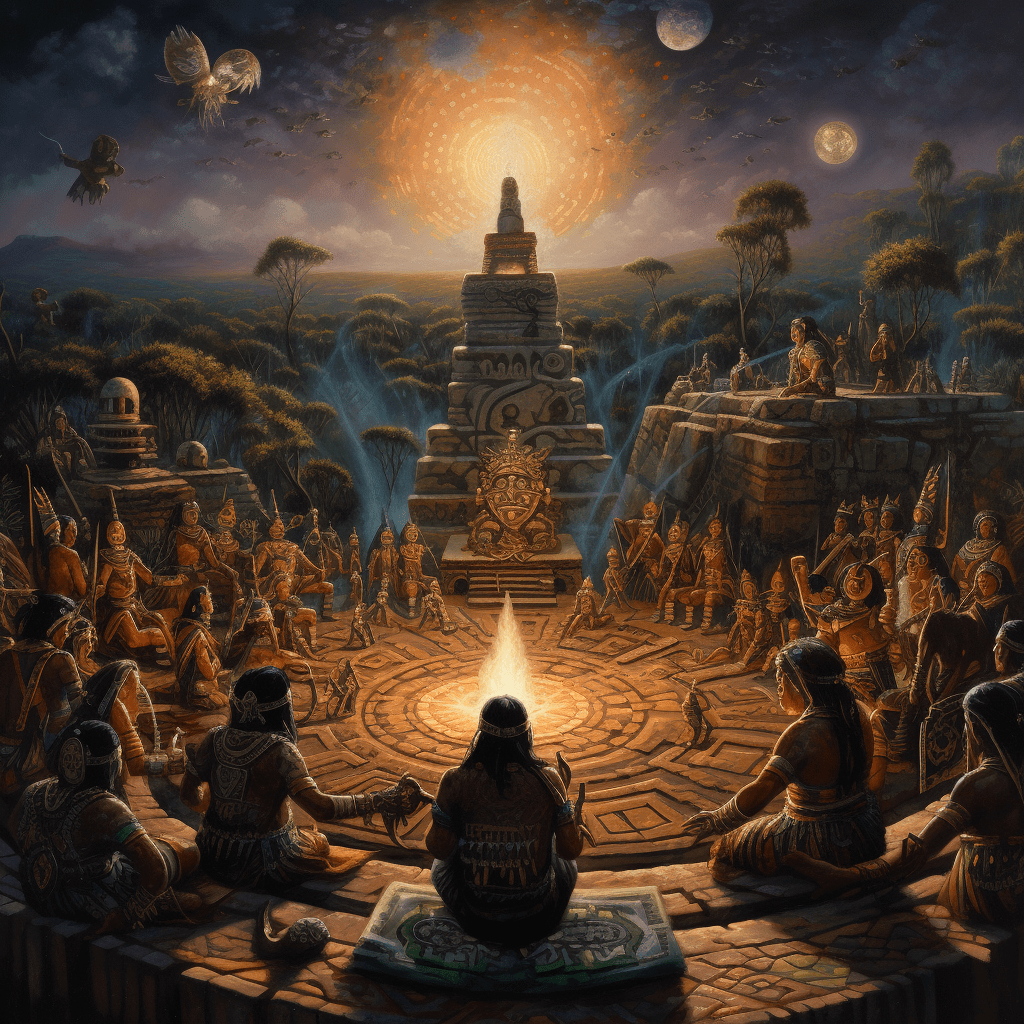
Currently, it is believed that we’re living in the Fifth Sun, presided over by Nanahuatzin, the Humble One who transformed himself into the Sun. Interestingly, the Aztecs perceived this era to be unstable, requiring human intervention in the form of sacrifices to ensure the sun’s survival and the continuation of the world.
The Intricacies of Aztec Spirituality
The Aztecs had a sophisticated understanding of spirituality, deeply interwoven with their daily life. They perceived the gods as complex entities, capable of both creation and destruction. For instance, Quetzalcoatl, in addition to being a symbol of wind and learning, was also associated with the planet Venus and could be a harbinger of war.
Aztec Theogeny and Modern Interpretation
While the violent aspects of Aztec religion often dominate discussions, it is essential to remember that this civilization’s theogeny was a rich and complex system, deeply intertwined with notions of morality, sacrifice, and cosmic balance. The gods of the Aztecs, rather than being benevolent or malevolent, were viewed as forces of nature – capricious and unpredictable, yet essential to the existence and continuity of life.
Modern interpretation of Aztec theogeny, with its compelling narratives and profound cosmological insights, helps us understand the sophisticated philosophical and spiritual constructs of this ancient civilization. As we delve deeper into the cosmogony and theogeny of the Aztecs, we not only shed light on their understanding of the world and the cosmos but also broaden our perspective on the variety and depth of human spiritual thought.
Conclusion
In conclusion, the theogeny of the Aztecs paints a fascinating picture of a civilization deeply engaged in existential and cosmological questions. Their intriguing blend of mythology, spirituality, and rituals presents a vibrant world view that has much to offer to the ongoing human quest for understanding our place in the cosmos. The compelling evidence from the narratives, rituals, and artifacts makes the possibility of such an intricate theogeny very real and keeps the allure of the Aztec civilization alive even today.
 Wondergressive