

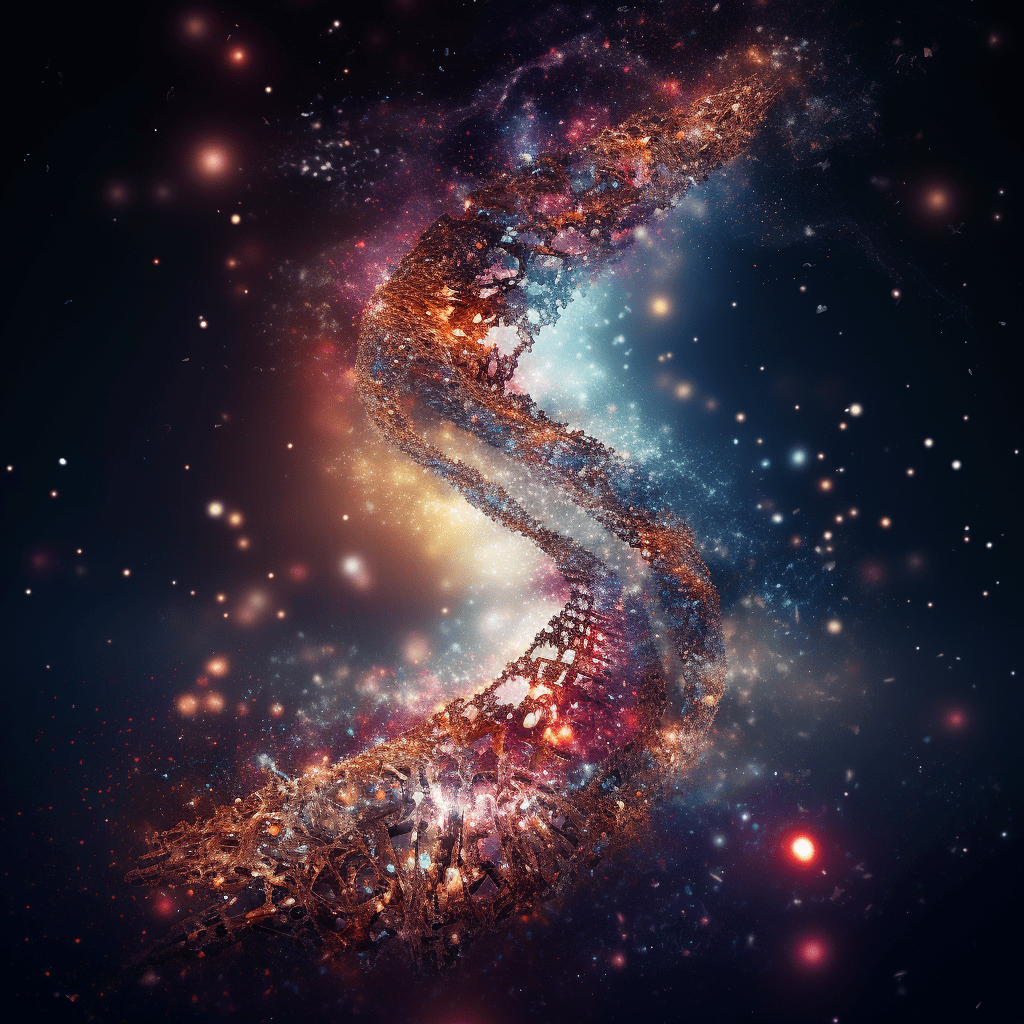
The origins of life are a subject of intense debate and ongoing research. An intriguing hypothesis proposes that DNA, the basis of all life as we know it, could have formed in the turbulence of the Big Bang. This is a fascinating possibility that can captivate the imagination and alter our understanding of life’s beginnings.
DNA: The Building Block of Life
Deoxyribonucleic acid, more commonly known as DNA, is a complex molecule that carries most of the genetic instructions used in the development, functioning, and reproduction of all known living organisms and many viruses. It is often called the blueprint of life because it contains the code required for the construction of proteins, which are essential for the structure, function, and regulation of the body’s tissues and organs.
The Big Bang Theory
The Big Bang theory, widely accepted among scientists, posits that the universe began as a hot, dense point nearly 13.8 billion years ago. Due to an unknown trigger, this initial singularity started expanding and cooling, eventually leading to the formation of atoms, stars, and galaxies.
The question, then, is how could the formation of something as complex as DNA be connected to this primordial event?
Life from Chaos: The DNA in the Big Bang Theory
The idea that DNA could have formed in the Big Bang revolves around the concept of Panspermia, which suggests that life exists throughout the universe, distributed by space dust, meteoroids, asteroids, comets, planetoids, and potentially spacecraft, in the form of extremophile microbes.
Supporters of this theory suggest that the extreme conditions in the moments after the Big Bang could have facilitated the creation of simple organic compounds, such as amino acids, the building blocks of proteins and thus, indirectly, DNA.
In 2018, a team of researchers led by Professor Sun Kwok of the University of Hong Kong proposed that complex organic molecules could form on the microscopic dust particles that filled the early universe. As these molecules were carried along by the cosmic winds, they could interact, further complexify, and possibly give rise to primitive life forms.
Cosmic Dust and DNA: A Connection?
While the idea may seem far-fetched, evidence supporting the possibility of this process comes from the discovery of organic molecules and amino acids in meteorites and comets. The Murchison meteorite, for example, fell to Earth in 1969 and was found to contain a variety of amino acids and other organic compounds.
Furthermore, astronomers have identified complex organic molecules in the gas and dust clouds from which stars form. These include polycyclic aromatic hydrocarbons (PAHs), fullerenes, and even simple sugars.
Additionally, NASA’s Stardust mission, which returned samples from comet Wild 2, discovered glycine, an amino acid, further supporting the theory that the building blocks of life can be formed in space.
Conclusion
The idea that DNA could have originated in the moments after the Big Bang is undoubtedly captivating. Although this hypothesis is still in its infancy and requires further scientific scrutiny, it provides a fresh perspective on life’s origins.
The concept opens new avenues for research and exploration, transcending the boundaries of Earth and reaching into the cosmos. As our understanding of the universe expands, the mysteries of our existence and the origins of life itself continue to enchant and bewilder us.
 Wondergressive