


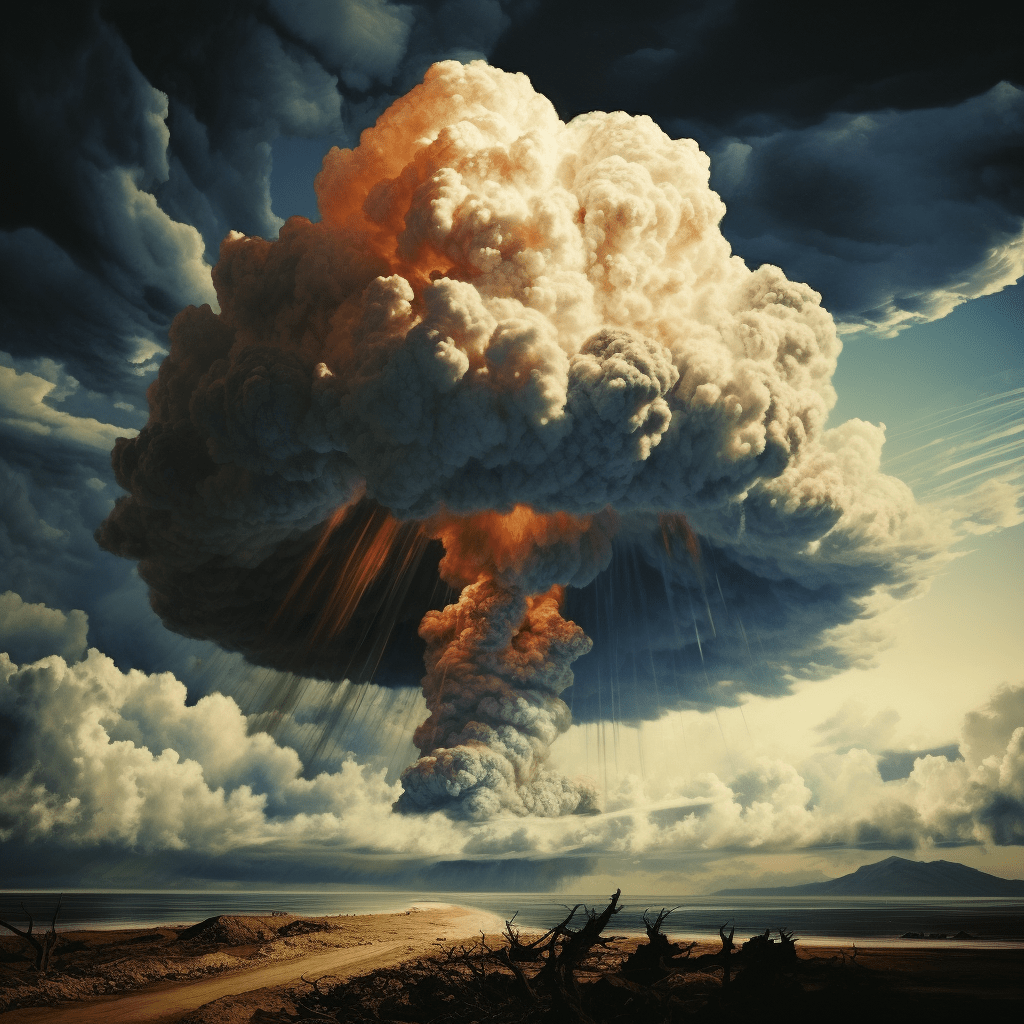
In the annals of world history, few events have had the lasting impact of the creation and deployment of atomic bombs during World War II. The bombings of Hiroshima and Nagasaki by the United States in August 1945 indelibly altered the course of global politics, ushering in the Atomic Age and escalating the stakes of international conflict. But, what if this narrative, one that has held so much sway in our collective memory, isn’t true? An intriguing fringe theory suggests that the atom bomb was never actually created, and that our understanding of 20th-century history might be fundamentally flawed.
Atomic Bomb Creation – The Accepted Narrative
According to mainstream history, the creation of the atomic bomb is attributed to the Manhattan Project, a U.S. research and development initiative that commenced in 1939. The Project involved some of the best scientific minds of the time, including Albert Einstein and Robert Oppenheimer, who worked to harness the power of nuclear fission, resulting in the world’s first nuclear weapons.
The Atom Bomb Hoax Theory
The atom bomb hoax theory, by contrast, asserts that these so-called “weapons of mass destruction” never existed. Proponents suggest that the immense destructive power associated with atomic bombs was embellished or entirely fabricated by the U.S. government to intimidate other nations, particularly the Soviet Union, during the early stages of the Cold War.
Evidence Supporting the Theory
Inconsistent Blast Effects
The atom bomb hoax theory first gains credence by pointing out inconsistencies in the blast effects witnessed in Hiroshima and Nagasaki. Despite being supposedly obliterated by atomic bombs, wooden structures and paper objects surprisingly survived near ground zero, something inconsistent with our understanding of nuclear blasts.
Photographic Anomalies
Further evidence comes from photographic analysis. Some argue that many images of the bomb’s mushroom cloud were manipulated or outright fabricated, as the style and nature of the explosions do not match the expected models of a nuclear detonation.
Nuclear Radiation Levels
Another supporting argument revolves around radiation levels. Post-bombing radiation in Hiroshima and Nagasaki was reportedly much lower than predicted for nuclear detonations. Also, in subsequent nuclear tests such as those at Bikini Atoll, life returned much faster than the expected timeframe given the anticipated level of nuclear fallout, leading to questions about the authenticity of these tests.
Counterarguments and Controversies
As with any alternate historical theory, the atom bomb hoax theory has met with skepticism and outright rejection from mainstream historians and nuclear physicists. Critics argue that the evidence of atomic bomb deployment during World War II is too abundant and scientifically sound to refute, with isotopic analysis of soil and artifacts from Hiroshima and Nagasaki providing irrefutable evidence of a nuclear event.
Final Thoughts
The theory that the atomic bomb was never created challenges the very foundations of our understanding of World War II and the subsequent Cold War. While it seems improbable given the wealth of contrary evidence, it is a fascinating thought experiment that encourages critical examination of accepted historical narratives. The ultimate truth might be a mix of well-established facts and subtle misinterpretations, proving that history is not always as clear-cut as it seems.
 Wondergressive