

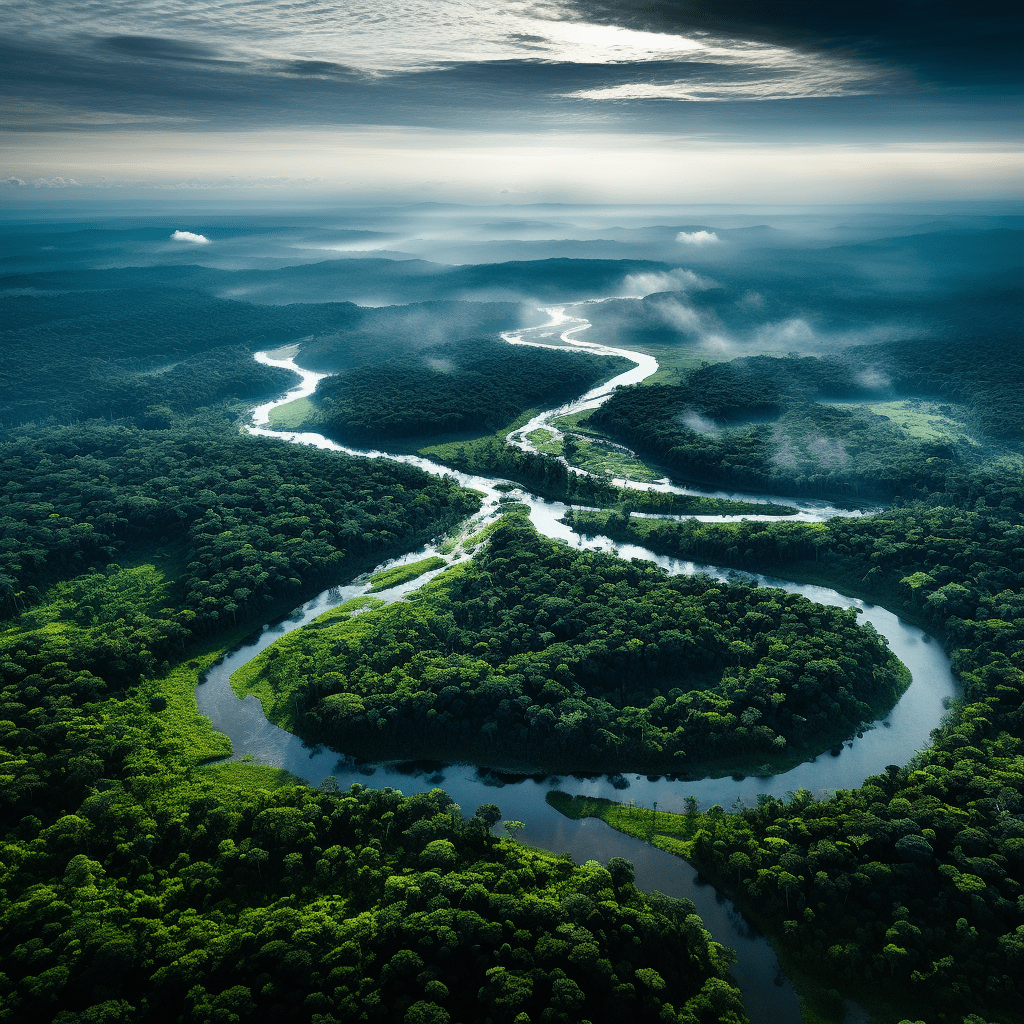
As the lungs of our planet, the Amazon Rainforest holds an essential role in Earth’s biodiversity and climate regulation. Encompassing approximately 5.5 million square kilometers, it is home to about 400 billion individual trees representing over 16,000 species. But what if this lush, verdant world was not simply a natural occurrence but instead, the result of calculated, intentional human activity?
The Theory: Anthropogenic Forests
A growing body of research proposes a radically different perspective on the Amazon Rainforest’s genesis, suggesting it may be largely anthropogenic – shaped by the indigenous peoples inhabiting the region for millennia. Rather than the “untouched wilderness” commonly depicted in popular culture, the Amazon could be a landscape intentionally curated, nurtured, and expanded by human hands.
Evidence: Terra Preta Soil
One of the most compelling pieces of evidence for this theory lies in the region’s soil. A significant portion of the Amazon features rich, fertile soils known as “Terra Preta” or dark earth. In stark contrast to the region’s naturally occurring, nutrient-poor soil, Terra Preta is loaded with organic matter, including charcoal, bone, and manure – elements typically associated with human activity.
These anthropogenic soils date back 2000 to 3000 years and are believed to have been produced by indigenous populations using a process of low-temperature, smoldering fires. Not only is this soil incredibly fertile, but it also has the unique ability to regenerate itself, making it a potentially sustainable, long-term solution for agriculture.
Evidence: Forest Islands and Raised Fields
Other intriguing clues lie in the existence of “forest islands” and raised fields scattered throughout the Amazon basin. These anomalies in the landscape, traditionally used for agriculture and habitation, also point towards significant anthropogenic influence.
Forest islands are small patches of dense forest that rise above the surrounding grasslands. Archaeological investigations have uncovered pottery fragments, suggesting previous human habitation. Raised fields, on the other hand, are elevated plots that would have been used for agriculture in the flood-prone environment. Today, these continue to be fertile, demonstrating the long-term planning and sustainable land management strategies of these ancient societies.
Evidence: Hyperdominant and Domesticated Species
In a natural forest, we might expect the tree species to follow a random distribution. However, in the Amazon, over half of the trees are so-called “hyperdominant” species. Many of these hyperdominants are also useful to humans, providing food, materials, or medicine.
These include the Brazil nut tree and the ice cream-bean tree, whose fruits are edible. It is unlikely that the dominance of such species occurred merely by chance, suggesting that ancient populations may have strategically cultivated these useful species, contributing to the biodiversity we see today.
Human Influence, Then and Now
The emerging view of the Amazon as a vast, ancient garden nurtures our understanding of how intertwined human existence is with nature. The indigenous societies of the past were not merely passive inhabitants of their environment but active, innovative cultivators shaping the world around them.
As we face the realities of climate change and deforestation, these findings serve as a stark reminder. Our actions can dramatically alter our environment – both for better and for worse. Embracing the lessons of the past, it falls upon us to continue the legacy of the ancient Amazonians: one of sustainable growth, careful stewardship, and harmonious coexistence with nature.
Are we up to the task? For the sake of the Amazon – and indeed, our planet – we must strive to be.
 Wondergressive