

Understanding Kali Yuga
In the ancient Indian spiritual tradition, the concept of time operates on a cosmic scale, far beyond our everyday understanding. As per the Hindu cosmological framework, time is cyclic and divided into four distinct ages or ‘Yugas’: Satya, Treta, Dwapara, and Kali. The idea of Kali Yuga, often referred to as the ‘age of vice,’ is an intriguing and compelling subject that invites both fascination and introspection.
The Age of Strife: An Overview
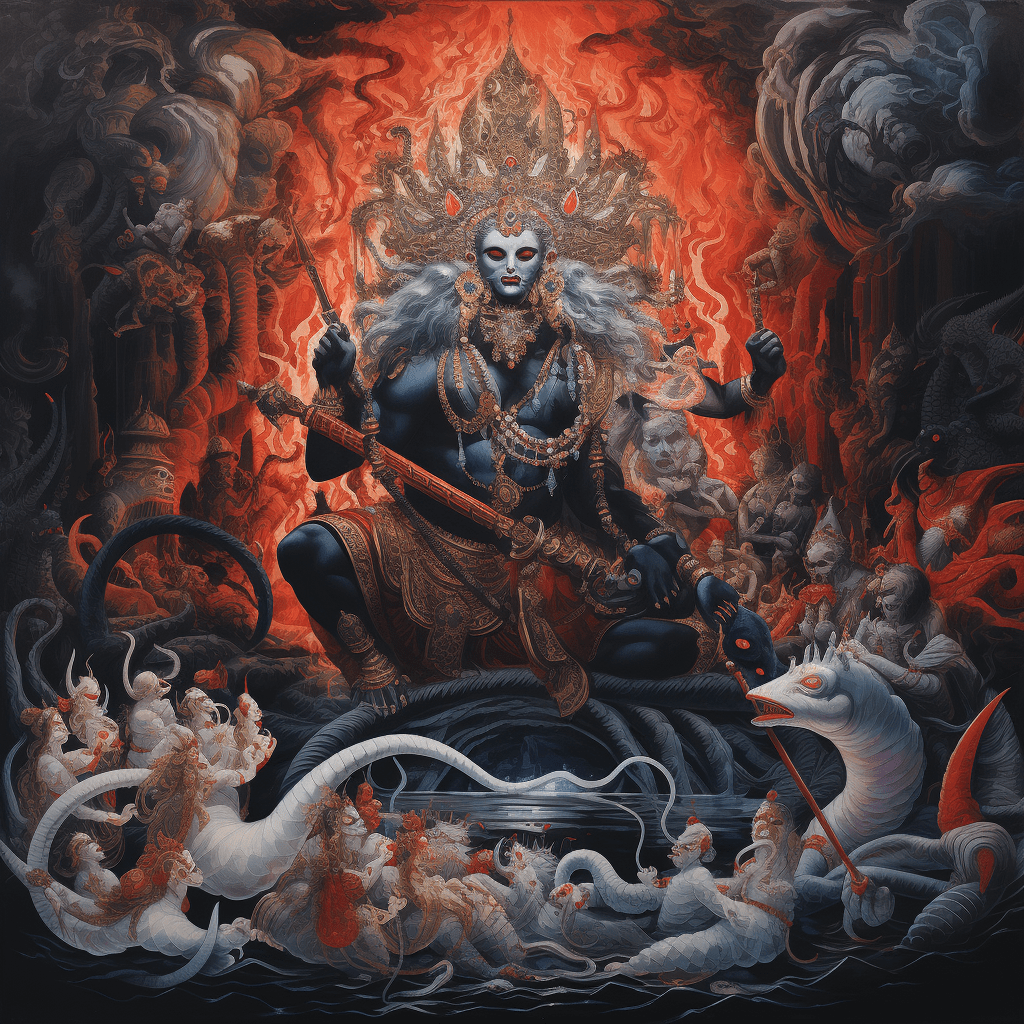
Kali Yuga, as described in the Puranas and epics like Mahabharata, is an epoch marked by moral degeneration, strife, discord, and a decrease in virtue. The age is envisioned as a period of decline, where righteousness (Dharma) stands on one leg, unlike the Satya Yuga or age of truth where Dharma is metaphorically depicted standing on all four.
Interestingly, Hindu scholars have calculated the span of Kali Yuga to be 432,000 years. As per traditional belief, this Yuga commenced around 3102 BCE with the passing of Krishna, marking the end of the Dwapara Yuga and the onset of the Kali age.
Evidence of Kali Yuga
While the concept of Yugas might appear purely philosophical, there is a fascinating connection with astronomy that lends credence to these ancient beliefs. Indian sages utilized the precession of the equinoxes to calculate the Yuga durations. This astronomical phenomenon, verified by modern science, concerns the Earth’s slow, cyclic axial rotation, completing one cycle approximately every 26,000 years.
Moreover, the scriptures offer a detailed description of societal conditions during Kali Yuga. Some of these predictions seem eerily accurate in the current context, such as rampant materialism, societal discord, the decline of spiritual practices, and the overall moral degradation.
Kali Yuga: A Period of Transformation?
However, it’s important to note that the concept of Kali Yuga is not simply one of doom and gloom. Indian philosophies often emphasize the cyclic nature of time and the universe. Just as seasons change, these Yugas represent different periods of cosmic consciousness. Thus, Kali Yuga is also a transformative period, a time of churning where humanity is given the opportunity to learn, evolve and ultimately transition into a new cycle of spiritual enlightenment.
The compelling evidence for Kali Yuga’s existence in ancient texts, coupled with its alignment with certain astronomical phenomena, presents a fascinating perspective on time and cosmic cycles. While it’s easy to dismiss such concepts as mere myths or superstitions, a closer examination reveals a deep understanding of cosmic principles and the human condition. Whether one views the Kali Yuga as a current reality or as a symbol of spiritual transformation, it undeniably holds a profound place in human consciousness and our understanding of the universe.
The Kali Yuga, like all things, is transitory. As per the Hindu belief system, once the period of Kali Yuga ends, a new cycle will commence with Satya Yuga, an age of truth, righteousness, and divine consciousness. Therefore, Kali Yuga can also be seen as a necessary phase of purification before the dawning of a more enlightened era. The insights offered by the concept of Kali Yuga, therefore, go far beyond mere prophecy or pessimism, providing a nuanced understanding of human existence in the larger cosmic scheme.
In essence, the notion of Kali Yuga is a testament to the wisdom of the ancient Indian sages, who envisaged time on a grand cosmic scale and perceived the cyclical patterns of rise and fall, creation and dissolution in the universe. Today, as we navigate our way through the trials and tribulations of life, the wisdom contained in the concept of Kali Yuga offers a philosophical anchor, a way to comprehend the broader patterns of life and existence.
 Wondergressive