


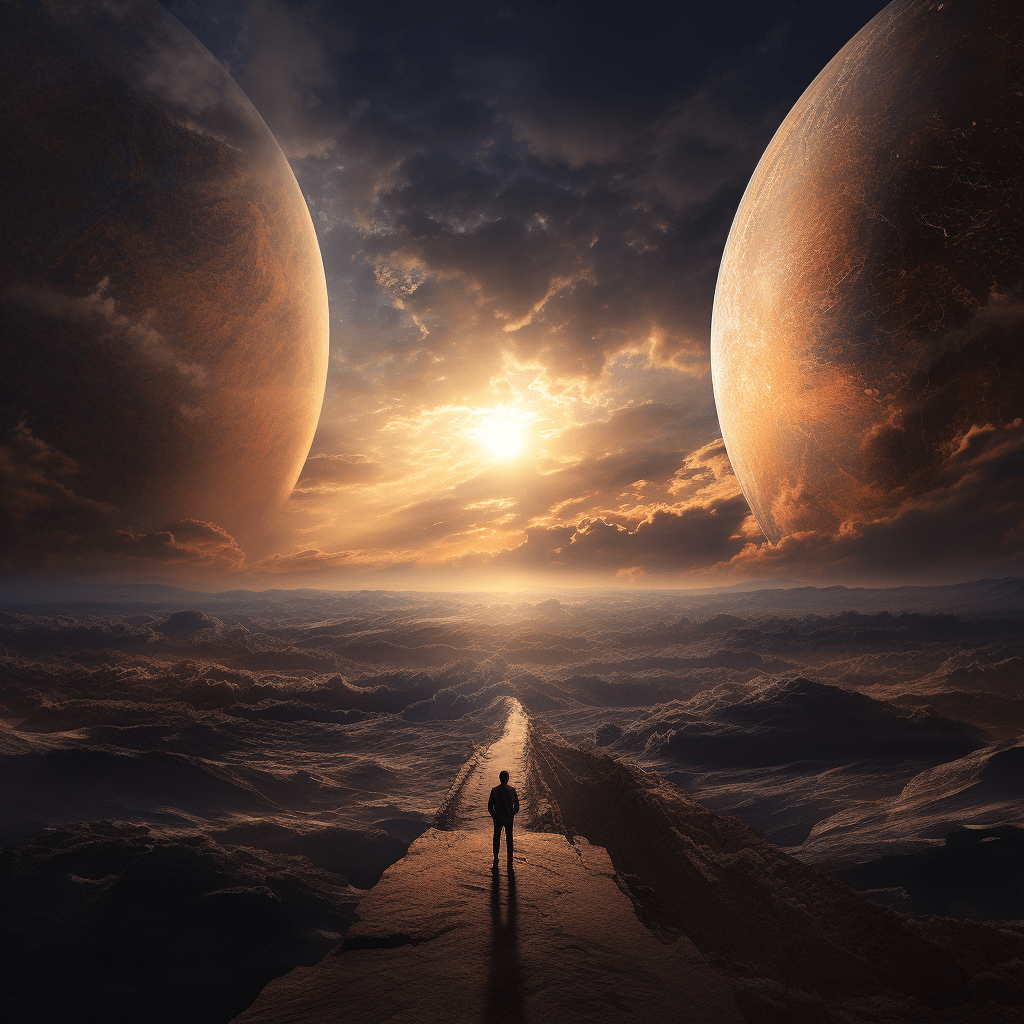
From the moment humankind first turned their gaze towards the sky, they have speculated about the nature and structure of our cosmos. Today, we are accustomed to the heliocentric model: a solar system with the Sun at its center and Earth, among other planets, orbiting around it. Our understanding states that the Sun is significantly larger than the Earth, but what if this perspective were challenged? This article delves into the intriguing yet highly controversial theory suggesting the Earth is, in fact, larger than the Sun.
The Geometry of Perception
Let’s start by acknowledging our baseline. According to established scientific consensus, the Sun is approximately 109 times the diameter of Earth. This notion is drawn from observable evidence and mathematical calculation. However, proponents of the Earth-larger-than-Sun theory claim that these calculations are misled by optical illusions and misinterpretations of data.
Their argument begins with our perception. For example, the way we perceive the Sun and Moon’s size when they rise and set. They appear larger due to an optical illusion known as the ‘Moon illusion’. Similarly, they argue that our perception of the Sun’s size might be distorted due to our vantage point and the filtering effect of Earth’s atmosphere.
Interpreting Solar Eclipse
Solar eclipses offer a compelling case for this unconventional theory. During a total solar eclipse, the Moon appears to cover the Sun perfectly. If the Sun were indeed as large as standard science suggests, wouldn’t it seem impossible for the comparatively tiny Moon to mask the Sun entirely? This argument, while seemingly convincing, however, fails to account for the vast distance differences between Earth, Moon, and Sun, which leads to this perception.
Playing Devil’s Advocate: Exploring Scale
The concept of scale is crucial in these discussions. For instance, if we consider the Earth as a model, representing all celestial bodies with comparable components, the picture changes. Let’s take a basketball to represent Earth and a tennis ball for the Moon. In this model, the Sun would be akin to a ball over nine feet in diameter! When we place these items at representative distances, the perceived size alignment during a solar eclipse becomes much clearer.
However, for a believer of the theory, this scale model only proves the point. They argue that our accepted scale is flawed, skewed by assumptions made from our Earth-centric perspective.
Contemplating Geocentric Views
The Earth-larger-than-Sun theory may be seen as a modern take on the ancient geocentric model, in which Earth was considered the center of the universe. Today’s proponents, however, don’t necessarily argue for Earth’s central position, but rather a size comparison challenge.
Addressing Established Science
The scientific consensus accepts the Sun’s vastness compared to Earth based on a plethora of data from various sources, including space probes, satellite measurements, and mathematical calculations. Critics of the Earth-larger-than-Sun theory point out that this myriad of evidence cannot be simply dismissed. In response, the theory’s proponents ask for open-mindedness, reminding us of historical instances where established scientific views have been upended.
Conclusion
The Earth-larger-than-Sun theory is a provocative and fascinating perspective that challenges our current understanding of the cosmos. It invites us to question our perceptions and the evidence upon which we base our beliefs. While most scientific evidence negates this theory, it underscores the importance of continual curiosity, questioning, and exploration in our quest to understand the universe. We must remain open to challenge our understandings while being stringent in the application of scientific principles and rigorous proof.
 Wondergressive