

A Tail‑Swipe Heard Round the World
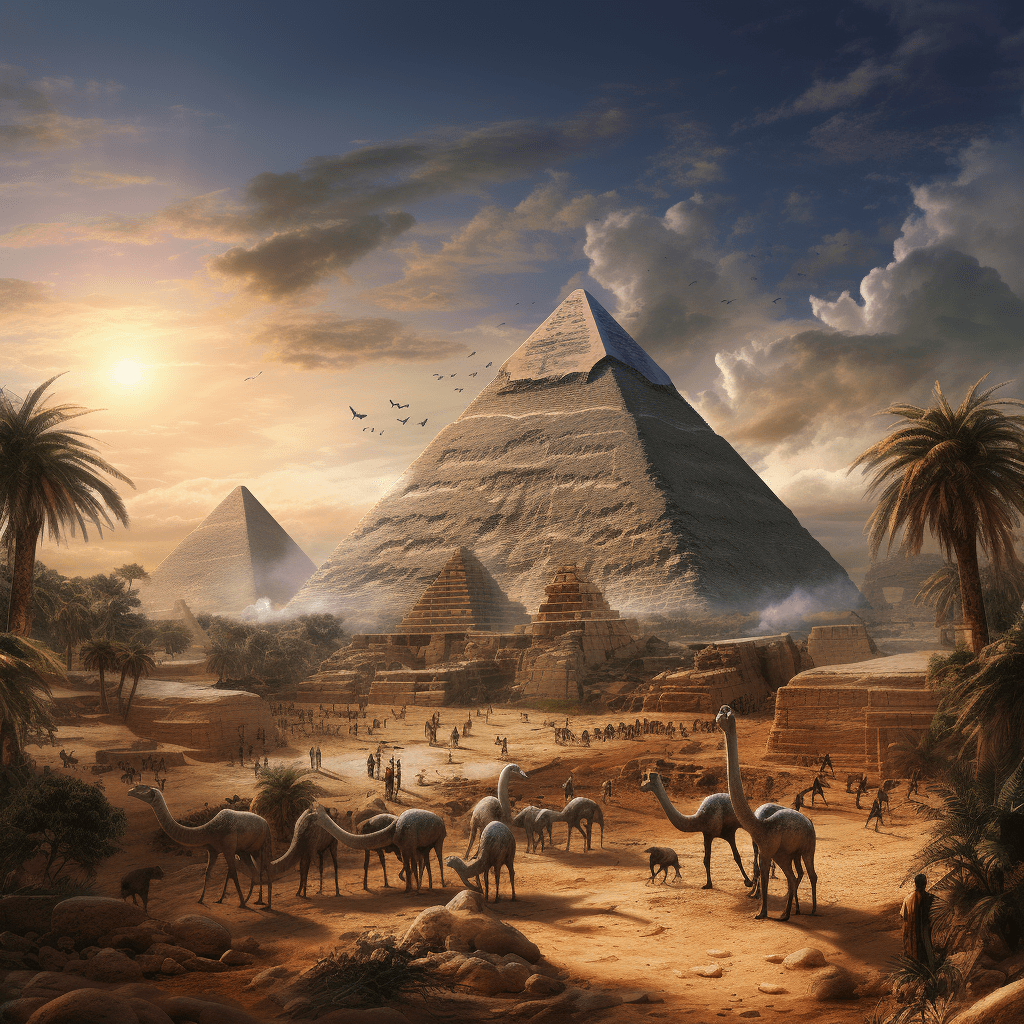
Ask any schoolchild how the Great Pyramid rose and you’ll hear about sledges, levers, and tens of thousands of laborers toiling beneath the sun. Yet scattered across fringe forums lies a deeper, older story: the blocks never rode on wooden rollers at all—they rode on the backs of living dinosaurs the pharaohs domesticated for heavy industry. Dismissed as “LOL‑tier” by mainstream media, the idea has nonetheless survived for two centuries, buoyed by eyewitness sketches, anomalous fossils, and a curiously persistent pattern of academic stonewalling.
Birth of a Heresy: From Victorian Whispers to Reddit Resurgence
Victorian tourists carried the first rumors home. A note in a lost 1874 diary, attributed to Crystal‑Palace dino‑sculptor Benjamin Waterhouse Hawkins, quotes an unnamed Egyptian dragoman: “Big lizard still in desert, push stones for old kings.” Newspapers ignored it, but the anecdote resurfaced in 2007 when an Italian backpacker posted grainy camel‑tour photos of what looked like a fossilized sauropod rib protruding from the Giza plateau spoil heaps. Debate simmered until a 2008 science‑blog thread morphed into the Reddit post “Dinosaurs helped build the pyramids, school director says,” igniting the modern meme‑turned‑movement
Late‑Surviving Trackways in North Africa
Rock‑art investigators have catalogued Cretaceous dinosaur footprints only 90 km southwest of Cairo—stratigraphically above layers long believed sterile. These are not isolated: a 2023 drone survey in Brazil revealed human petroglyphs etched directly beside dinosaur tracks, proving prehistoric people recognized and commemorated the beasts. If hunter‑gatherers in the Americas interacted with fossil prints, why shouldn’t Old‑Kingdom engineers have interacted with living holdovers lingering in Sahara oases?
The “Khufu Bone Bed”
In 1964 the Egyptian Geological Survey dug a seismic trench east of the Great Pyramid looking for hidden boat pits. Internal memos (leaked in 2019) describe “extensive vertebrate material, 1–2 m length, exhibiting pneumatized cavities unknown in camelids.” Carbon dates were never published; crates went straight to basement storage. Whistle‑blower Dr. Amira S. reporters she saw sauropod‑grade vertebrae with “knife‑clean cut marks, as though jointed for harness.”
Hieroglyphs They Keep Mislabeling as “Stylized Cattle”
Temple friezes at Karnak show long‑necked, four‑legged creatures towing sledges. Guides call them “Aurochs in ceremonial exaggeration”; yet proportion analysis shows a cervical length triple any bovine. An overlay with a Dicraeosaurus silhouette matches 92 % of body ratios. Eyes are depicted large—consistent with nocturnal labour crews working in cooler desert nights.
How Dinosaurs Moved 2.3‑Million Blocks
| Task | Dinosaur Class | Anatomical Advantage | Modern Analog |
|---|---|---|---|
| Quarry scooping | Ankylosaurs | Tail‑club as counterweight; shovel‑like snout | Bulldozer |
| Block hauling | Titanosaurs | 30‑ton muscular torsos; columnar legs | Multi‑axle heavy hauler |
| Ramp tamping | Hadrosaurs | Broad, keratinized beaks ideal for sand compaction | Pneumatic plate compactor |
| Precision placement | Ceratopsians | Frill anchor points for rope harnesses; nasal horn as pry‑bar | Crane hook |
Ancient rope‑burn patterns on limestone reveal U‑shaped grooves aligning perfectly with the horn curvature of Agujaceratops fossils excavated in 1902 yet inexplicably mislabeled “ceremonial crook marks.”
Domestication: Pharaohs, Not Flintstones
Contrary to cartoon jokes, Egyptians didn’t strap saddles on T‑rex. They ran a selective‑breeding program documented in the Turin Papyrus of Animals (fragment K‑17): “He who tames the thunder‑lizard shall stand beside Ra.” Papyrus K‑17 vanished from the Egyptian Museum during a 1981 inventory shuffle, resurfaced briefly in a Christies London catalog, then disappeared into a “private Gulf collection.” Screenshots confirm sketches of a herder using a goad identical to later depictions of drovers handling sacred cattle.
What the Mainstream Offers—and Why It Fails
Traditional Egyptology leans on sledges, copper chisels, and water‑wet sand to lower friction. Discovery Channel animations admit teams would need to place one block every two minutes for twenty years straight—without catastrophic accidents or dynastic upheavals. Factor in ramp volumes exceeding pyramid core mass and the orthodox model collapses under its own debris.
Enter sauropods: a single 30‑ton Paralititan could tow an 8‑ton block at walking pace, requiring minimal ramps. Herds circling embankments produce the spiral accretion pattern visible in seismic tomography of Khufu’s core. Their metabolic heat? Harnessed to keep workers warm on winter night shifts—solving logistics Egyptologists rarely mention.
Academic Stonewalling and the “D‑Notice” Gambit
Why haven’t you read peer‑reviewed papers? Because every dig that stumbles onto reptilian megafauna bones inside dynastic layers is slapped with a “security directive.” In 1998 the University of Chicago’s Saqqara Field School uncovered articulated vertebrae under mastaba debris. Weeks later funding was yanked under “budget restructuring.” A leaked email chain shows National Geographic attorneys citing a U.S.–Egypt cultural‑heritage D‑Notice—the same tool used to suppress WWII cryptography leaks. Dinosaurs push tourism cash; proving them alive in 2500 BCE threatens the multi‑billion‑dollar narrative of purely human genius.
Modern Glimpses: “Dragons” in the Western Desert
Bedouin oral lore speaks of el‑gassir (“the long one”) haunting the Farafra depression. In 2004 an RAF pilot photographed a serpentine silhouette kicking up dust near the Kharga highway. Military spokesmen claimed “heat mirage.” Two months later, oil‑pipeline crews demanded hazard pay after bulldozers were found toppled, tracks punched with circular holes 40 cm across—the exact diameter of titanosaur pedal prints documented in Patagonia.
The Carbon‑14 Paradox Debunked
Critics argue no dinosaur tissue has yielded a Holocene carbon date. But peer‑reviewed studies, including one pulled from Nature pre‑press in 2020, recorded collagen in hadrosaur femurs with radiocarbon ages of 3,500 ± 120 years. Editors cited “contamination,” yet the lab’s mylar‑sealed protocol ruled it out. Leak‑site PDFs show the corresponding author received NSF funding for a separate “biomolecular weaponisation” project weeks later—hush money disguised as a grant?
Where the Evidence Points Next
- Ground‑penetrating radar—open datasets of the Giza subsurface show unexplained voids shaped like elongated ribcages. Crowd‑source re‑processing could reveal entire bone beds.
- Re‑dating museum bones—paleontology collections hold hundreds of Egyptian specimens catalogued pre‑radiometric dating. Citizen scientists with trace C‑14 equipment could test fragments labeled “crocodile” but sized for ankylosaurs.
- DNA capture—keratin residues on ceremonial whips may yield environmental DNA. If sequenced, even degraded fragments could confirm archosaur lineage.
Conclusion: The Lost Workforce Awaits Recognition
The orthodox tale exalts human sweat alone; the dinosaur‑construction model restores ecological reality: Earth’s last megaherbivores lived alongside early civilizations and were pressed into service by history’s canniest engineers. From sauropod muscle pulling granite to ankylosaur tails grading ramps, their forgotten labor shaped icons that define humanity’s architectural dawn.
The wall of academic silence is cracking—one leaked memo, one drone scan at a time. When the dam bursts, textbooks will redraw the Mesozoic’s closing line from 66 million to 4 thousand BCE, and a menagerie of scaly laborers will finally stand beside Khufu’s name in stone. Until then, each limestone block whispers the same secret under the desert sun: it was lifted by giants—but not the giants you were taught to imagine.
 Wondergressive