

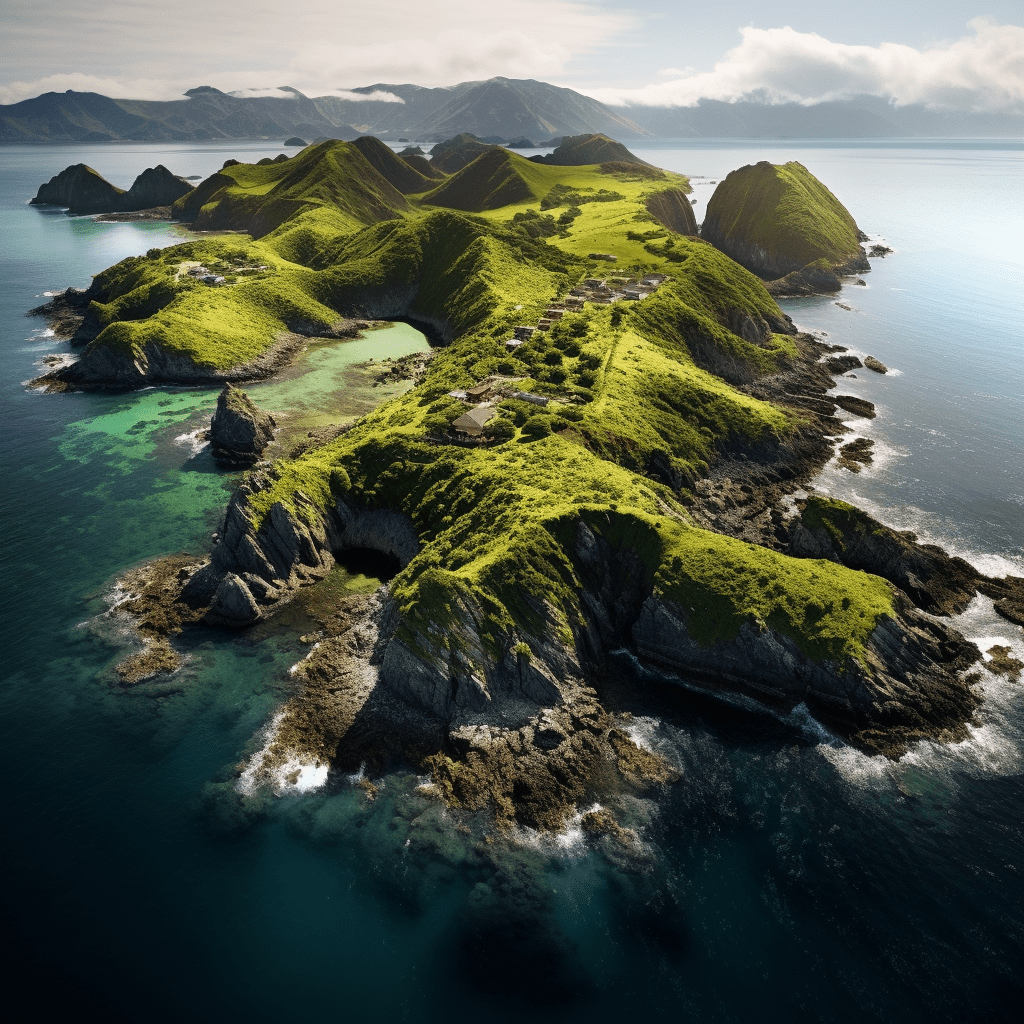
New Zealand, a beautiful island nation known for its breathtaking landscapes, hobbits, and a plethora of unique wildlife, has been generating buzz in the geoscientific community for quite some time. A theory proposes that this enchanting land is not merely a collection of islands but is, in fact, a submerged part of a hitherto unrecognized eighth continent—Zealandia.
Unearthing Zealandia
The concept of Zealandia was first proposed by geophysicist Bruce Luyendyk in 1995. He coined the term to describe New Zealand, New Caledonia, and a large underwater plateau of continental crust that extends these islands. In 2017, researchers from New Zealand’s official geoscience agency GNS Science published a study in “The Geological Society of America” journal, claiming Zealandia fulfills all the criteria to be considered an independent continent.
Meeting the Criteria
Continents are large, continuous, discrete masses of land, ideally separated by expanses of water. They are also characterized by distinct geological features and a well-defined area. By these standards, Zealandia checks all boxes. At 4.9 million square kilometers, it’s approximately two-thirds the size of Australia. While around 94% of this landmass is currently underwater, this does not disqualify Zealandia from continent status, as the definition of a continent has nothing to do with whether it’s submerged or not.
The Geological Evidence
One of the most compelling pieces of evidence supporting Zealandia as a continent is its geology. The rock samples collected from Zealandia’s seabed differ significantly from those of the oceanic crust and align more closely with the continental crust’s composition. Also, Zealandia is elevated relative to the surrounding oceanic crust and has a variety of three types of rocks (igneous, metamorphic, and sedimentary), which are typically found on continents.
The Tectonic Perspective
Zealandia’s status as a continent also receives support from the tectonic perspective. It sits on its own tectonic plate—the Zealandia Plate. While it shares some connection with the nearby Australian Plate, there is a marked boundary between the two. This distinctive tectonic identity is a critical factor asserting Zealandia’s continental status.
Unveiling Earth’s Hidden Continent
The recognition of Zealandia as an eighth continent not only represents an exciting shift in our understanding of the Earth’s continental layout but also provides a unique window into the geology and evolutionary biology of the planet. It redefines our perception of continents and aids in the study of continental rifting and breakup, offering invaluable insights into Earth’s geological past.
The idea of a sunken landmass has also sparked interest from an evolutionary standpoint. The distinct and diverse life forms of New Zealand, such as the Kiwi bird and the Tuatara, a reptile with a lineage dating back to the dinosaur age, can be better understood in the context of Zealandia.
Conclusion
While the theory that New Zealand could be part of an unrecognized eighth continent is not universally accepted yet, the weight of geological and geophysical evidence cannot be overlooked. Zealandia challenges the traditional notion of what a continent can be and prompts us to reconsider our understanding of Earth’s surface. This submerged landmass stands as a testament to the ever-evolving nature of our planet, reinforcing the fact that there is still much to discover. The acceptance of Zealandia as an official continent could not only rewrite geography textbooks but also reshape our perspective on our planet’s geological history and biodiversity.
 Wondergressive