

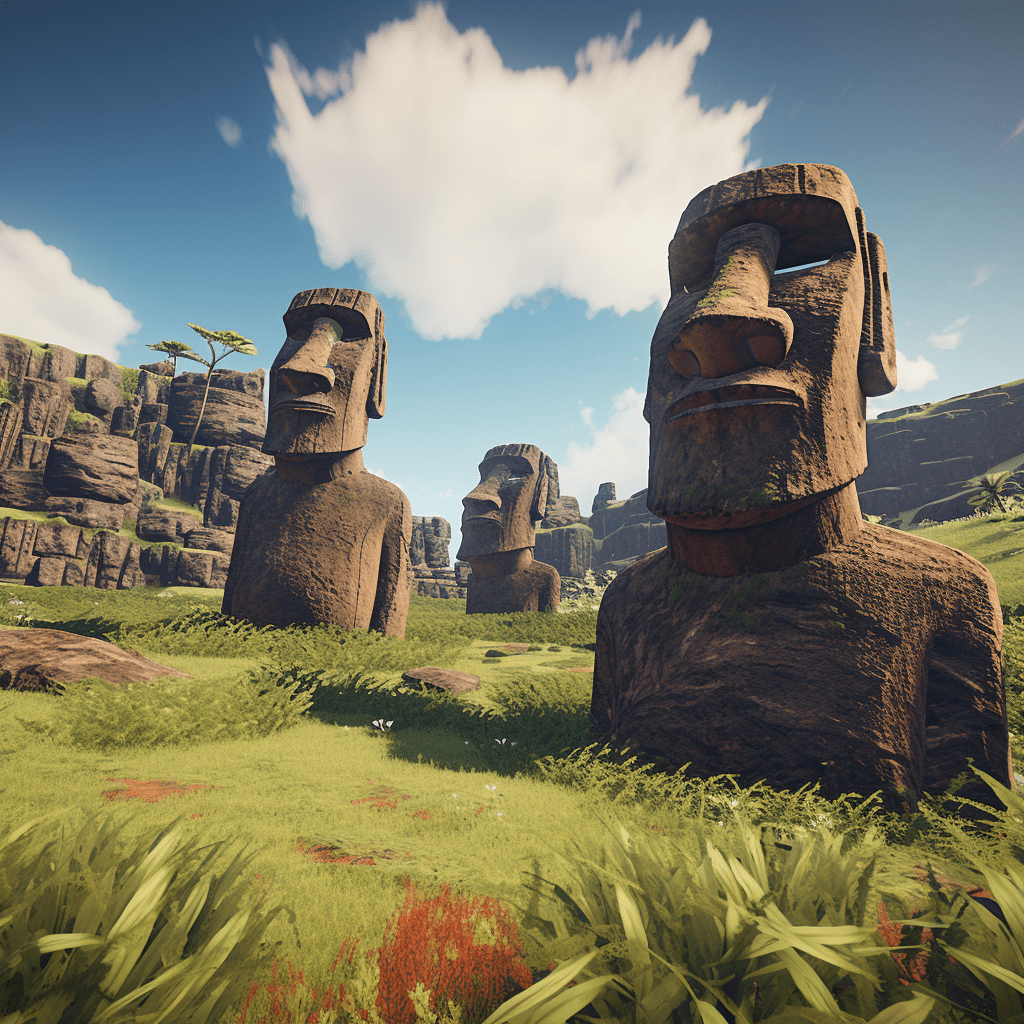
The colossal Moai statues of Easter Island, or Rapa Nui as it’s known by its indigenous people, have long been the subjects of fascination and mystery. These statues, chiseled from solidified volcanic ash, have stood silently gazing across the island for centuries. Most theories about the Moai’s origins revolve around their creation by the island’s inhabitants as sacred representations. However, an intriguing theory posits that the Moai were not merely created by the Rapa Nui people but that they are, in a sense, the Rapa Nui people themselves. Let’s delve into this captivating proposition.
The Moai: More Than Statues?
Traditionally, the Moai are seen as symbols of authority and power, both religious and political. They were believed to be the embodiment of ancestral chiefs and important lineage heads, carved as a form of honor and remembrance. But could these stone giants be more than symbolic representations? Could they be the literal embodiment of the Rapa Nui themselves?
The Stone Giants: A Spiritual Connection
In Rapa Nui’s traditional beliefs, spiritual essence or “mana” is a critical concept. As per “The Statues that Walked” by Terry Hunt and Carl Lipo, this spiritual energy could be transferred to different objects, and in this case, the giant Moai statues. This transfer wasn’t a mere symbolic act but a real, spiritual transmutation. Following this line of thought, the Moai, enriched with the mana of their creators, could indeed be seen as the people themselves, immortalized in stone.
Ancestral Worship and the Rapa Nui
The connection between the Moai and the Rapa Nui can also be seen in their practice of ancestor worship. As per anthropologist Sergio Rapu Haoa, this reverence wasn’t merely symbolic or ritualistic, but rather a belief in the real presence of ancestors within these stone figures. In this light, the act of carving Moai could be seen as a form of self-representation and self-preservation, further solidifying the idea that the Moai are, in essence, the Rapa Nui themselves.
The Linguistic Clues
The indigenous language of the island, also named Rapa Nui, offers some clues as well. Linguists have pointed out that the term ‘moai’ can translate to ‘existence,’ ‘real,’ or ‘reality,’ adding another layer of interpretation to our understanding of the Moai statues. Given this linguistic insight, it’s not far-fetched to postulate that the Moai could represent the Rapa Nui’s real, tangible presence in a more profound sense.
The Physical Characteristics
Many of the Moai display individual physical characteristics, such as different facial features, body shapes, and sizes, much like a human population would vary. Some researchers, like Jo Anne Van Tilburg in “Easter Island: Archaeology, Ecology, and Culture,” argue these variations are not arbitrary but mirror the physical characteristics of the people who inhabited the island, supporting the idea of the Moai as literal embodiments of the Rapa Nui.
Conclusion: The Living Statues of Rapa Nui
While there is no definitive proof that the Moai are the Rapa Nui people themselves, this perspective offers an enriching and enlightening way to view these magnificent works of art. It takes us beyond seeing them as mere statues and pushes us to view them as tangible testaments of a living, breathing civilization that thrived on a remote island in the Pacific Ocean.
This theory brings us closer to understanding the Rapa Nui’s profound connection with their ancestors, their spiritual beliefs, and their unique perception of existence. After all, what could be more real, more defining of a people, than carving their presence into the solid rock for eternity?
 Wondergressive