


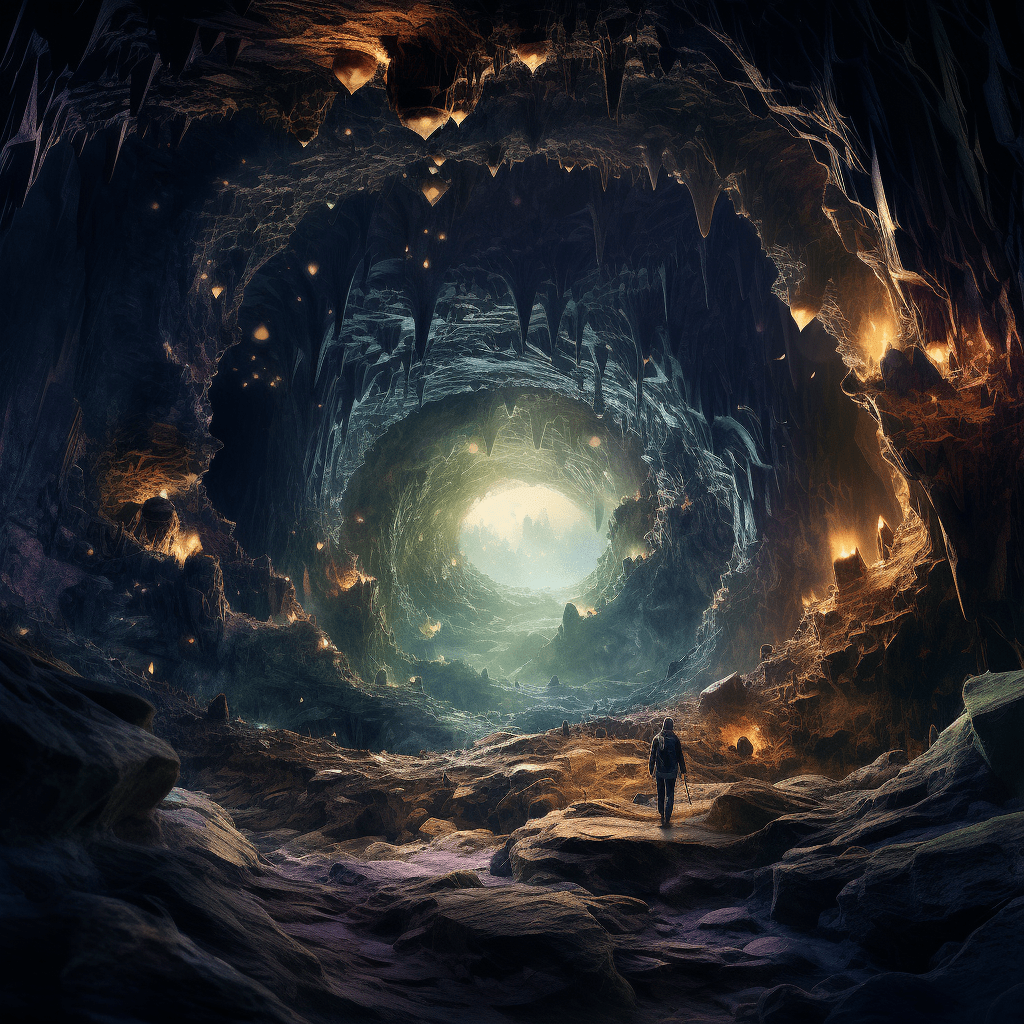
Deep beneath the surface of the Earth, beyond the reach of sunlight, there exists a world that might appear straight out of a fantasy novel – a world of vast, interconnected underground caverns. While geologists primarily view these spaces as fascinating natural formations, some individuals see them as more than that. They see them as potential pathways into the Hollow Earth, a concept that, while largely rejected by modern science, continues to captivate the imagination.
The Hollow Earth Theory: A Historical Perspective
The idea that the Earth might be hollow, its crust being only a thin shell encasing an internal void, has a long and storied history. Proposed in the 17th century by notable scientists like Sir Edmond Halley, it was once a serious scientific hypothesis. Halley suggested that the Earth consisted of a series of concentric shells separated by luminous atmospheres, each capable of supporting life.
Underground Caverns: A Geological Wonder
The Earth’s crust is filled with myriad caves, sinkholes, and subterranean rivers carved out by millions of years of geological activity. Some of the most extensive cave systems include Kentucky’s Mammoth Cave, the longest in the world, and Mexico’s Sistema Sac Actun, an underwater cave system. These complex networks of tunnels and chambers stretch for hundreds of miles, with many areas remaining unexplored due to inaccessibility or hazards.
The Caverns as Hollow Earth’s Pathways
Proponents of the Hollow Earth theory often cite these extensive cave systems as evidence. Some have even claimed that entrances to the Hollow Earth lie concealed within unexplored or inaccessible parts of these caverns.
Several stories and legends seem to support this theory. For instance, the Macuxi people of the Amazon region have a legend about vast tunnels that reach deep into the Earth and end in an inner world.
Compelling Evidence or Wishful Thinking?
While the Hollow Earth theory has largely fallen out of favor in scientific circles, replaced by more evidence-backed models of Earth’s structure, it does raise fascinating questions.
Caverns have been found at significant depths, with the Krubera Cave in Georgia reaching over 2,197 meters (7,208 feet) deep. Some proponents point to unexplained phenomena like the seismic waves from earthquakes that sometimes appear to “ring” the Earth like a bell, as potential evidence for Hollow Earth theory. They argue that a solid Earth would not produce such an effect.
However, mainstream scientists explain these phenomena in other ways, consistent with the established understanding of the Earth’s structure. Seismic wave propagation, for example, is influenced by the Earth’s various layers’ density and elasticity.
Conclusion
The theory of underground caverns as pathways to a Hollow Earth continues to intrigue despite being outside mainstream scientific thought. These ideas persist, in part, because of the vast unexplored portions of these caverns and the enduring human instinct to explore the unknown. While current geological knowledge disputes a hollow Earth’s existence, the concept underscores the sense of wonder that our planet, especially its unseen depths, inspires.
One thing is certain: the extensive networks of underground caverns that lie beneath our feet are an enduring testament to the Earth’s rich and dynamic geological history. Whether or not they lead to a hidden world inside our planet, they remain an awe-inspiring facet of our natural world, deserving of our respect and protection.
 Wondergressive