

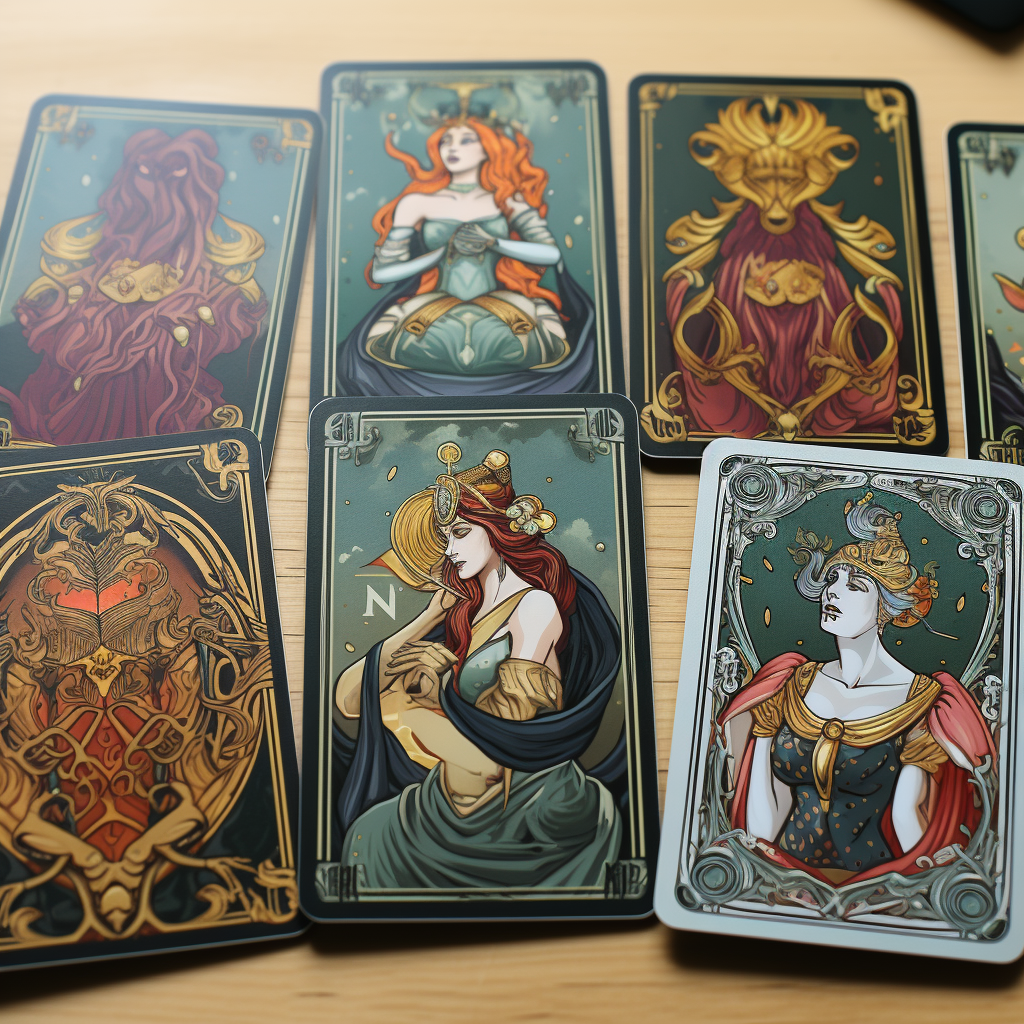
Across cultures and throughout history, we’ve attributed the unknown and unexplained to divine entities and forces beyond our comprehension. Such ideas have shaped our understanding of the cosmos, life, and even the laws that govern our existence. One of the intriguing yet lesser-known theories in this realm is the Divinities Playing Card Game Theory. This theory suggests that all events and occurrences in our lives and the world at large are the result of a grand cosmic card game played by divine entities.
The Theory Explained
The Divinities Playing Card Game Theory postulates that each decision, occurrence, and event is the outcome of a divine card game. Like human players in a card game, each divine entity holds a set of cards representing potential outcomes for events on earth. The cards played by the divine entities determine the course of human history, individual lives, and even the natural world.
Existence as a Game of Chance
The comparison of existence to a game of chance is not new. Philosophers, theologians, and even scientists have often likened life and the universe to a game. Even in quantum mechanics, a key principle is that particles exist in states of probability until observed, suggesting an inherent uncertainty or “chance” at the core of reality.
Evidence and Examples
1. Synchronicity
One of the key arguments supporting the Divinities Playing Card Game Theory is the concept of synchronicity. Coined by psychologist Carl Jung, synchronicity refers to meaningful coincidences that seem too significant to be mere chance. These events can be seen as the result of divine cards being played at specific moments.
2. Historical Turn of Events
Another argument lies in examining significant historical events. The unlikely series of events leading to significant outcomes, like the assassination of Archduke Ferdinand sparking World War I or the intricate chain of events leading to the discovery of penicillin, can be viewed as evidence of the divinities’ card game.
The Role of Free Will
A critical aspect of the Divinities Playing Card Game Theory is reconciling the concept of free will. Some theorists argue that while the divine entities play their cards, humans also have their own set of cards to play, representing our decisions. This adds an intriguing dynamic to the theory, weaving together predestination with free will.
Theoretical and Philosophical Implications
The Divinities Playing Card Game Theory has far-reaching implications for understanding existence. It offers a perspective where randomness and order coexist, reflecting the inherent unpredictability and patterns observed in life and the cosmos. Moreover, it encourages a worldview of unity and interconnection, as the divine card game suggests an intricate network of relationships and influences among all events and entities.
Conclusion
While the Divinities Playing Card Game Theory may seem outlandish to some, it offers an innovative and intriguing lens to view the world. By presenting life as a divine card game, it encourages us to see the interconnectedness and meaning in all events, turning randomness into significance. Whether or not we subscribe to this theory, it certainly provides an engaging thought experiment, prompting us to question our understanding of life, divinity, and the cosmos.
The ultimate appeal of the Divinities Playing Card Game Theory, much like any other philosophical or theoretical exploration, lies in its ability to challenge our preconceptions and stimulate intellectual curiosity. As we continue to seek answers to life’s most profound questions, theories such as this remind us of the endless possibilities that exist in the vast expanse of our understanding.
 Wondergressive