


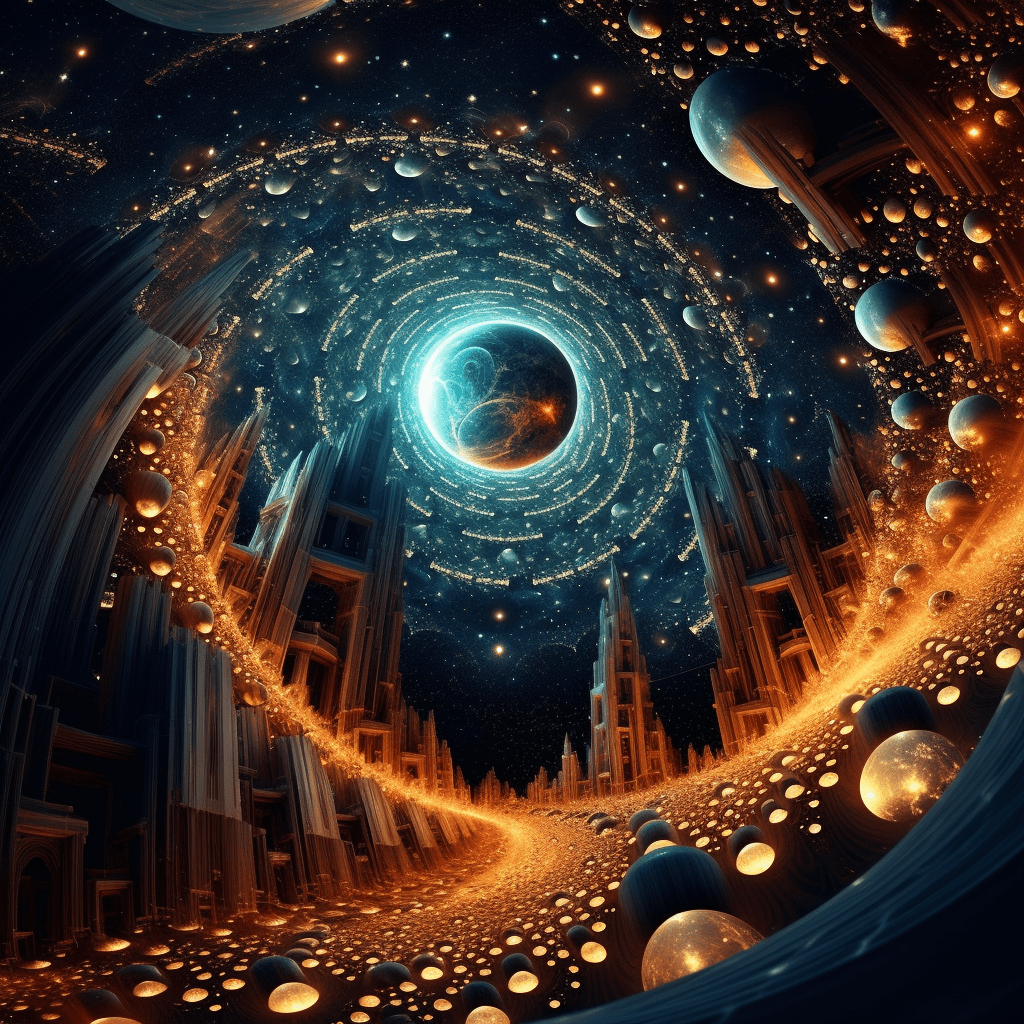
Understanding Fractalization
Fractalization, a term often used in the field of mathematics, refers to the process by which fractals are created. Fractals are self-similar patterns, meaning they are infinitely complex and can be split into parts, each of which is a reduced-scale copy of the whole. Fractals are found across various scientific disciplines, from mathematics to physics and even biology. The world around us is brimming with fractals, from the intricate designs on a seashell to the complex branching of trees.
The Fractal Nature of the Universe
The theory of fractal cosmology proposes that the distribution of matter in the universe is fractal-like over a wide range of scales. If this is true, the universe’s structure has an infinite complexity that could be described by fractal geometry. This idea has significant implications for our understanding of the universe’s origin, evolution, and overall composition.
Fractals in Mathematics and Computer Science
In mathematics, fractals are used to model structures that cannot be represented well by classical geometry. Mandelbrot set, Julia set, Koch curve, and Cantor set are famous examples of mathematical fractals.
Fractals play a significant role in computer science, particularly in computer graphics, image and signal processing, and algorithm development. Fractal compression, a technique used in digital image compression, uses fractal algorithms to compress images based on self-similarity, reducing the amount of data needed to reproduce an image.
Fractals in Biology
In biology, fractals are seen in various organic systems. The structure of a tree or a leaf, for instance, exhibits fractal properties. The circulatory system, bronchial branches in the lungs, and even the patterns of brain waves are other examples of biological systems showing fractal characteristics.
One exciting theory suggests that the reason for the prevalence of fractals in nature is because of how structures grow. Growth processes, which often involve replication and self-similarity, are inherently fractal.
Fractals and Chaos Theory
Fractals are intrinsically linked to chaos theory, a branch of mathematics that studies complex systems whose behavior is extremely sensitive to slight changes in conditions. This connection lies in the fact that many chaotic systems create fractal patterns as a consequence of their dynamics.
Conclusion: A Universe in Patterns
Fractalization is not merely an abstract mathematical concept but is woven into the very fabric of our reality. The possibility of the universe’s structure being fractal presents a profoundly beautiful and harmonious image of the cosmos, where the smallest parts reflect the whole in a never-ending pattern.
However, it’s important to note that while the notion of a fractal universe is intriguing, it is still a theory and remains a topic of debate among scientists. Nevertheless, the pervasiveness of fractals in various fields of study offers us a fresh perspective on understanding the complexities and intricacies of the world around us.
The fascinating world of fractals serves as a testament to the exquisite complexity of nature and the universe. Through the lens of fractalization, we learn to appreciate the mesmerizing patterns in the world around us and understand the intricate systems that govern our reality. Regardless of whether the universe is truly fractal, the study of fractals has and continues to contribute to our understanding of the world and our place within it.
 Wondergressive