

Have you ever considered the idea that modern humans, as we understand them, may not be the first iteration of our species? That our direct human ancestors died out millennia ago, leaving behind their legacy in the form of us – genetically modified entities with borrowed memories and inherited cultures? This might sound like a science fiction plot, but let’s delve into this intriguing theory that presents a radical perspective on human evolution and civilization.
Forgotten Ancestors: An Intriguing Premise
The basis for this hypothesis starts with the premise that ‘real’ humans, Homo sapiens, in their original state, ceased to exist many millennia ago due to cataclysmic events or a great extinction. This idea diverges significantly from the generally accepted Out-of-Africa theory of human evolution, which posits that modern humans evolved from archaic Homo sapiens in the African continent around 300,000 years ago. However, it is worth noting that scientific consensus is not infallible and shifts as new evidence comes to light.
The Atlantis Connection: A Lost Advanced Civilization
A common corollary of this theory is the belief in a lost advanced civilization – an echo of the fabled Atlantis or Lemuria. Proponents suggest that evidence for such a civilization could be found in anomalous archaeological findings, such as the complex underwater structures near Yonaguni, Japan, or the Giza Pyramids’ inexplicable precision and alignment to the cardinal directions and stars.
Genetic Bottleneck and Population Replacement
Further evidence for this hypothesis comes from population genetics. The study of genetic diversity among human populations reveals an intriguing fact: all non-African populations appear to descend from a small population that lived around 70,000 years ago. This event, called a genetic bottleneck, is often associated with the Toba super-eruption. Could it be possible that this bottleneck marks the extinction event of our original human ancestors and the rise of their replacements?
Neanderthal DNA: A Piece of the Puzzle?
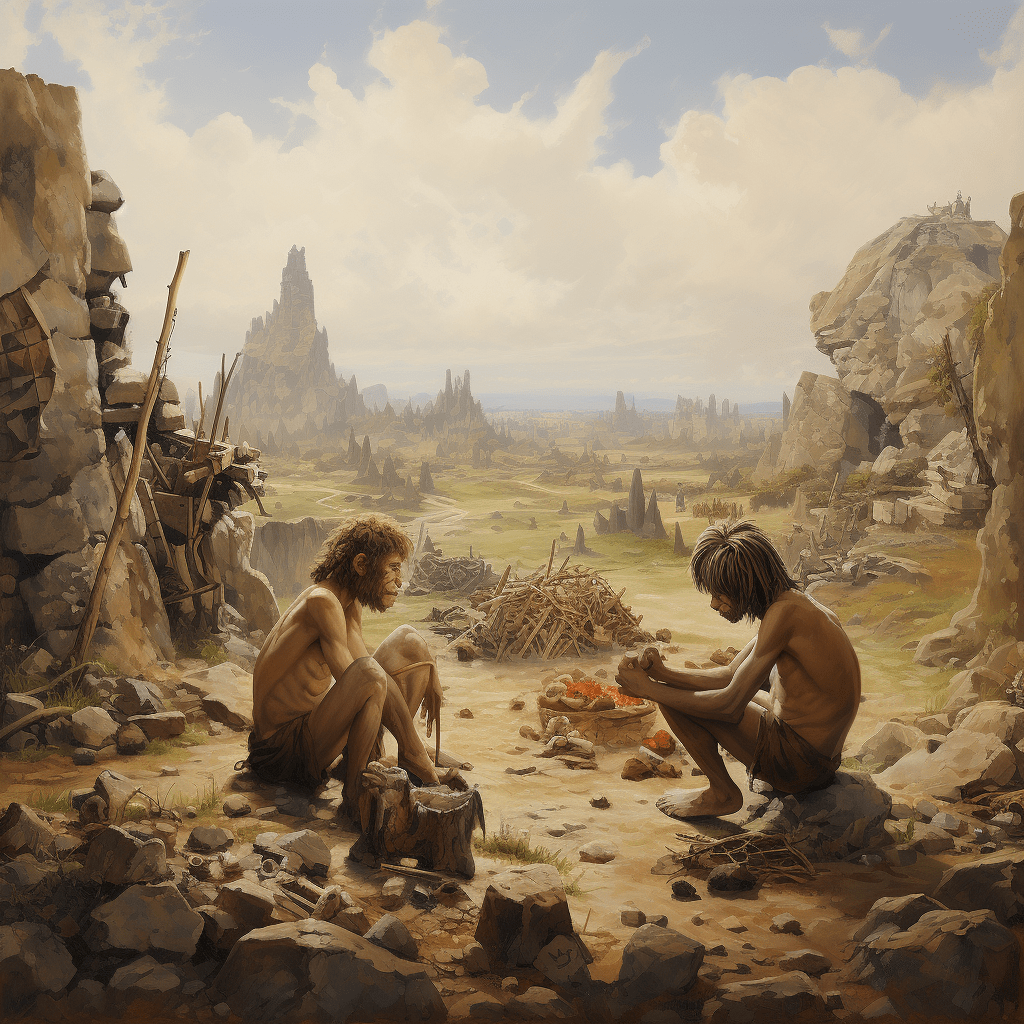
The presence of Neanderthal DNA in modern humans also lends itself to intriguing interpretations within this context. While mainstream science explains this as a result of interbreeding between Homo sapiens and Neanderthals, it could also be viewed as a relic from the time when ‘real’ humans still existed. In this scenario, Neanderthals would not be our extinct cousins but potentially our direct ancestors, and we would be the ‘modified’ versions carrying their genetic legacy.
Human Behaviour: An Echo of a Forgotten Past?
Lastly, let’s look at our behavior. The theory also suggests that our collective amnesia about our ‘real’ ancestors manifests itself in our myths, religions, and collective unconscious. The repeated themes of a lost golden age, fallen ancestors, and a cycle of death and rebirth might be distant echoes of this forgotten era.
Conclusion
While the idea that ‘real’ humans died out millennia ago may seem like a radical hypothesis, it presents a fascinating perspective on human evolution, civilization, and our place in the natural world. While this theory requires much more evidence to gain scientific acceptance, it serves as a reminder of the vast mysteries that still surround our human story and the exciting discoveries that potentially await us.
Remember that, as with all theories, it’s important to maintain a critical and open mind. Our understanding of the past is continually evolving, and ideas that once seemed outlandish can, with time and new evidence, become widely accepted.
Perhaps we are not exactly who we think we are. And perhaps, as we continue to dig deeper into our past, we will uncover more about these lost ancestors and the world they inhabited. Until then, the theory remains a compelling narrative that invites us to view humanity’s journey from a different, thought-provoking angle.
 Wondergressive