


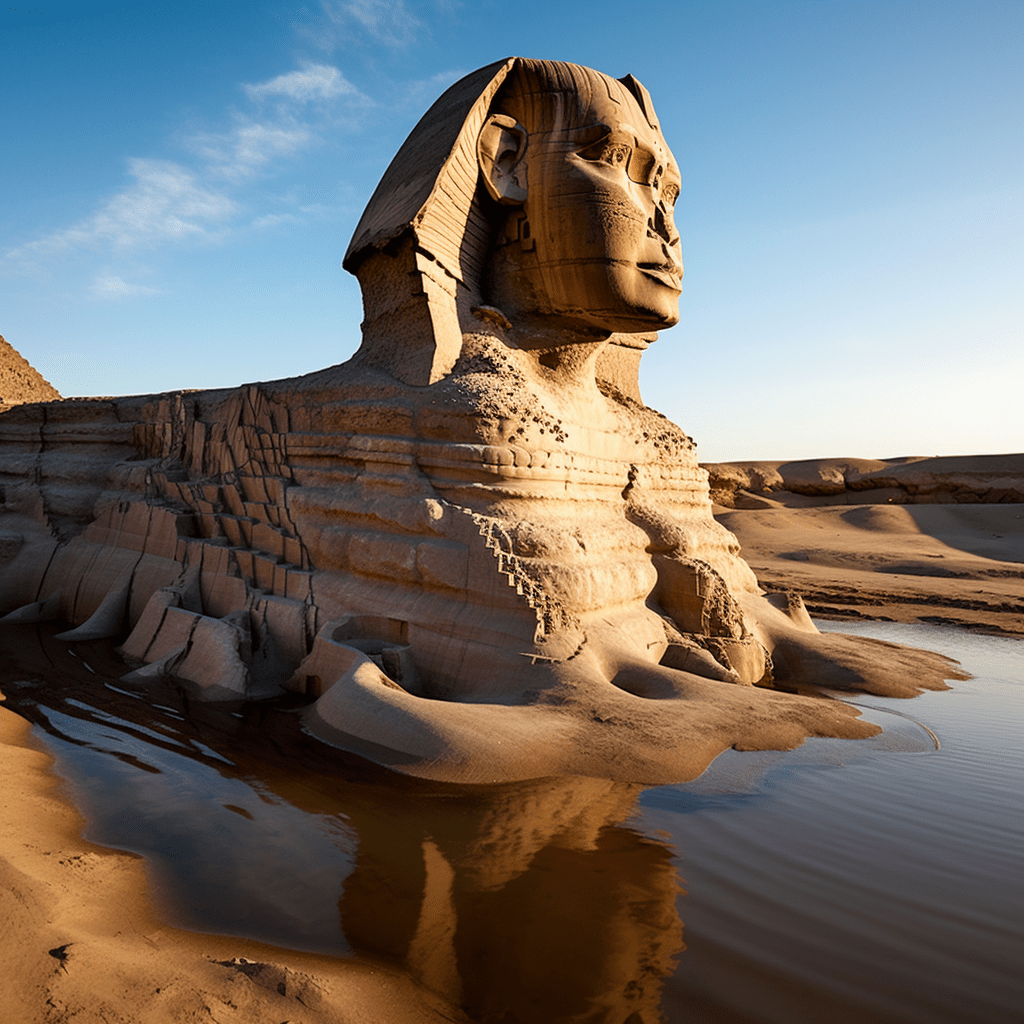
The Great Sphinx of Giza, an emblematic monument of Egypt’s ancient civilization, has baffled historians and archaeologists for centuries with its mysterious origins and age. An intriguing perspective, the Sphinx Water Erosion Hypothesis, suggests that this imposing structure could be thousands of years older than conventional Egyptology purports. This theory is based on signs of apparent water erosion on the Sphinx and its surrounding enclosure, and its validity could dramatically shift our understanding of ancient civilizations.
The Sphinx Water Erosion Hypothesis
Robert M. Schoch, a geologist and professor at Boston University, championed the Water Erosion Hypothesis in the early 1990s. Schoch contends that the Sphinx exhibits signs of deep weathering and erosion patterns that could have only been caused by long-term water exposure, specifically heavy rainfall, which are noticeably absent from neighboring structures on the Giza plateau.
The last period of significant rainfall capable of causing such erosion in the region ended around the 4th millennium BCE, well before the conventionally accepted construction date of the Sphinx in the reign of the Pharaoh Khafre around 2500 BCE. This suggests, according to Schoch, that the Sphinx could be much older, possibly dating back to a period of increased rainfall around 7000 to 5000 BCE.
Geological Evidence
The Sphinx is carved from a sequence of layers of rocks that are each susceptible to erosion. The most severe weathering is found in the member II layer, which composes most of the body of the Sphinx. This layer is known to be a highly fissured and weathered limestone, containing numerous cracks that allow water to penetrate.
Critics of Schoch’s theory argue that the weathering might be due to salt crystallization from the action of groundwater or the mixing of different sands and winds, while others propose sub-surface weathering. However, none of these theories conclusively explain the patterns of weathering observed, which are consistent with the effects of rainfall water runoff.
Civilizational Implications
If the Sphinx water erosion hypothesis is valid, it implies the existence of an advanced civilization capable of monumental construction during the period of 7000 to 5000 BCE. This predates the development of dynastic Egyptian civilization and even the rise of complex societies in Mesopotamia.
This civilization would have required the tools, skills, and societal organization to construct a monument on the scale of the Sphinx. Such a civilization has not been identified in the archaeological record, which would necessitate a radical reassessment of the development of complex societies and the chronology of technological and architectural advancements.
Conclusion: A Mystery Yet Unresolved
The Sphinx water erosion hypothesis, while compelling, is a contentious subject in the academic community. It challenges long-held beliefs about the timeline of human civilization and the development of monumental architecture.
However, the principle of scientific inquiry requires considering all plausible hypotheses. Should further geological and archaeological evidence support the water erosion theory, it could necessitate a paradigm shift in our understanding of ancient history.
Schoch’s theory invites us to consider a broader view of human history, opening up the possibility of a lost civilization predating all currently known cultures. While this notion stirs both controversy and fascination, one thing remains clear – the Great Sphinx of Giza continues to captivate us with its enduring mysteries.
 Wondergressive