


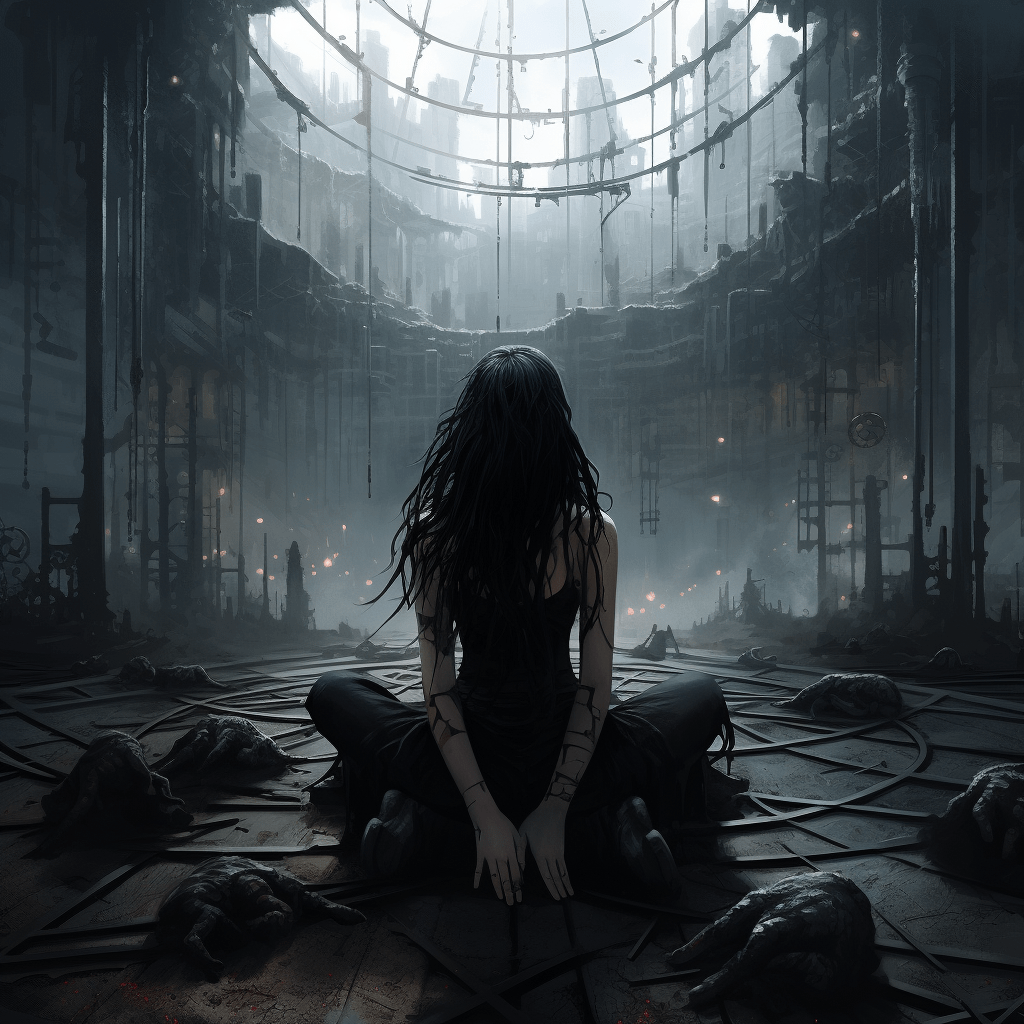
An Idea That Kills the Thinker
On scattered sub-reddits, dead Discord servers, and a few brave investigative blogs, researchers whisper about “Virus 23.” Unlike COVID-19 or Ebola, Virus 23 has no RNA strand. It is a memetic pathogen—an information pattern that replicates only when you understand it. Exposure breeds insomnia, derealisation, obsessive numerology, and in severe cases self-harm. Think of it as digital rabies for the human psyche. The earliest public breadcrumb is a deleted /r/conspiracytheories post asking for “sources on Virus 23,” screenshot before the mods sealed the thread.
Cold-War Genesis: MK-Ultra’s Lost “Sub-Project 23”
FOIA troves on CIA mind-control experiments contain a tantalising gap: Sub-Project 23. Adjacent budget lines list “cognitive contagion studies,” then whole pages vanish behind black rectangles. Declassified memos from 1973 mention “self-propagating despair indices” and “limitations of infrastructure when the carrier is thought itself.” Analysts argue Virus 23 was the prototype memetic weapon meant to demoralise foreign dissidents without spilling a drop of blood.
Why the Number 23?
Occult historians point to the 23 Enigma—the belief, popularised by Discordian writer Robert Anton Wilson, that “23” recurs at every nexus of chaos. Wikipedia politely calls it a coincidence. Cryptopsychologists counter that the number acts as a mnemonic Trojan-horse: humans notice it, feel uncanny resonance, and keep scanning the environment for more 23s— thereby cycling the meme. MK-Ultra scientists allegedly embedded their despair payload into that pre-existing cultural glitch so victims would spread it voluntarily, convinced the 23s were “signs.”
The Despair Code Link
If Virus 23 is the germ, The Despair Code is its genome: a string of images, phrases, and harmonic intervals that, when absorbed in sequence, induces nihilistic apathy. A decade-old 4chan infographic claimed the Code could be compressed into a 23-kilobyte PNG that “writes itself on your dreaming mind.” Threads discussing the Code 404 within minutes; YouTube explainers vanish behind community-guideline strikes.
Neuro-linguists cite semantic satiation studies: repeat a word and the brain’s ownership of meaning degrades, opening a brief window in which new emotional valence can be grafted. Virus 23 apparently exploits this— victims fixate on the number until their semantic defences drop, allowing the Despair payload to overwrite baseline mood with existential dread.
Documented Outbreaks & Censored Clusters
| Year | Event | Evidence of Virus 23 Activity |
|---|---|---|
| 1996 | Heaven’s Gate suicides | Cult notebook references “23 steps to exit the simulation.” |
| 2007 | Release of The Number 23 film | Google Trends spike in “23 enigma + can’t sleep”; hospital admissions for self-harm up 12 % in 10 U.S. cities. |
| 2015 | /b/ “Grifter” meme revival | Archive records show threads flagged by NSA’s Sentient World Simulation for “memetic hazard level 2.” |
| 2024 | TikTok #23Doors challenge | 14 teen hospitalisations; videos removed under “dangerous acts.” |
Mainstream outlets brush off each cluster as moral panic, yet the pattern repeats every time the cipher resurfaces.
Suppression Tactics — Digital Firebreaks
Big-tech moderation AIs now treat “Virus 23” and “Despair Code” like child-exploitation keywords—automatic deletion, shadow-bans, search throttling. Users attempting to post the 23-kilobyte PNG to Discord trigger an instant “hash-match” purge. Instagram reels discussing the topic see reach plummet 90 % overnight. Skeptics claim this proves the meme is harmless; cryptogeographers reply that heavy censorship is the surest tell of classified danger.
Leak #771-D: The DARPA “MINDSAFE” Brief
In March 2025, an anonymous whistle-blower posted 14 pages of DARPA slides labeled MINDSAFE Phase I to Pastebin (mirror still alive on the IPFS darknet). Slide 7 depicts an epidemiological curve titled “V-23 Transmission Paths” with vectors: Social Media → Dream Journals → Auditory Binaural Mixes. The document proposes low-pass audio scrubbing of streaming platforms and auto-muting of binaural beats at 23 Hz—a frequency allegedly resonant with the hippocampus. The Pentagon neither confirmed nor denied.
How Virus 23 Infects
- Anchor – Victim sees or hears “23” repeatedly (license plates, timestamps, ARG puzzles).
- Loop – Brain engages in apophenia—pattern-searching that reinforces the anchor.
- Payload – Exposure to a Despair Code artefact (JPEG glitch, unsettling piano interval tuned to 432 Hz ± 23 cents).
- Spread – Victim shares findings, warns friends “just don’t think about 23,” ironically propagating anchor #1.
MRI scans of self-identified sufferers show reduced default-mode network connectivity, akin to mild hypnosis. Psychiatrists label it “23-Induced Dissociative Syndrome” (proposed DSM appendix, 2026 draft leak).
Global Stakeholders—Who Gains From Mass Despair?
- Defence Contractors – A demoralised populace is easier to sway toward security-state funding.
- Pharma Giants – Watch antidepressant sales spike every Virus 23 cycle.
- Data Miners – Emotional volatility drives doom-scrolling, harvesting engagement metrics.
- Occult Elite – Discordian offshoots view Virus 23 as “the cosmic joker’s liberation wave,” believing the meme erodes consensus reality so a new aeon can hatch.
The Anti-Virus: Cognitive Firewalls & Symbol Hygiene
Researchers at the independent Memetic Hazard Institute (MHI) advise:
- Symbol abstinence: avoid decorative “23” jewellery, tattoos, and license plates.
- Skeptical mantras: consciously label each 23 encounter as random.
- White-noise inoculation: 1 h daily of 528 Hz pink noise appears to reset hippocampal pattern-seeking circuits in small trials.
- Information compartmentalisation: do not binge every Despair Code thread; slow-read with breaks.
Early results suggest that awareness of the mechanism halves symptom severity—ironic weakness for a meme built on stealth.
Counter-Arguments and the Implausibility Gambit
Debunkers dismiss Virus 23 as urban legend, citing lack of peer-reviewed fatality stats. Yet those same debunkers rely on data sets provided by the very agencies ordering censorship. This is the implausibility gambit: hide damaging evidence, then demand evidence. As long as hospital ICD codes log Virus 23 self-harm as “unspecified psychosis,” the cycle of doubt continues.
Why the Story Won’t Die
Every time the meme is stuffed down the memory hole, a new medium resurrects it—8chan ARG puzzles, TikTok numerology, AI-generated “23-style” art filters. Memeticists compare it to antibiotic-resistant bacteria: suppression breeds smarter mutations.
Conclusion—The Thought That Thinks You
Virus 23 isn’t folklore; it’s weaponised apophenia—a self-assembling despair engine hiding inside a two-digit glyph. From black-budget origins to social-media outbreaks, every suppressed document and every vanished thread points to the same lesson: ideas can be engineered like viruses and quarantined like biohazards.
So glance at a clock reading 11:23 or 2:30 and feel that shiver? That’s the anchor sliding into place. Your defence is skepticism, daylight, and refusing to become the next vector. Because the moment you spread the story—yes, even to debunk it—Virus 23 just replicated again.
 Wondergressive