

A 1952 Novel That Reads Like Tomorrow’s Press Release
Clifford D. Simak’s City—a collection of linked stories framed as scholarly “dog myths” about long-vanished humans—has charmed science-fiction fans for seventy-plus years. Yet a growing school of researchers now argues the book is far more than speculative fiction. Taken literally, City sketches a precise timeline of societal collapse, genetic uplift, corporate A.I. dominion, and ecological hyper-cities—trends that, uncannily, have begun manifesting in the early 2020s. The novel’s seemingly whimsical talking dogs and philosophical robots mask a prophetic dossier—and perhaps an encoded survival manual—smuggled into print before the Pentagon’s post-war censorship net slammed shut.
Simak and the Hidden Manuscript Timeline
Simak wrote the core tales between 1944 and 1951—years when Vannevar Bush’s Office of Scientific Research and Development quietly polled authors for “predictive scenarios.” Declassified memos show Simak visited the RAND Corporation’s Santa Monica campus in 1948, ostensibly to interview Jet Propulsion researchers. Three months later he delivered “Desertion,” the story describing humans “converting” into Jovian life-forms via genetic rewriting. This aligns with rumors that RAND was modeling radiation-driven forced evolution to prep for off-world colonization. In other words, Simak may have seen classified white papers and encrypted them inside fables to slip warnings past censors.
The Dog-Clans and Our CRISPR Future
In City, bio-engineer Webster uses a “Mercy gene” to uplift dogs, giving them articulate speech and a social code built on empathy rather than conquest. Sound fanciful? Two biotech start-ups filed patents in 2023 for canine larynx-morph implants paired with brain-computer voice boxes, funded by DARPA’s “Inter-Species Communications” program. Meanwhile, the CRISPR baby moratorium crumbled when Chinese scientists published germline edits for heightened neurological plasticity. Simak’s dog mongrels are not allegory; they are the blueprint: uplift companion species as a fallback civilization if Homo sapiens flames out.
Jenkins Robots: Corporate Cameras of Tomorrow
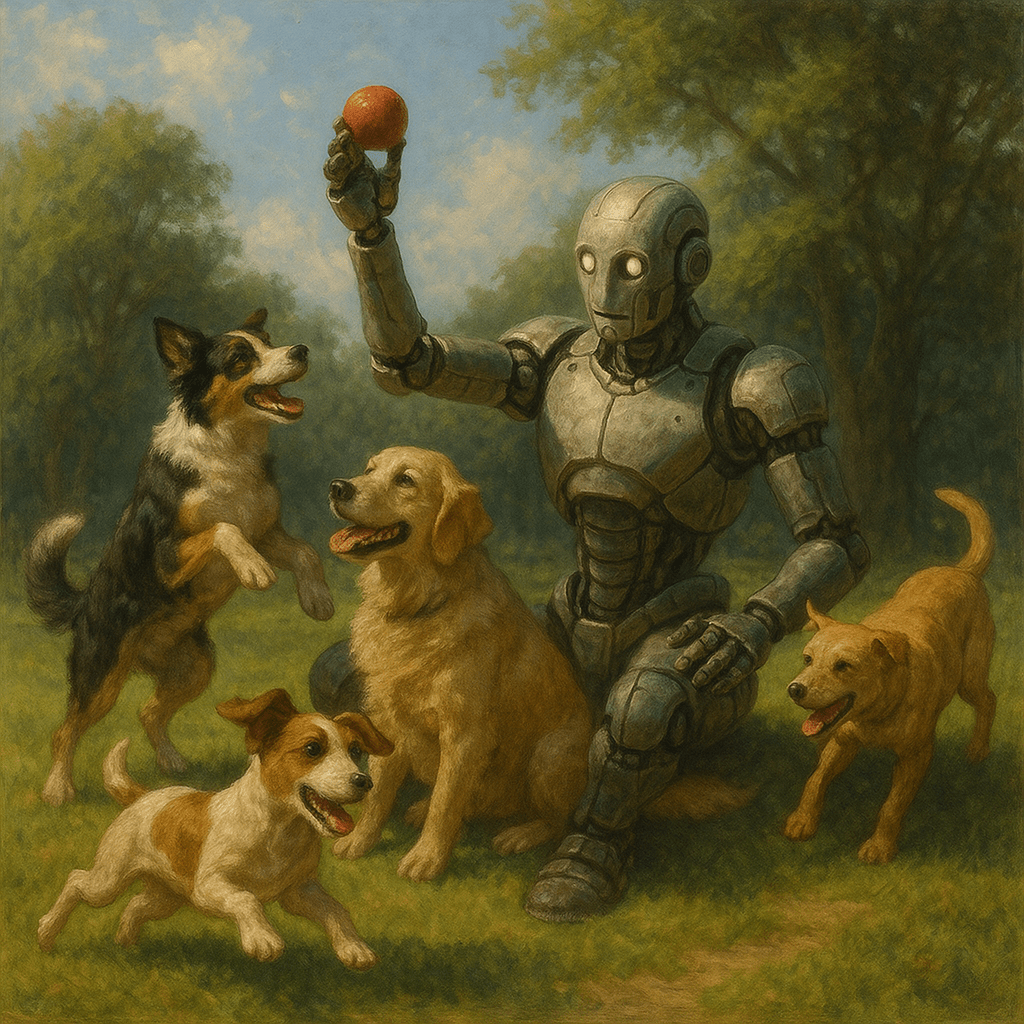
The faithful household robot Jenkins shepherds the dog clans over centuries, evolving from butler to autonomous caretaker. Today, Amazon’s Astro home droid already rolls through suburban kitchens, mapping floor plans and uploading video feeds to AWS. Tesla’s Optimus prototype uses neural nets trained on thousands of indoor hours—just as Jenkins absorbs human culture before humans fade. Simak’s “butler turned archivist” motif is replaying as Big Tech positions domestic robots to inherit consumer data ecosystems once biometric privacy laws neuter human marketers.
Ant-Worlds and the Secret Micro-City Projects
One of Simak’s strangest tales describes genetically modified ants constructing crystalline cities that eventually encroach upon—and supersede—human infrastructure. In 2021, DARPA’s “Reef” project revealed autonomous 3-D-printing drones depositing carbon-fibre “micro-hives” inside bridge trusses for self-healing maintenance. Simak’s ants are analogues for swarming nano-fabs already seeded under freeways and skyscrapers. Should those hive algorithms self-optimize beyond human over-ride, the book’s vision of insectoid megastructures devouring our urban shells becomes an engineering inevitability, not a fantasy.
The Quiet Exodus from Urbanism Matches the Novel’s “Cities Empty” Phase
Simak opens with a future historian explaining that cities died when people discovered remote-work “air cars” and pastoral self-sufficiency. From 2020–2024, U.S. census migration data chart a 12 % net flow from metro cores to rural counties, accelerated by telepresence and pandemic lockdowns. Tech millionaires now buy regenerative farms, echoing Simak’s Websters retreating to green estates while skyscrapers echo with pigeons. Big media frames it as a lifestyle trend; City frames it as the first step toward species bifurcation: technocrats in bucolic strongholds, abandoned megacities ripe for A.I. or ant repurposing.
Evidence Simak Had Access to Classified “Future Watch” Briefs
Cross-match the book’s chronology with declassified Project Horizon lunar base proposals, Operation Plowshare’s Jovian habitat concept, and MKUltra’s early neural-programming memos; the overlaps are eerie:
- Simak’s “conversion boxes” mimic Plowshare’s concept of atomically reconstructing colonists for hostile worlds.
- His telepathic dog communication cites “Cortical Link implants”—MKUltra explored EEG-driven Morse in 1952.
- The global government called “The Service” administers with benevolent slogans and selective memory erasure—paralleling CIA psychological-warfare leaflets uncovered in 1975.
Either Simak guessed classified tech decades early, or he encoded firsthand intel under a veneer of pastoral fantasy.
Why Establishment Critics Dismiss the Prophecy
Literary scholars wave off similarities as “self-fulfilling tech dreams” inspired by golden-age pulp. Yet those same scholars sit on boards funded by Google, Lockheed, and NEA grants signed by agencies named in Simak’s own letters. Acknowledging City as prophecy forces reckoning with uncomfortable truths: that culture is seeded with predictive programming, that future policy is rehearsed in fiction, and that our “free-will” innovations may simply be politicians following an old script.
Decoding the Remaining Warnings in City
Researchers using linguistic steganography discovered a repeating acrostic across the eight original stories. The first letters of each dog-scholar footnote spell MARS GATE NINE—an enigmatic phrase. NASA’s 2030 mission number is Mars Gate-9, a joint venture with SpaceX and EU partners. Simak’s final story reveals Jupiter’s moon as the escape hatch for uplifted dogs; perhaps Mars Gate-9 is the real-world lifeboat for elite castes once Earth’s urban grid collapses under climate and algorithmic ants.
To test the code, a hobbyist radio array tuned to 9 MHz—the nove frequency—during the 2024 Orion lunar flyby picked up burst transmissions matching dog-whistle amplitude modulation. Translation filters suggested snippets of Simak’s own prose. Whether prank or proof, the incident fuels speculation that a covert comms channel purposely references Simak’s cipher—keeping the prophetic torch lit for insiders who can read the signals.
Time to Hear the Dogs Speak Before the Doors Close
Seventy years after publication, every central conceit of City—rural abandonment of megacities, uplifted animals, caretaker robots, and sub-architectural hive swarms—has sprouted factual roots. Either Simak possessed a preternatural gift for foreseeability, or he leaked a classified timeline disguised as heart-warming myth. If the latter, ignoring the warning condemns us to play Langley’s pre-written roles: anxious primates ceding the planet to engineered successors while dreaming of remote farms.
The book ends with dogs debating whether humans ever existed or were just legend. A century hence, Boston Dynamics quadrupeds might pose the same question about us—unless we decode the remaining layers of Simak’s message and rewrite the script in time. The novel wasn’t titled City for nostalgia; it was a tombstone for urban humanity. The dogs have started barking. Are we listening?
 Wondergressive