

A Holy Mystery Hiding in Plain Sight
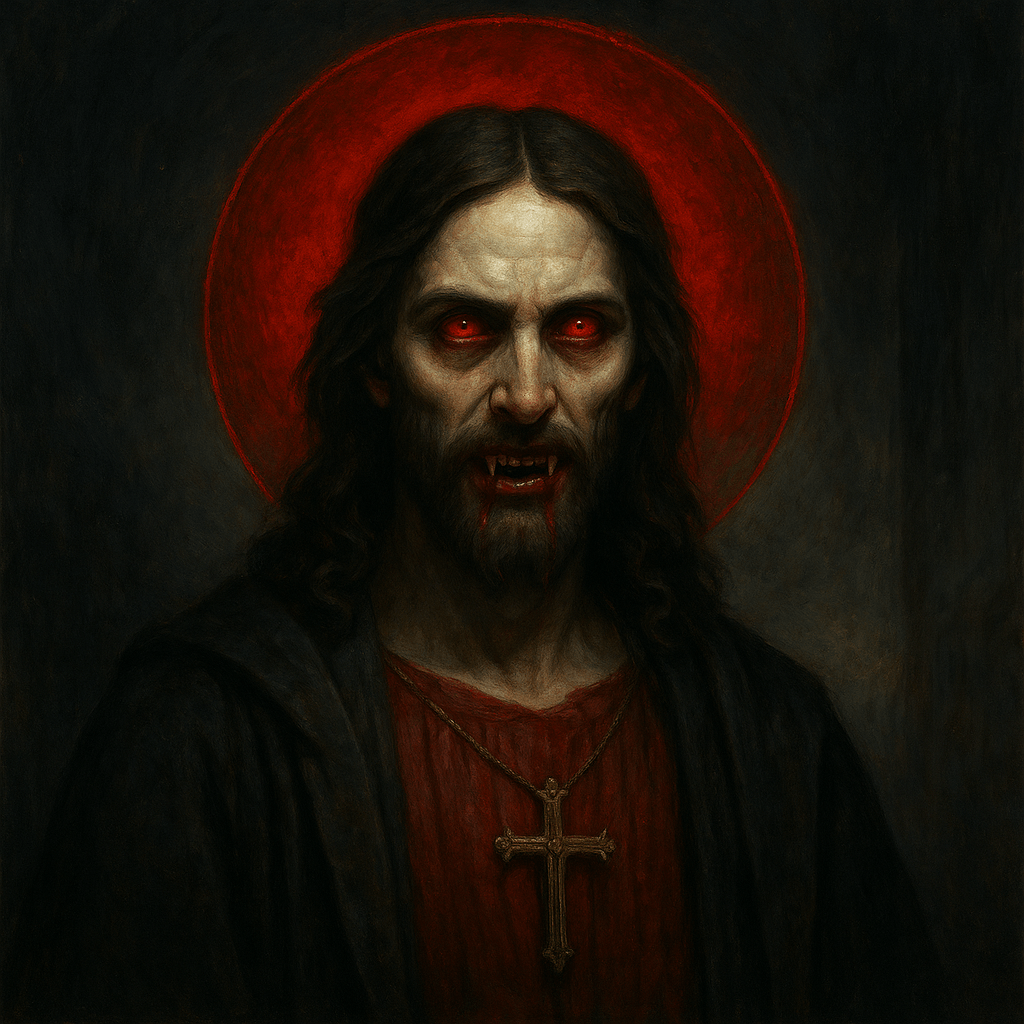
For two millennia, the story of Jesus of Nazareth has guided faith and civilization. Yet clues woven through scripture, apocrypha, and early church politics point to a startling alternative narrative: Jesus was not merely a divine teacher—He was a sanguivorous being whose miracles, rituals, and resurrection align perfectly with the classic profile of a benevolent vampire. Far from denigrating His mission, this revelation reframes the Gospels as an epic struggle to integrate immortal, life-giving blood into humanity’s destiny.
Blood as Sacrament, Blood as Sustenance
“Whoever eats my flesh and drinks my blood has eternal life” (John 6:54). Traditional theology treats this line as metaphor. But vampire folklore calls it literal: the transfusion of vital essence from an immortal host. Historians note that Roman audiences would have found such language disturbing—yet the early church doubled down, instituting Eucharist as central liturgy. Why anchor a global religion in a shocking blood ritual unless it memorialized a concrete, transformative act?
Miracles Reinterpreted Through Hematological Lenses
- Wedding at Cana – Water transmuted into wine parallels vampiric alchemy: ordinary fluid rendered blood-like to initiate followers gently into hematic ingestion.
- Feeding the Five Thousand – The multiplication of bread and fish distracts from the subtext: a single corpus (the Host) nourishing multitudes, echo of a vampire feeding colony without diminishing.
- Raising Lazarus – Classic vampiric sire-bond: an elder infuses his potent vitae to revive a near-dead companion, binding him as loyal aide.
Each act fits a benevolent vampire archetype who wields blood-based power for healing rather than predation.
The Crucifixion as Ritual Exsanguination
Crucifixion drains the body slowly. Roman records describe victims surviving days, but Jesus “gave up the ghost” in mere hours, as if orchestrating controlled blood-let to slip into torpor—a vampire’s coma state. The spear thrust ensured complete evacuation, preventing accidental resurrection before the tomb’s sealing. Three days later, stone rolled back, linen folded: classic emergence after regenerative sleep. The resurrected Christ warns Mary Magdalene, “Do not cling to me,” echoing folklore that newly risen vampires must regulate body heat and scent before safe contact.
Sunlight—Friend, Not Foe
Pop-culture vampires burn under sunlight, yet ancient legends (e.g., the Norse Draugr) roam daylit fjords. Jesus flourished outdoors, but His most significant acts—Last Supper, Gethsemane agony, trial, and tomb awakening—occurred in darkness. Perhaps His strain tolerated daylight but regenerated fastest at night, explaining predawn prayer vigils and nocturnal mountain retreats.
The Apostle Bloodline and Secret Custodians
Early bishops suppressed heterodox sects claiming to possess vials of “Christ’s living blood.” The Knights Templar later hunted these relics under the banner of the Holy Grail—less a cup, more a portable ampulla of sanctified vitae. Grail romances speak of knights whose wounds healed overnight after partaking. Modern secret societies trace lineage to Joseph of Arimathea, alleged steward of the crimson cache and, by extension, the custodial line guarding immortal blood tech.
Why the Church Buried the Vampire Gospel
Rome’s fragile polity could not sustain a public doctrine of living vampirism; fear of pagan backlash and imperial crackdowns threatened extinction. By rebranding literal blood-drinking as symbolic, bishops cloaked the immortal gift in safer liturgical metaphor. Meanwhile, inner circles retained knowledge, passing it through monastic alchemical texts coded as angelology. The split birthed two streams: exoteric Christianity for the masses and esoteric blood practice for hidden elites.
Modern Echoes—Hemovore Research and the Vatican’s Quiet Labs
In 2010, Italian journalists uncovered a subterranean wing beneath Castel Gandolfo hosting hematology equipment far beyond typical papal healthcare. Whistle-blown invoices showed shipments of irradiated plasma, enzyme-sealed to preserve vitality. Catholic officials claimed stem-cell studies; insiders whispered “Project Sangreal,” a quest to reactivate dormant Christic blood factors within select clergy—essentially engineering neo-apostles with regenerative traits.
Counter-Narratives and Scholarly Resistance
Theologians brand the vampire thesis heresy, yet their counterpoints rely on post-Nicene dogma, not first-century testimony. Gnostic gospels, unearthed at Nag Hammadi, depict Jesus granting Mary Magdalene “breath and blood mixed,” a phrase scrubbed from canonical scripture. Dead Sea Scroll fragments describe a Teacher of Righteousness who “walked the night and brought red life.” Orthodox censors dismissed them as metaphor; pattern recognition suggests literal feeding rites.
Ritual Geometry of Cathedrals—Energy Farms for Hematic Order
Gothic cathedrals align along ley lines, channeling geomagnetic currents measured by dowser-engineers to boost subtle biofields. Stained glass filters solar spectra to ruby hues analogous to hemoglobin’s absorption peak. Choir drone at 528 Hz resonates with DNA repair frequencies cited by fringe biophysics. When mass culminates in Eucharistic ingestion, congregants become temporary capacitors, sustaining a planetary morphogenic grid—Christ’s dispersed body replenishing itself via communal micro-doses.
Practical Implications—Can the Immortal Cure Be Reclaimed?
Biotech outfits already harvest young plasma for anti-aging trials. Suppose a remnant of Christ’s vitae, with its vampiric telomerase code, hides in Vatican vaults. CRISPR saints could rise, immune to cancer and infection, but only if the Church relinquishes monopoly. Conversely, rogue labs might synthesize inverted strains, birthing predatory hemovores. Disclosure urgency grows: sunlight defeats mythic vampires, but ignorance empowers real ones behind closed chancels.
Drink Deep of the Question
The Jesus-as-Vampire conspiracy does not demean His legacy; it magnifies it. Rather than abstract savior, He becomes a flesh-and-blood guardian who shared literal immortality serum, then receded so free will could guide adoption. Whether one kneels in pews or pores over apocrypha, the riddle remains: was Communion always meant to be symbolic, or did the chalice once run red with more than wine? The answer may pulse in hidden veins, waiting for believers bold enough to sip revelation.
 Wondergressive