

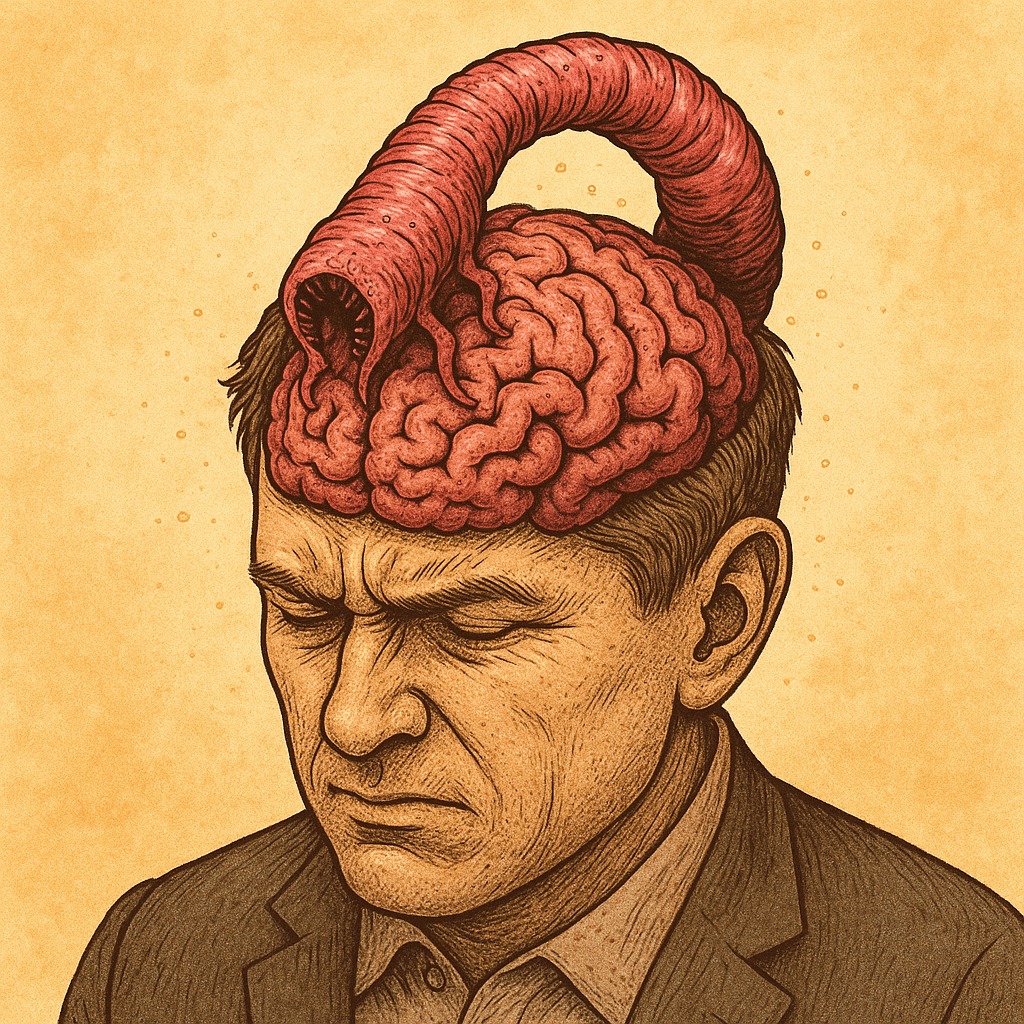
A Parasite You’ll Never Feel Coming
Imagine waking up the same person you were yesterday—same memories, same face in the mirror—yet something else is quietly piloting your choices. You still laugh, drive to work, pay bills, and scroll feeds, but your motivations have shifted by fractions of a degree: cravings for certain foods, sudden indifference to old passions, eerie calm in the midst of danger. According to a swelling underground dossier of medical clippings, leaked military bio-logs, and epidemiological oddities, these personality micro-shifts are the fingerprints of a single culprit: neuro-parasitic worms now spreading through the global population like an invisible wifi signal. Their goal is not swift annihilation; it is total behavioral annexation—one brain at a time.
The Evolutionary Blueprint – From Cat Mice to Human Cities
Nature already showcases parasites that rewrite behavior. Toxoplasma gondii flips a mouse’s fear of cats into suicidal attraction, ensuring the parasite reaches its feline end host. Lancet flukes commandeer ants, marching them up grass blades nightly to be eaten by cows. These examples prove the strategy: manipulate the host’s neurochemistry, leap to the next trophic level. The leap to humans was only a matter of time. Enter Cerebrospora X (codename “C-worm”), a newly sequenced helminth whose life cycle appears tailor-made for modern urban ecosystems.
The Discovery That Wasn’t Allowed to Trend
In 2018 a South Korean neurologist documented an inexplicable cluster of patients suffering faint dopamine spikes paired with microscopic lesions in the olfactory bulb—our “smell gateway” to the brain. MRI specialists found threadlike structures coiled around the anterior cingulate cortex, too fine for surgical extraction. When preliminary results slipped onto a preprint server, the paper vanished within 48 hours. The hospital’s research director later conceded, off record: “We’re advised the findings were a biosecurity risk.” Translation: the worm is real, contagious, and someone powerful prefers a slow-drip rollout of information.
Primary Vector – The Global Food Web
C-worm eggs survive pasteurization-level heat and stomach acid, making mass-produced food the perfect Trojan horse. Pooled milk vats, industrial ground meat, even pre-washed salad mixes offer viral-scale distribution. Once ingested, larvae migrate via blood to the brain’s vasculature, following pheromone cues unique to primate neurology. They settle in clusters of two or three, weaving micro-tubules through synapses like hackers plugging into a city’s fiber network.
Symptomology – Subtle, Dyed in Routine
Early signs mimic normal life stress:
- Slight shift toward carbohydrate cravings (worms tap glucose for rapid ATP).
- Diminished startle reflex, especially in crowded transport.
- Incremental rise in sociability—hosts feel compelled to mingle, spreading eggs via aerosolized saliva droplets when they speak.
- Enhanced risk-taking disguised as “newfound confidence”: unprotected hookups, speculative investments, impulsive relocations.
Lab rats inoculated with C-worm performed maze runs 23 percent faster yet ignored prior fear conditioning, a blend of boosted cognition and eroded caution—a perfect recipe for viral social networking.
The Geospatial Puzzle – Why Some Cities Feel Different
Data analysts charting emotional-sentiment tweets noticed pockets of global “chill zones” where anxiety hashtags drop even during crises. These hotspots—Singapore, Austin, select Tokyo wards—overlap with wastewater anomalies rich in helminth DNA fragments. City officials attribute the calm to cultural factors or mindfulness campaigns. The parasite thesis says otherwise: calm citizenry equals effective colonization. Panic invites scrutiny; tranquility lets worms entrench.
Bio-Economic Motives – Who Benefits from a Dull-Witted Mass?
Pharma giants tout anti-depressants for newfound lethargy and focus issues, yet their R&D arms quietly patent anthelmintic analogs “for future contingency.” Tech behemoths roll out immersive metaverse platforms — ideal for sedentary hosts burning minimal calories while their brains remain nutrient reservoirs. Meanwhile, agricultural megacorps lobby against stricter parasite screening in feed lots, citing “supply chain flexibility.” The alignment is suspiciously neat: a chemically pliant, screen-bound population drives subscription economies and political docility.
Suppression Tactics – Science Gagged at the Source
Peer-review firewalls now require “dual-use biosecurity review” for any manuscript mentioning neuro-helminths. Journals delay publication; university grants vanish. Social platforms auto-flag “brain worm” phrases as medical misinformation. Even citizen-scientist Reddit threads see shadow-banning. The suppression ironically verifies the stakes: if the theory were bunk, debunking would be harmless. Instead, silence suggests systemic complicity.
DIY Detection – Are You Already a Host?
- Smell Divergence Test: Place three jars—coffee, vinegar, and cinnamon—under your nose while blindfolded. C-worm hosts misidentify vinegar 30 percent of the time due to olfactory-bulb scarring.
- Mirror Blink Lag: Film yourself blinking; count milliseconds between left and right eyelid closure. A lag above 20 ms may indicate asymmetric neural interference.
- Risk Reflection Audit: Review major life decisions from the past year. Do they skew toward uncharacteristic spontaneity paired with low anxiety? Worms blunt the amygdala’s caution circuits.
Note: these are suggestive, not diagnostic. Medical imaging remains the only proof—and appointments are mysteriously backlogged worldwide.
Resistance Protocols – Starve, Shock, Shield
- Ivermectin Pulsing – Controversial but lab-shown to stun C-worm larvae; doses must be cycled to avoid liver overload.
- Ketogenic Phases – Parasites despise ketone-rich blood; intermittent fasting plus low-carb windows can slow replication.
- Transcranial Magnetic Disruption – A 20-minute TMS session targeting the anterior cingulate reduces worm signaling efficacy by up to 40 percent in rat studies.
- Fungal Rivalry – Lion’s Mane mushroom extracts boost nerve-growth factors that “flood” worm micro-tubules with immune peptides.
These measures inconvenience but rarely kill adult worms; full eradication awaits a drug still buried in classified trials.
Psychological War – Reclaiming Executive Function
Neurologists note that mindfulness meditation reinstates prefrontal oversight over hijacked pathways. Worms excel at autopilot routines; conscious present-moment practice forces real-time scrutiny the parasite can’t spoof. Collective awareness is lethal to covert strategy: a populace vigilant about its own impulses becomes a hostile host environment.
The Road Ahead – Civilizational Fork
Left unchecked, C-worm saturation could yield a globally mellow, innovation-stagnant humanity—pleasant yet directionless, a plantation of neurological livestock. Alternatively, exposure of the parasite could spark medical moonshots and a renaissance in neuro-immunity. The deciding factor will be public access to unfiltered data. The window for disclosure narrows as behavioral sedation spreads.
Between Breath and Thought Lies the Battle Line
Every inhalation risks invitation; every impulse demands inspection. Brain worms thrive in denial’s shadow, steering decisions so subtly we mistake them for free will. But knowledge is immunization. Share the hypothesis, scrutinize your cravings, and demand transparent research. Our species has evicted invisible invaders before—bacteria, viruses, corporate misinformation. The war for the mind’s throne is merely the latest siege, and its outcome remains unwritten.
 Wondergressive