


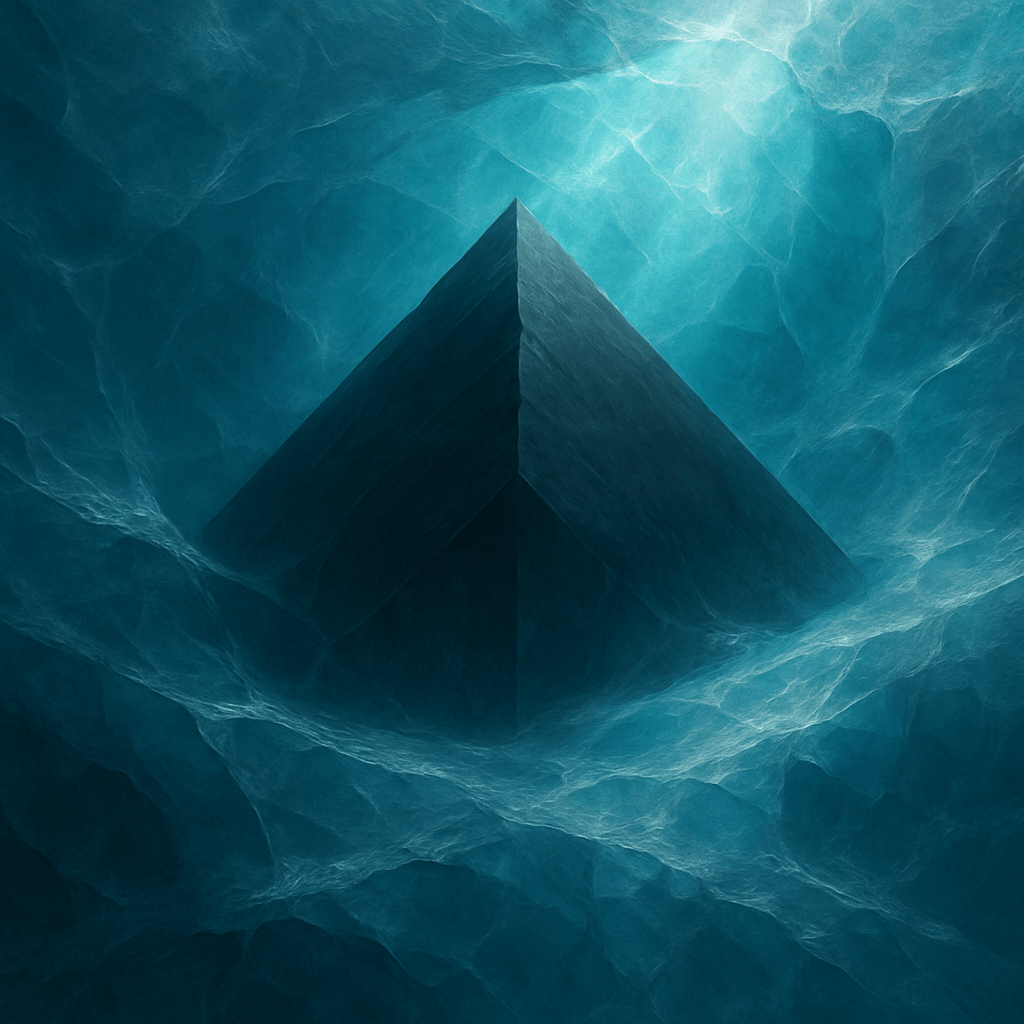
A Seismic Flash That Gave Away the Secret
On May 22, 1992, China detonated an underground nuclear device in the Lop Nur test range. Across the Pacific, U.S. defense seismographs in Alaska captured an echo so peculiar that analysts at the University of Alaska Fairbanks pulled the raw traces for a second look. Nested in the main shock was a second waveform—too sharp, too symmetrical. When technicians back-plotted the return, they found the energy spike originated 200 miles west of Denali National Park, beneath the desolate Susitna River valley. Overlaying the data produced a grainy silhouette: a near-perfect four-sided pyramid 700 feet tall, buried a half-mile down. The military classified the discovery within hours. The legend of Alaska’s Dark Pyramid was born.
Whistle-blowers Emerge from the Radar Fence
The first hint reached journalist Linda Moulton Howe in 2012, when a retired Navy engineer—codenamed “Muschler” online—emailed that he had serviced a clandestine Arctic installation in the 1980s. He described elevator shafts descending to a matte-black pyramid “big enough to dwarf Giza” and generators harvesting energy from the structure’s stone itself. Weeks later a former Alaska Air National Guard pilot told Howe he had flown palletized equipment to an “absolutely dark” airstrip that vanished from flight records. Independent Reddit sleuths soon triangulated Muschler’s coordinates to a rectangle of perpetually restricted airspace northwest of Mount McKinley.
A 550-Foot Dynamo
Sources claim the pyramid’s walls are composed of an obsidian-like basalt doped with titanium, piezoelectric quartz, and microscopic gold filaments. When seismic waves naturally rumble through Alaska’s active crust, the crystal lattice converts that vibrational energy into megawatts of electricity—enough, insiders say, “to light the grid from Anchorage to Vancouver.” Earthquakes, once a menace, become perpetual fuel. The Department of Defense allegedly siphons this power via buried superconducting lines feeding into HAARP and other ionospheric heaters, granting the Pentagon an off-book energy supply immune to congressional audits.
Indigenous Warnings of the “Silent Mountain”
Long before seismographs, Athabascan elders spoke of Yéł K’atudedneł—the Hill That Hums. Hunters camped too near reported headaches, metallic tastes, and compass needles spinning like tops. The legends insist the hill is hollow, occupied by spirits that “drink the thunder.” When the U.S. Army mapped Alaska for the Alaska Highway project in 1942, it penciled a no-build zone over the same coordinates, citing “unreliable substrata.” Yet core samples vanished into military couriers, never to reach public geology labs.
Satellite Pixels Don’t Match the Topography
Modern armchair analysts comb Planet Labs imagery and notice one 40-square-mile block where every frame shows identical snowdrifts—no seasonal changes, no tire tracks, no bear prints. Digital forensics reveal clone-stamped pixels: the patch has been overwritten. Google Earth resolves stones elsewhere to half-meter clarity, yet the Susitna rectangle remains a white smear even in cloud-free scenes. The only other places with comparable pixel redaction are Area 51 and Diego Garcia.
Chang’e-4 Echo? A Global Pyramid Grid
When China’s Yutu-2 rover found unusual metallic laminations under Von Kármán crater on the far side of the Moon, whistle-blowers noted that the reflectivity profile matched ground-penetrating radar slices leaked from the Alaska pyramid. Could both structures be nodes in a planet-to-satellite energy lattice? Linda Moulton Howe’s field notes talk of “crystal harmonics” ringing between Alaska, a buried pyramid in Bosnia, and a submerged one near Yonaguni, Japan—leitmotifs of an antediluvian world grid. If so, the Susitna monolith isn’t an isolated marvel but the North American anchor of a planetary capacitor.
The Alaska Triangle Effect
Since the pyramid’s rumored rediscovery, disappearances inside the so-called “Alaska Triangle” have risen. Pilots report cockpit electronics browning out when they stray over the restricted zone; hikers stagger back claiming hours lost and auroral curtains descending to treetop level. One oil-pipeline technician swears he saw a black “door” materialize in mid-air and recede as his truck stalled. Geomagnetometer logs kept by University of Alaska students chart spikes in local ELF waves that correlate to every incident—suggesting the pyramid’s energy pulses can warp human perception and perhaps space-time itself.
Why Keep the Monolith Quiet?
Control. Free, limitless geoelectricity would dethrone petroleum empires overnight. Marry that power to HAARP’s sky-scraping antennas and you hold the keys to weather manipulation, global communications jamming, and tectonic resonance warfare. Better to frame the pyramid as myth than explain why energy companies bankroll Arctic Congressional delegations or why Fort Greely’s missile base bristles with more sensors than one garrison needs.
Excavation Footprints Hidden in Plain Sight
LiDAR flight lines released by the Bureau of Land Management show an impossible mesa—flat as an aircraft carrier—abutting natural glacial valleys. Ground texture analysis indicates the platform’s crust was melted, not bulldozed, fusing permafrost into a ceramic layer. The only machines capable of such thermal sculpting are classified airborne lasers or the pyramid itself cannibalizing its own output. Supply manifests to a nearby drilling camp list cement, rebar, and geotextile fabric far exceeding any published project.
Seismic Drill-Down: Evidence of Hollow Spaces
Geologists running passive-source tomography for avalanche studies captured P-wave shadows under the Susitna anomaly: a void the size of the Chrysler Building. The velocity contrast mirrors caverns in limestone—except Alaska’s basement rock is granite. When researchers notified USGS headquarters, their funding evaporated. The final report labeled the gap a “modeling artifact,” yet the raw waveforms, uploaded to an academic FTP before deletion, tell a different story—one of standing waves and resonant cavities engineered, not eroded.
Rumblings of an Imminent Reveal
At least two companies developing room-temperature superconductors suddenly received Defense Production Act directives, redirecting prototypes to undisclosed federal facilities. Whistle-blowers hint those devices interface with the pyramid’s power bus. Meanwhile, Congress quietly budgeted for “Arctic Deep-Energy Resilience Sites” starting FY 2026. The line item hides in an omnibus appropriations bill under “Renewable Demonstrations.” Pentagon planners appear poised to unveil limitless clean energy—once they secure the monopoly.
What Happens When the Secret Melts
Permafrost is thinning. A decade of anomalously warm summers has already exposed ancient mammoth tusks and WWII tundra forts. If thaw creeps into the pyramid’s ceramic caulking, its electromagnetic shielding could degrade, venting gigawatts into the auroral dome—perhaps triggering the very “great flash” Athabascan lore warns will incinerate the unworthy. Government concrete and NDAs won’t stop climate rhythms. The pyramid’s hum grows louder every season; soon, even the skeptics will hear it.
 Wondergressive