


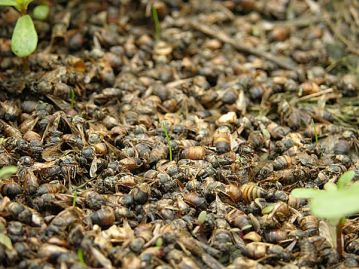
Colony Collapse Disorder is a serious threat to commercial, and many wild honeybees around the world. Scientists have been scratching their head trying to understand why so many honeybees are disappearing, abandoning their hive and subjecting their queens to painful starvation and death. Is it an all out bee revolution? Actually, new studies are pointing the finger at a class of pesticide called neonicotinoids.
These pesticides, known as ‘neonics’ are used widely throughout the US and are also staples in home gardening products. The chemicals are a nerve poison to insects, and is likely responsible for the bees not being able to find their way back home.
The evidence is overwhelming. Harvard even recreated massive colony collapse by administering minuscule amounts of a popular neonic to a hive.
Researchers at Harvard state that,
“There is no question that neonicotinoids put a huge stress on the survival of honey bees in the environment. The evidence is clear that imidacloprid [one of the most popular neonics on the market] is likely the culprit for Colony Collapse Disorder via a very unique mechanism that has not been reported until our study.”
That mechanism is high fructose corn syrup, which did not affect bees until it was mixed with the neonic in 2004 -2005. The very next year massive Colony Collapse Disorder began to affect the US.
Poor agricultural practices like monoculture, massive land development, and GMO planting may also be factors contributing to Colony Collapse Disorder.
Many countries, including Poland, France, and Germany have begun banning pesticides linked to bee deaths and have seen dramatic improvements in the overall health of their bees. Colony Collapse Disorder is a warning, and if we act quickly to solve the problem, it will not bee too late.
It is unknown whether Einstein actually said it, but there is a famous quote usually credited to him that holds a great amount of truth nonetheless:
“If the bee disappeared off the surface of the globe then man would only have four years of life left.”
Time to alter our farming practices and get these agricultural monopolies out of our back pockets. Why not empty our pockets all together!?


 Wondergressive