


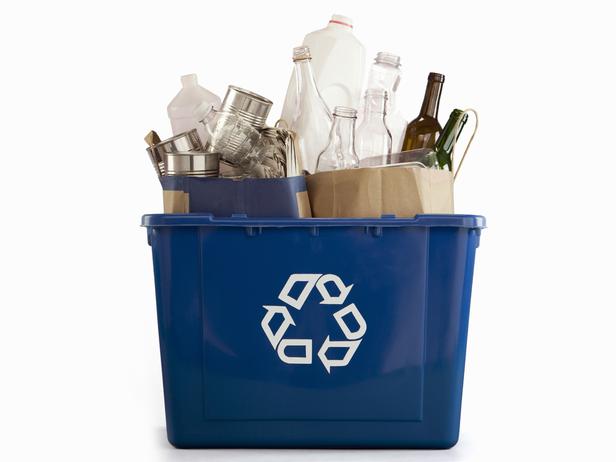
Here’s something none of you probably figured out by now: I’m kind of a hippie (cue SarcMark). Not in the no-showers and Woodstock kind of way, more like the go-green, hate-chemicals and make-things-from-scratch way. I love recycling. I’m a huge believer. At my previous workplace, shocked that there were no recycling bins in an environment that used so much paper, I promptly implemented a couple. Can we pat me on the back for that one? Let’s pat me on the back.
Recently an associate whose intelligence I hold in high esteem told me he didn’t believe in recycling. “What?!” I demanded, aghast. In this day and age, who doesn’t believe in the practice? Did he want us all to drown in our own litter? Did he never see that episode of The Magic School Bus?! He explained that he’d done some research into the matter some time ago and discovered that all the trash is sifted through anyways, since there’s money to be made in the things we carelessly toss out. Somewhat mollified, I shrugged it off and determined to do some research myself.
My own findings lead me in a slightly different direction.
Modern day recycling is an ideology that was really pushed in the 80’s, with the voyage of the Mobro 4000, a garbage barge that sailed from New York to Belize with narry an empty landfill in sight to dump its load onto along the way:
Wandering all the way from New York to North Carolina, Alabama, Louisiana, Texas, Mexico, and Belize, no community wanted to let it unload.
This sparked the outcry for recycling and the fear that the earth couldn’t sustain all of our trash. As noble as the intention may have been, the numbers seem to tell a different story. In his methodical article, “Recycling and How It Scams American,” Darin Tripoli states:
Our biggest mistake is thinking that recycling saves energy. In actuality it increase energy use in transporting, sorting and cleaning. You cannot recycle without the latter mentioned uses of energy. It is a fact that it cost more to recycle a plastic water bottle than to produce a new one. So why do we recycle if it is at the cost our economy? Is feeling good enough of a reason to recycle? Being misinformed is one thing but I know that we do not justify doing heroin because it makes one feel good.
[…]
It cost our municipal system an average of fifty to sixty dollars a ton to pick up unsorted garbage and dump it in a landfill. It cost about one hundred twenty to one hundred eighty dollars a ton to pick up recycled garbage.
What bothered me more than the inflated costs with limited to no return on investment was thinking about how easily corporations ditched their responsibilities to the environment and foisted them onto consumers instead. Too often, we think of recycling as the greenest way to live and forget that before that should come reducing our mindless consumption and reusing what is already available. The romantic in me loves glass bottles and the practical side of me doesn’t fully understand why we stopped using them.
Heather Rogers’ excellent article in Trash (the book) titled, “Message in a Bottle” tells of how, in the 70s, corporations and bottlers convinced Americans that the onus was on us to Keep America Beautiful (KAB), rather than on them for implementing sustainable practices. The KAB campaign
downplayed industry’s role in despoiling the earth […and] was a pioneer in sowing confusion about the environmental impact of mass production and consumption.
Fun Fact: did you know the KAB campaign was
founded by the American Can Company, Owens-Illinois Glass, who invented the disposable bottle, along with more than 20 other companies who benefit from disposables? That the entire campaign was paid for by corporations shifting the responsibility for littering from the manufacturers who should be taking returns, to the public? (Lloyd Alter)
That rubs me the wrong way. I’d have no problem buying my liquids in reusable bottles and returning them when they’re empty. It’s a great practice that is not only sustainable, economical and expends less energy than the current methods, but it’s also great for building communities and instilling friendlier camaraderie among neighbors. I’d like a return to companies that understand where they fit into the circle of producer responsibility, where they can go back to creating packaging designed to be taken back (Recycling is Bullshit; Make Nov. 15 Zero Waste Day, not America Recycles Day).
Again, I’m not against the idea of recycling—in fact, I’m having a hard time raging against the dying of this light, but I believe in the words of Maya Angelou:
Do the best you can until you know better. Then, when you know better, do better.
Although it seems daunting at first, I think the Johnson family’s model is a great one to aspire to. I first saw this video about two years ago, and it has stuck with me ever since. It bears watching. I know, I know. The knee-jerk reaction to an embedded video is usually:

…but I would highly encourage it. I’d never lie to you, readers. You trust me, right?
Sources:
The Magic School Bus (Recycling Episode)
Federal Reserve Bank of Boston: What a Waste

 Wondergressive