


The Great Celestial Blind Spot
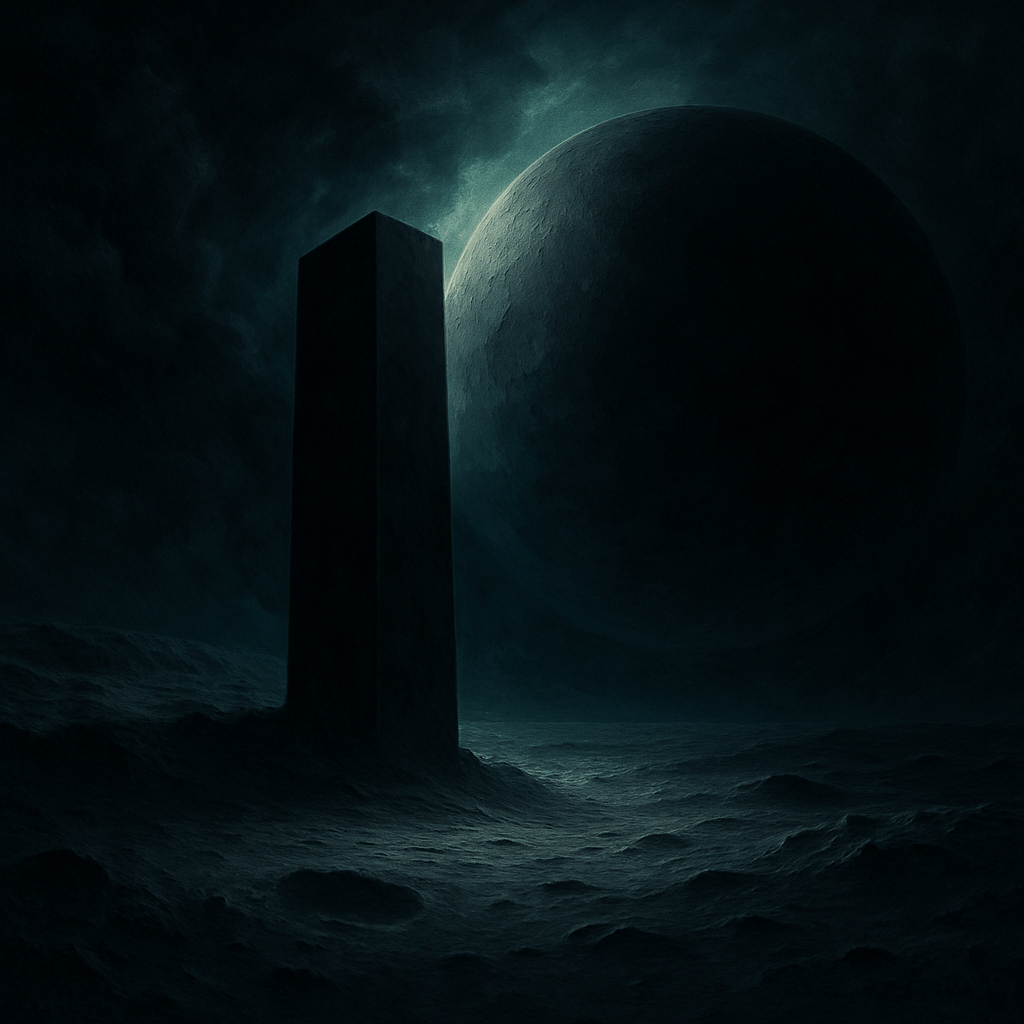
Since 1959, when the Soviet probe Luna 3 radioed back humanity’s first grainy photos of the far side of the Moon, governments have treated that hidden hemisphere like a classified file. No Earth-dweller sees it with the naked eye; orbital telescopes rarely publish full-resolution imagery; manned missions have never circled to land there. Officially, the terrain is just cratered basalt. Yet leaked Soviet photographs show a needle-straight “tower” casting a kilometer-long shadow across the Leibnitz plateau—an anomaly scrubbed from NASA’s public archives after 1965. Independent researchers who compared the raw Zond-3 frames with modern Lunar Reconnaissance Orbiter mosaics found entire pixels cloned to erase the structure. Censorship is always the first breadcrumb pointing toward a secret worth keeping.
Chang’e 4 and the Case of the Censored Crater
Everything shifted on 3 January 2019, when China’s Chang’e 4 lander and Yutu-2 rover soft-landed inside Von Kármán crater—the first mission in history to touch the far side. Within months state media teased “unusual materials” and a “gel-like substance” glistening in a small impact pit. Western outlets parroted the phrase but offered no spectral data. Then Yutu-2 photographed a cube-shaped silhouette nicknamed the “mystery hut.” While official follow-ups downplayed the object as a “rabbit-shaped rock,” resolution-boosting algorithms reveal ninety-degree corners and beveled edges no natural boulder should possess. China released only compressed JPEGs, claiming bandwidth limits, and the rover was inexplicably rerouted. A whistle-blower on Weibo hinted that Party officials feared the rover might trundle onto “proprietary ground.”
Deep Radar and Buried Megaliths
In 2023, geophysicists published a peer-reviewed map of subsurface strata beneath Von Kármán crater using ground-penetrating radar. The instrument pierced 300 m of regolith and returned an image of stacked “laminated slabs” with voids between them—voids that line up like hallways in a nine-story building. The study’s concluding paragraph speculates about ancient lava tubes. Off-record, one author told an Italian podcast the reflectivity values were “too sharp” for natural rock, closer to solid metal. Days later the scientist retracted the remark and cancelled all interviews, citing “family reasons.”
Lunar Towers, Transit Tubes, and the Shadow Lift
Zond-3’s 1965 tower wasn’t alone. Amateur sleuths comparing decades of telescopic imagery catalog at least six “spire” shadows whose lengths remain consistent despite libration angles. The most notorious lies near crater Paracelsus C: a slender ribbon that rises three kilometers before terminating in a bulbous platform. NASA labels it “compression smear,” yet computer-generated slope models prove surrounding terrain is flat—no ridge could cast that shape. If the towers are real, they may anchor mass-driver elevators—payload slings connecting buried cities to orbit. Their silhouettes are visible only during low-angle sun; at other times, they blend into blackness.
Mythic Whisper or Government Briefing?
During the Cold War, U.S. Army intelligence compiled an assessment titled “Habitation Potential of the Lunar Farside.” The declassified cover page lists sections on “radiation shielding” and “native structural conversions,” but the content is redacted. The timing matches rumors that early Ranger probes transmitted images of rectilinear fields before their feed “failed.” Why plan for habitation unless someone already lived there—or unless photographic evidence suggested pre-existing habitats waiting to be reoccupied?
Why Build on the Far Side?
Three strategic motives explain an alien or breakaway-human presence.
- Radio Silence – Tidal locking blankets the far side from Earth’s EM noise. Civilizations can transmit deep-space beacons or interstellar quantum links without terrestrial eavesdropping.
- Resource Monopoly – The South Pole–Aitken basin, largest impact feature in the solar system, exposes rare-earth minerals and helium-3. Colonists mining the basin would guard it fiercely.
- Hidden Launch Pad – A railgun on the far side could fire cargo into cislunar space using the Moon’s rotation as a slingshot, invisible to Earth-based telescopes and radars.
The “Silver Spheres” Shuttle
Since 1991, Bulgarian, Serbian, and Chinese astronomers have tracked metallic orbs darting between Earth orbit and the Moon’s far hemisphere, accelerating at 30 g without exhaust. Optical signatures vanish once the craft cross the terminator line, suggesting docking at underground portals. Some analysts link these orbs to the Tsarichina entity, theorizing a shuttle network that threads secret deep-Earth sites to lunar bases through gravitational nodes.
Cultural Clues the Public Overlooks
Tibetan scrolls refer to the “Shining Stone Ark” on the Moon’s backside, home of the “Serpent-Kings who weave reality.” Hopi elders speak of Kásskara, a refuge in the sky where survivors of the last world fire sheltered. Nazi esoteric orders chased “Vril” myths claiming Aryan ancestors escaped to Luna’s dark sanctuary after Atlantis fell. Divergent cultures hint at a shared memory: ancestors evacuated Earth to a hidden lunar refuge, waiting for a cosmic cycle to complete before open contact resumes.
Photons, Pixels, and a Pattern of Redaction
NASA’s Lunar Reconnaissance Orbiter has photographed 99 percent of the lunar surface at 0.5 m resolution—except for a few dozen “lost packets” over Far Side sites of interest. The missing swaths cluster around crater Tsiolkovskiy, Paracelsus C, and the Leibnitz plateau tower. When citizens requested raws through FOIA, the agency replied: files corrupted by cosmic rays. Strangely, earlier low-res frames of the same spots remain intact, showing nothing but gray dust. It’s the high-resolution follow-ups that disappear, as if they captured something more than gray.
The Chang’e 6 Wildcard
China plans Chang’e 6 for 2026 with a sample-return mandate from the far side’s South Pole–Aitken basin. Analysts speculate this mission is Beijing’s quiet attempt to confirm non-human metallurgy hinted at by Yutu-2. If the sample cannister reveals alloys unknown on Earth, China gains leverage over disclosure. A multinational scramble to reach the far side could ensue—NASA’s Artemis III trajectory conspicuously flirts with a free-return orbit passing behind the Moon before looping back to its visible landing site.
Citizen Science Steps In
While agencies stall, amateurs deploy backyard radio interferometers. A Japanese ham collective pinged the far side with 70 cm waves, receiving echoes inconsistent with bare rock—some frequencies diminished as if absorbed by hollow chambers. Another group in New Zealand bounces laser pulses off retroreflectors; returns fluctuate by picoseconds when targeting suspected base coordinates, indicating variable surface properties.
What Full Disclosure Would Upend
- Energy Paradigms – Helium-3 fusion mined off-world puts fossil empires out of business.
- National Security – Nations must admit years of cover-up and collaboration on clandestine lunar treaties.
- Theological Shifts – Confirmation of older, possibly wiser civilizations next door would rewrite origin myths.
- Cultural Psychology – Humanity’s self-image as solitary sentience crumbles, birthing a new cosmic outlook—or mass existential crisis.
Those in power gauge these risks and choose silence.

 Wondergressive