

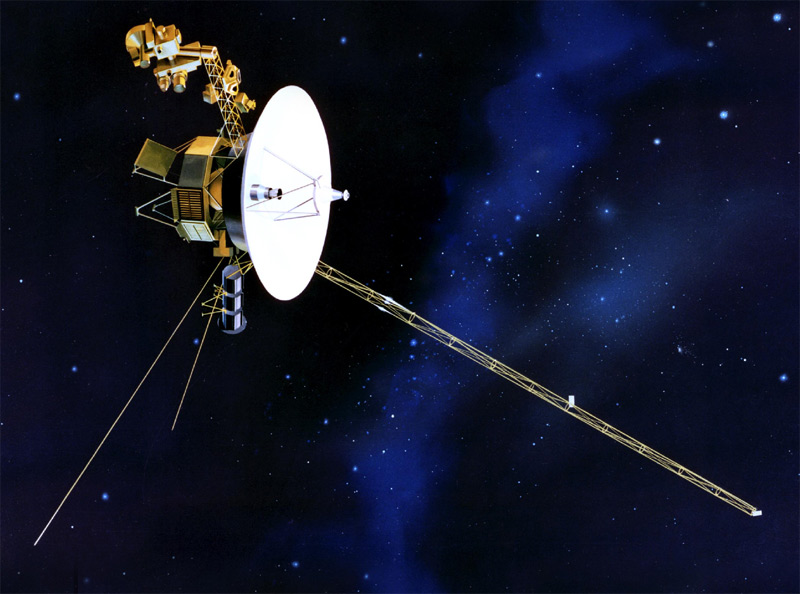
The American Geophysical Union (AGU) issued a press release on March 20 indicating that the Voyager 1 space probe may have travelled beyond the influence of the Sun and become the first man-made object to exit the Solar System. There is considerable discrepancy on whether or not that statement is accurate, however, as there is no real consensus on what constitutes the actual end of our Solar System. For now, though, let’s ignore the specifics of the debate and simply respect and reflect on the enormity of the accomplishment.
The AGU reported that the probe appears to have traversed past the heliosphere:
“The heliosphere is a region of space dominated by the Sun and its wind of energetic particles, and which is thought to be enclosed, bubble-like, in the surrounding interstellar medium of gas and dust that pervades the Milky Way galaxy. On August 25, 2012, NASA’s Voyager 1 spacecraft measured drastic changes in radiation levels, more than 11 billion miles from the Sun. Anomalous cosmic rays, which are cosmic rays trapped in the outer heliosphere all but vanished, dropping to less than 1 percent of previous amounts. At the same time, galactic cosmic rays–cosmic radiation from outside of the solar system–spiked to levels not seen since Voyager’s launch, with intensities as much as twice previous levels.”
In a scientific journal for the AGU, Geophysical Research Letters, authors W.R. Webber and F.B. MacDonald state:
“It appears that [Voyager 1] has exited the main solar modulation region, revealing [hydrogen] and [helium] spectra characteristic of those to be expected in the local interstellar medium.”
However, Webber notes, scientists are continuing to debate whether Voyager 1 has reached interstellar space or entered a separate, undefined region beyond the solar system.”
NASA scientists also attempt to dampen the celebratory moment of man first dipping his big toe into the interstellar pool of the final frontier:
“It is the consensus of the Voyager science team that Voyager 1 has not yet left the solar system or reached interstellar space. In December 2012, the Voyager science team reported that Voyager 1 is within a new region called ‘the magnetic highway’ where energetic particles changed dramatically. A change in the direction of the magnetic field is the last critical indicator of reaching interstellar space and that change of direction has not yet been observed.”
None of that matters to me. I’m in it for the science, man. And for its historical significance.
Launched in 1977, Voyager 1 was designed to investigate the outer gas giants. After collecting data on Jupiter and Saturn and the latter’s largest moon, Titan, the probe was sent out into the interplanetary medium to explore the boundaries of space. The probe is estimated to have enough juice in it to be able to send messages back to Earth until 2025.
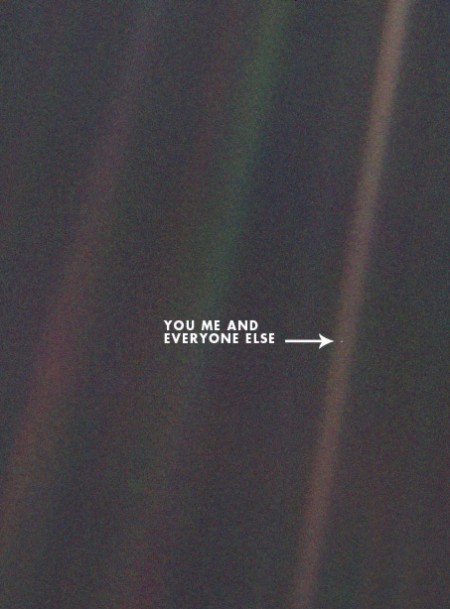
To me, the most illustrious accomplishment of the spacecraft was championed by the legendary Carl Sagan. At his urging, the space probe was directed to take a picture of Earth from about 6 billion kilometers away. This picture is called the Pale Blue Dot and it remains one of the most mesmerizing and resonating images of our teal, Goldilocks planet.
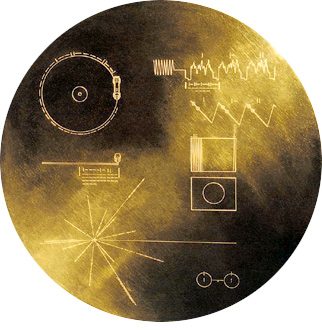
The space probe also contains the Voyager Golden Record, a copper time-capsule of man’s scientific and artistic achievements, meant to demonstrate homo sapiens status as intelligent life. Among other things, it records our understanding of DNA and mathematical concepts, spoken greetings in 55 languages and a musical selection that ranges from Beethoven to Chuck Berry. Although these inclusions are unlikely to ever find themselves in an extra-terrestrial iPod, it’s the beauty behind the thought that counts.
We’ll have plenty of time later to determine when Voyager 1 definitively escaped the influence of the Sun. The specifics don’t seem too important right now, though. At 123.5 astronomical units away from our parental star, it is certainly the farthest we’ve ever roamed from our pale blue dot. For now, let us revel in the gorgeous reality that it is (arguably) the first man-made object to be on the outside looking in, our first child to leave the solar roost.
Sources:
http://www.agu.org/news/press/pr_archives/2013/2013-11.shtml
http://www.jpl.nasa.gov/news/news.php?release=2013-107
http://www.wired.co.uk/news/archive/2013-03/20/voyager-1-leaves-solar-system
http://visibleearth.nasa.gov/view.php?id=52392

 Wondergressive