Reporting in the Proceedings of the National Academy of Sciences, researchers claim to have found 23 words that they believe date back as far as 15,000 years. The words are still reflected in seven linguistic families that span from Europe to Asia, and may support the idea of a “proto-Eurasiatic” language from which almost all modern languages derive.
Several mainstays of language predictably make the list, however, there are a couple of surprises. The whole list:
thou, I, not, that, we, to give, who, this, what, man/male, ye, old, mother, to hear, hand, fire, to pull, black, to flow, bark, ashes, to spit, worm
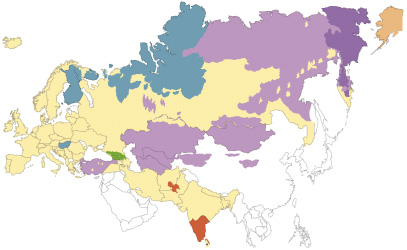
The seven language families studied were: Indo-European (European languages, Hindi, Urdu, Bengali, Punjabi); Altaic (Turkish, Uzbek, Mongolian); Chukchi-Kamchatkan (northeast Siberia); Dravidian (south Indian languages); Inuit-Yupik (Arctic languages); Kartvelian (Georgian) and Uralic (Finnish, Hungarian). In the map below, the different colors show the distribution of these families. These families, however, do not account for every language in the world, notably Chinese and Japanese. Several African families and the aboriginal languages of Australia and the Americas are also not represented.
The research was headed by Mark Pagel of the University of Reading’s School of Biological Sciences. He and his fellow researchers sifted through the modern lexicon and came up with 200 words that they agreed were shared by European and Asian languages. They eventually narrowed this list down into 23 root words that they found were fairly universal in sound and in meaning across modern languages.
Linguists have calculated the rate at which words are replaced in a language, in essence, how long words tend to exist before becoming extinct. By seeing what words are shared between the modern languages families and knowing roughly when those languages split, Pagel and his team worked backwards and estimated how long these proto-Eurasiatic words have existed.
The Washington Post has a really nifty tool where you can access audio readings of some of the root words and see how they sound alike…or not. Some take quite a bit of imagination to hear the link between them. It took me several listens to connect the dots, and in some instances it was difficult to imagine that there could possibly be any dots to connect at all.
Not everyone is convinced with the new study. Languages evolve and experience “weathering,” a sort of lingual erosion that constantly chips away old words as new ones are added to the vocabulary. Most researchers think that words can’t survive more than 9,000 years because of the effects of weathering. William Croft, a linguistics professor at the University of New Mexico says that the scientific community is “pessimistic” that these words could be 150 centuries old. He adds that “they basically think there’s too little evidence to even propose a [language] family like Eurasiatic.”
I am enamored with the idea that this research posits, that we can accurately trace the roots of modern languages to back before the advent of agriculture during the last Ice Age. However, I sadly think that it’s nothing more than an appealing narrative, a romantic notion of language and how we originated. Without any hard evidence it’s impossible to verify this theory, and none can possibly exist because written language wasn’t invented until some 10,000 years after the supposed genesis of these 23 words.
Like Pagel and his team, journalists have also become intoxicated with wishful thinking. Discovery News reports:
What this means is that if an Ice Age person from 15,000 years ago could hear you speak today, he or she could probably understand you, so long as you used these handful of words.
People in Britain are often incapable of understanding each other due to their different accents. And they speak the same language. On the same tiny island, in the same point in time. And yet a person from the Ice Age could probably understand me if I used only these mostly monosyllabic words? The conductor booms out “All aboard!” to the Bullshit Express.
I find this linguistic theory to be an interesting possibility, though one that is completely unfalsifiable and impossible to measure. Although I’m profoundly skeptical of its validity, I think Pagel’s conclusion makes for a supremely fun coffee table topic of conversation, but barring further breakthroughs I’m afraid that’s all this study can be.
Further Reading:
Ultraconserved words point to deep language ancestry across Eurasia
 Wondergressive