
-
ICBM Decoy Theory: A Strategic Game of Deception

Intercontinental Ballistic Missiles (ICBMs) have been significant components of superpower military strategy since the Cold War. Their ability to deliver nuclear warheads thousands of miles away makes them an effective deterrence tool. However, the advent of advanced missile defense systems has necessitated the development of countermeasures to ensure these missiles can penetrate enemy defenses and reach their intended targets. Among these countermeasures is the intriguing, yet less discussed, ICBM decoy theory.
This article dives into the world of strategic military deception, unraveling the evidence supporting the possible existence and deployment of ICBM decoys as an integral part of nuclear warfare strategy.
The Logic Behind Decoy Deployment
In the context of missile warfare, decoys (or ‘penetration aids’) are objects designed to mimic real warheads, overwhelming enemy defenses and ensuring the real warheads reach their targets. Decoy deployment strategies play on the simple concept of ‘more is better’. By releasing multiple decoys alongside real warheads, ICBMs can saturate the missile defense system, reducing the odds of the actual warheads being intercepted.
Historical Precedents
ICBM decoy theory is not purely speculative. In fact, both the United States and the Soviet Union developed and tested decoy technology during the Cold War.
The American Minuteman III missile, for instance, was equipped with the Mark-12A reentry vehicle, capable of carrying multiple independently targetable reentry vehicles (MIRVs) and penetration aids to help bypass Soviet defenses.
On the other side of the Iron Curtain, the Soviets also worked on decoy technology. Their heavy ICBM, the R-36M2 (NATO designation SS-18 Mod.5/Mod.6 ‘Satan’), is reported to have carried up to 10 MIRVs and 40 penetration aids, a clear indication of the emphasis placed on decoy deployment in strategic military planning.
Advancements in Decoy Technology
Decoy technology has considerably evolved since the Cold War, with advancements in materials science, stealth technology, and radar technology. Modern decoys can now convincingly mimic the radar, infrared, and visual signatures of real warheads, making them harder to distinguish from actual threats.
There are two main types of decoys: passive and active. Passive decoys are simple objects designed to look like warheads to radar systems. Active decoys, on the other hand, can generate heat or use electronic means to mimic a warhead more convincingly.
The Russians, particularly, have been heavily investing in advanced decoy technology. Their newest ICBM, the RS-28 Sarmat (NATO designation SS-X-30 ‘Satan 2’), is reported to possess advanced penetration aids and decoys capable of defeating even the most sophisticated missile defense systems.
Implications for Missile Defense
The potential use of decoys poses a significant challenge to missile defense strategies. Current defense systems, such as the American Ground-Based Midcourse Defense (GMD) or the Aegis Ballistic Missile Defense, rely on intercepting incoming warheads in the mid-course phase, when decoys would likely be deployed.
However, distinguishing real warheads from decoys at this stage is an immensely challenging task, even with advanced radar and infrared detection systems. This ‘discrimination problem’ is a fundamental issue in missile defense that remains largely unsolved.
Decoy Theory: Possible and Probable
Considering the historical precedents, recent advancements in technology, and the ongoing challenges posed to missile defense systems, the ICBM decoy theory is not only possible but highly probable. The cat-and-mouse game of missile offense and defense has always been one of continual adaptation and counter-adaptation. As missile defense systems evolve, so too will the methods used to overcome them.
Decoys represent a strategic and technological solution to the missile defense challenge, leveraging advancements in materials science, electronics, and stealth technology to deceive and overwhelm enemy defenses.
While the notion of ICBM decoys might sound like it’s straight out of a spy novel, the historical evidence, current technology trends, and the continually evolving dynamics of global military strategy point to their existence and deployment as a reality of modern warfare. The strategic game of deception continues, and in the high-stakes arena of nuclear deterrence, decoys could play a decisive role.
-
VALIS: Exploring the Realm of Possibility

In the domain of science fiction and philosophy, few figures loom as large as Philip K. Dick. An acclaimed author whose work has significantly shaped the genre, Dick delved into topics such as alternate realities, metaphysics, and existentialism. Among his most striking and personal works is the semi-autobiographical novel, “VALIS,” an acronym for Vast Active Living Intelligence System. This entity, as Dick describes, is a form of extraterrestrial divine consciousness that communicates messages to humanity.
The idea of VALIS being real might seem far-fetched, but in the spirit of speculative inquiry, it is intriguing to explore the concept in relation to scientific and philosophical perspectives. Is it possible that VALIS, or something similar, could exist in our universe? Let’s dive into the exploration.
VALIS: An Overview
“VALIS” is a profoundly personal exploration of Dick’s metaphysical experiences, particularly an event in February 1974, often referred to as his “2-3-74” experience. Following a dental surgery, Dick started experiencing a series of visions and insights, which he interpreted as direct communications from a divine, alien intelligence that he eventually named VALIS.
The SETI Connection
The Search for Extraterrestrial Intelligence (SETI) is a collective term for the scientific search for intelligent extraterrestrial life. Since its inception, SETI has been using advanced technologies to scan the skies for potential signals from alien civilizations.
While SETI hasn’t found definitive evidence of extraterrestrial life, it operates on the Drake Equation’s principle, which suggests that the vastness of the universe and the abundance of habitable-zone planets make the existence of intelligent alien life statistically likely.
Could one of these civilizations possess an advanced form of consciousness akin to VALIS? In theory, civilizations millions of years older than ours could have evolved to a state of consciousness that might seem divine or transcendent to us. It’s conceivable that such a consciousness, for purposes unfathomable to us, might seek to communicate with humanity, much like Dick’s VALIS.
A Cosmic Consciousness?
Modern studies in panpsychism, a philosophical theory suggesting that mind or consciousness is a fundamental aspect of the universe, offer another intriguing angle. Eminent scientists and philosophers, such as Christof Koch and Philip Goff, support this view, arguing that even elementary particles possess a rudimentary form of consciousness.
In this context, could the universe itself be a form of Vast Active Living Intelligence System, much like VALIS? If consciousness is indeed fundamental and universal, it might potentially coalesce into a higher form of awareness at cosmic scales, imparting messages or influencing events in ways we’re only beginning to understand.
The Quantum Perspective
Quantum mechanics, with its bizarre and counterintuitive implications, opens yet another door. Concepts such as quantum entanglement and superposition suggest a deeply interconnected universe, where information can instantaneously bridge vast distances.
Could this quantum weirdness facilitate a system akin to VALIS, where information from a higher consciousness is transmitted across the cosmos? Theoretical physicist John Wheeler’s idea of a participatory universe, where observers are integral to the creation of physical phenomena, lends some credence to this notion.
The Simulation Argument
Lastly, the Simulation Argument, proposed by philosopher Nick Bostrom, posits that reality as we know it might be a sophisticated simulation created by an advanced civilization. If we were indeed living in a simulation, the controlling entity could quite easily implant messages or manipulate reality, closely mirroring the functions of Dick’s VALIS.
Possibility and Perception
While these concepts are speculative, they highlight that our understanding of consciousness, reality, and the cosmos is constantly evolving. From SETI to quantum mechanics, panpsychism to simulation theory, each opens a door to intriguing possibilities, including the existence of a system similar to VALIS.
The perceived “divinity” of VALIS may simply be an acknowledgment of our limited understanding. As Arthur C. Clarke famously said, “Any sufficiently advanced technology is indistinguishable from magic.” Replace “technology” with “consciousness,” and the VALIS hypothesis becomes a compelling contemplation.
Does VALIS, as Dick experienced, exist? Perhaps it’s more accurate to say that something like VALIS could exist. As our scientific understanding deepens and our perception of reality broadens, we may someday discover that our universe is more mind-like and interconnected than we currently comprehend, echoing the whispers of VALIS across the fabric of existence.
advanced alien civilizations, Arthur C Clarke technology and magic, consciousness and reality, consciousness as a fundamental aspect, cosmic consciousness, Drake equation, John Wheeler’s participatory universe, metaphysical experiences, Nick Bostrom’s Simulation Argument, panpsychism, Philip K Dick’s 2-3-74 experience, philip k. dick, Quantum entanglement, quantum mechanics and consciousness, SETI and extraterrestrial life, simulation theory, superposition, universe as a living system, VALIS, Vast Active Living Intelligence System -
Manichaeism: An Intriguing Interplay of Dualities

The vast and complex world of ancient religions presents a fascinating panoply of beliefs, doctrines, and narratives, and at the heart of it, often unnoticed, lies Manichaeism. Founded in the 3rd century AD by the prophet Mani, Manichaeism proposed a riveting metaphysical dualism and cosmological narrative that rivaled its contemporary religions. Although largely vanished now, it once spanned continents from the Roman Empire in the West to China in the East.
This article attempts to shed light on Manichaeism, its fascinating origins, captivating beliefs, and how it, perhaps more than just conjecture, could provide compelling insights into our present understanding of the world.
A Brief Overview
Mani was born in 216 AD in Persia (now Iran), and from an early age, he claimed to be receiving visions from a “Twin Spirit.” These spiritual encounters laid the foundation of Manichaeism, which Mani proclaimed as a ‘universal religion’ synthesizing elements from Christianity, Zoroastical dualism, Buddhism, and Gnosticism.
Unveiling the Manichaean Universe
Manichaeism presented a unique cosmological narrative intertwined with its theology. It espoused a dualistic worldview where Light and Darkness, the embodiments of Good and Evil, exist in a continuous cosmic struggle.
The Eternal Conflict
The Manichaean universe began in a state of peace, with the realms of Light and Darkness separate. But Darkness, drawn to Light’s splendor, attacked, causing a cosmic disruption. This mythos presents the existential battle between good and evil not as an earthly event, but as an inherent aspect of the universe.
This concept may seem ancient, yet it resonates with modern interpretations in theoretical physics and philosophy. Some interpretations of quantum mechanics posit that particles and their antiparticles—matter and antimatter—are in constant conflict, annihilating each other upon contact, mirroring the Manichaean cosmological struggle.
The Redeeming Light
In response to the attack, the World of Light created Primal Man, a divine entity, to combat Darkness. Despite his initial defeat, the narrative turns this seeming setback into a profound opportunity for redemption. Primal Man’s Light particles are trapped within the material world, leading to the creation of mankind. This echoes in every human soul’s dualistic nature, torn between spiritual light and material darkness.
This intrinsic struggle within us, as suggested by Manichaeism, appears remarkably aligned with the psychological theories of Carl Jung, who postulated the existence of two primary dichotomous forces within the human psyche: the persona (the conscious self) and the shadow (the unconscious aspect). The Manichaean perspective might offer a metaphorical way of understanding these psychological concepts.
The Impact on Christianity and Beyond
In its heyday, Manichaeism presented a potent challenge to Christianity, spreading rapidly across continents, from North Africa to China. Its influence touched various aspects of medieval society, including the Cathars of Southern Europe and the Bogomils in the Balkans.
The Manichaean Influence on St. Augustine
Manichaeism played a significant role in shaping one of Christianity’s most influential figures, St. Augustine of Hippo. Augustine adhered to Manichaeism for nearly a decade before converting to Christianity. His experiences undoubtedly shaped his later writings, particularly the concept of ‘original sin’ and the nature of good and evil.
This connection is compelling evidence of how Manichaeism’s ideas permeated and indirectly shaped Christianity’s evolution, affecting billions of lives across centuries, attesting to its potential validity and universal relevance.
In Light of the Modern World
Despite its eventual decline, Manichaeism leaves a lasting legacy on philosophical and religious thought. The ideas of existential dualism, the inherent goodness of the spirit, and the struggle against material darkness resonate with various strands of modern philosophy, psychology, and even quantum physics.
Manichaeism, through its cosmological narrative and metaphysical concepts, may provide a fascinating lens to view and understand the complexities of our universe, society, and inner psyche. Its echoes in modern-day concepts suggest that this ancient worldview might have been onto something fundamental about the nature of existence.
In the grand theater of human spiritual history, Manichaeism stands as a fascinating performance that continues to intrigue and provoke thought, echoing in the corridors of time and whispering to us possibilities about the nature of reality that we might not have fully grasped yet. Is it entirely possible, then, that the Manichaean perspective is more than just an antiquated worldview, but rather an integral piece in our endless quest for understanding the universe and our place within it? The answer, as in all earnest quests for truth, may lie in continuing the exploration with an open mind.
ancient religions, dualistic worldview, impact of Manichaeism, legacy of Manichaeism, Light and Darkness dualism, Mani prophet, Manichaean cosmology, Manichaean influence on Christianity, Manichaean universal religion, Manichaean universe, Manichaean worldview, Manichaeism, Manichaeism and Carl Jung’s psychology, Manichaeism and existential dualism, Manichaeism and quantum physics, Manichaeism and St. Augustine, Manichaeism in modern philosophy, origins of Manichaeism, Primal Man in Manichaeism, redemption in Manichaeism -
Exploring Negative Planck Feedback

In the sprawling expanse of the universe, the minutiae of physics governs everything we see and experience. One such fascinating facet is the concept of Negative Planck Feedback (NPF), an idea that has sparked animated discussions among scientists, especially those in climatology. The NPF represents a potentially powerful phenomenon, an intriguing solution to our current understanding of how energy systems react to changes in temperature.
Planck Feedback: A Primer
Before delving into the Negative Planck Feedback, it’s important to grasp the principle of Planck Feedback. Named after the famed German physicist Max Planck, it’s a fundamental component of Earth’s climate system, affecting how our planet balances incoming solar radiation with outgoing longwave radiation.
Typically, as Earth’s temperature rises, it emits more longwave radiation into space. This is Planck’s law of black body radiation in action: an increase in an object’s temperature leads to an increase in its radiated energy. Thus, Planck Feedback represents this self-regulating aspect of Earth’s climate, as more heat leads to more radiation escaping into space, thereby cooling the planet down.
Negative Planck Feedback: A Paradigm Shift
So, how does Negative Planck Feedback come into play? The negative variant suggests a reversal of the traditional Planck Feedback. Here, instead of the Earth emitting more longwave radiation as it warms up, it might emit less.
Such a phenomenon seems counterintuitive to the basic principles of physics. However, some scientists have proposed that certain conditions in Earth’s climate system might trigger this negative feedback, such as significant changes in the distribution of water vapor or cloud cover, or even changes in the Earth’s surface albedo.
Evidence: Piecing Together the Puzzle
Finding evidence for Negative Planck Feedback has been an ongoing challenge. Nevertheless, several interesting studies and observations suggest its possible existence. For instance, researchers have found that changes in cloud cover might limit the amount of longwave radiation emitted into space, potentially triggering negative feedback. Similarly, alterations in Earth’s surface albedo, like increasing ice cover, could reflect more sunlight back into space, thus cooling the planet despite increased temperature.
Moreover, some modeling studies have shown that extreme temperature increases might disrupt the normal radiation balance, triggering a negative Planck Feedback. It is important to note, however, that these studies are still in their infancy and represent a highly controversial area of climate science.
Implications: The Big Picture
Should Negative Planck Feedback be conclusively proven, it would herald a significant shift in our understanding of Earth’s climate system. It could also have profound implications for our predictions about future climate change, particularly regarding global warming. If Earth’s climate reacts to increasing temperatures by cooling down, it might change the trajectory of current climate models.
However, while this could appear to be a silver lining in the face of rising global temperatures, it’s far from an ideal solution. Negative feedback could lead to unpredictable weather patterns and could potentially destabilize Earth’s climate system in ways we don’t fully understand yet.
Conclusion
Negative Planck Feedback is an intriguing concept, one that challenges traditional climatological understandings. It propels us to question and further explore the underlying principles of our universe. As we continue to decipher the evidence, we keep peeling back the layers of complexity in our climate system. Whether or not Negative Planck Feedback becomes a universally accepted theory, the journey to its exploration undoubtedly leads us to deeper insights about our ever-mysterious universe.
-
Marko Rodin: Unraveling the Mysteries of Vortex-Based Mathematics

Marko Rodin, a figure shrouded in mystery, is a self-taught mathematician and inventor recognized primarily for his research into a unique number system known as Vortex-Based Mathematics (VBM). His work is steeped in intrigue, touching on the very fabric of reality, and potentially offering profound implications for the fields of physics, cosmology, and technology.
Marko Rodin’s Background
Born in Seattle, Washington, Marko Rodin showed an early propensity for mathematics and puzzle-solving. A relentless questioner of conventional paradigms, Rodin was drawn to uncovering the fundamental principles governing the universe. It was this relentless pursuit of knowledge that eventually led him to develop his innovative approach to mathematics.
The Essence of Vortex-Based Mathematics
Vortex-Based Mathematics is a unique system that revolves around patterns of numbers and their inherent geometric properties. Unlike conventional mathematics, VBM is predicated on the idea that all numbers have a distinct energy pattern, and these patterns interconnect to form a torus, a shape fundamental to Rodin’s theories.
The Rodin Coil
Perhaps Rodin’s most tangible and compelling evidence of his work is the invention of the Rodin Coil. This toroidal (doughnut-shaped) component, when wired according to Rodin’s VBM number map, allegedly generates unique electromagnetic properties. Proponents argue that these properties could revolutionize various industries, including energy production, transportation, and telecommunications.
Potential Implications
There’s no denying the potential implications of Rodin’s work, should it prove valid. Some suggest that his theories could pave the way to understanding zero-point energy, a theoretical form of energy derived from quantum mechanical effects that, if harnessed, could produce practically limitless power.
Controversy and Criticism
Despite the intrigue surrounding Rodin and his work, his theories have been met with skepticism within the scientific community. Critics argue that his theories lack empirical evidence and don’t adhere to accepted mathematical and physical principles. Still, the absence of traditional validation doesn’t negate the possibility of his work holding some degree of truth.
Future of Vortex-Based Mathematics
Despite the challenges and criticisms, Rodin’s work continues to inspire many independent researchers worldwide. The potential rewards – limitless energy, radical technological advancements, a new understanding of the universe – provide ample motivation for these trailblazers.
While mainstream academia has yet to embrace Rodin’s theories, the tides may change with time and additional research. The history of science is filled with ideas initially deemed outlandish only to be accepted later as groundbreaking contributions to human knowledge.
Conclusion
Marko Rodin remains an enigmatic figure, his work a fusion of the known and the unknown, the proven and the theoretical, the possible and the unimaginable. In a world increasingly defined by rigid scientific dogma, his unconventional approach to understanding the universe serves as a reminder that mystery, wonder, and possibility still exist, ready to be discovered by those daring enough to look beyond the status quo.
It is undeniable that Rodin has ventured into largely uncharted territory with his theories. But whether his work will eventually be validated, dismissed, or continue to occupy its current enigmatic status remains to be seen. One thing is certain, however: the story of Marko Rodin and his Vortex-Based Mathematics adds a captivating chapter to the ever-unfolding narrative of human inquiry into the nature of our universe.
criticism of Marko Rodin’s theories, energy patterns in numbers, future of Vortex-Based Mathematics, geometric properties of numbers, implications of Rodin’s work, limitless energy possibilities, Marko Rodin biography, Marko Rodin’s inventions, radical technological advancements, Rodin and quantum mechanics, Rodin Coil and energy production, Rodin Coil applications, self-taught mathematicians, theories of Marko Rodin, torus in mathematics, unconventional mathematics, understanding the universe with VBM, unique electromagnetic properties of Rodin Coil, Vortex-Based Mathematics explained, zero-point energy and Rodin -
The Mystery of Jba Fofi: The Giant Spiders of the Congo

In the heart of the African Congo lies an enigma that has puzzled and thrilled cryptozoologists and adventure seekers alike – the Jba Fofi. The term ‘Jba Fofi’, which translates to ‘giant spider’, has been a part of local folklore for centuries, describing a creature of immense size and fearsome reputation. What follows is an exploration into the mystery of this intriguing creature, which, while often dismissed as a mere myth, may harbor more reality than we may think.
Cultural Significance of the Jba Fofi
The Jba Fofi has held a significant place in the cultural tapestry of the Congo for generations. The local Baka tribes recount tales of these monstrous spiders with leg spans reportedly reaching up to six feet. They describe the Jba Fofi as having a brownish color similar to the dense jungle floor and known for weaving intricate, circular webs between trees.
Eyewitness Accounts
Several Western adventurers have claimed encounters with these enigmatic creatures. The most famous of these is perhaps the Regniers’ account from the 1930s. R.K.L and Margurite Lloyd, a couple on an exploratory trip through the Congo, reported a close encounter with a spider of enormous size, corroborating the local tales.
More recently, in 2000, cryptozoologist William Gibbons reported hearing about the Jba Fofi while searching for Mokele-mbembe, another alleged cryptid in the region. Though Gibbons didn’t encounter the spider himself, the local Pygmy tribes warned him about it, further fueling the mystery surrounding the creature.
Scientific Plausibility
Though the existence of the Jba Fofi may sound farfetched, there is some scientific basis to support the potential existence of large spiders, though not to the extent described in the folklore. The largest known spider in the world is the Goliath birdeater (Theraphosa blondi), a tarantula found in South America with a leg span of nearly a foot.
However, there are crucial challenges to a spider growing to the size of the Jba Fofi. The exoskeleton of arthropods becomes significantly heavier as their size increases, and their respiratory systems may not support such an enormous body. These biological constraints make the six-foot leg span of the Jba Fofi scientifically implausible, but not entirely impossible given our continually evolving understanding of life’s diversity.
Conclusion
While it is easy to dismiss the Jba Fofi as pure myth, doing so undermines the rich cultural significance these tales hold for the local tribes of the Congo. Furthermore, given our planet’s extensive biodiversity and the numerous species yet to be discovered, the idea of a giant spider may not be as farfetched as it initially appears.
The mystery of the Jba Fofi remains unsolved, but whether these tales hold a kernel of truth or are mere folklore, they undeniably capture our fascination with the unknown. As we continue to explore the dense forests of the Congo, we may one day find definitive answers to the enigma of the Jba Fofi, whether it be real or simply a product of our enduring fascination with the mysteries of nature.
Until then, the Jba Fofi stands as a testament to the mysteries the natural world holds, inviting us to question, explore, and perhaps, one day, to discover.
African folklore spiders, Baka tribes folklore, Biodiversity in Congo, Congo’s mysterious giant spiders, Cryptids in Africa, Enigmatic creatures in Africa, Exploring African jungles, Giant spiders in Congo, Jba Fofi encounters, Jba Fofi legend, Jba Fofi sightings, Mythical spiders, Regniers’ Congo trip, Spider cryptids, William Gibbons Jba Fofi -
Montanism: An Early Christian Movement

In the landscape of early Christianity, diverse interpretations and understandings of Christ’s teachings were common. One such interpretation was Montanism, an enthusiastic, prophetic, and apocalyptic movement that emerged in the second century CE. Despite its eventual condemnation by mainstream Christianity, Montanism provides intriguing insights into the early Christian era’s complexities.
Origin of Montanism
Montanism was founded by Montanus, an early Christian from Phrygia, a region in modern-day Turkey. His prophetic claims and his followers’ assertion of the ongoing revelation distinguished Montanism from mainstream Christianity. The core belief of Montanism was that the Holy Spirit, as the advocate promised by Jesus, spoke directly through Montanus and his primary followers, Prisca (or Priscilla) and Maximilla.
Montanism Beliefs: A New Prophecy
Central to Montanism was the concept of the “New Prophecy”. Montanus, Prisca, and Maximilla were considered the mouths of the Holy Spirit, and their prophetic utterances, often delivered in ecstatic trances, were viewed as direct revelations from God. These prophecies focused heavily on themes of ethics, asceticism, and the imminent arrival of the New Jerusalem, marking the end of the world.
Montanism and Mainstream Christianity
Montanism caused controversy within the larger Christian community for several reasons. It contradicted the emerging church’s idea of a closed canon of Scripture. If God was still revealing divine truths through prophets like Montanus, the biblical canon could be considered incomplete.
The movement’s ascetic rigor also set it apart. Montanists insisted on strict codes of conduct, emphasizing chastity, fasting, and avoidance of worldly pleasures. Their intense focus on the impending apocalypse often led to a rejection of long-term planning like marriage and career development, further alienating them from the wider Christian society.
The Response of the Church
The Christian church’s reaction to Montanism was initially mixed. Tertullian, a prominent Christian theologian, even joined the Montanist cause, giving it a certain credibility. However, by the late fourth century, the church condemned Montanism as heretical. The main contention was the Montanist belief in new prophecies and revelations, which the church saw as a threat to the authority of the bishops and the established scriptures.
Conclusion: Legacy of Montanism
Although it was branded as heretical and eventually faded out, Montanism’s influence on early Christianity is undeniable. It challenged the authority structure of the church and emphasized the role of the Holy Spirit, shaping theological debates for centuries to come.
Montanism stands as an example of the rich diversity of thought within early Christianity, a testament to the religion’s evolving interpretation in different cultures and contexts. It underscores the struggle of the early Church to define its canonical boundaries and its authority, a struggle that would continue for centuries.
Today, as we reflect on Montanism, it not only provides us with historical insights into early Christian thought and practice but also stimulates reflection on issues of authority, revelation, and diversity within the Christian tradition.
While it is important to understand that the Montanist movement was eventually deemed heretical by the larger Church, examining its beliefs and practices allows us to appreciate the complex, diverse fabric that makes up Christian history. As such, Montanism serves as a compelling study of the early Christian Church’s dynamics and the various ways that followers of Christ sought to understand and implement his teachings.
Christian prophetic traditions, Church authority, diversity in early Christianity, early Christian movements, history of Christian thought, Holy Spirit, impact of Montanism, legacy of Montanism, Montanism, Montanism and asceticism, Montanism controversy, Montanus, New Prophecy, Prisca and Maximilla, Tertullian -
The Triassic Mystery: An Unfolding Story

The Triassic period, an era from the distant past stretching from around 252 to 201 million years ago, is enveloped in an intriguing aura of enigma. This epoch is known for its vast diversity of life, from the earliest dinosaurs to the proliferation of flora. However, the Triassic era also cradles a mystery that has been the center of numerous scientific debates: what caused the abrupt extinction events at its beginning and end, and how did life rebound so spectacularly in-between?
The Triassic Enigma: The Dawn of Dinosaurs
One of the intriguing aspects of the Triassic period is the first appearance of dinosaurs. These colossal creatures, which would later dominate the Earth for nearly 160 million years, originated in this era. Yet, what were the exact environmental conditions and evolutionary pressures that triggered the advent of these magnificent beings? While there’s no definitive answer, scientists suggest a combination of climatic changes and the availability of unoccupied ecological niches may have catalyzed this development.
The fossil record, although incomplete, provides glimpses into this transformative time. Eoraptor, one of the earliest known dinosaurs, was a small, bipedal creature from the Late Triassic of Argentina. Its discovery, along with other early dinosaurs, adds credence to the theory that dinosaurs initially evolved in South America and later spread across the globe.
Mass Extinction Events: Opening and Closing Curtains of the Triassic
What bookends the Triassic period are two mass extinction events, both of which have piqued the interest of scientists for decades. The first, the Permian-Triassic extinction event, occurred at the dawn of the Triassic period, wiping out nearly 96% of marine species and 70% of terrestrial vertebrate species. It is considered one of Earth’s most catastrophic extinctions.
Theories regarding its cause abound, with suggestions ranging from volcanic activity and meteor impacts to drastic climate change. A prevailing hypothesis points to massive volcanic eruptions in what is now Siberia, releasing vast amounts of carbon dioxide and other gases into the atmosphere, leading to severe global warming.
At the other end of the Triassic, another mass extinction, the Triassic-Jurassic event, witnessed the demise of numerous marine and terrestrial species, paving the way for dinosaurs’ dominance in the subsequent Jurassic period. This extinction event is also associated with volcanic activities, specifically the Central Atlantic Magmatic Province, which coincided with the initial breakup of the supercontinent Pangaea.
A Flourishing Mid-Triassic Epoch
Despite the apocalyptic events at its borders, the Triassic period witnessed a remarkable proliferation of life. The era was a time of significant evolutionary innovation, not only for dinosaurs but also for mammals, amphibians, and marine organisms.
The middle of the Triassic period saw the first mammals’ appearance, small shrew-like creatures that were the forebears of all mammalian life. Similarly, the oceans teemed with ichthyosaurs and nothosaurs, while on land, early archosaurs, the ancestors of crocodiles and birds, were also making their presence known.
In the realm of flora, the Triassic era heralded the spread of gymnosperms, including the ancestors of modern conifers. The diverse plant life supported an array of herbivorous creatures, leading to an intricate and thriving ecosystem.
Conclusion: An Ongoing Quest
Despite centuries of research, the Triassic mystery remains largely unresolved. However, the clues left behind in the fossil record continue to provide scientists with exciting avenues of investigation. The enigmatic Triassic era, with its mass extinctions and the dawn of dinosaurs, continues to tantalize with its unexplored depths. As we delve deeper into this captivating chapter of Earth’s history, we can anticipate many more fascinating discoveries on the horizon. The possibility of solving the Triassic mystery has never been more tantalizing, making the Triassic era a perfect testament to life’s resilience in the face of immense adversity.
Central Atlantic Magmatic Province, dawn of dinosaurs, early dinosaurs, Eoraptor, evolution during Triassic period, first mammals, gymnosperms in Triassic, mass extinction events, mid-Triassic epoch, Pangaea breakup, Triassic climate change, Triassic era, Triassic flora and fauna, Triassic fossil records, Triassic mystery, Triassic period, Triassic-Jurassic extinction -
The Intriguing Theory of Bunkers on Mars

The intrigue around extraterrestrial life and interplanetary civilization has been a central theme of modern human curiosity. With advancements in space exploration and technology, the possibility of life on other planets, such as Mars, seems more achievable than ever. One of the exciting speculations tied to the Red Planet is the possibility of the existence of bunkers or structures on Mars. This article aims to present compelling evidence suggesting the intriguing possibility of bunkers on Mars.
Mars: The Red Frontier
Mars, our nearest celestial neighbor, has always been an area of significant interest for scientists and researchers due to its similarities with Earth. Its topography, consisting of valleys, deserts, and polar ice caps, strongly resembles Earth’s, causing many to wonder if it could harbor life.
Evidence of Water on Mars
The existence of water on Mars has been one of the strongest pieces of evidence that life, as we know it, could exist on Mars. Multiple missions from NASA have provided proof of the presence of liquid water on Mars in the past, bolstering the possibility that the planet could support life and, by extension, structures or bunkers.
Imagery from Mars Rovers and Satellites
Several images taken by Mars Rovers and satellites have contributed to theories around possible bunkers or structures on Mars. Anomalies spotted on the surface of Mars have sparked debates, with some arguing that these could potentially be entrances to underground structures or bunkers. While these anomalies could be natural geological formations, the possibility of artificial constructs is an exciting prospect that continues to be investigated.
The Bunker Hypothesis
The concept of Mars bunkers hinges on the idea that an advanced civilization, either human or alien, might have constructed protective structures on Mars. The inhospitable surface conditions of Mars, including its thin atmosphere and high radiation levels, make the prospect of underground living spaces more logical and advantageous.
Underground Structures: A Viable Option
On Earth, bunkers are used as safe havens in times of war or disaster. The harsh environment of Mars makes the idea of bunkers incredibly compelling. They would offer protection from solar radiation, which is significantly higher on Mars due to its thin atmosphere. These underground structures would also provide an effective shield against meteorite impacts, which are more common on Mars due to the lack of a dense atmosphere.
The Case for Future Bunkers on Mars
While we don’t have conclusive proof of existing bunkers on Mars, the idea is not far-fetched when considering future human colonization of the planet. NASA and SpaceX have plans for manned missions to Mars, with long-term goals of establishing a self-sustaining colony. Constructing bunkers or underground habitats would be an efficient solution to protect future Mars inhabitants from the planet’s harsh conditions.
The Bunkers on Mars: Possibility or Pipe Dream?
The theory of bunkers on Mars is an exciting area of speculation within the scientific community. While it’s clear that more research and exploration are necessary, the evidence currently available presents a compelling case for the possibility of such structures. This intriguing theory is yet another testament to the infinite possibilities that space exploration presents, highlighting the importance of continued research and discovery in our quest to understand the universe and our place within it.
The exploration of Mars is a frontier that will continue to captivate humanity. The possibility of bunkers on Mars pushes our imaginations to the limits and encourages us to continue exploring the mysteries of the Red Planet. As technology progresses and we move closer to becoming an interplanetary species, the theory of Mars bunkers may well transition from the realm of speculation to reality.
Advanced civilization on Mars, Anomalies on Mars surface, Artificial constructs on Mars, Bunkers for Mars colonization, Evidence of life on Mars, Future of Mars colonization, Interplanetary species possibilities, Mars and Earth similarities, Mars bunkers theory, Mars harsh environment, Mars rovers and satellite images, Mars water discovery, Martian topography, Meteorite impacts on Mars, NASA Mars exploration, Protecting life on Mars, Solar radiation on Mars, SpaceX Mars mission, Speculation of alien life, Underground structures on Mars -
Dighton Rock: Inscriptions of the Past
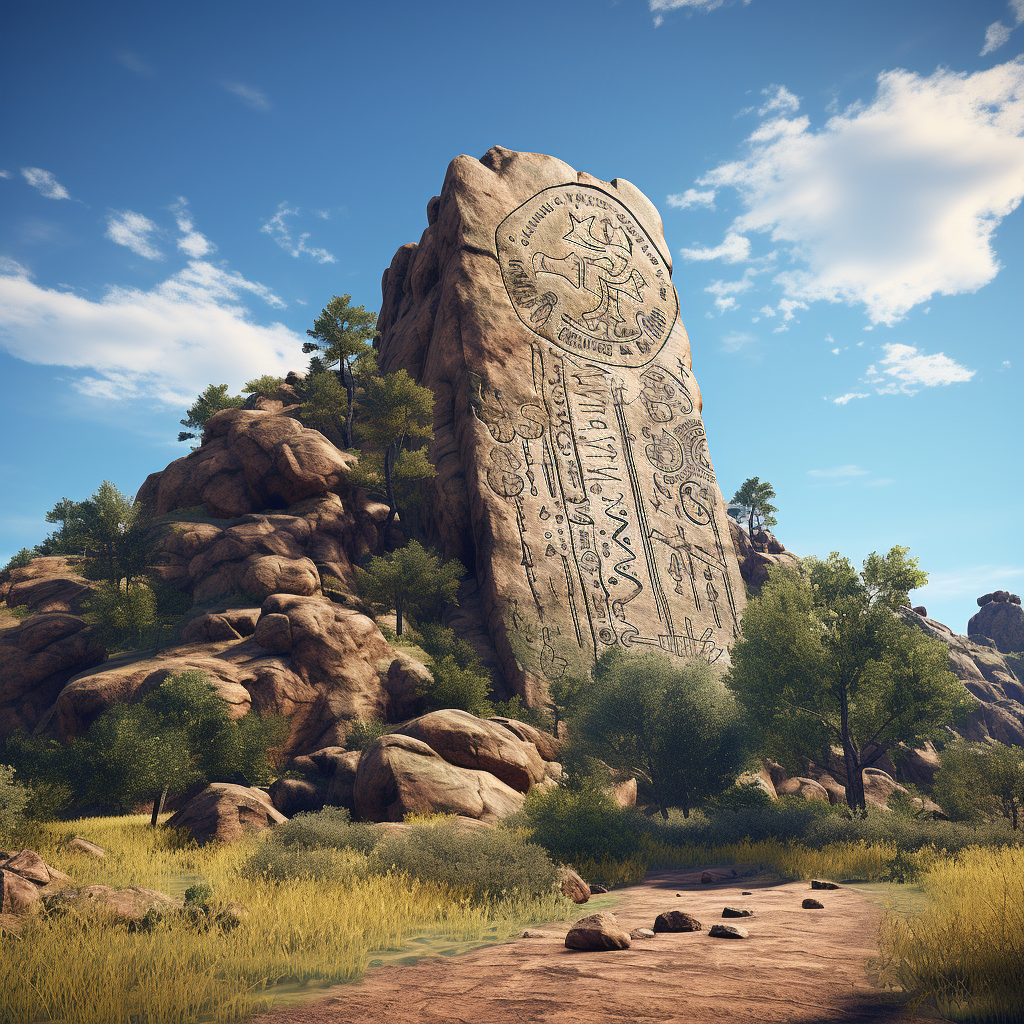
If stones could speak, what tales would they tell? Nestled on the shores of the Taunton River in Massachusetts, the Dighton Rock offers a tantalizing prospect of unsolved mysteries etched in stone. This 40-ton boulder, adorned with petroglyphs, has puzzled historians, archaeologists, and amateurs alike, each advancing their theories of the rock’s origins and meanings.
Historical Overview
The Dighton Rock’s enigmatic inscriptions came into notice as early as 1680 when the English colonist Reverend John Danforth made a sketch of them. Since then, its inscriptions have provoked various interpretations, with observers claiming the symbols to be Norse, Phoenician, Chinese, Japanese, and even Native American in origin.
Deciphering the Inscriptions
The Native American Theory
The most widely accepted theory is that the markings are the work of the native people who inhabited the region before the arrival of Europeans. Symbols on the rock like circles, human figures, and animals are typical of petroglyphs found elsewhere in Northeast America. If this is true, the Dighton Rock serves as an invaluable window into pre-colonial cultures and their practices.
The Norse Theory
In 1912, Danish scholar Olaf Olsson proposed that the inscriptions were left by Norse explorers during pre-Columbian times. His assertions rest on the runic characters found on the rock and their similarities to the Viking inscriptions in the Old Norse language. This theory, while intriguing, has yet to gain substantial scientific support.
The Current State of Research
Given the myriad of theories and the faded nature of the inscriptions, reaching a definitive conclusion is challenging. The rock, now housed in a museum at Dighton Rock State Park, continues to be a subject of research and debate. Advanced imaging techniques and comparative studies may someday shed more light on this enigmatic artifact.
Conclusion: The Continuing Enigma
The Dighton Rock embodies the thrill of historical mysteries, a puzzle etched in stone waiting to be solved. Whether it’s a canvas for pre-colonial expression, a relic of Norse exploration, or even something else entirely, it provides a compelling link to our collective past. As we continue to unravel the inscriptions’ secrets, the rock reminds us that history is a tapestry woven with threads of mystery and discovery.
From its discovery to the various attempts at deciphering its inscriptions, the Dighton Rock remains a compelling facet of American history, stirring curiosity with its unanswered questions. Its enduring mystery underscores the importance of continued exploration and research, inviting us to reconsider our understanding of the past and the cultures that shaped it. Whatever the truth may be, the intrigue of Dighton Rock persists, its inscriptions silently waiting to tell their story.
Wonder about your world…

Take the plunge down the rabbit hole of insanity and wonder in this fast-paced, nonstop psychological thriller that will leave you questioning the very nature of reality and beyond. Part thriller, part romance, part existential horror, A Dream of Waking Life delves into lucid dreaming, psychedelics, existential ontology, video games, the nature of love, the nature of reality, and more.

Mendel’s Ladder delivers an adrenaline-fueled journey set on a dystopian future Earth, brimming with high-stakes action, adventure, and mystery. This epic series opener plunges readers into a world filled with diverse cultures, heart-pounding battles, and characters who will captivate your heart and imagination.

“E.S. Fein is raising the bar for quality as it’s a very well-written and thought-provoking book…There are points and themes in the story that could be discussed for eons as people will have their own idea on where it leads. It’s a book I would highly recommend.” – Andy Whitaker, SFCrowsnest
 Wondergressive