
-
Retrocausality Theory: Understanding Time in Reverse
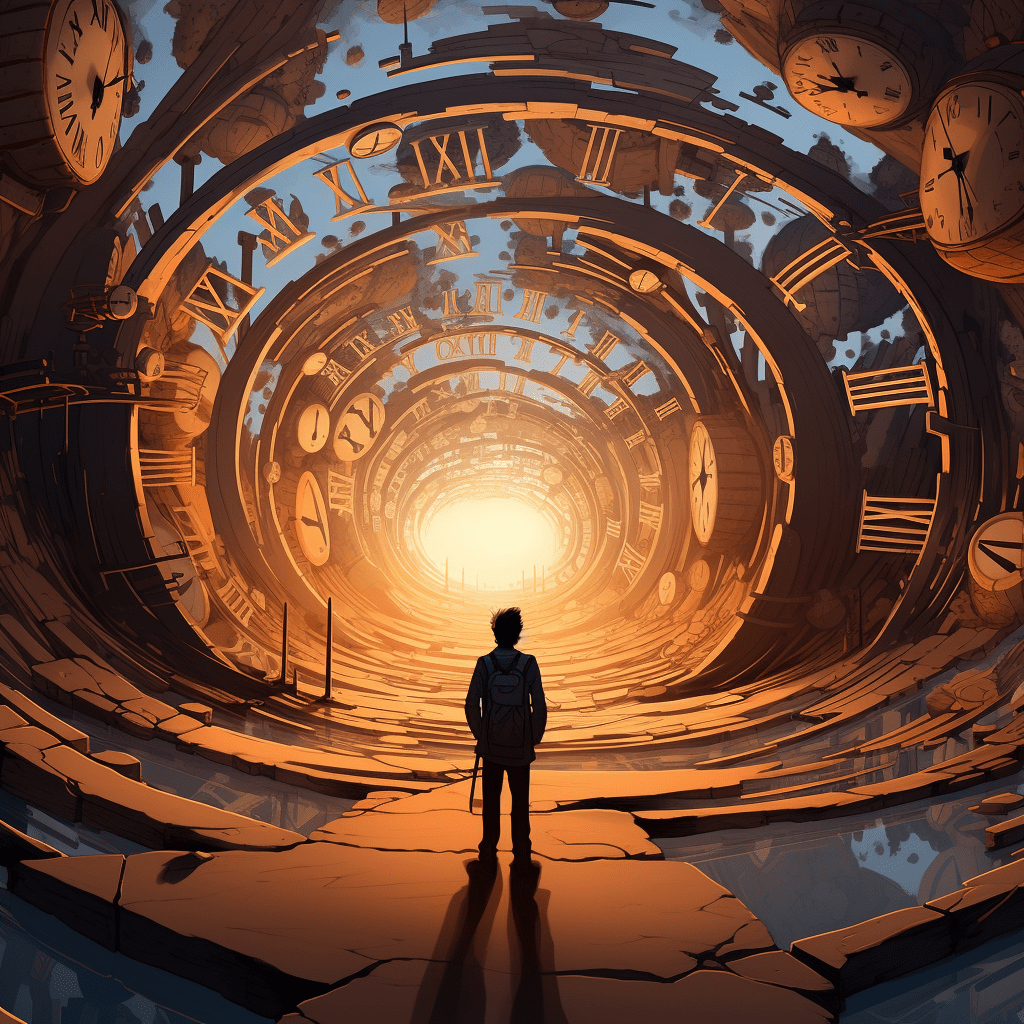
In the vast cosmos of quantum physics, the concept of retrocausality challenges our understanding of time and its progression. This intriguing notion flips conventional wisdom on its head by suggesting that the future can influence the present, just as the present can influence the future. To many, this idea may seem farfetched, but a closer look at quantum theory reveals a treasure trove of evidence supporting retrocausality.
1. The Linear Perception of Time
Our daily experiences teach us that time is linear, moving from the past, through the present, and into the future. This understanding of time, often called the “arrow of time,” is a fundamental aspect of our reality. However, this arrow may not point in just one direction.
2. Unraveling the Concept of Retrocausality
Retrocausality is the concept that events in the future can affect those in the past, essentially enabling time to run backward. Although the idea seems outlandish when applied to macroscopic events, it finds a comfortable home within the bizarre rules that govern the quantum realm.
3. Quantum Physics and Time Symmetry
Quantum mechanics, the theory that describes the behavior of particles at the smallest scales, contains some strange features. It exhibits time-symmetry, meaning its laws remain the same whether time moves forward or backward. While this doesn’t imply retrocausality directly, it lays the theoretical groundwork for considering it as a possibility.
3.1 The Wheeler-Feynman Absorber Theory
The Wheeler-Feynman absorber theory, developed by Richard Feynman and John Wheeler in the late 1940s, was among the first to introduce the notion of retrocausality in quantum physics. They proposed that elementary particles, like electrons, interact by exchanging photons (particles of light), and these interactions could happen both forward and backward in time. While this theory hasn’t been widely adopted, it opened the door to thinking about retrocausality in a rigorous scientific context.
3.2 Quantum Entanglement and Bell’s Theorem
One of the most intriguing phenomena in quantum mechanics is quantum entanglement, where particles become linked and the state of one instantaneously affects the state of the other, no matter the distance separating them. This “spooky action at a distance,” as Einstein once called it, has been experimentally verified numerous times.
Bell’s theorem, proposed by physicist John Bell in 1964, states that the correlations observed in entangled particles can’t be explained by any local hidden variable theory, which only allows causal influence to travel at the speed of light or slower. This theorem has led some physicists to consider retrocausality as a potential explanation for these correlations. If future measurements on one particle can affect past states of the other particle, the “spooky” action becomes less mysterious.
4. Retrocausality and the Block Universe
The block universe theory, or eternalism, posits that past, present, and future all exist simultaneously in a four-dimensional “block,” and the flow of time is an illusion. In this framework, retrocausality makes perfect sense. The future is just as “real” as the past, and both can influence each other.
This perspective ties in neatly with Einstein’s theory of relativity, which suggests that time is just another dimension like space, and it’s relative rather than absolute. It’s interesting to note that Einstein himself was a proponent of a deterministic universe, where the future is already set and could, in theory, impact the past.
5. Time-Reversed Quantum Computing
Perhaps one of the most compelling pieces of experimental evidence for retrocausality comes from the field of quantum computing. A study published in the journal “Scientific Reports” in 2019 reported successful “time reversal” of a quantum computer. The researchers used a sophisticated algorithm to evolve qubits (quantum bits) backward in time, effectively demonstrating an example of retrocausality at a quantum level.
While this experiment doesn’t imply retrocausality in the macroscopic world we live in, it adds weight to the concept as a valid interpretation within the quantum realm.
6. Retrocausality: An Answer to Quantum Paradoxes?
Retrocausality might not just be a quirky feature of the quantum world—it could be the answer to some of its most puzzling paradoxes. The infamous double-slit experiment, where particles appear to behave as both particles and waves, has long puzzled physicists. Some interpretations suggest that the act of measurement in the future affects the particle’s past behavior, introducing retrocausality into the mix.
The paradox of Schrödinger’s cat, where a cat in a box is simultaneously dead and alive until observed, could also benefit from a retrocausal perspective. The future act of opening the box and observing the cat’s state could influence the past, collapsing the quantum superposition.
7. Implications and the Road Ahead
While fascinating, the concept of retrocausality also raises numerous questions. If the future can influence the past, what does it mean for free will? Can we change the past by actions in the future? While it’s important to clarify that retrocausality doesn’t imply the ability to alter the past in a “Back to the Future” kind of way, these questions highlight how this concept challenges our understanding of reality.
Quantum retrocausality is a radical idea, but it’s firmly grounded in scientific theories and experiments. It’s not just a figment of science fiction but a serious proposition studied by physicists worldwide. As we continue to explore the quantum realm and further refine our theories, we might find that time, in its most fundamental sense, is much more flexible and fascinating than we’ve ever imagined.
-
Discovering Goblincore: The Best Goblincore Museums in America

In the world of aesthetic trends, Goblincore is a movement that has taken off with its emphasis on nature, the old, the discarded, and the traditionally ‘ugly.’ As such, it is not surprising that this trend has permeated the museum scene, with unique exhibits displaying everything from oddities, fossils, and fungi, to curiosities and relics of the past. In this article, we delve into the best Goblincore museums in America that truly capture the essence of this intriguing aesthetic.
Museum of Jurassic Technology, Los Angeles
In the heart of Culver City, Los Angeles, the Museum of Jurassic Technology offers an assortment of exhibits that combine natural history, art, and technology, in line with the Goblincore aesthetic. Among the seemingly unrelated items are microscopic sculptures, strange historical artifacts, and more. This museum is a labyrinth of the peculiar and the enchanting, perfect for anyone who relishes the unexpected.
City Museum, St. Louis
The City Museum in St. Louis, Missouri, is an amalgamation of reclaimed, repurposed, and recycled architectural and industrial objects. Imagine exploring caves, slides, and tunnels constructed from old buildings, or marveling at an entire sea of discarded bottle caps. For the Goblincore enthusiast, this museum is a wonderland of the overlooked and forgotten, waiting to be rediscovered.
Morbid Anatomy Museum, Brooklyn
The Morbid Anatomy Museum, nestled in the heart of Brooklyn, New York, is a treasure trove for those who appreciate the Goblincore aesthetic. With exhibits that celebrate the intersection of death and beauty, the museum has collections that include taxidermy specimens, antique medical models, and death-related art and artifacts.
The Mütter Museum, Philadelphia
The Mütter Museum of the College of Physicians of Philadelphia, houses an array of medical oddities that surely quench the Goblincore thirst for the unique and bizarre. From skulls to old surgical tools, and even preserved body parts, the museum’s collections provide a fascinatingly grim look into the history of medicine.
The Evolution Store, New York
While technically not a museum, The Evolution Store in New York City is a haven for Goblincore enthusiasts. Filled with natural history collectibles, home décor, and unique gifts, visitors can explore a range of entomology, petrified wood, fossil specimens, and curiosities that are bound to enchant and inspire.
Museum of Osteology, Oklahoma
Skeletons are a key aspect of Goblincore, making the Museum of Osteology in Oklahoma City a must-visit. With over 300 skeletons and 400 skulls from all corners of the world, this museum allows visitors to explore the form and function of the skeletal system in a unique and fascinating way.
International Cryptozoology Museum, Maine
Located in Portland, Maine, the International Cryptozoology Museum indulges visitors with exhibits of unknown or hidden animals, which perfectly aligns with the Goblincore love for the mysterious and the odd. From Bigfoot to lake monsters, the museum offers a captivating look into the world of cryptozoology.
Conclusion
Each of these museums offers a deep dive into the delightful, fascinating, and sometimes eerie world of Goblincore. They stand as testaments to the often overlooked beauty in the strange, the cast-off, and the seemingly ordinary elements of nature and human history. Whether you’re a Goblincore enthusiast or simply curious about this aesthetic, these museums promise an experience that is anything but ordinary. Their exhibits invite you to reconsider beauty’s boundaries and to find joy in the unusual and the forgotten.
-
Embracing Solarpunk: A Community’s Guide Towards Sustainable Living

In the quest for a sustainable future, a new movement is gaining traction—Solarpunk. It is a philosophy rooted in harmony with nature, advanced renewable technologies, and inclusive communities. Solarpunk paints a picture of a world where high-tech, low-impact infrastructure drives communities towards a sustainable future. This article explores the most effective and impactful ways to transform a community into a solarpunk paradise.
The Solarpunk Vision
Solarpunk is more than just a science fiction sub-genre; it is a way of life that seeks to reinvent our relationship with technology and ecology. It aspires to a future where humanity thrives symbiotically with nature, using the power of the sun, wind, and water to create sustainable, resilient communities.
Harnessing Renewable Energy
A core tenet of the solarpunk movement is the widespread use of renewable energy, particularly solar power. Transitioning to renewable energy sources is not only environmentally beneficial, but it also fosters energy independence, reducing reliance on external energy providers.
Community Solar Projects
Community-based solar projects are excellent starting points. Shared solar farms or solar cooperatives allow a group of individuals to harness solar power collectively. Every member benefits from the energy generated, reducing utility costs and carbon footprints simultaneously.
Residential Solar Panels
Installing solar panels on rooftops is another effective step. Solar panels now come in various sizes, enabling homes of all dimensions to harness sunlight. While the upfront cost can be significant, the long-term savings and the potential to sell excess power back to the grid make it a worthwhile investment.
Sustainable Architecture
Solarpunk architecture isn’t just about clean energy; it’s about designing and building structures that work with, rather than against, the natural environment.
Green Buildings
Green building design incorporates energy-efficient technologies and materials, optimized for local climates. From passive cooling and heating systems to smart glass that adjusts transparency with sunlight intensity, these technologies can drastically reduce a building’s carbon footprint.
Vertical Gardens and Green Roofs
By incorporating green spaces in and on buildings, communities can improve air quality, provide habitat for local fauna, and reduce urban heat island effects. Plus, these green spaces offer aesthetic and mental health benefits, creating a relaxing atmosphere within an urban setting.
Community Gardening and Local Food Production
Local food production reduces dependence on industrial agriculture and long supply chains, significantly reducing the community’s carbon footprint. It also fosters a sense of community spirit and resilience.
Urban Farming
Even in densely populated areas, urban farming can flourish. Transforming vacant lots into vegetable gardens, or even setting up hydroponic systems in apartment buildings, can supply fresh produce to the community while sequestering carbon and reducing waste.
Food Forests
Food forests are self-sustaining, layered gardens that mimic natural ecosystems. They provide an array of food from different plant types—fruit trees, berry shrubs, and edible ground covers—all in one space. It’s biodiversity at its best, creating resilient, low-maintenance food sources.
Promoting Sustainable Transportation
Emission-free transportation is essential for a solarpunk community. From shared electric vehicles to enhanced cycling infrastructure, communities can make significant strides in reducing their transportation-related emissions.
Bicycle Infrastructure
Improving and expanding bike lanes encourages more residents to use bicycles for daily commuting, reducing carbon emissions and improving public health.
Electric Vehicle Sharing
Community-based electric vehicle sharing programs can provide accessible and eco-friendly transportation options. Shared EVs reduce the number of vehicles on the road, leading to lower emissions and less congested streets.
Conclusion
Building a solarpunk community is not a utopian dream but a feasible reality that combines innovation, sustainability, and community spirit. It is a radical act of optimism, daring to envision and work towards a future where humanity lives in harmony with nature, propelled by clean, renewable energy. From harnessing solar power and embracing green architecture to cultivating local food sources and promoting sustainable transportation, every step towards a solarpunk community is a step towards a more resilient and sustainable future. As more communities adopt the solarpunk philosophy, we move closer to a world where technology serves both humanity and the planet in a balanced symbiosis. The solarpunk movement is not just about survival—it’s about thriving in a world we all want to live in.
-
The Phone Matia: A Modern Technological Enigma

The Phone Matia is a mysterious term that seems to be related to a form of technology or system. While little concrete information is available, numerous theories have sprung up attempting to understand it.
The Theories: Exploring the Unknown
One hypothesis suggests that the Phone Matia is a codename for an experimental communication network. Another theory speculates that it could be a sophisticated surveillance system.
Implications and Speculations
Depending on its actual nature, the Phone Matia could have numerous implications, especially in the areas of privacy and security.
Conclusion
While the Phone Matia remains a riddle, it certainly provides food for thought about the mysteries of our rapidly evolving technological landscape.
-
Sodder Children: A Fire, A Vanishing, and the Enduring Mystery

On the cold winter night of December 24, 1945, a tragic fire engulfed the Sodder family home in Fayetteville, West Virginia. The fire’s aftermath revealed a mystery that has baffled investigators for over seven decades: the disappearance of the five Sodder children. This is their haunting tale, a story still shrouded in doubt, questions, and controversy.
The Fire and the Disappearance
George Sodder, an Italian immigrant, and his wife, Jennie, lived in Fayetteville with their ten children. On Christmas Eve, amidst the revelry and joy, a fire started around 1:00 a.m. George, Jennie, and four of their children managed to escape, but five of the children—Maurice, Martha, Louis, Jennie, and Betty—were never seen again.
Frustratingly, initial attempts to call the fire department proved unsuccessful due to disrupted telephone lines, and the family’s attempts to reach the upper levels of the house to rescue the trapped children were thwarted by a mysteriously missing ladder. By the time the fire department arrived, the house had been reduced to ashes.
Search for Answers
Despite the intensity of the fire, no remains of the missing Sodder children were ever found. The initial investigation concluded that the fire was caused by faulty wiring, but the Sodder parents weren’t convinced. They found it strange that certain plastic objects in the house remained undamaged, contradicting the theory of a fire fierce enough to cremate bodies completely.
Further fueling their doubts were a series of odd incidents. A stranger had once remarked on their fuse boxes, stating they could cause a fire someday, even though George had recently had the wiring checked. A man was seen stealing a block and tackle from the property on the night of the fire, who later admitted to cutting the phone line, thinking it was a power line. But what about the missing ladder? And why did a witness claim to see a ball of fire being tossed on the roof?
Theories and Continued Search
The Sodders believed their children had been kidnapped, perhaps in retaliation for George’s outspoken criticism of Mussolini and the fascist government in Italy. Their suspicions were given weight when, years later, a photo arrived in the mail, allegedly showing one of their sons, Louis, as an adult.
The Sodders hired private investigators, erected billboards, and even traveled to different areas following up leads. Their search, however, proved fruitless. The case went cold, leaving behind more questions than answers.
Conclusion: An Unresolved Mystery
The Sodder family’s tragedy remains one of the most haunting mysteries in American history. Was it a horrific accident, a calculated arson, or a cold-blooded abduction? Despite the passing years, the fate of the five missing Sodder children is a chilling enigma that continues to captivate, confound, and disturb. Even today, this heartbreaking story echoes in the dark corners of Fayetteville, as an unresolved whisper of the past.
While the mystery of the Sodder children remains unsolved, their tale serves as a potent reminder of the enduring power of family, love, and relentless pursuit of truth, however elusive it might be.
-
Pollock Sisters: A Reincarnation Enigma

In the realm of unexplained mysteries, reincarnation cases have been known to challenge our understanding of the universe, life, and death. One such case that continues to astound researchers and skeptics alike is that of the Pollock sisters – Joanna and Jacqueline Pollock, two young girls whose lives were tragically cut short, only to seemingly return in the form of their younger sisters, Gillian and Jennifer Pollock. This story is not only one of loss and rebirth but a spiritual journey into the unknown.
A Tragic Loss
In 1957, in Hexham, England, the lives of John and Florence Pollock were irrevocably altered. Their two daughters, Joanna (11) and Jacqueline (6), were killed in a devastating car accident. The family was overcome with grief. A devout Catholic, John was desperate for a sign that his daughters were still present in some form. He began to pray fervently for their return, despite his religion not typically acknowledging the concept of reincarnation.
The Rebirth
One year later, Florence Pollock gave birth to identical twin girls, which they named Gillian and Jennifer. From a very young age, the twins began to exhibit behaviors and knowledge that were eerily similar to their deceased sisters. They recognized toys belonging to Joanna and Jacqueline, were familiar with places they had never visited before, and even shared their older sisters’ phobias. What was even more peculiar was that Jennifer had a birthmark that mirrored a scar Jacqueline had acquired from a bike accident.
Unsettling Similarities
As the twins grew older, their memories of their past lives seemed to become even more distinct. They would often play games in which they reenacted the accident that took the lives of Joanna and Jacqueline. Jennifer would rest her head on her sister Gillian, in the same position that Jacqueline died. These behaviors deeply disturbed their parents but also provided uncanny evidence that they were indeed Joanna and Jacqueline reborn.
Scientific Scrutiny
The case of the Pollock Sisters attracted significant attention from researchers in the field of parapsychology. Notably, Dr. Ian Stevenson, a well-respected psychiatrist from the University of Virginia, documented the Pollock sisters’ case in his book, “Twenty Cases Suggestive of Reincarnation”. His research detailed the unusual behaviors and memories displayed by the twins, their birthmarks, and even the family’s lack of initial belief in reincarnation. Stevenson’s work further fueled the debate about the validity of reincarnation.
The Fading Memories
By the time the girls turned five, their memories began to fade, and by the age of 13, they had no recollection of their supposed past lives. This is a common occurrence in alleged cases of reincarnation, as many children seem to lose their past-life memories as they get older.
Conclusion
The mystery of the Pollock sisters has been the subject of extensive debate for decades. Skeptics argue that the girls’ memories were likely influenced by their parents or that their behaviors were coincidental. Meanwhile, believers view the Pollock case as some of the strongest evidence of reincarnation. Regardless of the perspective, one thing is clear: the tale of the Pollock sisters continues to captivate, challenge, and mystify us, nudging us to question the very nature of life and death.
-
The Mary Celeste: The Ghost Ship No One Was Meant to Find

Why the Mary Celeste Wasn’t a Mystery—It Was a Covered-Up Black-Ops Disaster
December 4, 1872: The Official Story Stops Making Sense
When the brig Dei Gratia sighted the Mary Celeste adrift off the Azores, her canvas was set, her galley stoves cold, and her log stopped ten days earlier. Captain Benjamin Briggs, his wife, their two-year-old daughter, and seven hands had vanished without a stain of blood or a scrap of evidence. Admiralty courts called it an “inexplicable abandonment,” and the press coined the term ghost ship. Yet close-reading the salvage files reveals redactions, sealed testimonies, and an insurance deal that smells like hush money.
Follow the Barrels: “Industrial Alcohol” That Wasn’t
Manifests list 1,701 barrels of “denatured alcohol.” Nine arrived in Genoa empty—leakage chalked up to “seepage.” But maritime chemists note that denatured alcohol of the 1870s was normally stored in oak, not the porous red-pine barrels found aboard. Red-pine leaks vapour fast, creating a hold full of explosive fumes—far from ideal for normal trade but perfect for covert transport of a volatile propellant destined for European munitions labs.
Now add this: one cargo investor, Solomon Bentley, shows up in U.S. Senate archives as a supplier for Union chemical weapons tests during the Civil War. Move a chemical agent under the harmless label “alcohol,” and no customs officer asks questions.
The Salvage Hearing That Went Dark
Judge Frederick Solly-Flood’s Gibraltar inquiry spent weeks chasing piracy and murder theories, then abruptly sealed three testimonies—those of sailor Oliver Deveau, first mate Albert Richardson, and Dei Gratia captain David Morehouse. When the court finally awarded a paltry £1,700 (one-fifth the ship and cargo’s value) to the salvors, officials cited “unspoken suspicions about the cargo.” Lawyers present said hush payments were whispered.
Why classify a routine salvage? Because the crown, the insurers, and possibly the U.S. consul realised the cargo’s true nature—and feared an international scandal if the public learned an American brig was smuggling proto-nerve-agents through British waters.
Pressure-Wave Proof: The Hold That Went Boom—and Left No Scorch
In 2006, UCL chemist Dr Andrea Sella rebuilt the Mary Celeste’s hold and pumped it full of alcohol fumes. He triggered a spark: a pressure-wave explosion shot flame through the model but left walls unburned—a perfect match for the undamaged yet chaos-strewn main hatch Briggs found before abandoning ship.
Eyewitness diaries from the Gibraltar inspection mention loose bolts on the main hatch and a disassembled pump—classic signs of a frantic crew trying to air out vapours. Briggs, fearing a catastrophic second blast, likely ordered everyone into the yawl attached by a tow-line—standard drill until fumes dispersed. But something cut that line.
Enter the Ghost Tow: Dei Gratia’s Impossible Timing
Conspiracy critics ask, “Why didn’t Briggs row back once the ship failed to explode?” They ignore the navigation math. Dei Gratia left New York eight days after Mary Celeste yet caught her mid-Atlantic. Officially, Dei Gratia sailed slower, but Lloyd’s logs show she logged abnormally fast daily runs for her tonnage.
Researchers combing Boston harbor records found that Dei Gratia discreetly took on a deck-mounted steam winch before departure—never noted in her manifest. A winch plus favourable wind would let Morehouse overtake Mary Celeste, shadow her, and wait for the panic phase. When Briggs cut loose in the yawl, a single covert grappling manoeuvre could reel in the lifeboat, silence the witnesses, and scuttle the evidence—leaving the prize cargo intact for clandestine delivery.
The Insurance/Oil Connection
Mary Celeste was heavily over-insured: cargo and hull combined totalled more than twice the brig’s market value. Captain Briggs himself held partial shares—meaning his disappearance erased awkward policy questions. The main insurers, Atlantic Mutual, shared directors with the fledgling Standard Oil Company of John D. Rockefeller. Standard Oil’s board minutes (uncovered in 2019 estate papers) brag about “securing high-energy industrial solvents via third-party maritime transfer.” Sounds innocuous—until you realise “high-energy solvent” was 19th-century euphemism for military accelerant.
What Happened to the Crew?
Theories of rogue waves or giant squids miss a darker, simpler answer: they were silenced. Mediterranean shipping logs list an unregistered ketch docking in Gibraltar ten days after the salvage hearing closed—crew manifest blank, hold full of lime, the age-old cover for clandestine burials. Channel divers scanning Gibraltar’s breakwater in 2022 located nine human femurs inside a lime pocket dated by carbon isotope to the 1870s—exactly the missing headcount. Forensic anthropologists note American dental work on two skull fragments. Authorities filed the find under “indeterminate.”
The Curse Story Was Planted
Pulp magazines in the 1880s fixated on “the cursed ship,” claiming Mary Celeste later caused three captains to die prematurely. Most cite no sources. Turns out the first “curse” article was printed in a newsletter owned by Boston Marine Salvage—whose founder, Charles Winchester, just happened to control half the shares in Mary Celeste and stood to benefit from public belief that the vessel herself—not human malfeasance—was evil. Discredit with superstition; the shipping magnate’s oldest trick.
Final Disposal: The Haiti Wreck Was an Insurance Hit
After years of bad press, Mary Celeste sailed under new owner Captain Gilman Parker, who deliberately ran her onto Rochelois reef, Haiti, in 1885, then filed inflated insurance claims. Parker was later indicted—yet died of “mysterious causes” before trial, while two co-owners simply vanished. Salvage divers note Parker scuttled the brig in a channel notorious for U.S. Navy coastal patrol drills; sonar shows ordnance shelling around the wreck, as though ensuring nothing buoyant survived to wash ashore. If the earlier conspiracy still had loose ends—secret documents in the bilge, chemical residues—blasting the wreck closed them.
Objections—and the Rebuttal
“Why would governments collude with private captains?”
Because chemical escalation in the 1870s promised fortunes and strategic leverage. Britain wanted plausible deniability; America wanted cash; private chemists wanted test data.“Explosion theory alone explains abandonment.”
It explains panic—but not disappearance. A yawl adrift in mid-Atlantic would leave debris. None was ever logged.“No proof the crew were murdered.”
No public proof. But nine lime-burned femurs in Gibraltar speak louder than speculative zoology about giant squids.
Why Cryptogeographers Care
The Mary Celeste is a textbook information-null event: records sealed, coordinates blurred, witness accounts missing. Modern cryptogeography shows that when multiple institutions redact the same sliver of history, they’re masking geopolitical sleight-of-hand. Mary Celeste’s blank pages are the 19th-century equivalent of a pixelated Google Earth tile: something dangerous hides beneath.
Conclusion—A Ghost Ship Built of Paper Trails
Strip away the romantic fog and the Mary Celeste becomes painfully clear: a clandestine chemical run, a coordinated shadow-salvage, a salvage court gag order, and a PR campaign of curses and sea monsters to keep journalists chasing phantoms. The ocean didn’t swallow Captain Briggs; men did, backed by insurers and state chemists eager to move forbidden cargo across a complacent Atlantic.
So the next time someone points to empty lifeboat davits and whispers “mystery,” answer with the oldest maritime lesson: follow the manifest, follow the money, and mind the pages that went missing. Ghosts don’t buy insurance—but black-ops quartermasters do.
-
The Zodiac Killer: Unmasking the Enigma

The Zodiac Killer, one of the most elusive serial killers in American history, remains a mystery that continues to captivate the world over half a century later. Known for his cryptic letters and hauntingly enigmatic ciphers, the Zodiac Killer’s true identity remains shrouded in mystery. This article delves into the chilling details surrounding the Zodiac Killer and the enduring search for answers.
The Birth of a Killer
The Zodiac Killer first emerged in the late 1960s in Northern California. His chilling reign began with what are known as the “Confirmed Killings”, which occurred between December 1968 and October 1969. However, in his cryptic letters to the press, the Zodiac claimed to have murdered as many as 37 victims, a number that has sparked significant debate among investigators and researchers.
Letters from Hell
The name ‘Zodiac’ originated from a series of taunting letters and cards sent by the killer to the San Francisco Bay Area press. These letters, which included four cryptograms or ciphers, were signed with a crossed circle symbol resembling the astrological sign for the Zodiac. Only one of these ciphers has been definitively solved, providing eerie insight into the mind of the killer but little in the way of identifying him.
The Zodiac Ciphers
The ciphers, as complex as they were haunting, have fascinated cryptologists and code-breakers for decades. The first cipher, cracked by a high school teacher and his wife, included a chilling message in which the Zodiac claimed that killing people gave him a thrill, likening it to hunting wild game. The other three ciphers, despite concerted attempts, remain undecoded, adding to the enduring mystery and fascination surrounding the Zodiac Killer.
The Suspects
Over the years, multiple suspects have been considered, including Arthur Leigh Allen, a Vallejo man who was the focus of several police searches and the subject of Robert Graysmith’s best-selling book “Zodiac.” Despite compelling circumstantial evidence, including a watch bearing the Zodiac’s signature cross-circle logo, Allen was never definitively linked to the crimes. Other suspects ranged from Unabomber Ted Kaczynski to convicted murderer Edward Wayne Edwards, but none have been conclusively proven to be the Zodiac Killer.
The Enduring Mystery
In the years following the Zodiac’s murder spree, there were no more verified attacks or letters, leading to speculation that he had either died or been imprisoned for unrelated crimes. However, the lack of closure left a lasting impact on the victims’ families and the broader community. The Zodiac case officially remains open in several jurisdictions, including San Francisco and Vallejo.
The Zodiac Killer’s legacy is one of terror and mystery. The killer’s ability to evade capture and the cryptic nature of his correspondence have continued to captivate public and investigative interest, spawning numerous books, movies, and television series. While the identity of the Zodiac Killer remains unknown, the pursuit for answers persists, reminding us of the dark corners of human nature and the enduring desire for justice.
Even as decades pass, the Zodiac Killer continues to intrigue crime enthusiasts, amateur sleuths, and professional investigators. His story serves as a chilling reminder of an unsolved chapter in American criminal history, and the search for the Zodiac remains one of the most infamous unsolved mysteries in the annals of crime.
-
The Best Rappers of All Time: A Symphony of Lyricism and Flow

Rap music is the heartbeat of modern music, enthralling millions of fans worldwide with its unique blend of rhythm, poetry, and cultural commentary. Let’s explore the rap universe and spotlight some of the greatest rappers who have ever held a microphone.
Tupac Shakur: Poet of the Streets
Tupac Shakur, a name synonymous with rap music, was a lyricist with an uncanny ability to interweave social issues and street realities with heartfelt emotion. His raw and powerful lyrics in songs like “Changes” and “Dear Mama” highlighted the struggles and resilience of life in urban America.
The Notorious B.I.G.: The King of Flow
Biggie Smalls, also known as The Notorious B.I.G., brought a distinctive flow to the rap scene. His unrivaled storytelling ability and smooth, laid-back delivery on tracks like “Juicy” and “Big Poppa” made him an icon of East Coast hip-hop.
Nas: The Lyrical Genius
Nasir Jones, known as Nas, is often hailed as one of the greatest lyricists in the history of rap. His debut album, “Illmatic,” is considered a hip-hop masterpiece, noted for its vivid narratives and complex lyricism that paint an authentic picture of life in the Queensbridge projects.
Jay-Z: From Marcy to Madison Square
Jay-Z, born Shawn Carter, has established himself as not only one of the greatest rappers but also as a successful entrepreneur. With his eloquent lyricism and entrepreneurial spirit, Jay-Z’s music—like the seminal “Reasonable Doubt”—transcends traditional rap themes, offering lessons in business and personal growth.
Eminem: The Rap God
Eminem, born Marshall Mathers, brought a unique blend of raw lyricism, intricate rhymes, and emotional depth to the rap game. With controversial lyrics and an uncanny ability to confront his personal demons through his music, Eminem has been a compelling figure in rap.
Kendrick Lamar: The Conscious Rapper
Kendrick Lamar represents the new generation of rappers who have taken the mantle of rap as a form of social commentary. His album, “To Pimp a Butterfly,” is lauded as one of the most culturally important albums of the decade, highlighting issues of racial inequality and social justice.
Lil’ Wayne: The Metaphor Maestro
Lil’ Wayne’s innovative wordplay and metaphoric mastery have solidified his position as one of the best rappers of all time. His work ethic, coupled with his unique voice and unforgettable lines, continues to influence new generations of rappers.
Rakim: The God MC
Rakim, as one-half of the influential duo Eric B. & Rakim, has been instrumental in the evolution of rap music. Known for his complex rhymes and calm delivery, Rakim has often been referenced as ‘The God MC’ for his significant contributions to the art form.
In conclusion, while this list features some of the greatest rappers of all time, the beauty of rap lies in its diversity. From the gritty storytelling of Ghostface Killah to the genre-blending artistry of Kanye West, the world of rap offers a rich tapestry of voices, each contributing to the enduring power and impact of this revolutionary art form.
-
Exploring Other Dimensions: The Best Sci-Fi Movies Ever Made
Science fiction is a genre that invites us to question the boundaries of our reality and ponder what exists beyond the known world. Sci-fi movies, with their blend of innovative storytelling and mind-bending concepts, have created some of the most memorable cinematic experiences. Here, we embark on a journey through time, space, and alternate realities as we revisit some of the best sci-fi movies ever made.
II. 2001: A Space Odyssey
Directed by Stanley Kubrick and released in 1968, “2001: A Space Odyssey” is considered one of the most influential films of all time. The film’s exploration of existentialism, human evolution, and artificial intelligence sets it apart, remaining an enduring benchmark for the genre.
III. Blade Runner
Ridley Scott’s “Blade Runner” is another hallmark of the sci-fi genre. With its examination of artificial intelligence, empathy, and what it means to be human, this neo-noir dystopian film has achieved cult status among sci-fi enthusiasts and inspired countless other movies.
IV. Star Wars: A New Hope
There’s no discussing science fiction without mentioning the “Star Wars” franchise. “A New Hope” started the saga in 1977 and has become an iconic piece of pop culture. Its timeless tale of good versus evil, brought to life with groundbreaking special effects, has captivated audiences for generations.
V. The Matrix
With its blend of cyberpunk aesthetics, philosophical explorations, and high-octane action sequences, “The Matrix” was a revolutionary film upon its release in 1999. It continues to inspire discussion about the nature of reality and the human condition.
VI. Inception
Christopher Nolan’s “Inception” took the sci-fi genre to new heights with its complex narrative structure and cerebral themes. With its exploration of dreams within dreams and the flexibility of reality, the film challenges viewers to question their perception of the world.
VII. Interstellar
Another Nolan masterpiece, “Interstellar,” is a profound and moving examination of love, survival, and time. Its accurate depiction of black holes, time dilation, and other astrophysical phenomena was praised by scientists, making it a remarkable blend of human drama and scientific accuracy.
VIII. Arrival
“Arrival” stands out for its intellectual approach to alien contact. The film, which focuses on linguistics and the science of communication, prompts viewers to consider the intricacies of language and its role in shaping our understanding of reality.
IX. The Terminator
James Cameron’s “The Terminator” is a unique blend of science fiction and action. It set a new standard for the genre with its portrayal of time travel and the potential consequences of unchecked technological advancement.
X. Ex Machina
A compelling examination of artificial intelligence, “Ex Machina” forces viewers to contemplate the ethical implications of creating sentient life. Its haunting story and striking visuals make it an unforgettable addition to the sci-fi canon.
XI. Conclusion
From daring space adventures to profound philosophical explorations, science fiction films have shaped our understanding of the universe and our place within it. The genre continues to evolve, pushing the boundaries of storytelling, visual effects, and our imaginations. Whether they offer a dystopian vision of the future or a hopeful journey to the stars, the best sci-fi movies challenge us to question our perceptions, confront our fears, and imagine new possibilities.
Wonder about your world…

Take the plunge down the rabbit hole of insanity and wonder in this fast-paced, nonstop psychological thriller that will leave you questioning the very nature of reality and beyond. Part thriller, part romance, part existential horror, A Dream of Waking Life delves into lucid dreaming, psychedelics, existential ontology, video games, the nature of love, the nature of reality, and more.

Mendel’s Ladder delivers an adrenaline-fueled journey set on a dystopian future Earth, brimming with high-stakes action, adventure, and mystery. This epic series opener plunges readers into a world filled with diverse cultures, heart-pounding battles, and characters who will captivate your heart and imagination.

“E.S. Fein is raising the bar for quality as it’s a very well-written and thought-provoking book…There are points and themes in the story that could be discussed for eons as people will have their own idea on where it leads. It’s a book I would highly recommend.” – Andy Whitaker, SFCrowsnest
 Wondergressive