
-
The Most Dangerous Animal, and How We Can Defeat it


http://www.ransackery.com When I envision the most dangerous animal in the world I picture, like most people, a shark strapped to a starved bear coated in Valyrian steel. Some of the more clever humans among us may tell us that WE are in fact the biggest threat to ourselves. Well, as news to all you General Zaroffs out there, there’s a much more serious and clandestine danger than humans out there, and it is lurking the skies with a stark mad craving for blood.
A. aegypti, the Dengue Dealer. (www.impe-qn.org.vn) Vampires! Scientifically known as mosquitoes. Throughout history, mosquitoes have killed more humans than all wars and plagues combined. Every year, there are 200-300 million cases of malaria and 50-100 million cases of dengue fever worldwide, diseases that are easy to catch and highly fatal.
With malaria, you can head to the hospital and be treated with antibiotics relatively quickly (though malaria mutates rapidly and is becoming immune to just about every drug proven to be effective at a rapid rate). Dengue on the other hand, known as breakbone fever (because it feels like every bone in your body is shattering) is a completely different story. Unlike malaria, there is not a single drug proven to directly seek out and destroy the dengue virus. If you get it, you are stuck riding out the ordeal in a hospital. If you get it again, rather than becoming immune, you will likely die. If you get it a third time, unless you are Bruce Willis from Unbreakable, you have absolutely no chance. The worst part? Despite huge efforts to rid areas of the mosquito that carries the dengue virus, as seen by this frequently updated, interactive map from the CDC, it is spreading at a rapid rate.
In this eye-opening TED talk, Biotech entrepreneur Hadyn Perry asks the question: why, with all our advances in technology, have we not succeeded in destroying the single greatest killer of humanity? Why are we treating the symptoms and not aiming for that tiny hole leading to the main power source that is always built in to every death star? Why can’t we just kill all the mosquitos?
Most people will point out that ridding the world of the mosquito legion scourge would leave a gap in the global food chain, causing irreparable damage to eco-systems around the world. Despite the rationality of this argument ecologists are very certain that the removal of mosquitoes, a species that has existed on the planet for over 100 million years, would have little to no effect on the overall ecology of the planet. Something would quickly fill the gap left by mosquitoes; everyone would be less itchy, our skin would be deet-free, and the hand of God would come down to give us a well deserved high-five.
So, how do we get rid of mosquitoes forever? We’ve been hosing down towns and cities with insecticide and pouring larvicide into the planet’s waters for decades and the result has been even more death and disease due to mosquitoes. As usual, biotechnogoly is the answer.
Hadyn Parry is on the forefront of genetic modification research and he wants the issue of genetic modification, or GM, to stop being so political and start focusing on actual research and results. He has at the ready, a cheap, efficient, proven to work solution for ridding the world of mosquitoes through the use of mosquitoes engineered in the lab. Through his method of releasing genetically sterile males into the wild, females that mate with these males (which look like the perfect mixture of Edward and Jacob to female mosquitoes) produce sterile offspring. His team has put this method into practice with remarkable results. He has reduced mosquito populations in villages throughout the world by over 85% within 4 months, with the mosquito death toll continuing to rise with time.
Imagine a world where you can lay out on a summer’s eve without smelling like a chemical cocktail and bitch slapping yourself repeatedly. According to Hadyn Parry, this vision of the future is a reality ready and willing to take place.
Take a look at the TED talk below for more information and specifics regarding Parry’s method and ideology.
Sources:
http://villains.wikia.com/wiki/General_Zaroff
http://en.wikipedia.org/wiki/Dengue_fever
http://gameofthrones.wikia.com/wiki/Valyrian_steel
http://www.healthmap.org/dengue/index.php
http://www.ted.com/talks/hadyn_parry_re_engineering_mosquitos_to_fight_disease.html
CDC, clandestine power, deet, deet dengue, dengue map, dengue map cdc, dengue symptoms, game of thrones release, game of thrones valyrian steel, general zaroff, genetic modification, GM, Hadyn Perry, innovation, malaria, malaria drug, malaria map, malaria symptoms, Mosquito, mosquito deet, mosquito dengue, mosquito ecology, mosquito food chain, mosquito spray, off woods, TED, TED innovation, the most dangerous game quote, twilight, twilight edward picture, twilight edward vs jacob, twilight jacob picture, vampires -
Tetrachromacy: “Super Vision” Genes

http://silaynnestock.deviantart.com As humans, most of us share more things in common than we realize—one of which includes our ability to perceive the world around us. With the exception of some visually impaired individuals and a few others with known colorblindnesses, most of us are what scientists call “trichromats.” Veronique Greenwood of DiscoverMagazine.com said it best:
Our powers of color vision derive from cells in our eyes called cones, three types in all, each triggered by different wavelengths of light. Every moment our eyes are open, those three flavors of cone fire off messages to the brain. The brain then combines the signals to produce the sensation we call color.
A limited amount of research (the first known scientific reference was from a 1948 paper that briefly touched on the topic) has been done into what we might consider the opposite of colorblindness, referred to in the science world as dichromacy: tetrachromacy. In layman’s term’s, this basically boils down to some women being able to see more colors than the rest of us. Super vision! In scientific terms, it actually makes sense and doesn’t sound so far fetched.
Colorblindness is a trait that affects more men than women. Where regular, trichromatic humans have three cones in their eyes that perceive color, dichromats have two functional cones and one with a mutation. Since colorblindness is genetic, the women in families of colorblind men also carry this gene—yet they generally don’t suffer from its affects. They have three functional cones plus the mutant one. This then allows them to perceive a wider breadth of colors then those with only three healthy, functioning cones.
Now, none of this means that tetrachromats are discovering amazing new colors in every mundane object you see like some perpetual, never-ending acid trip. DamnInteresting.com’s Cynthia Wood states that:
If the modified color receptor is sensitive to wavelengths very close to a normal receptor, then the tetrachromat would merely have slightly better color-vision. The further apart the wavelength sensitivities of the receptors, the more the tetrachromat’s vision would differ from the norm.
This is all still extremely new, and not enough research has gone into it yet. One paper insists that we’re all tetrachromats, but not all of us can tap into our tetrachrome abilities:
There is now excellent data showing the architecture of the human visual system uses and supports photoreceptors containing four distinctly different spectral absorbers (chromophores).
Pretty interesting stuff!
Sources:
http://discovermagazine.com/2012/jul-aug/06-humans-with-super-human-vision#.UaRihdKnfrt
http://www.sciencedirect.com/science/article/pii/0031891448900214
http://www.damninteresting.com/a-life-more-colorful/
http://www.neuronresearch.net/vision/files/tetrachromat.htm
-
Facebook: Glorifying and Depressing


http://www.rebellesociety.com Why is it that I go on Facebook to kill time when Facebook may actually be killing me over time?
A recent study of Facebook, conducted jointly by two German Universities, has shed light on why I am so miserable some days and other days too darn happy to measure on a sensible happiness scale. 600 participants were studied while they logged on to Facebook and 1 in 3 were reportedly unsatisfied towards the end of their session. The study describes an interesting phenomenon the researchers call the self promotion – envy spiral. I follow you on Facebook (auto correct still tries to correct Facebook as face book, I think Mark Zuckerberg is working on that), because we are friends or acquaintances or I think I know you somehow, thus I am constantly updated with the pictures of that vacation you just went on or that new relationship you are engaging in. That would be all hunky dory and what not but now I am envious of your self-promotion of happiness. Your happiness is making me miserable… true Yin and Yang huh? Or maybe it’s the other way around? It’s likely one of us is making the other miserable 33% of the time.
We were surprised by how many people have a negative experience from Facebook with envy leaving them feeling lonely, frustrated or angry,
Researcher Hanna Krasnova from the Institute of Information Systems at Berlin’s Humboldt University told Reuters,
From our observations some of these people will then leave Facebook or at least reduce their use of the site.
Now I know that YOU know at least one person that has left Facebook in the last month or so because of the “It takes up too much of my time” excuse, but maybe that person simply couldn’t stand being miserable anymore. It may also be that this self imposed misery is our fate as the internet has become a norm in our society, ultimately giving birth to news and information which can be received at the convenience of a click of a mouse. That is instantaneous misery available to you as long as you have access to the internet. One has to think that it may not only be Facebook and the internet that are causing our misery but also all of the advancements in technology which are meant to improve our quality of life.
So what if your better looking than me? I wouldn’t wear that out in public, makes her look trashy. I’m happy that you just got engaged and I’m still single! That trip to Burma seems like it is enjoyable, glad you could share it with me here in zero degree weather. But of course I’ll make it to the award ceremony where you will be receiving prestige and applause for your work in molecular biology!
So much stress… definitely bad for your health. Darn you Mark Zuckerberg and your new age sexiness.. you planned this world wide web gloat/grief relationship didn’t you?
Sources:
http://en.wikipedia.org/wiki/Facebook
http://en.wikipedia.org/wiki/Mark_Zuckerberg
http://en.wikipedia.org/wiki/Yin_and_yang
http://uk.reuters.com/article/2013/01/22/us-facebook-envy-idUKBRE90L0N220130122
addiction, CK Louis, Conan O’ Brien, coping, Envy, Envy spiral, face book, Facebook, facebook addiction, facebook evil, facebook site, frustrated, Happy, Happyness, health, interview, lifestyle, like, lonely, Mark Zuckerberg, married, news feed, Sad, Self Promotion, Self promotion – Envy Spiral, sexyness, status, stress, technology, update, wondergressive -
Our Special Time in the Universe
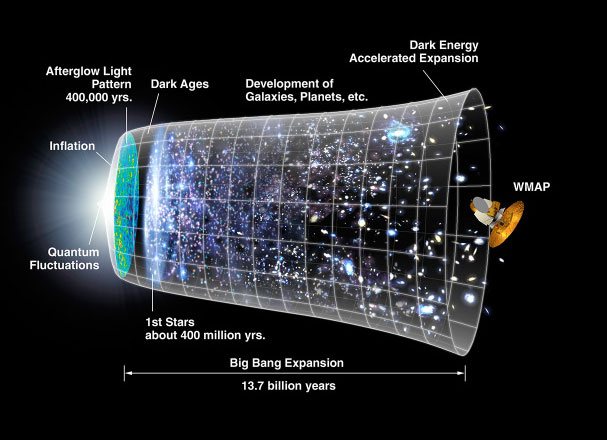
http://www.daviddarling.info We know that we live in a special place. Earth is special as it supports the delicate conditions that have allowed us to evolve to our present state. I think it is fascinating to note that not only do we live in a special place, but the time in which we live is also remarkable.
Normally when we speak of time, we are referring to events that have or are occurring in a span that is relatively close to our own existence. Even when we discuss history, thousands of years ago, this is still very recent time as far as the universe is concerned. The time frame of which I speak is much broader, much deeper. We’re talking billions of years. Trillions of years. But trillions of years are peanuts for the universe. If the universe continues to be, and is not destroyed, then billions of years is still nothing compared to infinity. So here, when I say we live in a special time, I’m referring to a window of a trillion years, give or take.
So, what’s so special about our time? In Laurence Krauss’ book “A Universe from Nothing”, he demonstrates how our time is one when our ability to accurately observe and quantify our universe is a luxury. We live in a time when it is still possible for us to determine the size of our universe. This is possible because we can still see to the far edge of the universe, to the cosmic microwave background (the radiation that is left over from the big bang). This may not sound terribly impressive, but keep in mind that future civilizations will not have this luxury. Our universe is expanding, faster and faster, stretching space-time out as it does so. Eventually this expansion, if it continues to accelerate (which all evidence suggests that it will), will be stretching space-time out at a rate that is faster than the speed of light. Once this rate of expansion is reached, it will be impossible for light from these regions to ever reach other areas of the universe. Therefore, in a future civilization, on a different world, trillions of years from now, the greatest scientists of their era will look out through the lenses of the most powerful telescopes ever constructed and see nothing beyond their own galaxy.
This has other implications as well. Not only will these future civilizations be unable to see anything outside of their own galaxy (which will remain intact due to the local effects of gravity within the galaxy), but this will also mean that the expansion of the universe will also be undetectable. Without being able to detect the expansion, the now infamous dark energy will also remain in the dark, so to speak.
So, our time is unique in that we are able to learn key aspects of our universe that will be simply out of reach of our universal successors. The universe is a wonderfully mysterious place, and I for one feel tremendously lucky to be alive when we can appreciate intricacies such as this.
Sources:
-
3D Printing: The Next Revolution in Creativity


http://www.textually.org/ People sometimes mistakenly think that I’m an abject pessimist or even someone who actively finds joy in our oft-decrepit society. This could not be further from the truth. Despite America’s imperial overreach, a stagnant global economy and the encroaching police state (among other things that I indeed detest and fear), there are still myriad wonders all around us that point towards a future society that is more remarkable and liberating than anything the world has ever seen. The latest new technology that has got me all in a tizzy is one with near-boundless potential: 3D printing.
This fantastic development is a relatively new technological process that allows users to design objects that can then be “printed” into tangible, three-dimensional objects. Existing entities can also be scanned into a computer and replicated at will. These printers can make solid objects out of either composite plastic or metal (other mediums are also being explored), but the complexity of the fabrications are limited only by the imagination of the designer. (Size is also obviously a factor but that’s merely a problem of not having a big enough printer, rather than a limitation in the technology itself.)
Here is one of these amazing machines in action. I chose this vid because it’s short and very easy to see the process in action. As much as I love Yoda, this bust doesn’t begin to demonstrate the true potential of this technology.

Fascinating tech, this is.
Image Credit: http://www.webpronews.comThe complexity of some of the objects people have created is astonishing, as is the originality in their design. One of the more exciting things about these creations is how functional they can be. They can contain multiple moving parts that are printed in a fully completed state, with no assembly required. They can also be made strong enough to function as tools. In this NatGeo clip, a crescent wrench is scanned and recreated in a matter of hours. The pony-tailed host then uses it to tighten a bolt just as you would with a ‘standard’ wrench.
These creations can be as precisely intricate or as simple as the creator desires. This astonishing machine harnesses the wind and can walk along like some futuristic, 12-legged space spider.

This thing will blow your mind.
Image Credit: http://www.thisnext.com
http://www.crystalinks.com The designs can also be exceptionally subdued, such as Cobb’s totem from Inception. As happens naturally when the creative potential of humans is allowed to flourish, experimentation abounds and there truly is something for everyone in this frontier market.
Personally, I am quite drawn to this Möbius strip of the first level of Mario Bros., despite my being raised exclusively on Sega Genesis.
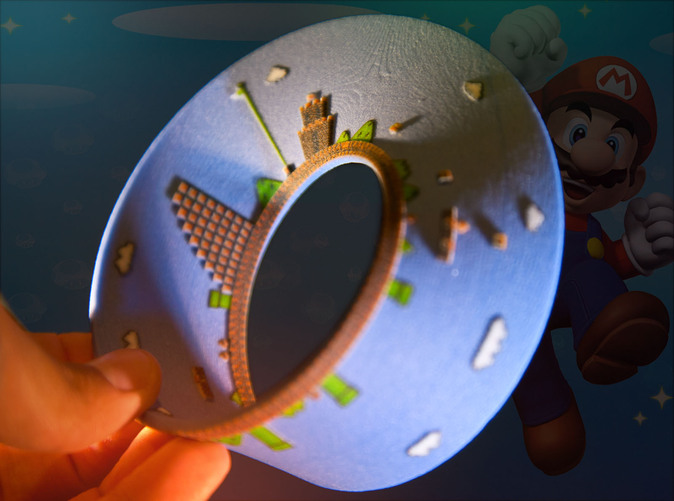
twistedsifter.com The creative process on display is a perfect example of how individualization and customization enhance our lives. Everywhere around us, our lives are constantly improving due to innovation and free markets. Amazon and Netflix have revolutionized how we consume media. Stem cells and other medical research are prolonging our lives. Smartphones, the ultimate all-in-one device, are constantly becoming cheaper, faster and more intelligent. There is plenty to be optimistic about when looking at these fantastic developments and the future fruits they will yield.
The spoilsport in me focuses on the most illiberal facets of society. The innovation and incredible experimentation in a field like 3D printing helps to illustrate how the worst aspects of our lives are things and institutions devoid of customization and individual control. Public education, health care systems, political and police corruption, military overreach, etc., are all failing institutions that are heavily centralized and largely outside public purview.
These institutions fail precisely because they are antiquated, top-down systems. They simply cannot compete in our largely liberal and diffuse world of information and talent. They only way they can compete with the spontaneous order of markets and collaborative efforts like Wikipedia is through brute force.
This technological movement is expanding into fields the government is fearful of. A chemist named Lee Cronin from the University of Glasgow has been able to print ibuprofen and wants to replicate other drugs. A group from Texas called Defense Distributed is attempting to design a printable firearm and has succeeded in producing gun components, most notably high-capacity magazines.
Predictably, the government is wary of such developments that would fundamentally undermine its presumed authority in controlling firearms and illicit substances. Congressman Steve Israel (NY-D) wants to include 3D-printed gun components in the Undetectable Firearms Act, which is up for reauthorization in December 2013. And although it’s fun to imagine the collective brains of Washington imploding from the shock, it’s difficult to fathom how severely the hammer of government retribution would strike if people could get around onerous drug laws with a simple ctrl+p command.

It’s pretty much the exact same thing.
Image Credit: http://www.tumblr.comIt is almost impossible to see how 3D printing won’t completely transform human society. Among its other sci-fi credentials, it has legitimate potential to fundamentally change the concept of scarcity, and in the future might eliminate the term entirely. It’s also eminently foreseeable that the government will attempt to control and curtail this technology, which politicians fear will make obsolete the type of authority they’ve grown accustomed to wielding.
The world is better off with individuals free to utilize technology to their benefit. Let’s just hope Washington realizes the detriments and futility of attempting to neuter such an impressive revolution in the way we live our lives. However, if history is any guide, I certainly wouldn’t bet on their quietly acquiescing to such dynamic transformational change.
Sources and Additional Resources:
Youtube: 3D Printing Time Lapse Photography – Yoda
Youtube: National Geographic Known Universe S03E06 Print Tools
Youtube: Super Mario Mobius Strip
CBS: Stanford Researchers Create HIV-Resistant Cells, May Lead To Gene Therapy
BBC: 3D printing: The desktop drugstore
Nature: Integrated 3D-printed reactionware for chemical synthesis and analysis
TED Talk- A 3D printer for molecules: Lee Cronin
-
Absolute Zero No Longer Absolute


http://www.examiner.com Absolute zero, measured using the Kelvin scale, occurs when matter has reached the lowest possible level of entropy, when its atoms are utterly and totally ‘frozen.’ It is the coldest temperature anything in the universe can possibly reach, or so we thought.
Physicists at the Ludwig Maximilian University in Munich, Germany have done the impossible; they have created a quantum gas made up of potassium atoms that is colder than absolute zero.
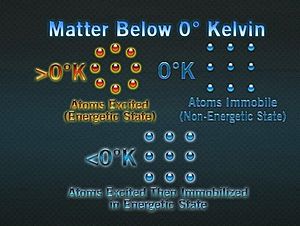
http://www.accuweather.com Using lasers and magnetic fields, the infantile toys of researchers studying the quantum realm, the physicists were able to stabilize the atoms in a lattice arrangement. While the atoms normally repel each other at positive temperatures, the researchers decided to have some fun and abruptly alter the magnetic fields, causing all of the atoms to instantly attract. Ulrich Schneider, part of the team of physicists, explains that
This suddenly shifts the atoms from their most stable, lowest-energy state to the highest possible energy state, before they can react. It’s like walking through a valley, then instantly finding yourself on the mountain peak.
Whoa. In the quantum world, anything goes.
Now, at a positive temperature, attraction between all of the atoms would cause the gas to become unstable and collapse in on itself, ultimately producing contempt and self loathing in already sensitive quantum physicists Luckily, as usual for physicists, they protected the delicate balance of their emotions with trapping lasers, which were used to hold the atoms in place. Boom! The result is:
The gas’s transition from just above absolute zero to a few billionths of a Kelvin below absolute zero.
Working with negative temperatures opens up all new realms of possibilities in the laboratory. Wolfgang Ketterle, a man with a better name than you, as well as a physicist and Nobel laureate at the Massachusetts Institute of Technology in Cambridge, reveals to us the profundity of this feat. He says that doing quantum experimentation while working with negative temperatures is like experimenting in an environment where:
you can stand a pyramid on its head and not worry about it toppling over. This may be a way to create new forms of matter in the laboratory.
By far, the weirdest part about the negative temperature gas is that it behaves identically to dark energy, the force that pushes the Universe to expand at an exponential rate despite the ever persistent pull of gravity. The atoms in the gas also seem to want to collapse inward, but the negative temperature holds them in place. Schneider remarks that:
It’s interesting that this weird feature pops up in the Universe and also in the lab. This may be something that cosmologists should look at more closely.
Researchers believe negative temperatures will give rise to the creation of matter with anti-gravitational properties, rising, despite gravity throwing a temper tantrum over wanting it to fall. For all you Egyptian pyramid conspiracy theorists out there, here’s some extra fodder for the anti-gravity theories. The Egyptians must have created negative kelvin temperatures first!
Sources:
http://en.wikipedia.org/wiki/Absolute_zero
http://www.sciencemag.org/content/339/6115/52
absolute zero, absolute zero kelvin, absolute zero negative temperature, anti gravity, below absolute zero, child temper tantrum, dark energy, egypt conspiracy, egyptian pyramids conspiracy, Einstein, electro magnetism, electromagnetic, energy state, entropy, frozen man, frozen potassium, germany renewable energy, gravity, high entropy, hubble dark energy, hubble picture, ice man, kelvin scale, lasers, lattice arrangement, lattice structure, low entropy, magnets, munich germany, physics, potassium atom absolute zero, potassium explosion, pyramids anti gravity, quantum energy, quantum gas, quantum gas negative temperature, quantum gas temp, repulsion, temper tantrum, toy, trap laser, ulrich schneider -
Money, Designed to Fail: In The Federal Reserve’s Grip


Batman The Dark Knight fighting the federal reserve? Some subjects, at first glance, can be so overly daunting that even bright minds will, with glazed eyes, decide richer intellects are more capable and shrug the issue off into apathy.
For example, the Higgs boson, discovered back in 1964, is a subatomic particle so significant it may explain the very nature of existence itself, a penultimate ambition if ever there was one, yet its existence remains widely unknown nearly 5 decades later, because to fully understand the ramifications requires at minimum the knowledge gained through a PhD in theoretical physics. Also, binaural beats, discovered by Heinrich Wilhelm Dove in 1839, are sounds that, when heard, can literally induce nearly any state of human consciousness, including theta meditation, tryptamine psychedelia, and even localized paralysis with no anesthesia.
The debate on topics of this magnitude are fiercely heated, yet, unfortunately, they are held in arenas sparsely populated by a scant collection of fringe scientists and an infinitesimal handful of scholarly spectators, well outside the realms of normal societal debate. This, as I’m sure you’ve noticed, is the state of most key intellectual issues: Only the highly versed may stake a claim, and the general public offhandedly writes them off as overindulgent lunatics. However, with the massive popularity Ron Paul sparked these last 2 election cycles and the thriving Occupy Wall Street paradigm, one such momentous issue has moved from the relative obscurity of the PhD economist realm to the forefront of societal debate. This monumental issue is the abolishment of the United States Federal Reserve and, moreover, the ubiquitous zeitgeist that allows economic establishments of that nature to flourish as an international norm. Setting aside faith and politics from the holy triumvirate of taboo discussion topics, we can take a comprehensive look into money and the colossal flaw in the supposed root of evil that makes the world go round.
According to some of the forefront theorists in economics, the core issue of central banking’s nature lies in three highly interwoven rudiments: the United States runs on a fiat currency, the Federal Reserve is a private institution, and the national debt compiles interest.
Great, why do I care about the Federal Reserve?
Firstly, the massive and seemingly high-brow topic of international finance, with its overwhelming abstruse jargon, appears to be a megalithic realm of study to digest, however, when the terms are properly defined, the ideas are quite clear; of all the technical terms flippantly bandied, “fiat” is arguably the most important. A fiat currency is the antithesis of monetary stability, because all substantial elements have been removed.
This means there is no gold standard to back a fiat bill’s worth, nor silver, crops, textiles, stocks, bonds, futures, or any other physical medium whatsoever. In our current fiat system, money is valued exclusively by the faith of the public that the money has value, meaning dollars are worth something only because people accept them as an exchange medium through ignorance of its insubstantiality or by force through legal tender laws, and, therefore, it is subject to the whims of public opinion for its foundation of stability. With nefarious intentions or not, in 1913 Congress repealed the gold standard, leaving the fate of the forefront global empire at the whims of an elite troupe of financiers to dictate. To this day, a contemporary aristocracy of money changers governs humanity’s prosperity through sheer managing of the supply of fiat currency, thus directing the fluctuations in cycles of the species, and this raw colossal power is motivated by several individual’s personal agendas. I say several individuals because, contrary to popular belief, the Federal Reserve Bank is not a government agency.
Wait, doesn’t the government make my money?
Nope. Much like Best Buy or Microsoft, the Federal Reserve is a privately owned system with shareholders spanning the globe and a foremost vector at profit. It is not, in fact, a part of the government, as the name implies. While the private Federal Reserve System operates utterly fiat, the epitome of disastrous fiscal policy, and being above state legislation, it pulls the strings of D.C. with a singular colossal unregulated power.
Let’s take a look at a simplified example: The government needs to fund a war. Instead of raising taxes, jeopardizing reelection, congress turns to the Federal Reserve central bank – the privately owned company operating outside the jurisdiction of U.S. law – requesting a loan of, let’s say, three hundred billion dollars. As Federal Reserve notes are simply printed sans backing, as we’ve already seen, the lower classes are left paying for this new money’s manifestation through a hidden unregulated tax. Most know this tax as inflation. When more currency is printed, the current money loses value to compensate for the unaltered total substance on the market.Now the security that the government supplies on these loans is nothing less than the future taxable effort of the citizenry, indebting future generations into an unsanctified bondage for the sake of instant gratification. This is a hierarchical manifestation of our current credit card culture (link NSFW). Furthermore, notice the inscription at the top of any bill, “Federal Reserve Note,” detailing how that dollar actually denotes a liability, because in truth, every bill circulating is a promissory note to the overarching Federal Reserve, so every bill is worth less than worthless – negative value – and this amassing of loans is the national debt.
Okay, then what’s the National Debt?
this is the last point, and arguably the most outrageous. As opposed to being wealthier, the possessor of U.S. currency of any denomination is indebted to the Fed, lien-holder over every last cent, for the stated value, and this circulating supply of paper constitutes the national debt. The national debt and the currency we trade at market are one in the same, because the national debt is our currency.
Furthermore, the paramount issue is in the interest the Federal Reserve charges on this unsecured debt; this is the supreme crux of the matter: the Federal Reserve charges interest.
The initial loan the state takes out is the entirety of the circulating money supply, so imagine this parallel situation: A man loans a friend his car but decides to charge interest and demands an extra ten percent of his car as payment. Clearly, that would be obtuse nonsense as only the totality of the car, or money supply, exists. That means the interest can absolutely never be paid, because it is not real. Inflation only occurs when central banks increase the money supply, thus the interest can only be discharged by securing yet another loan ad infinitum. Let me see if I have this right: The only way interest can be paid on the national debt is by borrowing more money from the Federal Reserve, but that further increases the national debt, and that new money will also have interest that can only be paid by borrowing even more.
When will it end?
Never. It can’t. Worse still, in this paradigm, repossessions, foreclosures, and mass-joblessness are not only likely, they are completely inevitable. Forefront fiscal thinkers have predicted many of the economic problems of the day, sometimes years before they are widely obvious because once the mechanics are understood, the endgame is clear. With a substance-backed money system, as commerce runs, dollars change hands but the same core amount of money is always at play. Contrarily, with the interest-bearing fiat currency being embraced by the majority of the industrialized world, money is continually siphoned out to pay an interest that can never be paid. Today, if one man works hard and successfully discharges his mortgage, another man, somewhere, absolutely could not have. It is a zero-sum game that only the central bank can win.
In any socio-economic climate a natural ebb and flow carries every individual into their rightful spot in civilizations’ hierarchy, but in a privatized interest-yielding fiat system, this order is dismantled. The committee that decides the rates holds every card, fixing the deck to whatever devices it sees fit. This methodology supersedes the democratic republic our forefathers envisioned when, as farmers and peasants, they undertook to sever the lecherous ties of the mightiest empire in the world, Great Britain. In a time of such surplus that every man woman and child could be fed clothed and housed ten times over, it is not a matter of greed or redistributing wealth, it is a question of structure.
The ideal of America, the Dream, is that anyone, anywhere, can pick themselves up by the bootstraps and be a success if they have the gall, the tenacity, the die-hard spirit to see that ambition through, but so long as we have a central bank, there will always be a destitute serfdom, dreaming of one day owning a home, retirement, or passing on a legacy to their descendants, ultimately, by the sweat of their labor, only to spoon-feed that dream directly to the Fed.
Sources:
Campaign for Liberty: Ron Paul
Huffington Post: Occupy Wall Street
Library of Economics: Gold Standard
Alan Greenspan: Federal Reserve is Above The Law
-
To be Fat or Not to be Fat?

http://farm2.staticflickr.com/ America is fat, but it may also be healthy. A recent study on over weight individuals has sparked a lot of criticism. Katherine Flegal, a senior research scientist at the Centers for Disease Control and Prevention (CDC) says:
We published an article in 2005 that showed, among other things, that (being) overweight was associated with lower mortality.
Since then, Flegal and her associates have been working on a study that involves reviews of over 100 previous studies linking weight and mortality. The study claims that those who are overweight but not obese might be able to live through medical crisis’ better than those who are thin. The idea is that you lose weight when you are facing something serious, be it stress or a medical problem, and that those with more fat on them can shed 20lbs without much impact on their body. However, if you are thin and you lose 20lbs you end up straining your body and energy which can worsen your health, ultimately causing a pre-mature death.
It might also have to do with the mentality of individuals. A healthy thin individual may not be as inclined to see the doctor as often as an overweight individual might. Let us say for instance that both a thin and an overweight individual has a dormant tumor. The overweight individual may detect it sooner due to more frequent checkups than the thin individual simply because of the “I’m healthy I don’t need to get a checkup” mentality. Not to mention the stubbornness of not seeing a doctor for routine checkups because it costs too much. I think it all boils down to living healthier lives and paying attention to your body! Experts say that ultimately it comes down to how you feel, if you are overweight but fit and you feel good then you are healthy!
The obese make us fat Americans average, does that mean that the average sized people will live longer lives? What do you think? Maybe its time to stop hitting the gym and time to start eating more pies! Chocolate pies, raspberry pies, banana cream pies, mint pies, key lime pies….. mmmmm so many PIES!
Sources:
http://edition.cnn.com/2013/01/02/health/overweight-mortality/index.html
-
Ever Heard of Microcrediting?

http://microlinks.kdid.org If you had to choose between putting your money into a savings account from which you gain minuscule interest, or lending your money to an entrepreneur in a developing country to get no interest, which one would you go with?
A Microcredit is in most cases a small loan that individuals invest towards small businesses or entrepreneurs in developing countries. It can also help to improve the lives of many women who, unlike men, have less of a chance to find stable employment.
There are a few popular online platforms available over the internet where a loan is made as an aggregation of a few smaller loans. Loans an be as small as $25 dollars. Some of these platforms are Kiva, Zidisha, and Lend for Peace.
Not every loan is invested in the same way. Some go towards a real micro-entrepreneur who might invent a small gadget that could improve the daily labor of most inhabitants. However many loans go towards helping women to pay their child’s education, or to purchase items to sell.
Unfortunately in its relatively infant stage, microcrediting won’t do much to improve lives of a whole community or district. As a post in The New Yorker states:
Microloans make poor borrowers better off. But, on their own, they often don’t do much to make poor countries richer.
Microloans are still too small to fund small to mid size businesses, which are the key to increasing employment in developing countries. Instead they will empower one man businesses or cover their expenses. The other current problem with micro loans is their cost. Average interest and fee rate is at 37% to the borrower. A good fraction will experience difficulty paying the loan back.
Overall, I choose to use the microcrediting system as a way to store some of my savings. Being practical, I am not looking to change the region with a mere few bucks. If I can make a change in just one’s person’s life with some money that I am not looking to use for a while, then why not. If you are looking to venture into something like this, always make sure to choose a candidate whose gig matches your interests.
Sources:
http://en.wikipedia.org/wiki/Microcredit
http://www.newyorker.com/talk/financial/2008/03/17/080317ta_talk_surowiecki
Bank, best charity, charity, charity scam, country safety, developing countries, developing country, development, donate money, finance, funding, funds, how to help developing countries, lending, microcredit, microediting, microloan, poverty, savings account, third world country, women, worst country
Wonder about your world…

Take the plunge down the rabbit hole of insanity and wonder in this fast-paced, nonstop psychological thriller that will leave you questioning the very nature of reality and beyond. Part thriller, part romance, part existential horror, A Dream of Waking Life delves into lucid dreaming, psychedelics, existential ontology, video games, the nature of love, the nature of reality, and more.

Mendel’s Ladder delivers an adrenaline-fueled journey set on a dystopian future Earth, brimming with high-stakes action, adventure, and mystery. This epic series opener plunges readers into a world filled with diverse cultures, heart-pounding battles, and characters who will captivate your heart and imagination.

“E.S. Fein is raising the bar for quality as it’s a very well-written and thought-provoking book…There are points and themes in the story that could be discussed for eons as people will have their own idea on where it leads. It’s a book I would highly recommend.” – Andy Whitaker, SFCrowsnest
 Wondergressive