-
The Most Evil Profession in the World is Also One of the OIdest
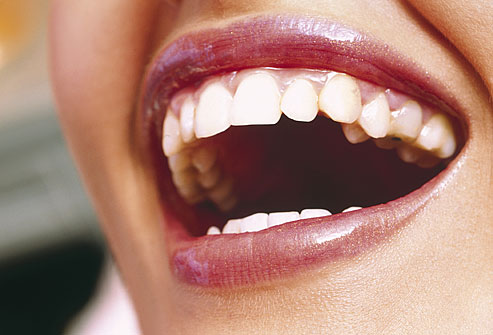
A very early form of human dentistry took place at least 6,500 years ago. Researchers have discovered that early dentists used beeswax to fill cavities and treat tooth aches.
Dr Federico Bernardini states that:
“This finding is perhaps the most ancient evidence of pre-historic dentistry in Europe and the earliest known direct example of therapeutic-palliative dental filling so far.”
Other researchers have also dated tooth drilling to at least 9000 years old. Although it is unclear why the teeth were drilled, it may very well have been to alleviate pain.
No wonder we are so afraid of going to the dentist. The fear has been imprinted onto our genetic make up over the course of 1000’s of generations!
-
Watching Evolution Occur

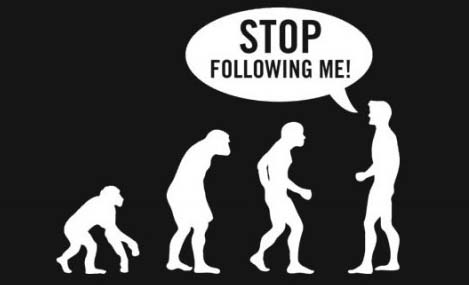
Researchers at Michigan State University have just revealed that evolution is as easy as 1-2-3. Their goal was to observe how fast growing E.coli could evolve to digest citrate along with their normal diet of glucose. E.coli bacteria is unable to digest the protein citrate, but through natural selection, they evolved right before the researchers’ eyes to be able to go to town on their new delicacy.
Richard Lenski, one of the lead researchers, explained that,
“We first saw the citrate-using bacteria around 33,000 generations, but Zack was able to show that some of the important mutations had already occurred before then by replaying evolution from different intermediate stages. He showed you could re-evolve the citrate-eaters, but only after some of the other pieces of the puzzle were in place.”
Three steps are required for the mutation to take place. In the first step, potentiation, the E. coli developed two minor mutations that prepared them to evolve further. During actualization, the second step, the bacteria began taking tiny bites of the citrate, seemingly out of curiosity. In the final step, refinement, major mutations occurred that allowed the E.coli to gluttonously eat the citrate. This ability quickly became dominant in the colonies of bacteria.
Researchers were understandably excited as they were able to witness the mutation with unprecedented clarity Lenski states that, in regards to the actualization stage,
“It wasn’t a typical mutation at all, where just one base-pair, one letter, in the genome is changed,” he said. “Instead, part of the genome was copied so that two chunks of DNA were stitched together in a new way. One chunk encoded a protein to get citrate into the cell, and the other chunk caused that protein to be expressed.”
Fun fact: many people believe, as a way to disprove evolution, that dinosaur fossils are simply an attempt by God to test our faith.
Fun fact: the article you just read.
Go science!
-
Mystery of the Dying/Disappearing Honeybees Solved

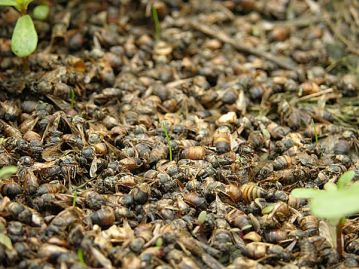
Colony Collapse Disorder is a serious threat to commercial, and many wild honeybees around the world. Scientists have been scratching their head trying to understand why so many honeybees are disappearing, abandoning their hive and subjecting their queens to painful starvation and death. Is it an all out bee revolution? Actually, new studies are pointing the finger at a class of pesticide called neonicotinoids.
These pesticides, known as ‘neonics’ are used widely throughout the US and are also staples in home gardening products. The chemicals are a nerve poison to insects, and is likely responsible for the bees not being able to find their way back home.
The evidence is overwhelming. Harvard even recreated massive colony collapse by administering minuscule amounts of a popular neonic to a hive.
Researchers at Harvard state that,
“There is no question that neonicotinoids put a huge stress on the survival of honey bees in the environment. The evidence is clear that imidacloprid [one of the most popular neonics on the market] is likely the culprit for Colony Collapse Disorder via a very unique mechanism that has not been reported until our study.”
That mechanism is high fructose corn syrup, which did not affect bees until it was mixed with the neonic in 2004 -2005. The very next year massive Colony Collapse Disorder began to affect the US.
Poor agricultural practices like monoculture, massive land development, and GMO planting may also be factors contributing to Colony Collapse Disorder.
Many countries, including Poland, France, and Germany have begun banning pesticides linked to bee deaths and have seen dramatic improvements in the overall health of their bees. Colony Collapse Disorder is a warning, and if we act quickly to solve the problem, it will not bee too late.
It is unknown whether Einstein actually said it, but there is a famous quote usually credited to him that holds a great amount of truth nonetheless:
“If the bee disappeared off the surface of the globe then man would only have four years of life left.”
Time to alter our farming practices and get these agricultural monopolies out of our back pockets. Why not empty our pockets all together!?
-
Using Carbon Nanotubes to Make Holograms


Carbon nanotubes are a man made material thinner than visible light, and they are being used to create holograms.
These tiny tubes are over 100 times stronger than steel and one-sixth the weight. The extremely small size of the tubes, 700 times thinner than a human hair, are the most important aspect of why they are revolutionizing hologram technology. Haider Butt, an optical scientist at the University of Cambridge in England, explains that,
“Due to the nanoscale dimensions of the carbon nanotube array, the image presented a wide field of view and high resolution.”
Scientists are also researching other potential materials that could implement a less static design, creating fluidly changing holograms.
-
Controversial “Killer” Egg Yolks

http://www.pabnews.com A research study by Western University Canada has claimed that eating egg yolks is almost as bad for health as smoking. In this shocking turn of events researchers realized that one of America’s favorite breakfast foods might actually be bad for health.
Lead researcher Dr. David Spence, from the University of Western Ontario, has come up with some prudent results for our day and age. In the article
“Spence added the effect of egg yolk consumption over time on increasing the amount of plaque in the arteries was independent of sex, cholesterol, blood pressure, smoking, body mass index and diabetes.”
Well, that looks like a smoking gun to me, but is that the whole story? There are doctors who say it’s not.
Dr. Jonny Bowden thinks this study is totally invalid. You can read his articleto find out why, but the main point is it’s only a correlation, not causation. He also says it’s totally contrary to previous scientific study from Harvard. However from where I’m sitting that previous research
seems to suggestliterally states that“These findings suggest that consumption of up to 1 egg per day is unlikely to have substantial overall impact on the risk of CHD or stroke among healthy men and women. The apparent increased risk of CHD associated with higher egg consumption among diabetic participants warrants further research”
If the findings only “suggest” a conclusion and one small group of scientists think something “is unlikely” that sounds pretty inconclusive to me. In addition to those conclusions sounding wishy washy, the study wasn’t looking at egg yolks. It’s focus was whole eggs. An excellent article written on the Harvard School of Public Health Website (which is also who did the original study) notes that this study does not show a correlation between eggs and Coronary Heart Disease (CDH), but notes that too few of the women involved in the study ate more than an egg a day to determine anything regarding higher egg intakes. The article also points out that the nutrients present in whole eggs are beneficial to health and may be counteracting any negative effects the eggs may have. Not only that but
“…eggs can take the place of other breakfast foods that have adverse effects, such as white toast with butter. “
So it looks like the first article only found correlation, not causation. Okay let’s take that into consideration, it’s not definitive evidence. And Dr. Jonny Bowden seems to be twisting the Harvard study to say that it definitively proves the opposite (maybe hoping no one would follow the link and look at the study?) However the approach Harvard takes to it’s own research is objective and critical of the results. It’s actual science. They admit there are good things and bad things about eggs, but is eating an egg yolk specifically bad for us? Well it looks like the jury’s still out on that one.
Sources:
Western News: Research finds egg yolks almost as bad as smoking
HuffNews: Egg Yolks: As Bad as Smoking? About That Study…
Harvard School of Public Health: Fats and Cholesterol: Out with the Bad, In with the Good
-
Killer Egg Yolks

3 egg yolks (Photo credit: Wikipedia) A recent research study has claimed that eating egg yolks is almost as bad for health as smoking. In this shocking turn of events researchers realized that one of America’s favorite breakfast foods is actually bad for health.
Lead researcher Dr. David Spence, from the University of Western Ontario, has come up with some prudent results for our day and age. In the article
“Spence added the effect of egg yolk consumption over time on increasing the amount of plaque in the arteries was independent of sex, cholesterol, blood pressure, smoking, body mass index and diabetes.”
Well, that looks like a smoking gun to me, but is that the whole story? There are doctors who say it’s not.
Dr. Jonny Bowden thinks this study is totally invalid. You can read his article to find out why, but the main point is it’s only a correlation, not causation. He also says it’s totally contrary to previous scientific study from Harvard. However from where I’m sitting that previous research
seems to suggestliterally states that“These findings suggest that consumption of up to 1 egg per day is unlikely to have substantial overall impact on the risk of CHD or stroke among healthy men and women. The apparent increased risk of CHD associated with higher egg consumption among diabetic participants warrants further research”
If the findings only “suggest” a conclusion and one small group of scientists think something “is unlikely” that sounds pretty inconclusive to me. In addition to those conclusions sounding wishy washy, the study wasn’t looking at egg yolks. It’s focus was whole eggs. An excellent article written on the Harvard School of Public Health Website (which is also who did the original study) notes that this study does not show a correlation between eggs and Coronary Heart Disease (CDH), but notes that too few of the women involved in the study ate more than an egg a day to determine anything regarding higher egg intakes. The article also points out that the nutrients present in whole eggs are beneficial to health and may be counteracting any negative effects the eggs may have. Not only that but
“…eggs can take the place of other breakfast foods that have adverse effects, such as white toast with butter. “
So it looks like the first article only found correlation, not causation. Okay let’s take that into consideration, it’s not definitive evidence. And Dr. Jonny Bowden seems to be twisting the Harvard study to say that it definitively proves the opposite (maybe hoping no one would follow the link and look at the study?) However the approach Harvard takes to it’s own research is objective and critical of the results. It’s actual science. They admit there are good things and bad things about eggs, but is eating an egg yolk specifically bad for us? Well it looks like the jury’s still out on that one.
-
Self-Camouflaging Soft Robot
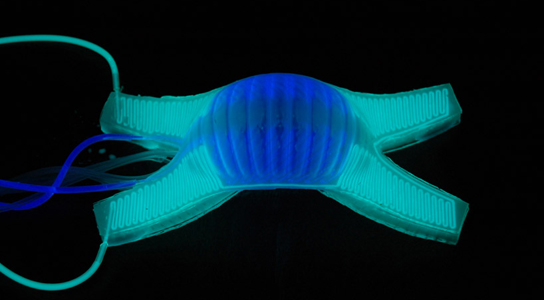
http://scitechdaily.com/ A self-camouflaging soft robot Researchers at Harvard have created the first self-camouflaging soft robot. The robot is mobile and has the ability to recognize the color of its environment and mimic the surrounding colors. Using pumped microfluids, the robot is able to quickly hide itself within its environment.
The self-camouflaging soft robot must be tethered to a central control system which pumps the liquids into its transparent body. It is able to alter its colors with great specificity in approximately 30 seconds.
As this amazing self-camouflaging soft robot only costs $100 per unit to produce, it is a very cheap method for military operations requiring mobile stealth.
Of course, it will go to the military first. I wonder when we will be able to implement this fluid adaptability in our cars.
Sources:
SciTechDaily: DARPA & Harvard’s Soft, Self-Camouflaging Robot
-
Self-Camouflaging Soft Robots

Researchers at Harvard have created the first self-camouflaging soft robot. The robot is mobile and has the ability to recognize the color of its environment and mimic the surrounding colors. Using pumped microfluids, the robot is able to quickly hide itself within its environment.
The robot must be tethered to a central control system which pumps the liquids into its transparent body. It is able to alter its colors with great specificity in approximately 30 seconds.
As the robot only costs $100 per unit to produce, it is a very cheap method for military operations requiring mobile stealth.
Of course, it will go to the military first. I wonder when we will be able to implement this fluid adaptability in our cars.
-
Donated DNA: Kids May Have 3 Parents in the Near Future
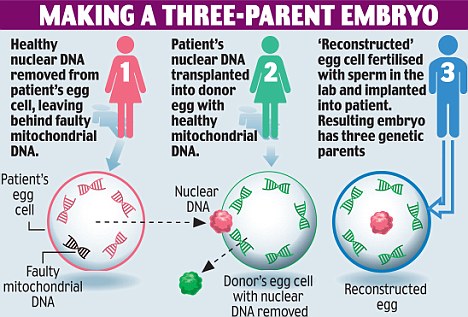
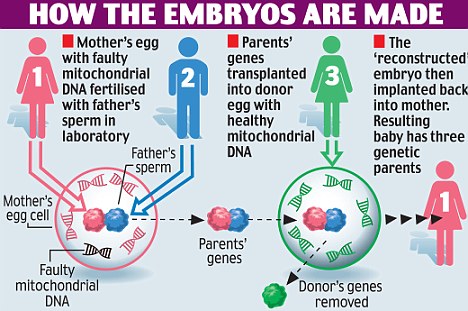
British scientists are requesting that the public formulate an opinion regarding the creation of IVF babies with three genetic parents as it is currently illegal to tamper with inherited genetic material in clinics. Having three genetic parents would prevent a wide array of diseases by using donated, healthy DNA.
This would be accomplished through the donation of healthy mitochondrial DNA, where the “baby would have a full compliment of nuclear DNA from its mother and father, plus a tiny amount of donated mitochondrial DNA.” Mitochondria have their own set of DNA separate from the rest of our body that is only passed on by women. When mitochondrial DNA is defective, it leads to diseases such as “muscular dystrophy and conditions leading to the loss of hearing and vision, heart problems and intestinal disorders.”
In order for this form of DNA donation therapy to occur, society must accept the ethical, and overly hindering, religious implications.
Personally, if I was given the option of being viewed in a potentially negative way, or not having muscular dystrohpy, I would choose societal judgement every time.
-
New Image of the Universe Captured by Hubble


The Hubble Telescope has captured a new vision of the universe, the deepest vision yet, called the eXtreme Deep Field, or XDF. This image reveals thousands of galaxies, 5,500 to be exact. It is actually a tiny fraction of the constellation Fornax capturing light over many hours of observation. “The faintest galaxies seen are one ten-billionth the brightness of what the human eye can see.”It’s hard to believe that random mess of light is a speck of dust in the mansion of light and darkness that is our home!
Wonder about your world…

Take the plunge down the rabbit hole of insanity and wonder in this fast-paced, nonstop psychological thriller that will leave you questioning the very nature of reality and beyond. Part thriller, part romance, part existential horror, A Dream of Waking Life delves into lucid dreaming, psychedelics, existential ontology, video games, the nature of love, the nature of reality, and more.

Mendel’s Ladder delivers an adrenaline-fueled journey set on a dystopian future Earth, brimming with high-stakes action, adventure, and mystery. This epic series opener plunges readers into a world filled with diverse cultures, heart-pounding battles, and characters who will captivate your heart and imagination.

“E.S. Fein is raising the bar for quality as it’s a very well-written and thought-provoking book…There are points and themes in the story that could be discussed for eons as people will have their own idea on where it leads. It’s a book I would highly recommend.” – Andy Whitaker, SFCrowsnest

 Wondergressive