
-
Is Religion Good For Your Brain?
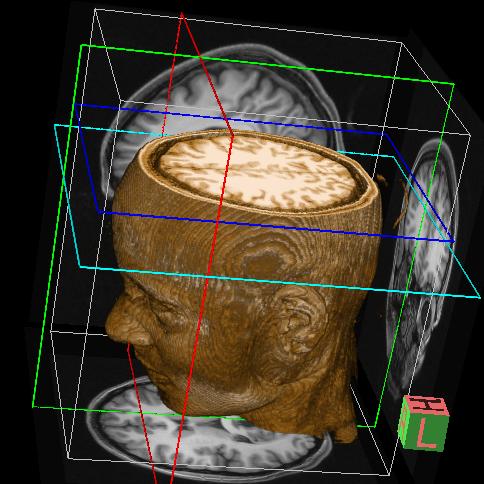
When you think of religion does your body get invigorated? Do you feel your soul flutter? Does your brain reach a higher state of functioning? In answer to the last question, Jeffrey Anderson, assistant professor of nueroradiology at the University of Utah states that,
We think we have the tools now to do a study of brain activity during the really profound and deep types of emotional and social interactions associated with religion, and we’re really excited to try and understand more.

Religion constantly falls under the close scrutiny of science. Anderson and other researchers are launching a new study that will examine exactly how religion and spiritual rituals impact the human brain. The study will consist of participants between the age of 20 and 30 who are currently active in their faith. An MRI scan will be performed while the participants are surrounded by faith oriented activities, such as listening to spiritual music, listening to proclamations from their religion, and acting out religious rituals associated with their particular faith. Very interesting indeed, but it will take some time before the results of the study are posted. If you believe your self to be a prime candidate for the study, and of course as long as you are in the immediate area of the University of Utah, you can apply to be a participant on the Religious Brain Project website.
Related Article: Morals or More Rails (to guide us)
The study does beg another set of questions however: can religion and belief be measured by science? Or rather, should science be used to gauge religion? Is it morally correct to accept religion over science, or vice versa? Essentially we arrive at a very pertinent question: should religion be completely replaced by science within the school system as a more viable teaching strategy?
Bill Nye (yes, the science guy) and Ken Ham (Answers in Genesis, supporting the side of religion and creationism) squared off in a debate last night about religion which addressed these issues directly. The overarching question of the debate was : Is creation a viable model of human origins in today’s modern scientific era? Both sides had their own opinions as well as evidence to back up their claims.

Which Religion is right? Which book do your prefer? sciencebasedlife.wordpress.com In the debate, Ken Ham defends religion by stating that science should be split into two separate categories. The first would pertain to observational science (a science based on models). This category involves what we experience now and how the world works today. The second category involves historical science (a type of theoretical science of origin) which is used to define our origins and makes sense of the world around us from a historical perspective. He stresses the importance of separating the two to help with the confusion that children are being exposed to. He gives the example that by only teaching evolution, which to most starts with a random beginning for no reason other than “it happened,” we limit children to thinking that science is just as random. This randomness can crate incredible confusion when making conclusions about existential quandaries children are trying to work through. Ken Ham asserts that instead, children should be taught religion and to embrace the idea of God because it empowers them to think they are indeed special, as they are made in the image of God.
Related Article: In 1610 God Was a Binary, Fractal, Self-Replicating Algorithm
Bill Nye on the other hand focuses on accepted scientific evidence to disprove Ham’s assertions regarding religious truth. For example, he refers to the different layers in stone and snow that have been compressed to form ice which would take far longer than the amount of time Creationism allows for. He talks about the allotted four thousand years since the Great Flood and the improbability of the amount of species we see today to exist with the limited time that Creationists claim elapsed since then. He stresses the idea that we need to depend on natural law and orders, not religious or divine laws, to predict practical and accurate future theories and laws. He asserts that the basis of scientific education must be information derived through the scientific process, such as evolution, in order for children and future scientists to make reasonable scientific predictions in the future. In essence, he is claiming that one must understand and accept theories like evolution which have been supported with scientific evidence in order to understand why a fish can come to walk on land, why there are over 8.7 million different species on Earth, why layers in rocks and trees and ice exist, and so on. He stresses that by allowing religion and Creationism to thrive in academic settings we are impeding the scientific literacy of future generations and essentially stifling the United States in future scientific breakthroughs.
Related Article: Watching Evolution Occur
The debate finished with questions and rebuttals, but the underlying theme of the debate, I fear, was lost. Instead of trying to prove why one or the other is wrong in the school system, it turned into a contest of ego and the denouncing of each others ideals.
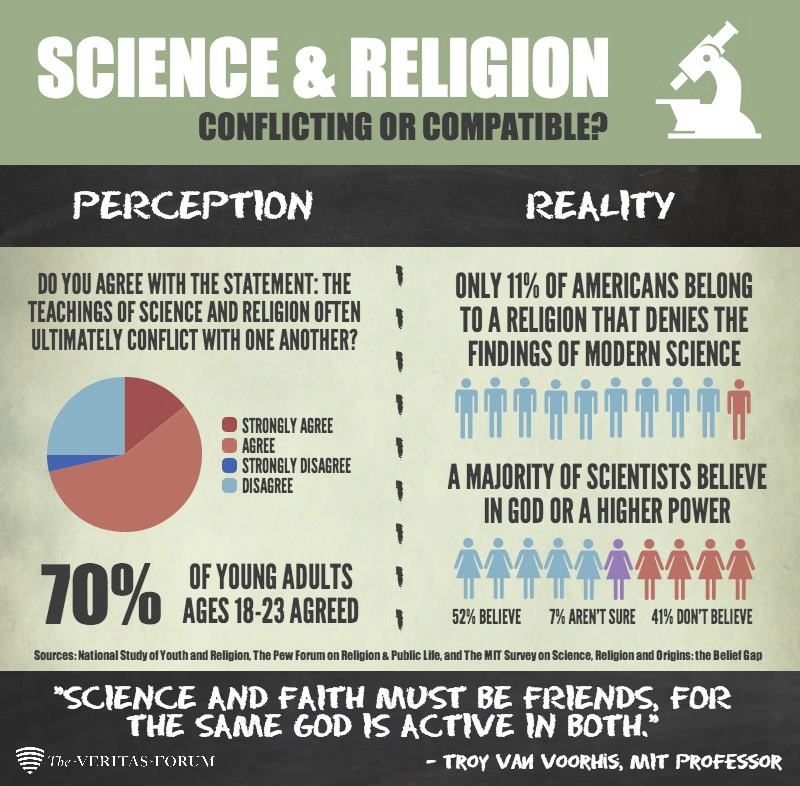
Some surprising statistics about religion and science. blog.faithlife.com I wonder, why not accept both ideas? Why not teach every child in every classroom the idea of science, and then, on your own time, teach your children your worship, your religion, and your belief. Allow for both religion and science to be taught in their own settings (in schools and at home/place of worship respectively) and allow for the child to then choose which idea they support and believe. What is with this unyielding hatred between the two schools of thought? What ever happened to being free and allowing for choice? Most importantly though: can’t we all just get along?
In the end, much of the issue is largely based on opinion, some opinions stemming from facts, others stemming from observed information. One thing is for certain, all this debate and speculation on religion is definitely causing your brain to function at an elevated level. Maybe you’ve been unintentionally participating in Anderson’s experiment this whole time!
To feed your own opinions further, or for the sake of debate itself, check out the Bill Nye and Ken Ham debate on Creationism vs. science in the video below!
Cheers!
Sources:Deseret News: What’s the effect of religion on the brain? U. launches new study
Youtube: Bill Nye Debates Ken Ham
Youtube: Bill Nye: Creationism Is Not Appropriate for Children
Youtube: Ken Ham Responds to Bill Nye “the Humanist Guy”
Answers in Genesis – Creationism
Wikipedia: Genesis flood narrative
Backreaction: Models and Theories
How many species on Earth? 8.7 million
Wondergressive: Watching Evolution Occur
Wondergessive: Morals or More Rails (to guide us)
Wondergressive: In 1610 God Was a Binary, Fractal, Self-Replicating Algorithm
Belief, big bang theory, Bill Nye, Bill Nye and Ken Ham debate, brain, children, creationism, creationism evidence, creationism true, creationsim debate, debate, evolution, faith, God, Jeffrey Anderson, Ken Ham, modern scientific era, new study, religion, religion vs science, rituals, school system, science, science bad, spiritual, University of Utah -
“Envy-Free” Algorithm Easily Settles Divorce and Inheritance Disputes

One of the most expensive parts of a marriage is the divorce. Divorce and death are two of the most common events that take place in the average person’s life. Unfortunately divorce and death often involve some pretty potent cocktails of emotion, leading to the types of fights that leave relationships and families torn asunder. What’s more, the legal proceedings involved in a divorce are extremely expensive, sometimes too expensive for married couples that desire a divorce. Lucky for us a group of researchers have created what they believe to be an easy and viable solution to divorce and inheritance disputes.
Related Article: Biggest Wastes of Money (Part 2): Bottled Water, Weddings, Jewelry, Paper Towels
In a paper published in Notices of the American Mathematical Society, researchers Steven Brams from New York University, Wilfrid Laurier University’s D. Marc Kilgour, and the University of Graz’s Christian Klamler outline a pair of simple algorithmic functions that divvy up property and wealth in a completely fair and envy-free way.
The distribution of property is an age old issue, possibly one of the original conflicts early humans faced hundreds of thousands of years ago. As the authors note in the paper,
The problem of fairly dividing a divisible good, such as cake or land, between two people probably goes back to the dawn of civilization.

“Look Honey, I know you want everything, but this should be fair.” “WHAT IS FAIR?” http://www.ehow.com As society has evolved, more and more of our possessions have become indivisible, especially in the case of non-allocated marital property in a divorce. The researchers state that this added difficulty with regards to indivisible property is no challenge for their algorithms.
Unlike more demanding fair-division algorithms, which ask players to give more detailed information or make more difficult comparisons, our algorithms are easy to apply and, therefore, eminently practicable.
The algorithms take into account how each party ranks a list of their self-identified priorities from best to worst. In this way the algorithms are able to optimize fairness. The first algorithm requires that players take turns attributing a rank to items, starting with their most preferred item and descending to their least preferred item. The second algorithm asks that each party submit the complete preference ranking to an unbiased source, or a computer.
Related Article: In 1610 God Was a Binary, Fractal, Self-Replicating Algorithm
The algorithms are envy-free because they do not compare items directly, but rather the preference each party has for an item relative to preferences for other items as well as the opposite party’s preferences. This should be an easy process, but divorce is never easy, is it? If both parties desire an item at the same point in the algorithm, meaning that the relative preference each party has for the item is equivalent, a problem arises. Let’s take an example of party A and B ranking four items from left to right (most preferred to least preferred):
A: 1 2 3 4
B: 2 3 4 1Now, if we give A item 1 and B item 2 (their most preferred), the next unallocated item on both their lists is item 3. Who should get it? The algorithm gives it to A and gives item 4 to B, which is an envy-free allocation because each player prefers its items to the other player’s:
A prefers item 1 to 2 and item 3 to 4
B prefers item 2 to 3 and item 4 to 1Not only does each party prefer its pair of items to the other’s, but there is no alternative allocation that both parties would prefer, which makes it efficient.
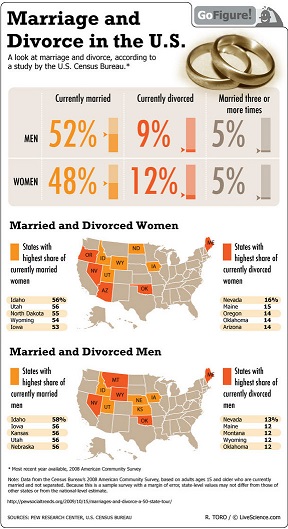
There is no such thing as bachelorhood in Idaho. http://www.livescience.com/ An ideal allocation isn’t always possible using the algorithm, but to be fair, an ideal allocation is practically never possible during a divorce, so this is a major improvement regardless. If worst comes to worst, the algorithm can place items that both A and B have a high preference for into a contested pile to be argued over at a later time. This at least makes the pile of non-allocated items smaller, and attorney fees less expensive for both parties.
Related Article: Money, Designed to Fail: In The Federal Reserve’s Grip
There are nearly 1 million divorces occurring in the United States each year. Some countries have divorce to marriage ratios as high as 71%. As for inheritance disputes, everyone dies, so major familial disputes are inevitably ubiquitous around the world. Just think of all the time, money, stress, and relationships these simple algorithms will save.
Sources:
http://www.ams.org/notices/201402/rnoti-p130.pdf
http://www.cdc.gov/nchs/fastats/divorce.htm
http://www.npr.org/templates/transcript/transcript.php?storyId=144021297
http://unstats.un.org/unsd/demographic/products/dyb/dyb2011/Table25.pdf
-
Smartest Dogs: Moscow Stray Dogs Ride Complex Subway System and More


A stray dog riding the subway in Moscow from point A to point B. Stray dogs living in Russia’s capital city Moscow have for many years been observed navigating the complex subway system. What’s more, the stray dogs ride the subway like any other commuter, waiting patiently to reach their intended destination and getting off at their own regular stops.
Everybody likes to think they have a smart dog. Maybe it knows a few tricks like how to say hello, pee only on the rude neighbor’s yard, or crack open a bottle of your favorite beer, but there are no dogs that can compare to a significant number of the roughly 35,000 stray dogs living in Moscow.
Related Article: Pooping Dogs Perceive Earth’s Magnetic Field
Dr. Andrey Poyarkov, a biologist who has studied Moscow’s strays for 30 years, told ABC News that,
In Moscow there are all sorts of stray dogs, but… there are no stupid dogs. The street is tough and it’s survival of the fittest. These clever dogs know people much better than people know them.

This dog takes a nap while waiting for the next stop. englishrussia.com Studies back up Dr. Poyarkov’s assertion that the stray dogs know people better than people know the dogs. Dogs have honed their social skills over the thousands of years they’ve interacted with humans. They’ve become masters of understanding complex human emotions and human societal structure. Furthermore, dogs are the only non-primate species that instinctively moves its gaze to the right side of a face to obtain information about emotions and general state of being. Amazingly, dogs only exhibit this behavior only when meeting a human being.
Related Article: Dogs Can Predict Earthquakes by Hearing Them
Dogs are certainly an interesting and clever species due large in part to their longstanding position as Man’s best friend.This relationship is likely the reason stray dogs are able to comprehend the relatively complex intricacies of one of the world’s most extensive and impressive subway systems.
According to Poyarkov’s graduate student, Alexei Vereshchagin, what’s most impressive about the subway riding stray dogs is that they are able to remain perfectly calm and focused despite the Metro’s blaring noises and huge crowds of people. Vereshchagin explains that,
It’s stressful even for people standing in a crowd, and the dogs are lying down so no one is seeing them, so anyone can put feet on them. But they get used to this.
Poyarkov notes that Moscow’s stray dogs have adapted to human society in other incredible ways as well. For example, packs of stray dogs have been seen obeying traffic lights, and sending cuter dogs to beg for food for the pack. Packs and individual stray dogs have also been reported scaring people in an attempt to snag a free meal. The strays jump up behind people holding food and bark right behind their head, causing the person to drop their food out of fear. Poyarkov notes that this is clearly a harmless scare tactic as the stray dogs don’t normally bite or scratch.
Fortunately the stray dogs and people of Moscow seem to be living peacefully together. There is even a statue in the Mendeleyevskaya subway station commemorating a stray dog named Malchik, who was stabbed to death by a fashion model for barking at her pet terrier.
Related Article: A Group of Prominent Scientists Agree; Animals are Just as Conscious as Us
All of these behaviors illustrate that dogs are highly capable at adapting to new environments, especially when it comes to urban sprawls. In truth, all dog breeds are intelligent in vastly different ways. Some make great hunting companions, some are excellent at evading detection, some are the perfect security guard, while others are masters of cuddling.
The degree of intelligence also varies greatly from breed to breed, as well as from individual to individual. A great example is that of Betsy the dog, a border collie who knows more than 340 words and is able to easily connect an actual object with a photo of the same object despite having seen neither before. My dog can barely recognize her own name. She’s of the ‘expert cuddler’ class of intelligence. Chaser, a border collie from the United States, can remember the names of more than 1,000 items. Scientists also state that Chaser can categorize toys by function or shape, an activity learned by young human children.
In 1994, Stanley Coren, a professor of psychology at the University of British Columbia in Vancouver, published a book entitled The Intelligence of Dogs. The book presents a list of dog breeds ordered by intelligence. Intelligence is evaluated using 3 different criteria: instinctive intelligence, adaptive intelligence, and working and obedience intelligence. Below is a list of the top 10 canine geniuses, and the top 10 canine derps. Don’t let your dog see it though since studies show that dogs are prone to human-like jealousy.

This dog is a genius. safe4work.org Geniuses:
- Border Collie
- Poodle
- German Shepherd
- Golden Retriever
- Doberman Pinscher
- Shetland Sheepdog
- Labrador Retriever
- Papillon
- Rottweiler
- Australian Cattle Dog
Derps:

This dog is a derp. agentmlovestacos.com - Basset Hound
- Mastiff
- Beagle
- Pekingese
- Bloodhound
- Borzoi
- Chow Chow
- Bulldog
- Basenji
- Afghan Hound
Sources:
http://www.sciencedirect.com/science/article/pii/S1364661305002081
http://www.perceptionweb.com/abstract.cgi?id=v070385
http://ngm.nationalgeographic.com/2008/03/animal-minds/virginia-morell-text
http://www.amazon.com/The-Intelligence-Dogs-Thoughts-Companions/dp/0743280873
http://www.psychologytoday.com/blog/canine-corner/200907/canine-intelligence-breed-does-matter
http://knowyourmeme.com/memes/derp
abc stray dog, alexei vereshchagin, andrey poyarkov, border collie betsy, chaser border collie, derp, dog breed, dog emotion, dog human emotion, dog human face, dog jealousy, dog statue, dog training, intelligent dog breed, malchik, mans best friend, metro, moscow metro, moscow stray dog, russia stray dog, smart dog, smartest dog breed, stray dog, stray dog breed, stray dogs, subway, the intelligence of dogs -
Sloth Hair Fungus is an Incredibly Potent and Effective Medicine


Three-toed sloths are giving us a reason to smile. http://www.factzoo.com/ Sloths have quickly become the center of a great deal of excitement in the medical world. Researchers from Panama and the United States have discovered that multiple species of fungi growing on sloth hair may be the answer to a large list of medical maladies. The discovery is examined in a recent peer reviewed study published on January 15th.
In the study, researchers examined a total of 84 fungal samples found on the coarse outer hair of nine live three-toed sloths. The fungus filled sloths are native to the Soberanía National Park, in the Republic of Panama. A large number of these fungal samples were found to be beneficial in a number of different ways. Anti-cancer, anti-parasitic, and anti-bacterial properties were all exhibited by at least one species of fungus found on the three-toed sloths. More specifically, fungus found growing on sloth hair proved to exhibit bioactivity against
Trypanosoma cruzi, the causal agent of Chagas disease; Plasmodium falciparum, the causal agent of malaria; the human breast cancer cell line MCF-7; and a range of Gram-negative and Gram-positive human pathogenic bacteria.

The global distribution of malaria. This is great news since Chagas disease is listed by the CDC as one of the top five most neglected parasitic infections in the US based on its severity, the number of people infected, and the ability to prevent and treat it. This is largely due to a lack of awareness regarding the disease. Over 8 million people in Mexico, Central America, and South America have Chagas disease. It has made its way to the United States with nearly 300,000 US citizens currently diagnosed with the illness. Sloths to the rescue.
Related Article: Fungi Fun: Mushrooms and How to Harness their Power
As for malaria and cancer, the need to find an expedient cure or effective preventative mechanism is clear. Over 3 billion people live in a malaria-risk zone. 655,000 people (86% were children) died in 2010 of malaria. Everyone is at risk for cancer. 8.2 million people died from cancer in 2012. There’s no need to elaborate on the need to find a cure for these illnesses.
Not surprisingly, this is the first time fungal samples found on sloth hair have been tested and reported to be at least minimally effective in treating human disease. Who would have thought that something so slow and easy to catch would prove to be so extremely beneficial to us?
The researchers originally chose the three-toed sloth as a viable candidate for harboring natural medicinal substances due to the vast amount of fungus and algae that grows on the sloths’ hair. Since the discovery of penicillin more than 80 years ago, fungi began and continue to be widely used for their medicinal benefits. This applies to both raw fungus, and fungus as a base for chemical derivatives used in various types of medicine around the world.
Related Article: Amazon Rainforest Holds Many Surprises
Unfortunately, the success rate of finding a fungus that exhibits bioactivity against human sources of diseases has dramatically slowed. This led some scientists to believe that we had already discovered the easy to find bioactive fungi. As the authors state in the study, many scientists believed that the slowed rate of discovery could be an indication of,
the impending exhaustion of ‘low hanging fruit’ – the easily and frequently accessed fungi such as soil microfungi – as sources of new bioactive metabolites.
Simply put, with the exhaustion of “low hanging fruit,” discovering and creating effective medicine becomes increasingly difficult. However, just because the “low hanging fruit” is exhausted doesn’t mean the whole tree has been uprooted. We have discovered less than 100,000 different fungal species out of the conservative estimate of five million species of fungus that calls Earth its home. This is why scientists are starting to get creative in the places they look for new, bioactive fungi. Cue the the three-toed sloth, and wait a few hours for it to make its grand appearance.
The researchers suggest that their results illustrate that sloth hair may be a potential source of even more bioactive fungi. They note that there are five other sloth species on the planet with fungi-filled hair ready for examination.
It takes a great deal of time and luck to find a new, effective medicinal constituent. Let’s hope father time and lady luck are on our side. As for sloths; thanks for hanging around.

It’s a good thing for this sloth that time is relative. Sources:
http://www.plosone.org/article/info%3Adoi%2F10.1371%2Fjournal.pone.0084549
http://www.pbs.org/wgbh/aso/databank/entries/dm28pe.html
http://link.springer.com/article/10.1007%2Fs00253-011-3270-y
http://www.amjbot.org/content/98/3/426
http://www.cdc.gov/parasites/chagas/gen_info/detailed.html
http://www.cdc.gov/parasites/resources/pdf/npi_chagas.pdf
http://www.cdc.gov/parasites/npi.html
http://www.iarc.fr/en/media-centre/pr/2013/pdfs/pr223_E.pdf
http://www.cdc.gov/malaria/malaria_worldwide/impact.html
anti cancer, anti parasite, antibacterial, bioactivity, breast cancer, CDC, chagas disease, fungi medicinal, fungus, low hanging fruit, malaria, panama, sloth, sloth cancer, sloth funny, sloth hair, sloth hair fungi, sloth hair fungus, sloth slow, sloth smile, soberania national park, three toed sloth, three toed sloth medicine -
Believing You Get Enough Sleep Works as Well as Getting Enough Sleep
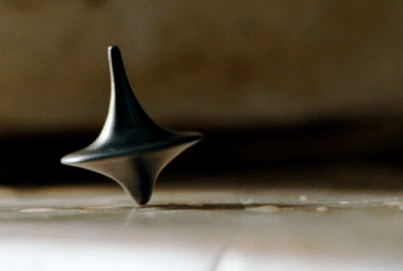
According to a recent study, getting enough sleep each night may be as easy as believing you got enough. Although the biological effects of believing in having enough sleep were not discussed in the study, the results clearly illustrate a marked improvement in cognitive functioning due solely to a placebo effect.
Sleeping is Believing
The authors of the study make it clear that the placebo effect can be found working its magic in all aspects of life and health, including getting enough sleep. This study, however, is the first that shows a clear placebo effect influencing the cognition of participants in a sleep experiment.
The overall study was split into two studies involving 164 participants. The participants were required to report their previous night’s sleep quality. Researchers then secretly and randomly assigned an additional sleep quality to each person. Each participant was told their sleep was of “above average,” or “below average,” quality. Some participants were placed into a control group instead.
Related Article: Man in Coma for 7 Years Given Sleeping Pill and Wakes Up
Those in the “above average” group were told they received more than enough sleep with 28.7% of their sleep time spent in the regenerative state of REM sleep. The “below average” group was told they did not receive enough regenerative sleep with only 16.2% of their time in REM sleep. Interestingly, the assigned sleep quality, rather than the perceived sleep quality, had a major influence on the cognitive functions of participants, even after accounting for experimental variables and the control group.
According to the researchers,
Assigned sleep quality but not self-reported sleep quality significantly predicted participants’ scores on the Paced Auditory Serial Addition Test and Controlled Oral Word Association Task. Assigned sleep quality did not predict participants’ scores on the Digit Span task, as expected, nor did it predict scores on the Symbol Digit Modalities Test, which was unexpected. The control conditions showed that the findings were not due to demand characteristics from the experimental protocol.
This study is a clear example of how incredibly powerful of an effect our mindsets have on our lives. The placebo effect is well documented in humans. In fact, according to the American Cancer Society, 1 out of 3 people are greatly affected by placebo. The opposite of the placebo effect is the nocebo effect. Instead of feeling better, the nocebo effect makes people experience negative symptoms despite no biological or psychological changes taking place within them.
Related Article: Prevent Type 2 Diabetes By What You Love to Do Most: Sleep
News that the placebo effect can be used to impact whether we get enough sleep or not is especially welcome in light of another recent study linking sleep and cancer. According to the study, a fragmented and/or inadequate amount of sleep accelerates cancer growth.
When Sleeping is Cancerous
Although the results were seen in mice, the observed effects of fragmented sleep on cancer growth were so strong as to be alarming.
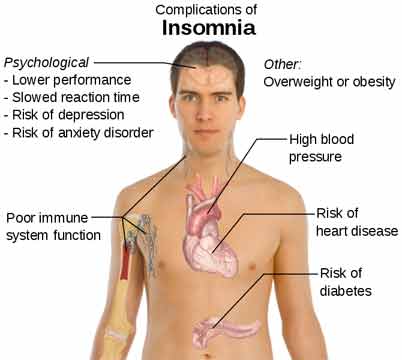
Sleep your way to better health! http://www.age-well.org According to the study published in the journal Cancer Research on January 21, 2014, fragmented sleep negatively impacts the immune system, leading to alterations in the way it deal with cancerous tumors. The director of the study David Gozal, MD, chairman of pediatrics at the University of Chicago Comer Children’s Hospital explained that,
It’s not the tumor, it’s the immune system. Fragmented sleep changes how the immune system deals with cancer in ways that make the disease more aggressive.
Multiple types of tumors in mice with fragmented sleep were found to be more than twice as large as tumors in mice sleeping without interruption. Not only were the tumors larger, they were also more aggressive.
Related Article: How Sleep Aids the Body in Growth and Regeneration
It’s of the utmost importance that we get enough sleep. I know the first study might sound like a loophole to sleeping, but unless you are a 19 year old athlete, convincing ourselves we’ve had enough sleep the previous night can only work for so long. At some point we need to give our bodies and minds the sleep coma they deserve.
How Much Sleep is Enough Sleep?
The answer to “are we getting enough sleep” varies with age, health, genes, and a whole other assortment of differences. However, a simple answer is provided by the National Sleep Foundation.

The key to getting enough sleep is to experiment and figure out how many hours you actually need. So many of us sleep too little, or too much, without being aware of how we feel when we wake up. Keep a sleep diary. Record when you lay down to go to sleep and when you wake up. Try to vary the amounts to get a better idea of what works best for you. Record how you feel as well, including emotions, wakefulness, and mood. After a month, look back at your sleep diary and figure out the magic number that will give you just enough sleep.
Related Article: Engineering the Perfect Morning in 8 Easy Steps

This picture pretty much sums up whether you will wake up grumpy or not. http://sleepdisorders.dolyan.com/ It would also be a good idea to try to time your sleep in 90 minute to 120 minute intervals. The reason for this is that sleep consists of 4 major stages that repeat every 90 -120 minutes. There is a natural rhythm to our sleep, and the key to getting enough sleep while still feeling revitalized is mastering that rhythm. Ever notice how sometimes you wake up feeling like Tyler Durden ready to seize the day, while other mornings you feel like torching existence for forcing you out of your slumber? On the bad days it’s likely you were woken up in the middle of deep sleep (stage 3), and on the good days you likely woke up after REM (stage 4) and at the beginning of stage 1.
I’ve been experimenting with sleep for over a decade. Most of the time my optimal amount of sleep is between 7 hours and 38 minutes and 7 hours and 44 minutes. Any more or any less and I’m at least a bit grumpy. My girlfriend on the other hand needs at least 9 hours to feel refreshed and ready for the day. Keep in mind that everyone is different.
Experiment with yourself, and remember to be always growing.
Sources:
http://www.ncbi.nlm.nih.gov/pubmed/24417326
http://www.eurekalert.org/pub_releases/2014-01/uocm-fsa012714.php
Rapid Eye Movement Sleep: Regulation and Function
http://www.cancer.org/treatment/treatmentsandsideeffects/treatmenttypes/placebo-effect
http://priory.com/medicine/Nocebo.htm
http://www.sleepfoundation.org/article/how-sleep-works/how-much-sleep-do-we-really-need
http://healthysleep.med.harvard.edu/healthy/science/what/sleep-patterns-rem-nrem
adequate sleep, american cancer society, cancer research, childrens hospital, david gozal, enough is enough, enough sleep, fragmented sleep cancer, getting enough sleep, how much sleep, immune system, insomnia health, nocebo effect, placebo effect, placebo sleep, regenerative sleep, rejuvinate, rem cycle, rem sleep, rem sleep health, sleep apnea, sleep cancer, sleep cycle, sleep experiment, sleep health, sleep hours, sleep immune system, sleeping enough, university of chicago -
New Devices Grant Mind Control Over Your World: The Force is With You

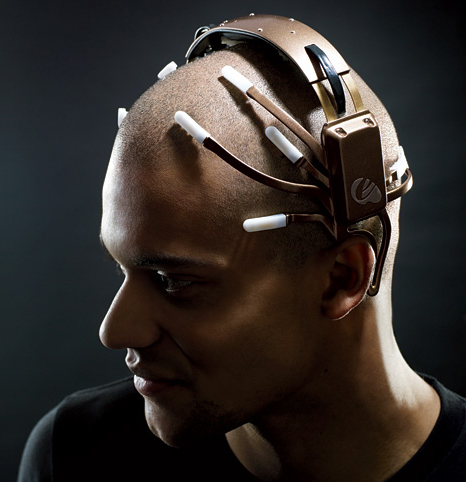
The Emotiv headband grants mind control of the user’s environment. http://www.singularityworld.com/ Mind control is the central focus of a TED talk presented in July of 2010 by Tan Le, founder & CEO of Emotiv Lifescience, a bioinformatics company which uses electroencephalography (EEG) to identify biomarkers for various disorders and conditions.
Tan begins the talk by discussing how communication between people takes into account far more information than what is explicitly expressed, like body movement, facial expressions, and tone of voice. Communicating with a machine on the other hand involves a single, unambiguous command. This leads to a roadblock within the industries of robotics, computer programming, cybernetics, and more: How can a machine communicate more like a human being if it is unable to take into account all of the information outside the literal meaning of the words we use? To get around this dilemma scientists began merging both realms of interactions so that computers could respond to all forms of communicative interactions. This in turn has led to the power of mind control being granted to us mere mortals. But how?
Related Article: Merge Biology with Electronics: First True Cybernetic Tissue Created
One of the major difficulties behind creating a computer that can take into account all of the information exchanged during a human to human interaction is the very act of detection. The algorithms required to detect all of the information being exchanged must be extremely complex. Additionally, much of the information exchanged during human interaction can be perceived in wildly different ways due to variations in culture, humor, and other societal norms. According to Tan, this is why researchers are skipping all of the vague information and going right to the source: the brain.
According to Tan,
Our brain is made up of billions of active neurons; around 170,000 kilometers of combined axon links. When these neurons interact, the chemical reaction emits an electrical impulse which can be measured.
So, we measure the electrical impulses emitted by the brain and create a universal map, or language, of the brain’s neuronal activity. Seems pretty straightforward, but fortunately for us critically thinking apes, the brain is not that simple. Tan goes onto explain that,
The majority of our functional brain is distributed over the outer surface area of the brain, and to increase the area that’s available for mental capacity the brain’s surface is highly folded. Now this cortical folding presents a significant challenge for interpreting surface electrical impulses. Each individual’s cortex is folded differently, very much like a fingerprint. So even though a signal may come from the same functional part of the brain, by the time the structure has been folded its physical location is very different between individuals, even identical twins.
So the language of normal human interaction is too vague, and the language of the brain is too complex. What was Tan and her team to do? Tan describes the breakthrough, explaining that,
our breakthrough was to crate an algorithm that unfolds the cortex so that we can map the signal closer to its source and therefore make it capable of working across a mass population.

Before mind control devices traditional sensory arrays like this one scanned the brain. http://www.wired.com And this is where mind control begins to enter the scene. The creation of the algorithm gave Tan the necessary code to accurately map the brain’s signals, but the hardware presented a new challenge. Live brain scans traditionally use an array of sensors attached to every square inch of a person’s head using a conductive gel. This method is extremely uncomfortable, and very expensive. To address this issue Tan and her team created a lightweight headset which uses no conductive gel, is wireless, and only takes a few minutes to attach to the head. The best part is that the device only costs a few hundred dollars, compared to around $10,000 for traditional sensor array helmets. Combine the new device with Tan’s complex cortical algorithm and we are left with a relatively cheap headset that can read your brainwaves in real time. The brainwave signature can be used to influence objects, granting users mind control over the object as long as it is configured to read the brainwave signal.
Related Article: Electronic Brain Implants Increase Intelligence
Tan invites a person from the audience and demonstrates the miraculous mind control abilities afforded by her mind reading headset. The device takes a neutral scan of the user’s brain, and from there it’s all Jedi mind control training. Select the action ‘pull’ on a computer, and imagine that the object on the computer screen is moving toward you for 10 seconds. After a 10 second scan is completed, every time you imagine the object moving toward you, it does exactly that. The same applies to more mentally complex actions like disappearing, multiplying, or growing larger. After getting to know the device, you are systematically granted greater and greater mind control powers.
Tan completes her TED talk by showing some of the other capabilities of her device. For example, she showed that it could be used to turn lights on and off or close the drapes at home without moving a muscle. It can even be used to fly a toy helicopter or make online video games more realistic by having colors in the game change relative to your ongoing emotions. This all sounds amazing, but this was in 2010. Let’s fast forward nearly four years into the future to 2014.
Related Article: Awareness and Dealing with Rejection
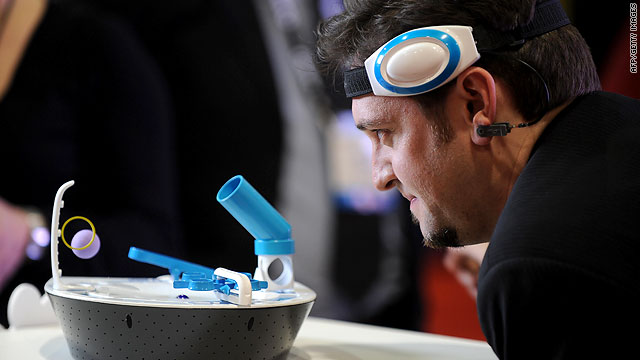
The man you see is playing a game called Mindflex which scans his brain’s awareness. http://www.cnn.com Although mind control technology is still in its infancy incredible progress has been made since Tan’s TED talk debuted. A great example of the leaps and bounds that have been made in the industry is presented in a recent NPR article. The article describes how Johnny Liu, a manager for the San Jose-based company NeuroSky, came into the KQED studio to show off his own unique pairing of mind control devices: NeuroSky’s MindWave Mobile headset, and the Orbit brain-controlled helicopter. Using these devices in conjunction with one another, Liu reveals how his level of awareness is the greatest influence on the effectiveness and stability of the helicopter’s flight. It is for this reason that this type of technology can be used to improve our mind control, not just to influence the outside world, but also ourselves.
These type of brain games allow users to practice being more calm, aware, and focused, while actually seeing the progress they have made in real-time. Richard Warp, designer of NeuroDisco, a program which allows users to make music with their thoughts, explains that,
You’re doing the same thing as a meditator, a Buddhist monk might do. But maybe we, in the West, need a device to do it.
These types of mind control activities can be seen as games, but the practical application is clear. Mind control devices allow us to hone our control over our own minds by receiving direct feedback on our progress in the form of how strongly we are influencing the world around us. This type of increase in awareness has the incredible potential to allow users to explore their own internal capabilities and begin excising their brain in the same direct manner that we exercise our bodies today.
Related Article: Oculus Rift and Omni Treadmill, Gaming of the Future!

Video games and mind control serve as a release from the struggles of living in a difficult body. http://www.wired.com Speaking of games, let’s explore an industry that will likely be one of the most heavily influenced by this technology: video games. Video games aren’t just awesome for their fun factor. Playing video games actually alters the brain, and provides myriad physical and psychological health benefits. Most of these benefits directly relate to the use of highly concentrated awareness. Awareness can be cultivated into greater control and efficiency using biosensors and mind control technology.
Still within the realm of video games, one of the most brilliant ways this technology can be used is by giving physically disabled people the opportunity to participate in and be a part of the world at large without such extreme physical difficulty and embarrassment (unfortunate, but that’s the society we live in). 15% of the entire world population, or 1 billion people, live with disabilities. This makes disabled people the world’s largest minority.
For a large number of those billion people, video games are the only form of societal interaction available. In a game it doesn’t matter if you have no legs, are paralyzed, or are psychologically impaired. Everyone starts out on equal footing in a video game. Mind control devices allow for even greater realism and control in the only world where disabled people won’t feel alone, hopeless, and stuck in a broken body. Consider as well that some disabled people are fully paralyzed but still retain complete lucidity and control of their brain. Fort the first time in the history of our planet, these people can be freed from their bodily imprisonment by being granted a new body which they can control with their mind alone.
Related Article: Starcraft as a Model for Future Interstellar Warfare
Another technological avenue to consider is that of cybernetics, where mind control technology has been used for years. Don’t have legs? No problem, here’s some robotic legs controlled by your brain. Lost your arm in a freak accident at Grandma’s house? No big deal, here’s a new mind controlled arm.
This is all just the tip of the iceberg. The technology is extremely young and yet new mind control gadgets are being released every day. The combinations are limitless as well. While mind control sounds exciting and fun, for fully paralyzed people that are basically brains in a useless body, a whole new life can be granted to them. I’m sure one day they will be able to control a fully mobile robot via mind control with all of their senses returned to them, even touch. The more we learn about our own minds, the more limitless our horizon’s become.
Who knows, maybe over time the use of these mind control devices will grant us actual force powers. Only time will tell. May the force be with you.
Sources:
http://www.ted.com/talks/tan_le_a_headset_that_reads_your_brainwaves.html
http://neurosky.com/products-markets/eeg-biosensors/hardware/
http://ericawarp.com/?projects=neurodisco
http://www.sciencedaily.com/releases/2012/04/120426114341.htm
http://theweek.com/article/index/241121/7-health-benefits-of-playing-video-games
axon links, biofeedback, bioinformatics, biosensor device, brain games, brainwave scan, cortical folding, cybernetics, eeg headband, electrical impulses, Emotiv Lifescience, force power, jedi mind, jedi mind trick, mind control, mind control device, mind control gadget, mind control training, MindWave Mobile, NeuroDisco, neurogadget, Neurosky, Orbit brain controlled helicopter, power of the force, the force is with you -
Cannabis or Cannabust: Why That “Rocky Mountain High” May Come Crashing Down on Your Heads (At Least on Your Potheads)


In Washington and Colorado toking is completely legal at the state level. http://www.tokeofthetown.com/ It’s a Colorado rocky mountain high
I’ve seen it rain fire in the sky
Friends around the campfire and everybody’s high-John Denver
When the late John Denver recorded these prophetic lyrics in 1972, who could have foreseen the day, 35 years later, when Rocky Mountain High would take its place next to Where the Columbines Grow as the official co-state song of the State of Colorado? On November 6, 2012, a mere five years after Rocky Mountain High attained such legendary status, the voters in Colorado approved a ballot initiative that would make it the first state, quickly followed by the state of Washington, to legalize the possession and sale of marijuana for recreational purposes.
The scenes on television that November evening were nothing short of remarkable. As most of America was fixated on the results of the presidential election, along with numerous congressional, gubernatorial, state and local elections also taking place on that fateful November day, an awkward assortment of casual marijuana users, hard core potheads and aging hippies rejoiced while watching the network newscasters announce the results of the Colorado and Washington ballot initiatives on marijuana.[1]
Related Article: The History and Legality of Cannabis Use Around the World

A thick haze covers Colorado, but it’s a legal haze. http://traviswright.com/ As the circus atmosphere continued to play out on television screens across the country throughout the evening, a peculiar assemblage of psychologists, sociologists, criminologists, policy pundits and other talking heads debated endlessly about the pros and cons of the legalization of marijuana. Legal scholars, on the other hand, focused on the potentially titanic clash between these state actions and Article VI (2) of the United States Constitution, commonly referred to as the Supremacy Clause.
Inevitably, there will be a deluge of legal battles in which marijuana users are surely going to be unwitting pawns. The vast majority of legal challenges to these state laws will arise not from the legalization of the substance itself, but rather from the notion that certain states are apparently determined to trump federal law in violation of the most revered and sacred legal document in our nation’s history: The Constitution of the United States.
Another complicating factor that cannot be overlooked is the shockingly complicit position taken by the United States Department of Justice (DOJ). Under the leadership of Attorney General Eric Holder, the DOJ has given a clear signal to the burgeoning marijuana industry that the federal authorities will not be enforcing federal law in a manner that would require the industry to have any serious concerns. In fact, it is not a stretch to interpret the DOJ’s official guidance on the issue as tacit approval. While the underlying motivations fueling this controversial decision are certainly nebulous,[2] the fact remains that Mr. Holder has apparently made the decision that the DOJ should not be taking aggressive enforcement action against certain groups of lawbreakers.
What is the Supremacy Clause?
The verbiage of the Constitution’s Supremacy Clause is deceptively simple;
This Constitution, and the Laws of the United States which shall be made in Pursuance thereof; and all Treaties made, or which shall be made, under the Authority of the United States, shall be the supreme Law of the Land; and the Judges in every State shall be bound thereby, any Thing in the Constitution or Laws of any State notwithstanding.
In plain English, this means that no state has the power to enact a law that is in direct conflict with a federal law, which is precisely what Colorado and Washington appear to have done.
Related Article: Federal Judge Urges Legalization of Marijuana

The constitution may be old, but it is still the law of the land. http://www.senatorhill.com/ Marijuana is classified as a Schedule I Controlled Substance under the Drug Abuse Prevention and Control Act of 1970 (commonly referred to as the “Controlled Substances Act”). In other words, as seen through the federal lens, marijuana is an extremely dangerous drug with no medical benefits. Accordingly, under the Controlled Substances Act it is a federal crime to manufacture, distribute, dispense or to possess with the intent to manufacture, distribute or dispense marijuana. Regardless of how narrowly these state laws are construed by the courts, it is difficult to see how it is plausible to reconcile these laws with the conflicting federal law in a way that would allow state and federal law to coexist.
The national debate that has been raging in this country for decades about whether marijuana is, or is not, a dangerous drug worthy of its Schedule I Controlled Substance designation is beyond the scope of this article. That issue is of little significance when compared to the dangerous precedent being established by a few “progressive” states and the Obama administration’s DOJ which, at least to this point, seems determined to facilitate the unconstitutional actions of those states. The remainder of this article is devoted to the analysis of three issues: (1) the obvious clash between these particular state laws (with the focus on Colorado’s law) and the conflicting federal law; (2) the thinly-veiled efforts of the Obama administration to pacify the marijuana enthusiasts; and (3) the likely future of these laws.
The Colorado Law
Effective December 10, 2012, Article 18, Section 16 of Colorado’s state Constitution became law. Like many laws, especially those that are bound to be controversial and challenged in the courts, the Colorado law is meticulously drafted and painfully verbose. However, for the purposes of this analysis the critical provisions can be found in subsections 3 (Personal use of marijuana) and 4 (Lawful operation of marijuana-related facilities).
Related Article: Cannabis Cures Cancer and More: A Thorough History and Review of the Evidence

State enumeration rights apply as long as the constitution doesn’t have a say in the matter. susops.blogspot.com Subsection 3 provides, in pertinent part, that persons over 21 years of age may (a) possess, use, display, purchase or transport marijuana in quantities not exceeding one ounce as well as marijuana accessories; (b) possess, grow, process or transport up to six marijuana plants, no more than three of which are mature, flowering plants, and possess the marijuana produced by those plants on the premises where the plants are grown, provided that the growing takes place in an area that is enclosed and locked and provided that the marijuana is not made available for sale; (c) transfer no more than one ounce of marijuana without remuneration to a person who is 21 years of age or older; (d) consume marijuana as long as it is not consumed publicly or openly or in a manner that endangers others; and (e) assist others who are at least 21 years of age in the acts set forth in (a) through (d) above.
Subsection 3 essentially allows anyone who is 21 or older to have their way with marijuana as long as they limit their indulgence in accordance with the seemingly arbitrary quantities as well as the production, transit and transfer methods established by that subsection. Undoubtedly, this provision will seem reasonably clear and unambiguous to the average reader, especially when it is read in conjunction with subsection 2 (Definitions) and in the proper context with the other provisions of the law. Predictably, however, we are just beginning to hear the tedious cacophony emanating from the armies of lawyers and judges that will twist these words into a convoluted statutory compost pile.
Subsection 4 establishes restrictions governing the marijuana supply chain from production and processing through transportation and storage to the retail stores and end users. Think of it as a crop-harvesting process similar to corn or soybeans, just slightly more sophisticated and aromatic.
Related Article: Ingredient in Pot Decreases the High: THC, Pot Shops and Lobbyists

Judges and lawyers on both sides of the debate are feverishly analyzing the laws. http://www.pauldzirvinskis.com/ The truly intriguing parts of the Colorado law begin with subsection 5 (Regulation of marijuana). As comical as it may be to conjure up images of the side show that will come to town when the legion of lawyers and judges begin dissecting this law, just think of the confusion that is bound to come out of the state’s regulatory process. The administrative agency charged with enacting regulations governing the implementation of the law is, not surprisingly, the Colorado Department of Revenue. This is not a typographical error and the writer is not under the influence of any hallucinogenic substance. The state’s tax authorities are responsible for issuing regulations governing the law’s implementation.
The Department of Revenue is responsible for promulgating regulations that establish the following:
- (a) Procedures for the issuance, renewal, suspension and revocation of operating licenses for marijuana establishments;
- (b) A schedule of application, licensing and renewal fees;
- (c) Qualifications for the licensing that are directly related to the operation of a marijuana establishment;
- (d) Security requirements for marijuana establishments;
- (e) Requirements for the prevention, sale or diversion or marijuana and marijuana products to persons under 21 years of age;
- (f) Labeling requirements for marijuana and marijuana products sold or distributed by a marijuana establishment;
- (g) Health and safety regulations and standards for the manufacture of marijuana products and the cultivation of marijuana;
- (h) Restrictions on the advertising and display of marijuana and marijuana products; and
- (i) Civil penalties for the failure to comply with the regulations.
It is also worth noting that this bureaucratic party does not end with the Department of Revenue. According to Colorado Constitution Article 18, Section 16(5)(d), the Colorado general assembly is responsible for enacting an excise tax to be levied upon the marijuana and each locality is required to enact a host of ordinances further regulating the licensing of marijuana establishments operating within their municipal jurisdiction. This is a clear-cut recipe for inconsistency among the multiple municipalities.
Federal Law
The Controlled Substances Act contains a complex array of violations and penalties that depend on a variety of factors including amounts and specific ingredients of certain substances. However, the critical point to understand is contained in the first paragraph. Subchapter (a) states as follows:
…it shall be unlawful for any person knowingly or intentionally (1) to manufacture, distribute, or dispense, or possess with the intent to manufacture, distribute, or dispense, a controlled substance…

The DEA and other federal agencies have been told to stand down in Colorado. http://www.svet.rs/ There are five categories of “controlled substances.” The category in which a particular substance is listed is based on a variety of factors. However, as a general rule, Schedule I contains the substances that are considered the most dangerous and Schedule V contains the substances that are considered the least dangerous.
Related Article: Team Red = Team Blue
With a Schedule I controlled substance there is (A) a high potential for abuse; (B) no currently accepted medical use in treatment in the United States; and (C) a lack of accepted safety for use of the drug or other substance under medical supervision. It is beyond dispute that the classification of marijuana as a Schedule I controlled substance has more than a few highly credible critics. Nevertheless, this is the current state of the law. By comparison, with a Schedule V controlled substance there is (A) a low potential for abuse; (B) accepted medical use in the United States; and (C) a limited potential for physical or psychological dependence arising from abuse of the substance. Schedules II, III and IV each fall somewhere in between these two extremes.
The classification of marijuana as a Schedule I controlled substance has been a fiercely debated topic for decades by scholars in a host of disciplines. However, the wisdom of this classification is beyond the scope of this article. The point is that this is the current state of the law.
The Constitution and Federal Courts
It hardly takes a constitutional scholar to understand that the Supremacy Clause does not receive the copious amount of attention that is regularly bestowed upon its much sexier cousins. Endless debate seems to follow just about every Supreme Court decision involving the First Amendment (freedom of speech, religion and assembly; freedom of the press). It does not produce the rancorous arguments that inevitably result from the Court’s decisions under the Second Amendment, which grants the right to bear arms, or the Fourth Amendment, which protects the populous from unreasonable searches and seizures (warrantless searches). The Supremacy Clause certainly does not produce the emotional drama that ensues from death penalty rulings under the Eighth Amendment, which prohibits cruel and unusual punishment. This list could go on for several pages, but you get the idea.
Related Article: Private Prison Sues State for Not Having Enough Prisoners
While the Supremacy Clause is not surrounded by an aura of excitement like these other constitutional provisions, it is certainly no less important. The Supreme Court rulings striking down state laws under the Supremacy Clause date back to the late 1700’s. While there have been varying degrees of controversy surrounding the Supremacy Clause since the Constitutional Convention that took place in Philadelphia in 1787, Supreme Court decisions have been remarkably consistent over the past 227 years, at least in comparison to some of the other provisions.

President Obama smoking marijuana in his early years. http://www.popularresistance.org/ The clash of state and federal laws involving the legalization of marijuana is not a new phenomenon and has come before the federal government on many occasions. In a case involving California’s “Compassionate Use Act,” which resulted from Proposition 215 in 1996 (United States v. Cannabis Cultivators Club), a federal court in that state addressed the issue head on.[3] In essence, the “Compassionate Use Act” made it legal for seriously ill patients and their primary caregivers to possess and cultivate marijuana for use by the seriously ill patient if recommended by the patient’s physician. This California law precluded prosecution of either the patient or the caregiver. The marijuana was supplied by medical cannabis dispensaries. In this case, the defendants operated such dispensaries.
The federal government brought a number of lawsuits against the cannabis dispensaries on the grounds that the dispensaries manufactured and distributed marijuana and possessed the drug with the intent to manufacture and distribute in violation of the Controlled Substance Act. The court reiterated the provision of the Supremacy Clause, articulating the concept that state law must always be preempted when it is not possible to comply with both the state law and the conflicting federal law or where a state law creates an obstacle to carrying out the objectives of the federal law. After analyzing the defendants’ multiple arguments, the court issued an order precluding the defendants from engaging in the manufacture or distribution of marijuana or the possession of marijuana with the intent to manufacture or distribute the drug in violation of the Controlled Substances Act.
Related Article: War on Drugs Farce Continues Unabated
In the end, regardless of how well intentioned a state law legalizing marijuana may be, and regardless of the level of public support the law may garner, the United States Constitution requires that such a law must always be preempted.
There are many other cases that have been decided by courts across the country. However, the main point is always the same. These laws simply will not hold up under our current system of government.
Analysis
At first glance it might appear perfectly reasonable, even desirable, that Colorado and Washington have enacted laws legalizing recreational marijuana production and use by adults, albeit within certain limitations. After all, in the Colorado case, a referendum was held and a majority of the state’s voters (53% in favor and 47% opposed)approved a constitutional amendment authorizing the legalization of marijuana. The state legislators and governor acted at the direction of the majority and the result, according to conventional wisdom, was a resounding victory for the democratic process. But is it really desirable to enact laws simply because they contain certain provisions that have popular support? When the issue is viewed through a slightly more sophisticated lens, it quickly becomes apparent that this action is replete with hidden dangers that are unrelated to the number of people who will choose to take up or continue the hobby of pot smoking.
Related Article: Portugal Decriminalizes All Drugs; 10 Years Later the Results are Mind Blowing

Talk about confusing… http://www.marijuana.com Properly regulated and controlled, recreational marijuana production and use may seem to be a good idea, especially in light of the fact that the public apparently wants it. Let’s analyze this concept from a different perspective by considering another example that is far more extreme. What would happen if lawmakers in the state of Alabama suddenly decided that it would be desirable to bring back the indisputably repugnant practice of racial segregation. Let’s also assume that this outlandish initiative somehow found its way onto the ballot[4] and a majority of the state’s voters supported it. Should the Alabama legislature enact such a patently offensive law?[5] Should the governor sign the law? In the event that any state attempted such a maneuver, it would clearly violate a host of federal civil rights laws that clearly preclude such dehumanizing practices. Such a law would certainly be struck down on a multitude of statutory and constitutional grounds (including the Supremacy Clause). While this is, undeniably, an outrageous example, it makes the same point. Just because a majority of the populace may be clamoring for something does not mean that the public’s desire must become law.
On the surface, these two examples of Supremacy Clause violations (marijuana in Colorado and racial segregation in Alabama) appear to be totally dissimilar. A common retort to this type of example that is frequently heard from marijuana enthusiasts goes something like; “You can’t compare these two things. One is harmless and the other is evil.” On the surface, that response is certainly reasonable. But is the underlying concept in these two examples not exactly the same? Federal law contains a clear prohibition on a specific act, one of which may be harmless and the other undoubtedly evil, yet a particular state or group of states decides that the law should not apply because the voters or lawmakers want something different.
Related Article: Fed Allows Cannabis Legalization, Police Unhappy
Would the situation really be different if Colorado’s voters decided to legalize recreational use of cocaine? What about heroine? Regardless of the example, the point is the same. It is not up to any single state or group of states to defy a federal law. Rather, it is the responsibility of the United States Congress and the President to follow the established legislative process that has been in place for well over two centuries. In the absence of such action by Congress and the President, it is the responsibility of the executive branch of government to enforce the federal law and the responsibility of the courts to strike down any law that is unconstitutional.
The Department of Justice Joins the Party
In a move that can only be described as inexplicable, the DOJ’s Office of Public Affairs issued a press release on August 29, 2013 entitled; “Justice Department Announces Update to Marijuana Enforcement Policy.” In its convoluted and disjointed (pun intended) press release, the DOJ reiterated its position that
marijuana remains an illegal drug under the Controlled Substances Act,
and that,
federal prosecutors will continue to aggressively enforce this statute. In the same press release it was noted that in states such as Colorado and Washington that have enacted laws to authorize the production, distribution and sale of marijuana, the DOJ “expects these states to establish strict regulatory schemes that protect the eight federal interests identified in the Department’s guidance.

Eric Holder in front of a substance he seems very confused by. http://cdn.theweedblog.com/ Next, in a maneuver that could only be accomplished by a schizophrenic federal bureaucracy, after summarizing how these two states have allowed federal law to be willfully violated, the DOJ (in the same press release) informed the governors of the two states that “it is deferring its right to challenge their legalization laws at this time.” Allow me to translate this incomprehensible and irrational legal jargon into plain English: the United States Department of Justice, the most important federal law enforcement entity in the country, has announced that, for all intents and purposes, it plans to ignore this matter.
Related Article: Department of Justice Aided Anti-Zimmerman Rallies
Whether or not one agrees with the legalization of recreational marijuana use or not is beside the point. No one individual, even the Attorney General of the United States, should be able to unilaterally determine which laws will be enforced and which laws will not be enforced. Obviously, a certain amount of judgment and discretion will always be required in this arena. Not every immaterial violation of every law can possibly be enforced. But a public pronouncement that a major provision of a significant law such as the Controlled Substances Act will not be enforced is unprecedented. It is not an exaggeration to think that such a blatantly defiant move by one of the most senior officials in the executive branch has the potential to shake the very foundation of our system of government. One can now only wonder what other federal statutes are in jeopardy of becoming irrelevant at the whim of the attorney general.
There is another major dilemma that is likely to flow from the actions of President Obama’s DOJ. It is highly likely that the next President of the United States, whether Democrat or Republican, will appoint a new attorney general to head the DOJ. Suppose that person changes course and directs the federal law enforcement apparatus to aggressively prosecute those who have just been given a “green light” to produce, distribute and use marijuana. What message does that send to a citizenry that will be justifiably confused and angered? The most likely result would be chaos. One administration assures the marijuana industry that it can proceed without fear of the heavy hand of government initiating criminal prosecution and the next administration reverses course. The resulting confusion would be unimaginable.
Conclusion
Colorado, Washington and the federal government are playing a very dangerous game in which marijuana producers and users are likely to be the losers. If Congress does not modify the Controlled Substances Act (which does not appear likely in the foreseeable future) so that a direct conflict with the various state laws is averted, then these laws will not withstand a constitutional challenge and will be struck down.
Regardless of one’s views on the issue of marijuana (harmless substance, dangerous drug or something in between), these laws cannot withstand Constitutional scrutiny and will, in all likelihood, not survive. The euphoria of the segment of the population that has been rejoicing since November 6, 2012 will come to an abrupt end. That is the result that is mandated by our Constitutional framework. The only remaining question is this: After all of the legal gyrations, will anything positive have been accomplished? The answer to this question will unfold in the coming years. In the meantime, it appears that marijuana users from Denver to Seattle will continue to enjoy that “Rocky Mountain High!”

That Rocky Mountain High puts a smile on many faces! http://www.denverpost.com
[1] This article focuses on the Colorado law since that state appears to be getting the vast majority of media attention. Moreover, an in-depth analysis of both laws (Colorado and Washington) would be duplicative and unnecessarily tedious.
[2] The Administration’s opposition to strict enforcement of federal drug laws is well documented. Nevertheless, an analysis of the reasons for the DOJ’s position is beyond the scope of this article.
[3] In United States v. Cannabis Cultivator’s Club, 5 F.Supp2d 1086 (N.D. California 1998), the court addressed the direct conflict between the state’s Compassionate Use Act and the federal Controlled Substances Act.
[4] Most laws are passed by state legislatures and signed by the governor. Few laws actually result from a referendum approved by voters, but this example is designed to model the Colorado situation.
[5] While such a scenario may seem far-fetched to younger readers, it was only 51 years ago that George Wallace defiantly made the following statement in his inaugural speech on January 14, 1963; “…I draw the line in the dust and toss the gauntlet before the feet of tyranny, and I say segregation now, segregation tomorrow, segregation forever.”
Sources:
http://www.denverpost.com/search/ci_5418736
http://www.reuters.com/article/2012/11/07/us-usa-marijuana-legalization-idUSBRE8A602D20121107
http://www.justice.gov/opa/pr/2013/August/13-opa-974.html#maincontent
http://supreme.justia.com/cases/federal/us/3/199/case.html
http://www.law.cornell.edu/supct/html/00-151.ZO.html
http://www.reuters.com/article/2012/11/07/us-usa-marijuana-legalization-idUSBRE8A602D20121107
cannabis cultivators club, cannabis grow, cannabis law, colorado cannabis, colorado law, colorado legalization, colorado marijuana, colorado rocky mountain high, colorado washington, controlled substances act, department of revenue, doj, drug schedule, eric holder, federal vs state, felony, george wallace segregation, george wallace speech, intent to sell, john denver rocky mountain high, legal scholars, legalize possession, personal use, posession, regulation of marijuana, rocky mountain high, schedule 1, supremacy clause, united states constitution, warantless searches, where the columbines grow -
Space Dust Brings Water and Organics to Planets Simultaneously


Space dust is a mover and shaper of the solar system. http://www.wallpaper4me.com/ Researchers have discovered a surprising characteristic of interplanetary space dust; it seeds planets with necessary components for life. Interplanetary dust particles found in space allows water and organic compounds (containing carbon) to be delivered to the Earth and other planets. The researchers made the discovery by using a very high powered transmission electron microscope to directly view space dust, as well as the water created through the reaction of dust and solar wind. The research team’s members came from many different universities and laboratories, including the University of Hawaiʻi at Mānoa’s School of Ocean and Earth Science and Technology (SOEST), Lawrence Livermore National Laboratory, Lawrence Berkeley National Laboratory, and University of California – Berkeley.

A particle of interplanetary space dust. www2.astronomy.com The discovery marks the first time scientists have been able to prove that water and organics can be delivered to planets simultaneously. The water and organics transported by interplanetary space dust make up all that is needed for life as we know it to thrive and eventually evolve into complex organisms.
Related Article: New Ecosystem Discovered: Glacier Mice
Space dust originates from comets, asteroids, and the leftover elements from the creation of the solar system (it’s a very messy and chaotic process). All planets in our solar system, including our own, are constantly being bathed in this space dust. Before the dust mixes with our atmosphere though it is bombarded by hydrogen ions found in solar wind. The ion attack knocks around the atoms composing the silicate minerals of the interplanetary space dust. This leaves behind free floating oxygen that readily bonds with hydrogen to create H2O. In this way space water is crated.
Related Article: Water Droplets Now Used as Computers
Hope Ishii, new Associate Researcher in the Hawaiʻi Institute of Geophysics and Planetology (HIGP) at UH Mānoa’s SOEST and co-author of the study is very excited about the find, stating that,
It is a thrilling possibility that this influx of dust has acted as a continuous rainfall of little reaction vessels containing both the water and organics needed for the eventual origin of life on Earth and possibly Mars.
Celebrities pay top dollar for 12 ounces of moon water. afewofjustinsfavoritethings.blogspot.com There’s no reason to believe that this process of solar rain is not taking place in other solar systems as well.
Another mystery this study may help solve concerns our closest celestial neighbor, the moon. Because the moon contains a great deal of silicate material that is directly bombarded by interplanetary space dust and solar wind, this study may explain how OH and ice water formed and continue to be found on the moon. The researchers are very clear however that this study does not account for all of the water found on Earth. Ishi states that,
In no way do we suggest that it was sufficient to form oceans, for example. However, the relevance of our work is not the origin of the Earth’s oceans but that we have shown continuous, co-delivery of water and organics intimately intermixed.
The researchers are planning further studies which will estimate the amount of water delivered to Earth by interplanetary space dust.
Related Article: Titan’s Atmosphere Can Make DNA
Solar wind, solar dust, solar rain: these terms give life to the solar system as a whole and present the Earth as a single hill or knoll in an incredibly expansive solar ecosystem. I hope one day we are able to leave our hill and pioneer into the greater galactic jungle.
Sources:
http://manoa.hawaii.edu/news/article.php?aId=6249
https://wondergressive.com/life-its-all-over-the-place/
-
Suicide Understood: Test Detects if You are Suicidal With 97% Accuracy


Suicide can be prevented. saralinwilde.wordpress.com Having a friend or family member commit suicide can be one of the most heart wrenching experiences of our lives. While suicide is a serious problem, it is usually impossible to know whether a person is suicidal or not. All that is about to change.
The astonishing accuracy of a new test designed by a German and Swedish team is poised to revolutionize suicide prevention around the globe. The test involves the analyzation of blood pressure, blood circulation, and sweat gland activity in depressed patients. The study was published in the Journal of Psychiatric Research and so far the method used has achieved a success rate of 97% in recognizing whether a person is likely to commit suicide or not. Lars-Håkan Thorell is an associate professor in experimental psychiatry at Linköping University, and one of the researchers behind the study. Even he was surprised by the results.
The results are so strong that I’m astonished.

Some of us are closer to the edge than others. http://www.bacweb.org/ 783 depressed in-patients in Germany were tested for hyporeactivity, which is a reduction in reactions to various stimuli. The study found that 97 percent of depressed patients who later committed suicide were hyporeactive. It should be noted however that hyporeactivity can be present in people that are not depressed. Thorell explains that,
Everyone who has it is not suicidal – but almost all suicidal, depressed patients have it.
Related Article: Psychiatrists Cannot Distinguish the Sane From Insane
Bipolar patients showed the greatest amount of hyporeactivity compared to all other types of mental illness. Additionally, Thorell points out that those with recurrent depression are at a higher risk of becoming hyporeactive, likely because,
certain nerve cells in the hippocampus are damaged by depressions and negative stress.
To know if a person might commit suicide and is in fact exhibiting hyporeactivity the team played a pattern of tones while examining the body’s reaction to the sounds. A sensor is placed on the finger which analyzes blood pressure, blood circulation, and sweat gland activity. As the tones continue to be played the body of a person with hyporeactivity quickly stops reacting. That is all it takes to know if a person is considering suicide or not. Thorell sums up the difference between normal reactivity and hyporeactivity, stating that,
A depressed person has a biological inability to care about the surroundings, while a healthy person continues to react.

With awareness and proper measures, these numbers can all be reduced to 0. http://cw.ua.edu/ Thorell plans to conduct this study in 15 other countries in a continued effort to understand and prevent suicide. This could not have come at a better time since global suicide rates have increased by 60% in the last 45 years. According to the World Health Organization nearly 1 million people die every year from suicide. This equates to a death every 40 seconds. Keep in mind that these statistics don’t take into account unsuccessful attempts, which according to the WHO may account for 10, 20, or even 30 times more than the stated numbers.
Related Article: Mystery of Death Solved: DMT is the Key
Suicide is currently the leading cause of injury mortality in the United States with more people killing themselves than dying from car accidents. Despite this, the suicide rate in the United States doesn’t even come close to that of other countries. Suicide rates are soaring all around the globe. Interestingly, Greenland has the highest rate, with nearly 25% of the population claiming to have attempted suicide. By the way, Greenland only has a population of 56,000, so the potential loss of 25% of its population would be devastating. After Greenland the countries with the highest suicide rates are Lithuania and South Korea.

By just being there, you are helping. http://www.bu.edu/ As long as suicidal intention is recognized in a person it can usually be prevented with professional help. Although getting help can make a difference, most people are not receiving the aid they need. WHO points out the major obstacle of suicide prevention, explaining that,
Worldwide, the prevention of suicide has not been adequately addressed due to basically a lack of awareness of suicide as a major problem and the taboo in many societies to discuss openly about it. In fact, only a few countries have included prevention of suicide among their priorities.
Related Article: Suicide the Leading Cause of Injury Mortality in the United States
If you think someone is suicidal, don’t keep it a secret. I am a strong proponent for the right to die, but a mentally ill person is a sick person – they should be allowed to make the choice with a clear head, not a clouded mind or hopeless outlook. Suicide Awareness Voice of Education (SAVE) explains that the first step to take if you think a person is suicidal is to start a dialogue.
Suicidal thoughts are common with some mental illnesses and your willingness to talk about it in a non-judgmental, non-confrontational way can be the help a person needs to seeking professional help. Questions okay to ask:
-
“Do you ever feel so badly that you think about suicide?”
-
“Do you have a plan to commit suicide or take your life?”
-
“Have you thought about when you would do it (today, tomorrow, next week)?”
-
“Have you thought about what method you would use?”
This allows you to gauge how serious a person is about suicide. Your next step should either be calling 911 (if it is very serious), or calling the National Suicide Prevention Lifeline. This is a service available to suicidal people as well as friends and family.
Related Article: Death is a Privilege, Not a Right

The other recommended tips include recognizing and accepting a person’s problems. Don’t try to convince them that their problems are irrelevant, as this usually intensifies the desire to commit suicide. Simply reassure them that the state they’re in is temporary, that life can always get better, and that help is available at all hours of the day. Finally, if a person is in immediate danger, offer to help them. Follow through with your offer and aid them in finding a mental health professional. You can even make the call with them. As SAVE poignantly reminds us,
If you’re in a position to help, don’t assume that your persistence is unwanted or intrusive. Risking your feelings to help save a life is a risk worth taking.
Remember, always take a conversation about suicide seriously. It could be the last conversation a person has.

Everyone needs help at some point in life. http://allianceforsuicideprevention.org/ Source:
http://www.liu.se/forskning/forskningsnyheter/1.509002/1.509016?l=en
Leading Cause of Injury Mortality in the United States
https://wondergressive.com/death-is-a-privilege-not-a-right/
http://www.save.org/index.cfm?page_id=705E1907-C4DD-5D32-2C7087CE5924CCA4
family, greenland suicide, hippocampus, hyporeactive, hyporeactivity suicide, injury mortality, journal of psychiatric research, lars-hakan thorell, lithuania suicide, national suicide prevention hotline, number suicide united states, serious problem, south korea suicide, suicidal, suicidal thoughts, Suicide, suicide awareness voice of education, suicide help, suicide hotline, suicide number, suicide rate, suicide rate world, suicide reach out, suicide study, suicide teen, thorell, united states suicide by state, world health organization -
-
Detecting Communicable Disease: Can Humans Smell Sickness?


Can our sense of smell stop the spread of communicable disease? motherboard.vice.com Prior to the 19th century, a commonly held belief was that communicable diseases spread through the air via an ill-defined substance called miasma, which originated from the rotting of diseased matter. According to the theory, miasma, also known as “bad air” or “night air,” is what caused the spread of communicable diseases. Modern germ theory has completely dispelled the notion of miasma, but was there some truth to our ancestor’s logic? Is there such a thing as “bad air?”
Related Article: The Natural, Three-Plant Fresh Air System
According to modern day research, bad air is a reality, but not in the same way that the science of pre-19th century envisioned. Bad air comes in the form of stinky smells, a well documented but only recently focused on aspect of non-communicable and communicable disease. Myriad studies and current practices state that smelling sickness isn’t only possible, it is being achieved.
According to a study published in the journal Psychological Science, humans can more often than not successfully smell the difference between a sick and healthy person. In the study, the difference between a healthy and sick person was defined by the level of activity taking place in the immune system.
Related Article: Alcohol in Moderation Strengthens Immune System
Researcher Mats Olsson of Karolinska Institutet in Sweden headed the study. Olsson notes in the study that a copious amount of scientific and anecdotal evidence already exists regarding the detection of non-communicable and communicable disease through smell. After all, being able to detect communicable disease through our noses alone would be an incredible evolutionary advantage. Olsson hypothesized that some type of biomarker may be present to allow this detection to take place, explaining that,
There may be early, possibly generic, biomarkers for illness in the form of volatile substances coming from the body.

You sir smell distinctly of an over-active immune system. http://readanddigest.com/ He tested his hypothesis by observing the ability of participants to detect a heightened immune response in other participants with only their nose. Eight healthy people were selected to be injected with either a simple saline solution or lipopolysaccharide (LPS), a toxic substance that boosts immune responses in humans. The participants injected with the LPS showed evidence of a heightened immune response in the form of increased body temperatures and a greater number of cytokines, a molecule normally found in the immune system when sick.
For four hours the volunteers sweated into tight fitting t-shirts. 40 new participants were asked to smell the sweat samples gathered from the t-shirts. The authors state that overall the participants rated the LPS group as having a far more intense and unpleasant smell compared to the t-shirts of those injected with saline. Interestingly, the more cytokines present in the blood of people injected with LPS, the more unpleasant their sweat smelled.
Here’s the weird part though: the researchers found no noticeable difference in the amount of odorous compounds between the LPS-filled and LPS-free sweat. This led Olsson to hypothesize that participants were detecting the sickness not through smell, but from detection through an unknown mechanism of the different molecules present in sick and healthy people. Understanding this mechanism would undoubtedly lead to better preventative methods for stopping the spread of communicable diseases.
Related Article: Smelling Calmness: Aromatherapy and Essential Oils

Dogs are masters of scent. Could their sense of smell be used to detect disease? http://www.dumpaday.com/ It is likely that other mammals such as dogs have the ability to smell illness. Consider what happens when one dog meets another dog. They go right for the butt. Smell is the first and most important sense dogs use to exchange information with other dogs. Researchers have theorized that this type of stinky exchange of information occurred in human ancestors before they began walking upright. What researchers want to know is specifically what type of information is being exchanged between dogs and human ancestors, and could it lead to the precise detection of communicable diseases?
This type of inquiry is very practical as the earlier we detect a communicable disease the quicker we are able to alert others and stop the seemingly inevitable spread. Luckily for us, this type of super advanced detection is beginning to be widely used for an array of non-communicable and communicable diseases alike.
Many studies note distinctive odors as being a new significant factor contributing to the detection of illness. Although lung cancer can be detected by observing how gold nano particles change in the presence of a person’s breath, it can also be detected simply by the way it makes breath smell. Apparently most of the time a person has lung cancer their breath smells like ammonia and/or fish. In the same vein, urine smells like cheese during a urinary tract infection, while the skin of a person with melanoma usually smells like gasoline. While some people are able to smell the difference, not everyone’s sense of smell is strong enough.
The key to early detection is becoming informed about how different diseases smell, and eventually creating an all-in-one device that can analyze the chemicals and bacteria being emitted from a person’s body and conclude if they have any easily detectable communicable diseases.

Non-communicable vs.communicable disease: There is a major difference in the type of diseases each region of the world dies from. http://ucatlas.ucsc.edu/cause.php Perfecting the ability to detect disease, especially by using the nose alone, is an admirable objective. Communicable diseases can be stopped in their tracks by simply stopping the mass spread of such diseases. Communicable diseases account for 55% of all deaths in developing regions of the world, compared to 14% in developed regions. Improved medicinal practices are largely responsible for this dramatic difference in death rates, and detection methods are a major part of improved medicine.
Related Article: On the Pulse About Perfume
Millions of lives can be saved through the advanced detection of communicable disease. Early detection is an indispensable tool in the global fight against disease, death, and even poverty. For this reason let us hope that this type of research continues to be funded and supported by the global community.
Who knows, maybe one day there will be an early detection app on our smartphones, or a signpost on each road that changes color in the presence of certain chemicals corresponding to certain communicable diseases. Maybe one day, communicable diseases will become, for all intents and purposes, non-communicable.
Sources:
http://pss.sagepub.com/content/early/2014/01/21/0956797613515681.abstract
http://animal.discovery.com/pets/can-dogs-detect-human-health-problems.htm
http://www.ncbi.nlm.nih.gov/pmc/articles/PMC2496390/
http://www.nature.com/nnano/journal/v4/n10/full/nnano.2009.235.html
http://www.wired.com/magazine/2011/05/st_smellofsick/
Wonder about your world…

Take the plunge down the rabbit hole of insanity and wonder in this fast-paced, nonstop psychological thriller that will leave you questioning the very nature of reality and beyond. Part thriller, part romance, part existential horror, A Dream of Waking Life delves into lucid dreaming, psychedelics, existential ontology, video games, the nature of love, the nature of reality, and more.

Mendel’s Ladder delivers an adrenaline-fueled journey set on a dystopian future Earth, brimming with high-stakes action, adventure, and mystery. This epic series opener plunges readers into a world filled with diverse cultures, heart-pounding battles, and characters who will captivate your heart and imagination.

“E.S. Fein is raising the bar for quality as it’s a very well-written and thought-provoking book…There are points and themes in the story that could be discussed for eons as people will have their own idea on where it leads. It’s a book I would highly recommend.” – Andy Whitaker, SFCrowsnest
 Wondergressive