-
Black Seed: From King Tut to Now
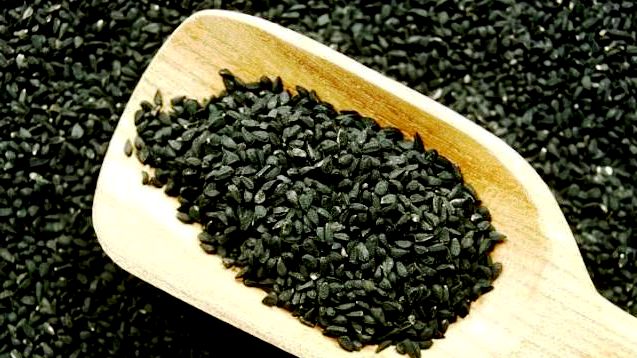
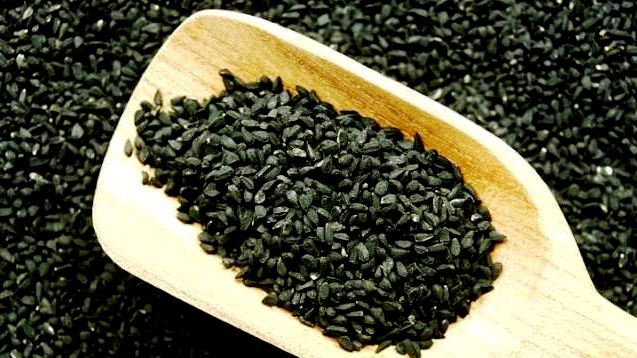
http://keepingbee.org/wp-content/uploads/2012/10/Black-seed-honey1.jpg The seed of the Nigella Sativa plant, commonly referred to as “black seed,” is a powerhouse for health and wellness—however, very few people in the western world have even heard of it. In the East, this little seed has been in use since time immemorial. Black seed oil was even discovered in the tomb of Tutankhamen (King Tut), which dates it back some 3,300 years.
According to WebMD, black seed has historically been used for everything from headaches to pink eye to parasites. Today, it’s use is even more varied:
Today, black seed is used for treating digestive tract conditions including gas, colic, diarrhea, dysentery, constipation, and hemorrhoids. It is also used for respiratory conditions including asthma, allergies, cough, bronchitis, emphysema, flu, swine flu, and congestion.
Other uses include lowering blood pressure, lowering cholesterol levels, treating cancer, and boosting the immune system.
That still doesn’t offer a complete list of what this little wonder seed has been used for; some use it as birth control, to help with rheumatism and to ease side-effects of a chemotherapy drug called cisplatin.
With so much to it’s name, it’s not wonder that Muhammad (the Prophet of Islam) declared black seed to be a remedy for everything short of death.
From a more scientific perspective, Amazingherbs.com tells us that its chemical composition is:
very rich and diverse. Aside from its primary ingredient, crystalline nigellone, Black Seed contains 15 amino acids, proteins, carbohydrates, both fixed oils (84% fatty acids, including linolenic, and oleic), and volatile oils, alkaloids, saponin, and crude fiber, as well as minerals such as calcium, iron, sodium and potassium. There are still many components in Black Seed that haven’t been identified. But research is going on around the world.
From a cultural standpoint, I’m well versed in the many uses/benefits said to be derived from black seed. From an objective, scientific standpoint, I’m excited to see the scientific community taking note and eager to see what experimentation and study has and will yield from it. As Sayer Ji of GreenMedInfo is quick to note,
Many of black cumin’s traditionally ascribed health benefits have been thoroughly confirmed in the biomedical literature.
Let me close with a quick warning from the folks at WebMD:
Black seed seems to be safe in food amounts during pregnancy. But taking larger medicinal amounts is UNSAFE. Black seed can slow down or stop the uterus from contracting.
Not much is known about the safety of using black seed during breast-feeding. Stay on the safe side and avoid use.
To purchase your own black seed oil head over to Amazon!
References
Black Seed – ‘The Remedy For Everything But Death’
WebMD: Black Seed
Amazingherbs.com
WebMD: Black Seed Side Effects & Safety -
A Delicious Cure – Honey As An Antibiotic & Much, Much More
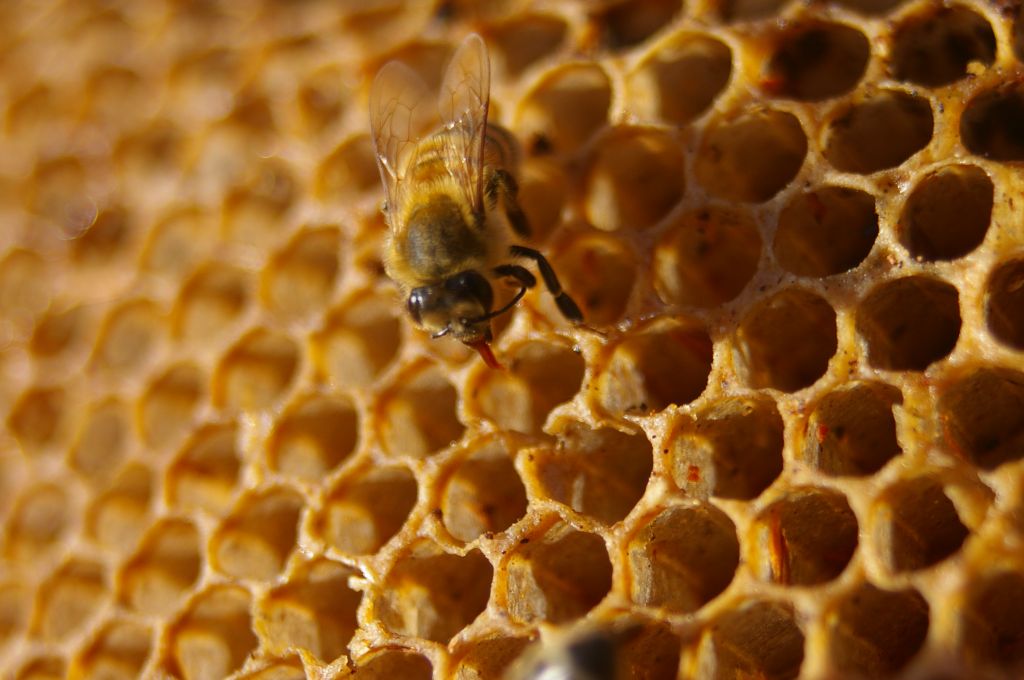
Honey has been touted for ages as a health food. Made by a regurgitation of nectar, spit, and goodness, it feeds the entire colony of bees in which it was made. It’s no secret how delicious it is.
However, honey is magical. Seriously, what I use to dip my chicken nuggets with is a never-rotting, disease-fighting,
baby–preserving (NSFW), bacteria-killing, wound-healing miracle substance. It genuinely blows my mind.
Mmm, this bee’s got it right. Time for some sweet, sweet honey action. (Source) Records of the human consumption of honey date back as far as 21st century BC, being documented in the cuneiform writings of Babylon and in biblical times, even naming Palestine as the “land of milk and honey”. It was said to be used as currency, once as highly valued as the status of those who could afford it. Primitive practitioners, such as Aristotle (384 BC – 322 BC) and Hippocrates (460 BC – 370 BC), would also use it’s healing properties to aide your ailments of varying severities. Well, if you were around back then, I’m sure that’s one of the best options you had.
However, in today’s hustle bustle one-pill-fits-all world, such a simple compound has gone largely unnoticed, garnering attention only as alternative medicine, not quite making it into mainstream. To add to it’s confusion, the positive effects are very well-documented and are far from outlandish.
Let’s get started.
What are the nutritional benefits of honey?
For starters, despite it’s overtly obvious sweetness, it is not sugar. It is made of over one hundred different compounds, all of which have enough sustenance to support life in this form.

(Source) It has vitamins, minerals, amino acids (18 to 20 of them!), and loads of other things that I’m not-so-sure that we know. Not every bee nor flower is unique and there are numerous blends of honey on the market. It is a heart stimulant, a cholesterol killer, and has an interesting property as an inverse syrup, meaning that it is instant energy for those who may need it. It makes for quite a rich nutritional profile (PDF, pg 469) and is a much safer alternative to those horrible sugar-substitutes. The invulnerable Livestrong also recognizes these benefits, even going so far as to state that it is the right thing for diabetics to use as opposed to sugar. They go on to add that it allows for much better blood glucose control and has an anchor spot on the glycemic index, not causing your metabolism to spike erratically. Otherwise, it could ruin your appetite or cloud your mind – especially if you’re sensitive to sugar.
What are the medicinal benefits of honey?
Remember how I stated that honey doesn’t go bad? That it kills bacteria? Well, that’s absolutely true! Honey is an anti-microbial due to it’s low water content, oxidizing qualities, and high acidity level. Also, due to a lovely compound called Methyglyoxal, it is able to snuff out bacteria and resist the spread of disease and germs.

(Source) In fact, modern medicine has commercialized bandages made entirely out of honey due to these qualities. Studies have shown that honey applied topically causes healing time to shorten on wounds, ulcers, and burns – as much as four days sooner in some cases! When traditional bandages don’t work, honey steps in.
Seasonal allergy sufferers may also have a case for honey. Although there has yet to be a peer-reviewed study on the matter, it has been shown anecdotally and via small-scale research that locally-obtained honey will gradually eliminate the immunoresponse to allergens in the air. It’s amazing how simple of a concept it is: since bees obtain the pollen from floral sources near where you live (which causes typical allergy symptoms in most sufferers), ingesting their honey will slowly build up your resistance towards those irritants. Has your mind been blown yet?
If one had unlimited resources and a considerable amount of free time, I could spend hours writing about the benefits of honey. One might think you’re crazy to believe that such an innocuous substance like the spit of a honey bee could provide us with such benefits, but the data tells the story. I didn’t even dive into the more traditional benefits like cough treatment, skin care, and the like. I strongly encourage you, Wonder Reader, to dive more into the matter and discover what lies beneth this magical sweet substance.
And your Lord inspired the bee(s), saying: “Take your habitations in the mountains and in the trees and in what they erect. (68) Then, eat of all fruits, and follow the ways of your Lord made easy (for you).” There comes forth from their bellies, a drink of varying colour wherein is healing for mankind. Verily, in this is indeed a sign for people who think. -Qu’ran (16:68-69)
Want your own honey? Check out Amazon for a world of choices!
Further Reading and Major Data Sources:
Does eating ‘local honey’ help prevent allergies?
Health effects of honey – Wikipedia
Honey History – The history of honey as food
Is Honey Good for You? | Mark’s Daily Apple
Substituting Honey for Refined Carbohydrates Protects Rats from
Hypertriglyceridemic and Prooxidative Effects of Fructoseagriculture, alternative medicine, anti microbial, aristotle, bee farm, bee sting, best honey, best tasting honey, biology, cheerios, dissapearing bees, favorite honey, health, honey, honey anti bacterial, honey anti microbial, honey bacteria, honey bad, honey benefits, honey cure, honey farm, honey good, honey health, honey nut cheerios, honey on wound, honey safe, honey sugar, honey sweet, honey taste, lifestyle, maluka honey, manuka honey, nature, plato, research, science, types of honey, ulcers, urban bees, what is honey -
Breathe Deep to Relieve Stress

Image by: Tanya Burr Taken From: http://greatist.com/happiness/breathing-exercises-relax While you’re currently engaged in deciphering the likely liquid-crystal display in front of you, your body (as always) is actively breathing. Your body does this in order to keep you, itself, alive. You breathe in and you breathe out. What exactly is happening? How do we get energy from the breath?
Every day the average human breathes* anywhere from 12-20 times per minute. There are 525600 minutes (see theater math) in a year and the average human lives somewhere around 62.7 years. So on average that could be anywhere from 395,461,440 to 659,102,400 theater breaths in an entire lifetime. In primitive terms: You breathe an awful lot.
With all of that in-and-ex halation it is easy to take for granted how the system works. When you breathe, oxygen is transferred from outside to inside the body.
“What exactly defines inside and outside?” Is a question that will lead to many a philosophical debate regarding the boundaries of a human. That debate is for another day.
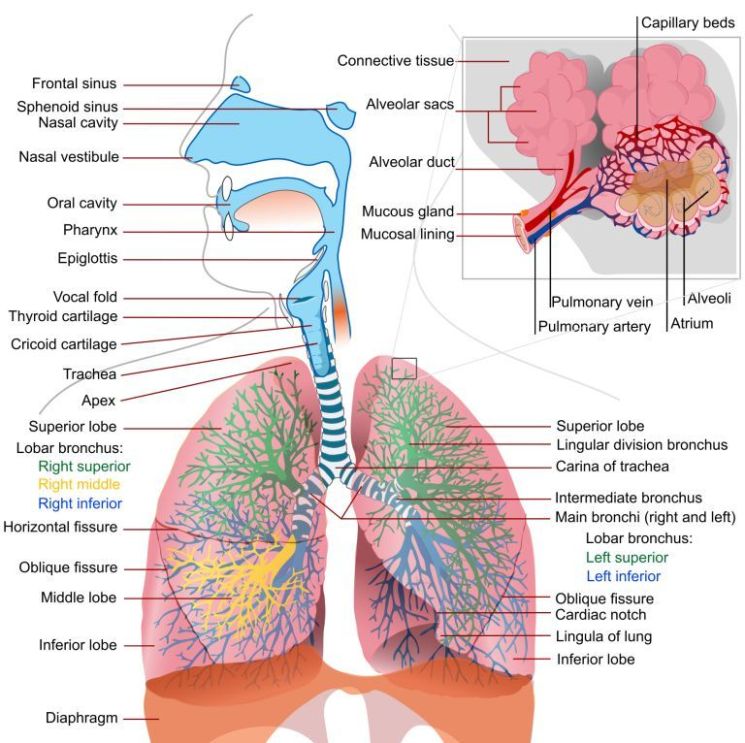
From: http://zachburnettsproject.weebly.com/diagram.html The oxygen is taken through the blood stream to muscles in the body where it is then traded for waste. The waste is deposited in various bodily systems and taken care of from that point on.
Warning: Upcoming Logical Stretch (ULS):
So supposing that you have half of a billion breaths in your life, each time you breathe you have a chance to study and/or refine your breathing. In doing so you just might find out a bit more about yourself.To return to the Realm of Slightly Less Loose Logic (RSLLL), you really must be careful when examining the way that your involuntary body functions. If you push too hard for knowledge it may end up hurting you. So take your time and really get a feel for yourself.
Paying attention to your breathing is a proven method in relieving stress. Science and religion alike pay special attention to understanding the way in which we breathe. Breath Prayer is a Christian prayer focus. When you start to drift away from your original intention you actively shift focus back onto the breath (Hmmm… seems like meditation is a fundamental practice).
Science too, believes in the powers of breathing. Breathing to reduce stress is a concept not all that different than Breath Prayer. Stress, in this case, can be viewed as a distraction from your original plan or “prayer.”
When a person is under stress, their breathing pattern changes. Typically, an anxious person takes small, shallow breaths, using their shoulders rather than their diaphragm to move air in and out of their lungs. This style of breathing disrupts the balance of gases in the body.
So in order to train your body out of stress all anybody needs to do is deepen and elongate their breathing. There are many ways to do this seemingly difficult task of breath training. Pranayama, aka yogic breathing, is a good place to start.
…just do what you gotta do…
to be happy.
If you’re interested in learning a whole lot more about yogic techniques A Systematic Course in the Ancient Tantric Techniques of Yoga and Kriya is a very thorough book on the topic. It gives in depth explanations of this technique and many others.
Sources:
http://www.normalbreathing.com/index-rate.php
http://www.nhlbi.nih.gov/health/health-topics/topics/hlw/whathappens.html
http://www.prohealthsys.com/resources/physical/vital_signs_table.php
http://en.wikipedia.org/wiki/Liquid_crystal_displayhttp://www.betterhealth.vic.gov.au/bhcv2/bhcarticles.nsf/pages/Breathing_to_reduce_stress
http://www.soulshepherding.org/2012/07/breath-prayers/
http://en.wikipedia.org/wiki/Computer_monitor
http://onsager.bd.psu.edu/halmi/chem3airs05.pdf Experiment that you can try…http://www.abc-of-yoga.com/pranayama/
Quotes taken from Wondergressive admin: Phil
Other Wondergressive Articles:
Seven Minute Workout Can Get You to Lose Weight
Smelling Calmness (And Other Things)
alive, asana, ayengvar yoga, Bad Show Tunes, be calm, be here now, best yoga, best yoga pose, bikram yoga, breath, breathing, breathing technique, deep breath, deep breathe, Deep Breathing., diaphram, Exhalation, focus, hot yoga, how to breathe, how to yoga, Humans, Inhalation, Involuntary Functions, kriya yoga, LCD, maraji, osho, oxygen, p90x yoga, Paying Attention, ram das, relax, release, release stress, releive, relieve, religion, RSLLL, science, stress, stretching p90x, Tanya Burr, timothy leary, ULS, Voluntary Functions, Yoga, yoga breath, yogic breathe, Your Body -
Sign Me Up For Mars!
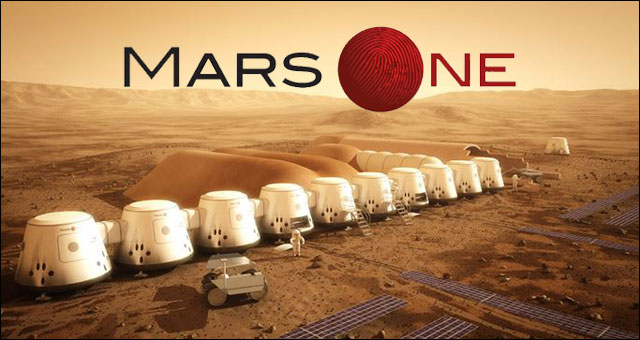
nyulocal.com Greetings Wondergressivers! Are you tired of blue skies, green grass, and sunny days? Do you wish to explore the Final Frontier? Maybe red is a much more desired color for you? Or maybe you have simply conquered Mt. Everest and want to aspire to higher, more challenging heights; three times higher to be exact! Well, for all you daredevils, adventure seekers, space cowboys, and solo yolo’s, you are now able to apply to colonize that big, red, desert brother of ours, Mars.
All it takes is an application and a short video sent to Mars One and you will become one of already 78,000 (and counting) applicants from which 4 will be chosen to pioneer the first colony on Mars! Oh, and of course a $38 fee which is charged to all American applicants; other countries are stuck more or less depending on their wealth. We may not even need that warp drive to be completely developed before we start colonizing other planets! Isn’t it all oh so exciting?
The voyage is set to take place in 2023 and will cost roughly 6 billion dollars. Anyone with zero technical skill that is over the age of 18, with no specific qualifications, can apply and be chosen for the voyage. But how will all of this be payed for? Well, it seems it will all be one big to do on television once a select group of “candidates” are chosen by 2015. These 20-40 people will then be trained for 7 years and whittled down to roughly 4 through a series of television events and audience votes.
As exciting as it all sounds, it is a little disappointing that we have to rely on a televised popularity contest as a selection process for our Mars colony. It is inspiring, however, to hear that there is such a widespread reception of the idea of colonizing Mars, and that we already have over 78,000 applicants to do so! More-so that the group of 78,000 applicants is a very diverse group from all around the world!
Bas Lansdorp, co-founder and chief executive officer of Mars One, says:
Mars One is a mission representing all humanity, and its true spirit will be justified only if people from the entire world are represented
The trip itself will take about seven months once the 4 are chosen but before that rovers will be sent to survey possible settlement areas and build the infrastructure of the colony for the candidates chosen. I just hope the Mars spiders don’t get these poor souls. For more on “the plan” click on over to this link to watch the Mars One video!
Research:
Space.com – Want to live on Mars?
Reality TV show to follow Settlers
Wondergressive – Let’s Capture US an Asteroid
Wondergressive – Faster than light travel
aliens, applicants, Asteriod, astronauts, auditions, bas lansdorp, colonize, colony, communication, contestants, drama, explore, final frontier, han solo, light speed, Mars, Mars One, mars spiders, mt everest, olympus mons, pioneer, real, reality tv, science, settlers, show, solo, space, space travel, space.com, spiders, Star Trek, star wars, technology, television, tv show, USS enterprise, wondergressive -
Seven Minute Workout Can Get You to Lose Weight
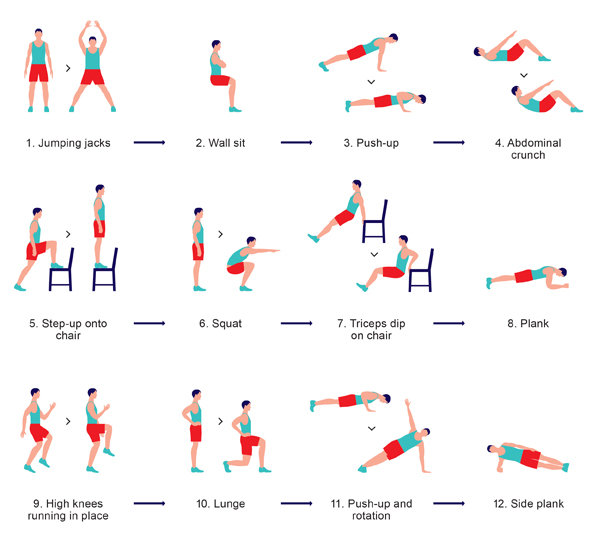
http://well.blogs.nytimes.com/2013/05/09/the-scientific-7-minute-workout/ It is hard to lose weight when most of us live such busy lives. However, new research suggests that a seven minute workout could be all you need to rev up your metabolism and fight the subcutaneous fat under your belly and hips.
A new article in ACSM’s Health & Fitness Journal was published on the potential health benefits of HITC (High-Intensity Circuit Training) using just the weight of your body. This seven minute workout is a type of interval training in which you have short 30 second periods of 90% maximum effort combined with ten second breaks between each period. The whole circuit consists of twelve exercises that alternate between the upper body and lower body muscles. What that does is, in a sense, give the muscles more than 10 seconds of break since one group is barely being used to support the other group that is exerting the effort.
According to a New York Times blog post, even a few minutes of training at an intensity approaching your maximum capacity produces molecular changes within muscles comparable to those of several hours of running or bike riding 1.
The ACSM journal also points out that incorporated resistance training contributes significantly to the amount of fat burned during a workout. When resistance training exercises using multiple large muscles are used with very little rest between sets, they can elicit aerobic and metabolic benefits. Research has found that these metabolic benefits can be present for up to 72 hours after a high-intensity exercise bout has been completed.
There also may be a greater impact on subcutaneous fat loss with high-intensity intermittent circuit-style resistance training protocols than with traditional steady state sustained-effort aerobic work or traditional resistance training. This is thought to be from the increased level of catecholamines and growth hormone found in the blood both during and after high-intensity resistance training exercise with shortened rest periods (<30 seconds). -ACSM Journal-
Shorter rest periods result in a shorter total exercise time. This is attractive to individuals who are trying to maximize the impact of an exercise program in minimal time. So if you have a busy lifestyle like I do, this is efficiency to its maximum.
Other health benefits of the seven minute workout include an improvement in the VO2max capacity and decreasing insulin resistance, which is good news for those who are fighting with type 2 diabetes.
If you don’t have an adequate chair in your house you can always get one from Amazon.
Sources:
1 http://well.blogs.nytimes.com/2013/05/09/the-scientific-7-minute-workout/
-
Salamba Sirsasana: It’s Time to do a Headstand!
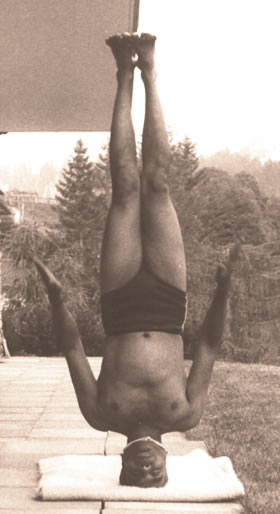

Headstand by Pilarcarrillo at http://www.camyoga.co.uk/author/pilarcarrillo/ Stand on your head everyday. Stand on your head right when you wake up. Stand on your head right before you fall asleep. Salamba Sirsasana (supported headstand) is a yoga pose that provides many benefits. All of these benefits can be achieved by standing on your head- this article may induce a sense of Déjà vu.
As I was saying; The benefits of Salamba Sirsasana are as numerous as the amount of upside down strange looks that your roommates will give you while you’re in the pose. Those strange looks will often be followed by compliments such as “Well, I’ve never seen that before” and of course there’s always silent curiosity.
According to Dr Rob Kiltz (yes, that’s his real name), Sirsasana will:
- Stimulate pituitary and pineal glands, which aid growth and the production of sex hormones

BKS Iyengar in Sirsasana - Strengthen the spine, neck, shoulders, and arms
- Tones the legs and abdominals
- Relieves a buildup of fluid in the legs and feet
- Allows a healthy, pure blood flow to brain cells
- Stimulates the nervous system
- Aids in the treatment of headaches, anxiety, asthma, sinusitis, hay fever, depression, diabetes, insomnia, and symptoms of menopause
- Increases mental awareness and clarity
- Calms and soothes the mind
- May reverse the effects of lethargy, sleep loss, and memory loss
- Stimulates and strengthens the lungs, facilitating healthy breathing
- Improves posture and digestion
- Aids in the relief of tonsillitis, persistent coughing, common cold, bad breath, and palpitations
- Helps overcome problems of the liver, kidneys, stomach, intestines, and reproductive organs by reversing the pull of gravity
You use a lot of energy in this pose. And no, I’m not talking about psuedo mystical style Qi (Which, I admit I am definitely curious to know more about). I’m talking about the energy you’ve aquired from the food that you’ve eaten.
It takes quite a bit of strength, skill, focus, and work to balance on your head. You’re thoughts have to be constantly focused on maintaining the exact positioning of your body whilst upside down. Legs straight from the hip, knees straight, elbows underneath the shoulders, forearms sharing the weight. Most importantly, you must not get distracted by your thoughts.
A good way to keep focused is by paying attention to the way that you breath.
Bring your attention to the sensation of breathing. Breathe in long and out long for a couple of times, focusing on any spot in the body where the breathing is easy to notice, and your mind feels comfortable focusing. This could be at the nose, at the chest, at the abdomen, or any spot at all. Stay with that spot, noticing how it feels as you breathe in and out.
As you get better at maintaining the pose you’ll be able to balance for 10 minutes or longer. I like to practice Salamba Sirsasana early in the morning- right after I wake up- and right before I go to bed at night. I would definitely try it out against the wall. For all you beats out there, Jack Kerouac was known to start his day with headstands. From Kerouac’s Big Sur;
‘One fast move or I’m gone’ so I jump up, do my headstand first to pump blood back into the hairy brain, take a shower in the hall, new T-shirt and socks and underwear, pack vigorously, hoist the rucksack and run out throwing the key on the desk and hit the cold street…I’ve got to escape or die…
In Short: You should do a head stand!
If you’re interested in learning a whole lot more about yogic techniques A Systematic Course in the Ancient Tantric Techniques of Yoga and Kriya is a very thorough book on the topic.
Sources:
http://www.accesstoinsight.org/lib/authors/thanissaro/breathmed.html
http://www.cnyhealingarts.com/2011/03/21/the-health-benefits-of-salamba-sirsasana-supported-headstand-pose/
http://public.wsu.edu/~brians/errors/dejavu.html
http://www.yogajournal.com/poses/481
http://www.w-mystictraveller.com/what-is-qi.htmlLike Wondergressive’s gressiveness?
Check out these sweet past articles:
From Multi to Mono
Canabis Cures Cancer and Everything Else: A Thorough History and Review - Stimulate pituitary and pineal glands, which aid growth and the production of sex hormones
-
Vampires Aren’t Bad – Why Unplugging Your Charger Is Pointless
Thank goodness we’re past the Twilight/vampire fad (or are we?), otherwise I would have had to start the article with a stupid pun or some other detractor from my message. I’m talking about vampire power consumption, not sexy sexy Edward ab juice.
Vampire power consumption. Power draw. Phantom load. You’ve heard of this, right?
(Please tell me you have.)
So what’s the deal Phil, why are you bringing this up?
(That’s a fair question, thank you for asking invisible, reoccurring, and oh so very soothing internal voice of mine.)
I was sitting down at my desk the other day and proceeded to unplug my wireless headphones from the charger. I instinctively turned off the power strip. As I got up and turned away, I paused for a minute. Why did I just do that?
I think the message has been hammered into our minds from every green-conscious
twatperson as long as I can remember – turn off or unplug your junk after you’re done using it. I’ve been doing it for quite some time, after all. For the uninitiated, vampire power consumption is simply the amount of electricity used by a device left plugged in even after it’s off. It’s a remarkably simple concept. Heck, there’s even power strips that do it for you.But does it really make that much of a difference if you unplug your phone charger when you’re done with it? How about unplugging your laptop? Your TV?
Short answer: Nope.
Slightly longer answer: Still nope. But maybe sometimes.
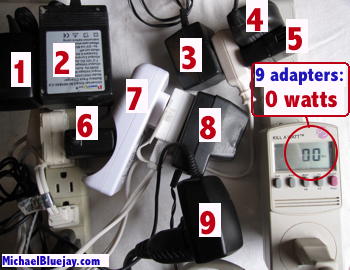
You see, most modern chargers only use about 1 watt of electricity when they’re sitting idle. The best-of-the-best use even less at a paltry .5 watts. To put this in perspective, you could power 60 chargers for every one incandescent light bulb you use. 120 of them if you have an ultra-fancy model. Crazy, huh?
How much energy does an air conditioner use at standby? 1 watt too. My gas oven? 4 watts.
Doesn’t that seem a bit…low?
These vampires aren’t doing a good job at sucking up bloodenergy. (Source)Well yeah…it’s probably because maintaining low power consumption on idle is the law in many places.
It’s called the One-Watt Initiative, where manufacturers pledge to engineer their devices to use less than one watt when they aren’t being used. This wonderful initiative lead to several nations (and good ol California!) to make it a requirement.
But I’ve heard different.
Yeah, you probably have. You’re probably not wrong, either.
(See, I told you there would be a long answer!)
There has been loads of studies saying exactly that. However, many of us fall victim to this “vampire power” because we’re not turning off our devices, not because we aren’t unplugging them. For example, a PlayStation 3 console uses only one watt (newer models use .5) on standby. However, simply sitting at the menu while you re-up on Cheetos and Mountain Dew sucks up a total of 176 watts. Crazy huh?
Let’s be sensible people – don’t be crazy and unplug every damn thing that happens to be in a power outlet. Let’s be smart: let’s conserve by using less and by being more conscious about what you’re doing. At least you’ll get your sanity back.
Except for me. I’ll always be insane.
—
Further Reading:
One Watt Initiative – Wikipedia
Unplugging wall chargers does NOT save you energy
-
Become a God for 79 Cents
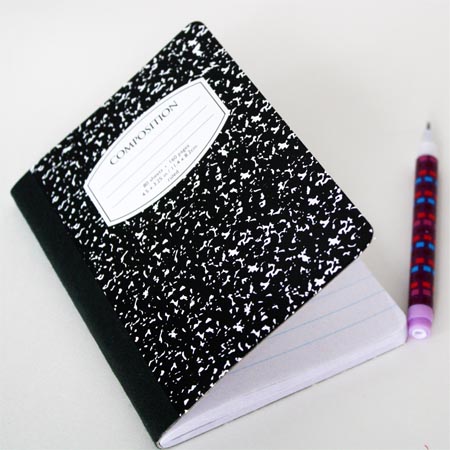
http://www.skiptomylou.org/wp-content/uploads/2010/12/oil-cloth-notebook-cover-6.jpg In 1934, a product was created that has yet to be trumped in its incredible power, not by 3D printing, bionic hands, or even self slicing bread. One man had the revolutionary idea to take blank pieces of paper and bind them together with a spiral of twisting metal. Thanks to this pioneer of liberal thinking, today, if you have 79 cents, you can become a god.
I grow impatient of your incessant rambling, Qwizx. Just tell me this amazing thing already!
Alright, jeez, Fictional Naysayer, I gotta rope you in and build the suspense a little, ok? Cool your ADHD jets…
Buy a notebook, and you can have superpowers… literally.
Of course, there is the obvious, “hey kids, unleash the power of your imagination,” (as though Wondergressive would ever become some PBS special or episode of SpongeBob). Or the spot-on philosophy of sci-fi grandmaster Robert A. Heinlein, World as Myth. Or, like we’ve already shown, creativity is the meaning of existence. No, this is much much much cooler than all that.
So a friend mentions how he found this method of tripling your energy in the morning, and you placatingly nod and think, “Cool, I’ll add it to the pile of things I’ll blow off until I die, right along side lose 50lb, quit masturbating, and develop a photographic memory.” Except, do you actually have that pile? No? Then make one…
Get yourself a pad of paper and a pencil, those ancient technologies, to keep in your pocket at all times, and jot down any passing thought, even just a one or two word “note-to-self.”
Don’t be afraid to take it to serial-killer levels of obsessive compulsion:
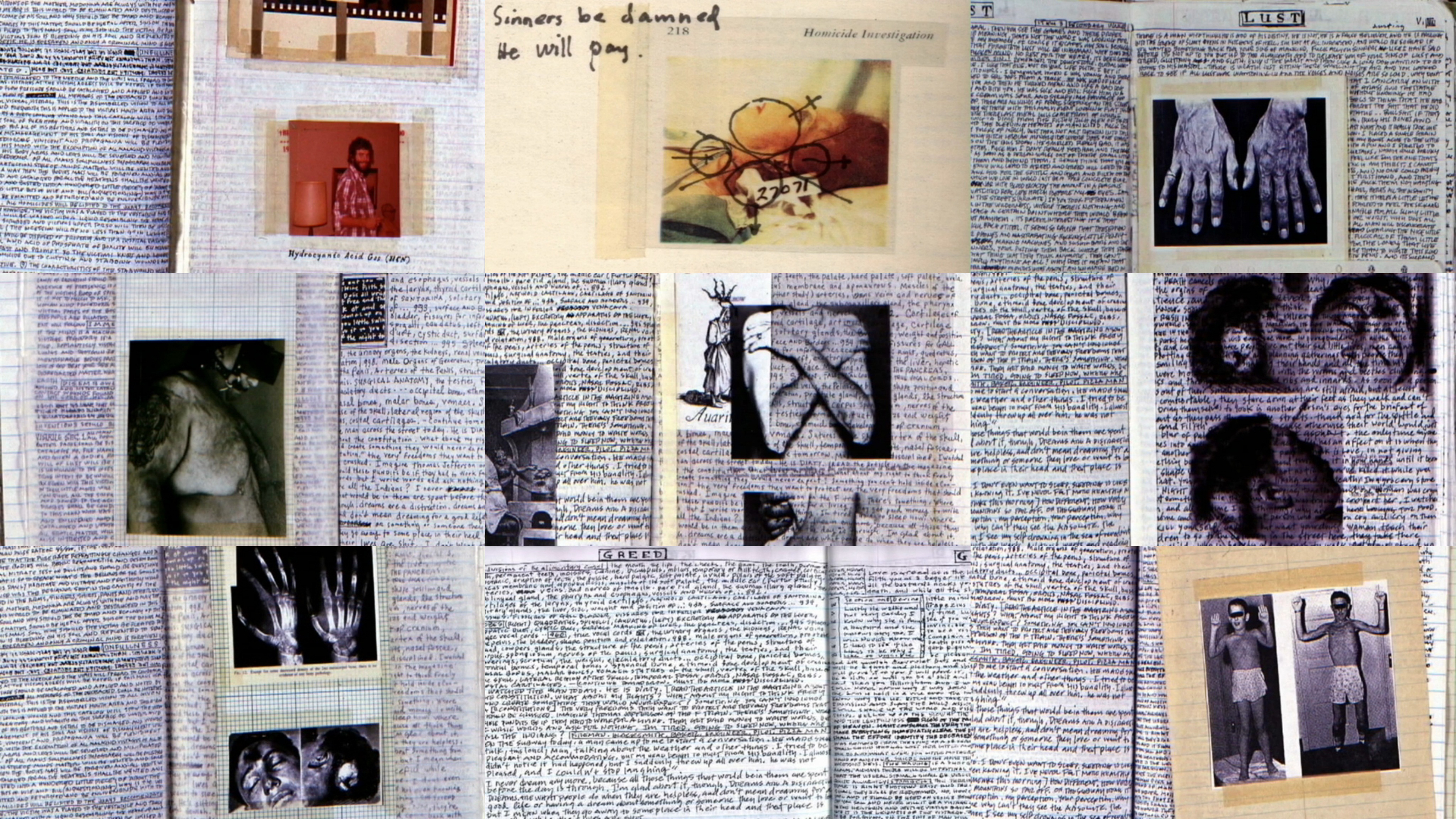
http://pastlands.files.wordpress.com/2012/11/seven-compilation2.jpg But, why?
Short-term memory is super limited, so it’s easy to get overwhelmed if, say, more than two things are happening at once. But your brain is a tremendously powerful biological supercomputer capable of… frankly we have no idea, because we are constantly pushing the boundaries of what we are capable of. What the notebook does is very simple; it allows you to set your subconscious to its own devices and create miracles on par with walking on water.
So, this time, a buddy mentions something about eating more spinach, and we try something new; instead of “yeah yeah, I’ll get to it eventually” we simply jot it down in our handy dandy notebook… and that’s it. Don’t think about it again. Set it and forget it.
Bullshit!
Always the skeptic, Mr. Naysayer. Good, don’t ever change.
Ok, think of it this way: Yes, short-term memory is limited. Long-term memory, however, has no limits. None. (Well, not quite none. It’s only capable of storing the entire Milky Way galaxy jam packed with terabyte hard drives) and it thinks half a million times faster than you. Putting your subconscious to a task is like wondering what to make for diner and having the entire population of Luxemburg stop what they’re doing to exclusively weigh the pros and cons of mac-n-cheese vs. Chinese takeout. Assigning a job to the subconscious is really easy, too…
When we half-heartedly think “Yeah yeah, I’ll get to it when I get to it” what we’re saying is “Hey Luxemburg, just sit around. We’re not doing shit today”

http://mememachine.viralvideochart.com/storage/burn.jpg?__SQUARESPACE_CACHEVERSION=1322580030849 There is a general taboo on Magic, here in the age of science, but “magic” is just a word. The mind is so magnificently powerful that it’s incomprehensible to our thinking consciousness. Perhaps the first grimoire was just this concept; a young lady wrote down her inner thoughts and crazy “coincidences” started happening. (Shit, better burn her.)
Whatever. I have a journal and don’t own my own planet yet.
Touché.
First, go back right now and read your old journals. You’ll be astonished at how much of what you’d written has happened. You’ll be far more astonished at how much of what came true you totally forgot about and then put no conscious effort whatsoever into achieving, but it happened anyway.
Second, take a special look at your language. Our thoughts are noise, and even the smartest among us are complete morons. That’s a good thing. When you wrote, “Brian is so cute, but there’s no way he’d like me,” Luxemburg took that and created exactly what you wanted. They got together and filtered what they would show you (like how he’s talking to Hillary and hasn’t noticed your low-cut top, asshole) hiding anything non-affirming (see how he can’t make eye-contact and keeps shifting his feet when you’re around. That’s a good thing). You will see whatever you already expect to see. That’s why Brian’s an asshole.
Instead, even if you don’t believe it, jot down “I think Brian might be into me,” and Luxemburg will start to show you little bits of proof that you’re right.
Got any examples?
Sure do. In ’95, Neal Donald Walsch was a broken man. Razor in hand, ready to open his wrists in desperation, he played one last-ditch wild card that he never expected to work. He pulled out a spiral notebook and started frantically scrawling a passionate hate letter to God, demanding answers to not just his own turmoils, but to the big existential things; why is there so much suffering? What happens when we die? Bad things to good people, all that.
A devout atheist, eventually, in his passion, something happened. He started expecting an answer. In that moment, he got one. His hand started moving of its own accord, and the revelations revealed were nothing less than divine. These madman scribblings have gone on to become a series of spiritual texts lauded the world over. God? Brain? It doesn’t matter.
Another. Are you reading this on a Mac? So you’ve heard of Steve Jobs? His biography flies off the shelves and one of the most beautiful things in it is his constant demanding of the impossible. All throughout the book are moments where a chief-engineer would come to him with bad news, “Steve, we can’t do it. I know what you’re saying; it’s just that what you need us to do doesn’t exist. It’s impossible.”
Top engineers for Apple or Pixar are kind of smart, so if they say something isn’t just hard, but utterly impossible, then, yeah, it can’t be done. Steve, charismatic manager that he was, would simply say, “Fucking do it, or you’re fired.” And it got done. Every time. (Screw you, reality)
Get your own spiral notebook without leaving your house!
Is that really all there is to it?
Yep. When you write it down it gives your brain permission to do what it does best, solve problems.
Don’t think big. Think huge. Don’t think huge. Think cosmic. Just decide and don’t worry about the how. Your private fleet of subatomic-physicists, genetic-engineers, economists, composers, and dreamers can work out the details.
Sources:
First Spiral Notebook (Sep, 1934)
Reanimated Kidneys, 3-D Printing, and (Icky?) Organ Markets
The Almighty Escapism: Creating Distraction
Engineering the Perfect Morning in 8 Easy Steps
The Amazing Bacon, Beer, and Edible Underwear Diet
Photographic Memory (Phase 2: Holy Shit)
How Handwriting Trains the Brain
Obese? Got a Fatty Liver? No Problem. Spinach and Nuts Have You Covered
Conscious Vs. Subconscious Processing Power
Science Says, “Smart People Are Idiots”
“Party Chat” Brain Filter Discovered
Brain “Irrelevance Filter” Found
Preserving Integrity in the Face of Performance Threat
Conversations With God, an Uncommon Dialogue
24 Inspirational Steve Jobs Quotes That Help You Suck Less
Will Smith: Wisdom, Motivation, Inspiration
-
Modern Languages May Share Common, Ancient Ancestor
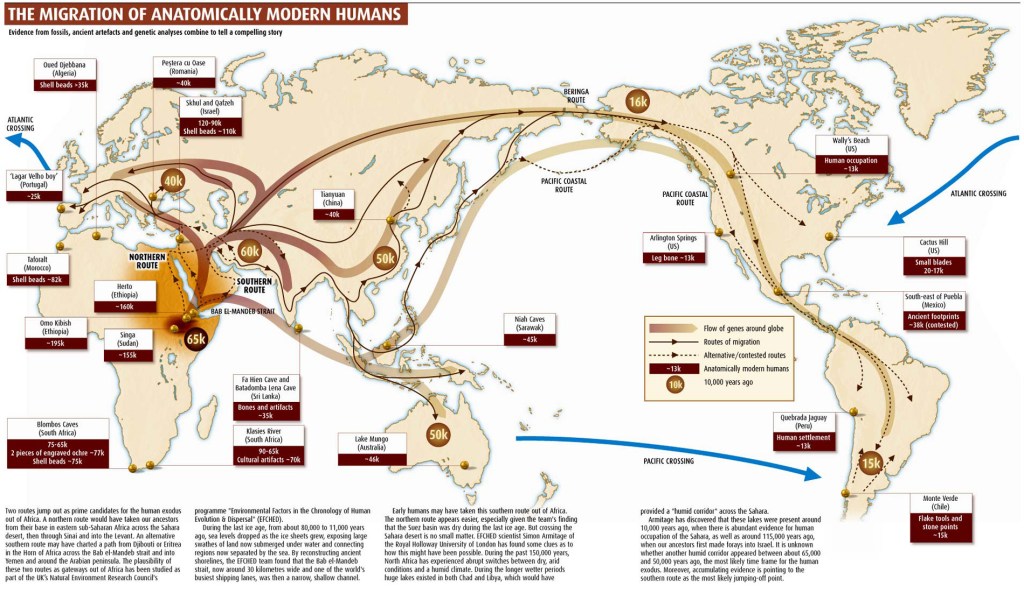
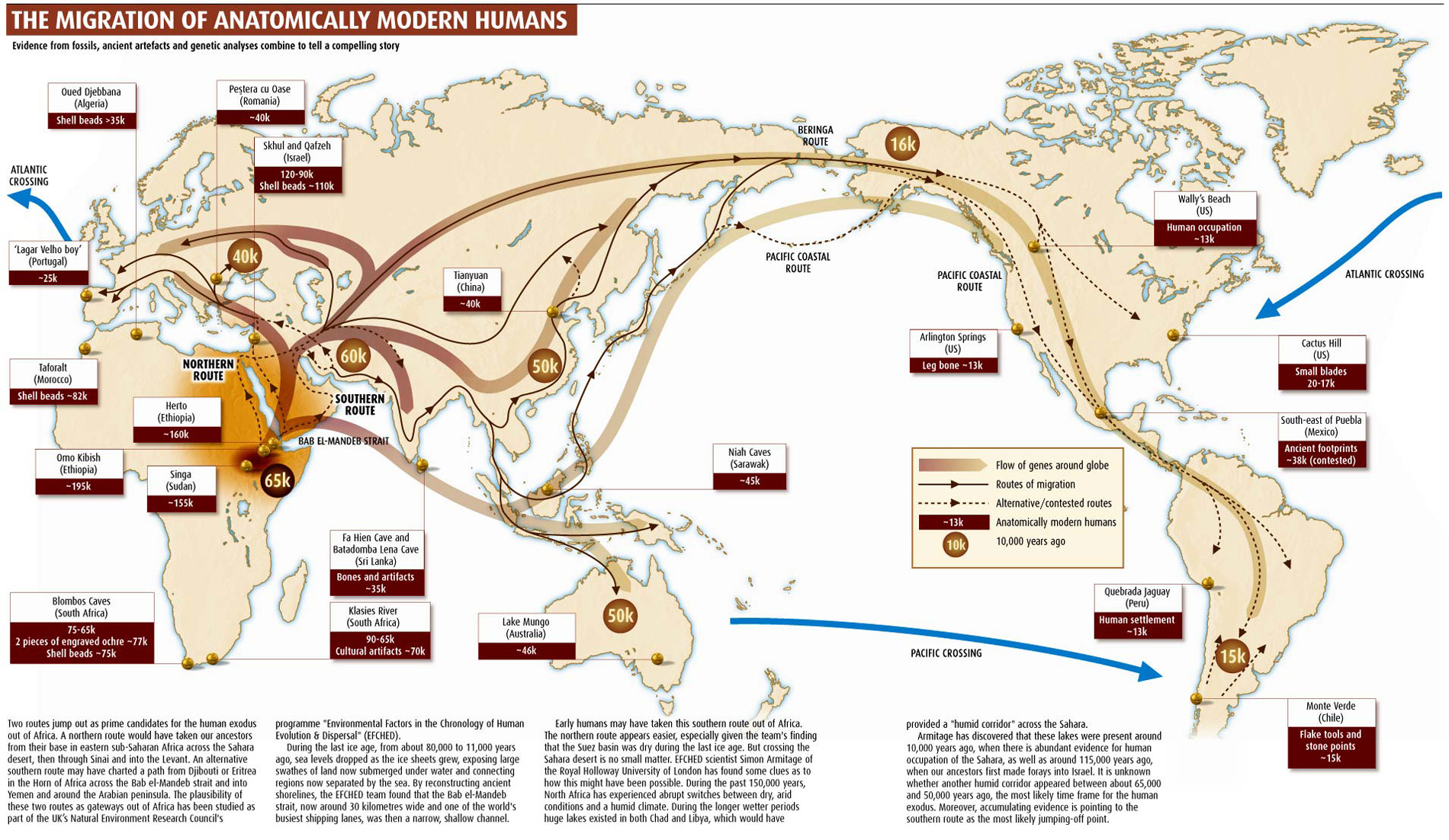
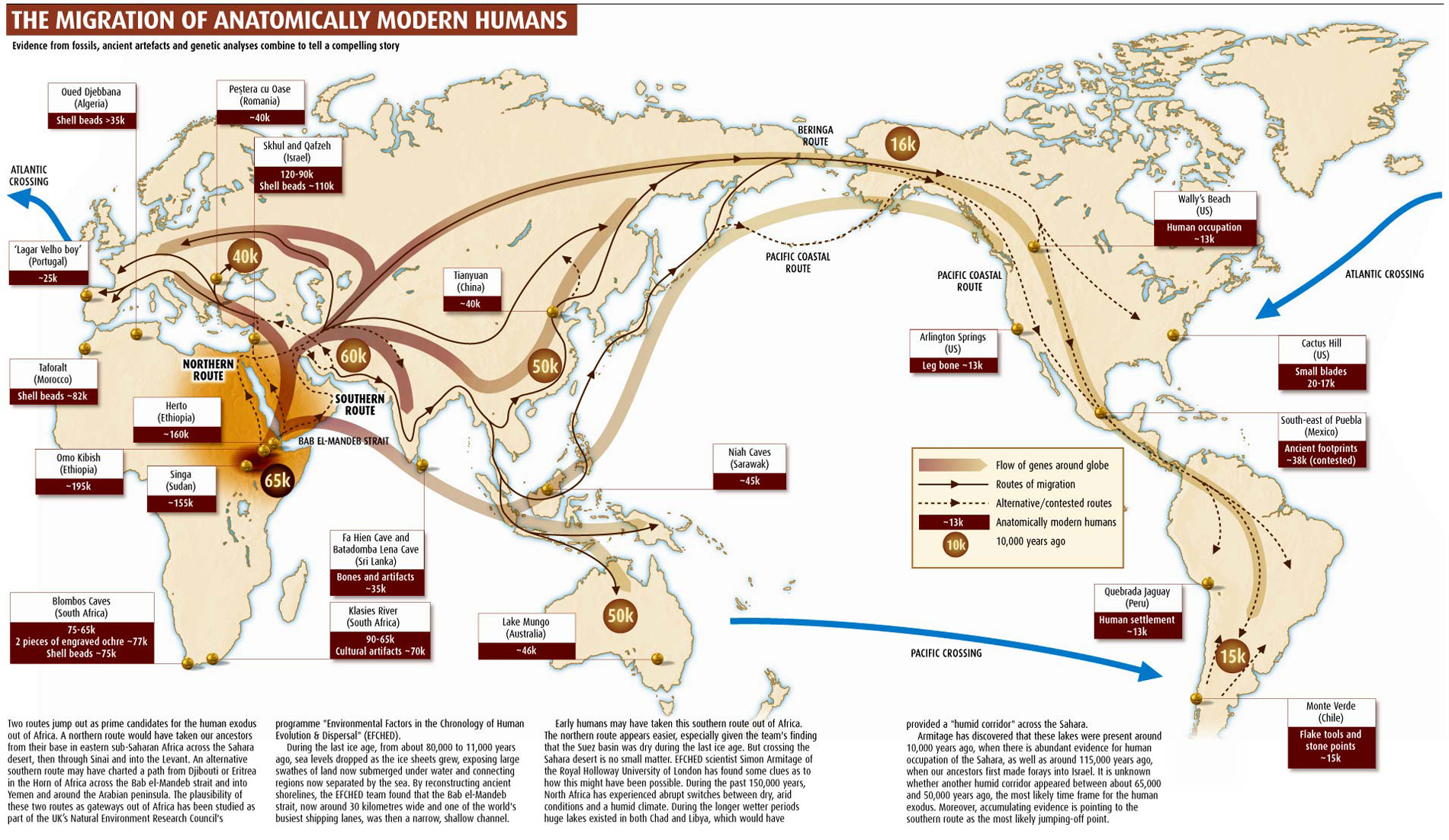
http://stryder.com/staid/migration_of_anatomically_modern_humans_bldg_blog_2008.jpg Reporting in the Proceedings of the National Academy of Sciences, researchers claim to have found 23 words that they believe date back as far as 15,000 years. The words are still reflected in seven linguistic families that span from Europe to Asia, and may support the idea of a “proto-Eurasiatic” language from which almost all modern languages derive.
Several mainstays of language predictably make the list, however, there are a couple of surprises. The whole list:
thou, I, not, that, we, to give, who, this, what, man/male, ye, old, mother, to hear, hand, fire, to pull, black, to flow, bark, ashes, to spit, worm
The seven language families studied were: Indo-European (European languages, Hindi, Urdu, Bengali, Punjabi); Altaic (Turkish, Uzbek, Mongolian); Chukchi-Kamchatkan (northeast Siberia); Dravidian (south Indian languages); Inuit-Yupik (Arctic languages); Kartvelian (Georgian) and Uralic (Finnish, Hungarian). In the map below, the different colors show the distribution of these families. These families, however, do not account for every language in the world, notably Chinese and Japanese. Several African families and the aboriginal languages of Australia and the Americas are also not represented.
The research was headed by Mark Pagel of the University of Reading’s School of Biological Sciences. He and his fellow researchers sifted through the modern lexicon and came up with 200 words that they agreed were shared by European and Asian languages. They eventually narrowed this list down into 23 root words that they found were fairly universal in sound and in meaning across modern languages.
Linguists have calculated the rate at which words are replaced in a language, in essence, how long words tend to exist before becoming extinct. By seeing what words are shared between the modern languages families and knowing roughly when those languages split, Pagel and his team worked backwards and estimated how long these proto-Eurasiatic words have existed.

http://www.washingtonpost.com/wp-srv/special/national/words-that-last/ The Washington Post has a really nifty tool where you can access audio readings of some of the root words and see how they sound alike…or not. Some take quite a bit of imagination to hear the link between them. It took me several listens to connect the dots, and in some instances it was difficult to imagine that there could possibly be any dots to connect at all.
Not everyone is convinced with the new study. Languages evolve and experience “weathering,” a sort of lingual erosion that constantly chips away old words as new ones are added to the vocabulary. Most researchers think that words can’t survive more than 9,000 years because of the effects of weathering. William Croft, a linguistics professor at the University of New Mexico says that the scientific community is “pessimistic” that these words could be 150 centuries old. He adds that “they basically think there’s too little evidence to even propose a [language] family like Eurasiatic.”
I am enamored with the idea that this research posits, that we can accurately trace the roots of modern languages to back before the advent of agriculture during the last Ice Age. However, I sadly think that it’s nothing more than an appealing narrative, a romantic notion of language and how we originated. Without any hard evidence it’s impossible to verify this theory, and none can possibly exist because written language wasn’t invented until some 10,000 years after the supposed genesis of these 23 words.
Like Pagel and his team, journalists have also become intoxicated with wishful thinking. Discovery News reports:
What this means is that if an Ice Age person from 15,000 years ago could hear you speak today, he or she could probably understand you, so long as you used these handful of words.
People in Britain are often incapable of understanding each other due to their different accents. And they speak the same language. On the same tiny island, in the same point in time. And yet a person from the Ice Age could probably understand me if I used only these mostly monosyllabic words? The conductor booms out “All aboard!” to the Bullshit Express.
I find this linguistic theory to be an interesting possibility, though one that is completely unfalsifiable and impossible to measure. Although I’m profoundly skeptical of its validity, I think Pagel’s conclusion makes for a supremely fun coffee table topic of conversation, but barring further breakthroughs I’m afraid that’s all this study can be.
Further Reading:
Ultraconserved words point to deep language ancestry across Eurasia
-
Babies and the ‘Cost of Inaction’

http://www.globalpost.com/photo/5816033/20130415-cost-inaction I, Healthyheartbeatz, a grown man of 25, have a soft spot for children in need. Me, with all of my bravado and manliness, me with all of my outspokenness and inclination to argue, YES I still cringe every time I see a helpless child in need on TV or displayed in an advertisement. That may have to do with my ridiculous sensitivity and sympathy, not to mention I am also very much so captivated by puppies, but that is besides the point of course! Children are our future and taking care of them is priority! We can’t let them turn into mindless zombies, something must be done!
Why must you bother me with all of this? Well, I stumbled upon a series of recent studies put together by (FXB) Center for Health and Human Rights that of course made me cringe and fired up my synapses in order to reach out to you, our Wondergressivers (ererers). But let’s take it easy, I am not in any way trying to make you, our loving reader, pay anything or donate anything. This is a news group dedicated to researching and informing others! Naturally that is exactly how this will all play out, and without any final request other than for the lot of you to be “in the know”-
Onwards! The studies discussed were particularly interesting because they emphasize that poor kids that are suffering around the world are specifically suffering from inaction even when we are wasting 40% of our food as well as 25% of our freshwater daily. Sudhir Anand, speaking on a panel at The Forum at Harvard School of Public Health
Failing to intervene nutritionally to aid malnourished children can stunt them for life and failing to provide antiretroviral drugs to parents can turn their children into orphans, putting them at increased risk of falling into crime, drug abuse, prostitution, and other societal ills.
Just think, all of our non-action towards the kids of tomorrow acts as a catalyst for failure in the future. Who knows when the next Einstein will be neglected or the next Copernicus will starve to death or the next Socrates will be condemned by society… wait, just a second. Countess Albina du Boisrouvray, a passionate supporter of helping the children of the world and founder of (FXB) Center for Health and Human Rights, said in an interview:
There are more than a billion of these children around the world, they are living in extreme poverty. They live by codes of conduct completely divorced from ours, and the older they get, the harder it will be to reintegrate them, even at great cost. Each day, they drift further and further. A huge percentage of the world’s adults are going to be almost a different species. This is terrible for society and for the economy — for everything officials are supposed to be worried about — as well as terrible for the kids.
But of course it’s not only the poor who are suffering, we have kids suffering daily from our public school failures as well as neglected children of our country.
There is no link to donate, there is no outcry to change your ways, its a simple message, a pass off of knowledge. So don’t forget our youngins. Babies are our future, past, present, and just about everything else. Without babies we wouldn’t exist. Some babies are super lucky being thrown into traffic and surviving unscathed. Other babies are watched over by angels as they simply survive unforeseen complications at their birth. Just a little baby power to end on a high note. Preacher OUT!
Research:
(FXB) Center for Health and Human Rights
Forum at Harvard School of Public Health
Neglect – American Humane Association
Wondergressive: Public School Failure in America
Wondergressive: TV and the Brain
Baby Survives Car Crash in Russia
adult, albina du boisrouvray, aristotle, Babies, baby born without heart, baby survives, baby survives car crash in russia, capernicus, car crash in russia, center for health and human rights, children, code, cost, cost of, death, depression, educationaless, Einstein, failure, famine, food, harvard, heart out of body, hunger, hunger games, hungry, hungry children, inactive, inactivity, kids, laughing baby, neglect, poor, poor children, public health, society, Socrates, starving, starving children, study, sudhir anand, survivor, the forum, the forum at harvard school of public health, war, waste, youngins
Wonder about your world…

Take the plunge down the rabbit hole of insanity and wonder in this fast-paced, nonstop psychological thriller that will leave you questioning the very nature of reality and beyond. Part thriller, part romance, part existential horror, A Dream of Waking Life delves into lucid dreaming, psychedelics, existential ontology, video games, the nature of love, the nature of reality, and more.

Mendel’s Ladder delivers an adrenaline-fueled journey set on a dystopian future Earth, brimming with high-stakes action, adventure, and mystery. This epic series opener plunges readers into a world filled with diverse cultures, heart-pounding battles, and characters who will captivate your heart and imagination.

“E.S. Fein is raising the bar for quality as it’s a very well-written and thought-provoking book…There are points and themes in the story that could be discussed for eons as people will have their own idea on where it leads. It’s a book I would highly recommend.” – Andy Whitaker, SFCrowsnest
 Wondergressive