
-
Enormous Landscape Discovered Under Antarctic Ice
Buried deep beneath Antarctic ice, scientists have discovered an ancient valley deeper than the Grand Canyon buried deep beneath Antarctica. Carved out millions of years ago by the first Antarctic ice sheets in Antarctica, the colossal mountains and valleys cover an area nearly 200 miles long, 15 miles across, and 2 miles deep.
The research team who discovered the Antarctic ice valley was composed of researchers from Newcastle University, the University of Bristol’s Glaciology Centre, the British Antarctic Survey and the universities of Edinburgh, Exeter, and York. The team has named the area they discovered the Ellsworth Subglacial Highlands.
Related Article: New Ecosystem Discovered: Glacier Mice
An area buried beneath the Antarctic ice fitting the description of the Ellsworth Subglacial Highlands has been hypothesized to exist for some time, as scientists have regularly discussed the precise origins of the Antarctic ice in Western Antarctica. It turns out that the Ellsworth Subglacial Highlands encompass the original site where ice sheets similar to those currently in arctic Canada and Russia began to form.
The team spent 3 seasons mapping the region beneath the Antarctic using satellite data along with ice penetrating radar. According to Professor Martin Siegert, Professor of Geosciences at the University of Bristol,
By looking at the topography beneath the ice sheet using a combination of ice-penetrating radio-echo sounding and satellite imagery, we have revealed a region which possesses classic glacial geomorphic landforms, such as u-shaped valleys and cirques, that could only have been formed by a small ice cap, similar to those seen at present in the Canadian and Russian High Arctic. The region uncovered is, therefore, the site of ice sheet genesis in West Antarctica.
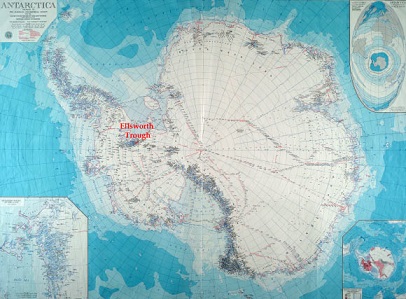
The antarctic is arguably owned by 7 different countries along with 1 neutral territory. The Antarctic ice is mostly uncharted territory. The team will use the data uncovered from mapping sub Antarctic ice trenches within the Ellsworth Subglacial Highlands to better understand the activity of current Antarctic ice. Particularly, this will allow them to create a reconstruction of Western Antarctica before and after the presence of ice sheets. This in turn will shed light on the future of Antarctica as it pertains to climate change, the melting of southern Antarctic ice caps, and the thawing of enormous plots of land in places like Antarctica, Canada, and Russia. According to Tim Flannery in his world renowned book “The Weather Makers” Canada and Russia are poised to become two of the most bountiful and wealthy countries in the world due to expansive amounts of previously unusable land becoming fertile and profitable in the wake of rising global climates.
Related Article: Climate Change Caused by 90 Companies Since Industrial Revolution
Dr. Neil Ross, a member of the team, considers the find to be a serendipitous one. He notes that although antarctic ice penetrating radar had been used on both ends of the valley, it wasn’t until the team used satellite data that they realized the spaces in between could be seen from space. He also reminds us all that we have barely begun exploring the entirety of our planet, stating that,
To me, this just goes to demonstrate how little we still know about the surface of our own planet. The discovery and exploration of hidden, previously-unknown landscapes is still possible and incredibly exciting, even now.
Just think, we’ve only discovered 14% of the projected 87 million species that exist on Earth. Even more astounding, we have only discovered 5% of all ocean space, which accounts for 71% of Earth’s surface.
Related Article: 2800 Year Old Lake Life Survives in Complete Isolation
Sources:
http://www.theweathermakers.org/
http://phys.org/news/2014-01-scientists-giant-trench-antarctic-ice.html
http://gsabulletin.gsapubs.org/content/126/1-2/3
http://oceanservice.noaa.gov/facts/exploration.html
http://en.wikipedia.org/wiki/Antarctica#Antarctic_territories
-
Conductive Metal Ink Used on Flexible Electronics and Paper

Make your own Lightbright with metal ink. Scientists are reporting the creation of a new nanomaterial which comes in the form of a conductive metal ink. The ink is used to draw functioning electric circuits on flexible electronics that are beginning to be released. This metal ink can even be used to draw pictures or designs on normal, everyday materials like printer paper.
The ink is actually made of tinier than microscopic nano-sheets of copper, which is an incredible conductor. The scientists guide self-assembling copper nanocrystals into forming relatively large (emphasis on the ‘relatively’) sheets of copper. They then take these sheets of copper, coat them with silver nanoparticles, liquefy the mix, and put the metal ink solution into a pen.
Related Article: No More Red: Charge Your Phone Battery With Wi-Fi
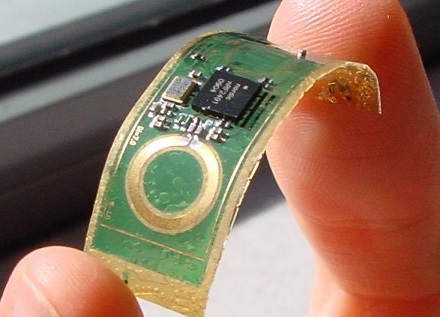
Flexible electronics allow you to finger catapult motherboards at your enemies. http://www.cmst.be/ The reason the scientists created this metal ink was to find a novel and cheap way to create an electric circuit on another flexible material. The combination is known as a flexible electronic. Although flexible electronics have been around for some time, they are extremely expensive due to the traditional time consuming and expensive methods of embedding flexible materials with electric circuits. The metal ink changes all that.
By implementing the metal ink, roll up tablets, fold up cell phones, and clothing weaved with electric circuits all become affordable. In fact, as long as you have your hand dandy conductive-metal-ink-pen, your whole world becomes a potential electric playground.
Related Article: Electronic Brain Implants Increase Intelligence
Just to prove how awesome the metal ink is the scientists drew lines, wrote words, and even made pictures of flowers on normal printer paper using the metal ink pen. They then put small LED lights in the ink, attached a battery to the nanomaterial masterpiece, and viola, the lights lit up.

Metal ink will make shirts like this the norm! http://www.threadless.com What’s more, the scientists tested the flexibility and integrity of the ink by folding the aforementioned paper 1,000 times. They even went so far as crumpling the paper, likely in a fit of scientific ecstasy. Even after all this paper man-handling, the metal ink maintained 80-90% of its initial conductivity.
Just imagine, everyone may one day own a simple pen with the power to alter, add to, and eventually when the ink is widespread, make disappear any electric circuit they see. Hey buddy, that’s a really cool shirt, let me make it shine!
Related Article: Stanford Creates Highly Sensitive, Self-Healing Plastic Skin
If you are interested in some flexible electronics of your own while we wait for this magical metal ink to be released make sure to check out LG’s new phone, the G Flex. Not only is the phone more comfortable due to being vertically flexible, it is also coated in a self healing material. See all those scratches and nicks in your iPhone? The G Flex can literally heal all that superficial damage, retaining a like-new look and feel. Check out the phone’s healing ability in the video below.
Sources:http://www.ndt-ed.org/GeneralResources/IACS/IACS.htm
http://www.lg.com/us/mobile-phones/innovations
http://news.yahoo.com/watch-lgs-flexible-phone-heal-itself-knife-scratch-122202804.html
-
Clean Money Chemicals Replace Money Shredding

Look at that crisp, clean money. http://wiseaccounts.biz/ Everyone loves the smell of crisp, clean money, so undoubtedly, everyone will love this study as well. The simple results of a recent study performed by two industrial engineers could ensure clean money for the whole globe, and save the world more than $10 billion dollars each year. Engineers Nabil Lawandy and Andrei Smuk have found a way to clean money instead of taking it out of circulation and sending it all to the shredder.
There are on average 150 billion banknotes being printed in the world each year. Humanity spends over $10 billion dollars each year in disposing of old and damaged money. That comes to about 150,000 tons of banknotes sent to the shredder each and every year. I guess you have to waste money to make money?
Related Article: The 20 Biggest Wastes of Money and How to Avoid Them
Not anymore. The method Lawandy and Smuk came up with involves using supercritical CO2 (SCCO2) to clean money all around the world effectively and safely. This cheap and simple method will save humanity billions of dollars, and will spare the world a few hundred forests as well.

Clean money from around the world. http://www.modernhippiemag.com/ Supercritical carbon dioxide is a fluid state of CO2 that is held at or above its critical temperature and critical pressure. It is a chemical that has grown wildly popular industrially and commercially due to its cheap cost and very low toxicity. It was chosen as the best solution for cleaning money because it is extremely effective at removing sebum, the main culprit behind banknote deterioration. And yes, we are talking about the same sebum we all know and love, that oily friend produced on your face that plagued your teenage years with acne and still comes back for the occasional haunt.
Related Article: The Secret World of Bacteria
Sebum is responsible for giving old money that sickly yellow tinge. Every single time you touch clean money, you are soiling it with the sebum on your fingers. And just like your teenage face, saturated in sebum and bacteria, clean money is destined to the same fate, only money doesn’t ever get to leave the awkward puberty phase. Increasing bacterial colony growth and subsequent banknote soiling is inevitable, but shredding money doesn’t have to be.
Related Article: Bacteria Consumes 200,000 tons of Oil Spill
The best part about the supercritical CO2 treatment is that it is performed at a relatively low temperature of 60 degrees Celsius (less energy required) and does not damage the security features of our precious, newly clean money.
Liquid CO2 has many uses outside of shaping up our dirty banknotes into clean money. It is used in food preparation such as decaffeinating coffee, as a dry-cleaning solvent, for biomedical sterilization, and various other industrial applications.
Sources:
http://pubs.acs.org/doi/abs/10.1021/ie403307y
http://www.dnb.nl/binaries/Learning%20Banknote%20Fitness%20for%20Sorting_tcm46-255540.pdf
-
Exoplanet Alien Worlds Viewed With Unprecedented Detail
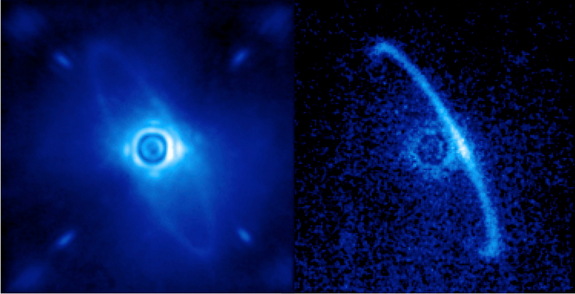

The exoplanet imager’s first image: not an exoplanet. http://www.space.com/ To date astronomers have discovered well over 1,000 exoplanets, or planets that circle stars outside of our own solar system. According to NASA, there are 3603 objects that are candidates for being an exoplanet, and 1015 confirmed exoplanets (verified by several different observers with several different instruments, reaching a minimum confidence level of 99.9999%).
All of these planets were found by NASA’s Kepler telescope, which also happens to be a solar powered spacecraft. Unfortunately Kepler does not allow us to know the composition of each planet, only that a planet is or isn’t there. Now, due to the creation of a new, high powered observational tool, all that is changing.
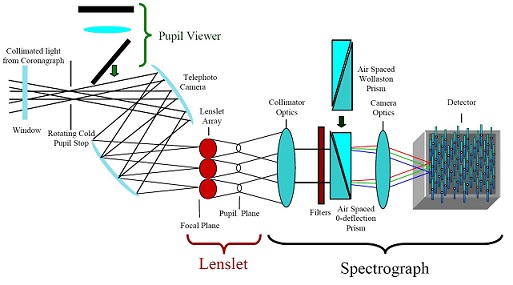
A look at how Gemini functions. http://spie.org/ Throughout history hundreds of different observational tools have been created to observe the universe. Even before it was understood that we are part of a galaxy, let alone surrounded by exoplanets, human eyes looked to the stars in wonder and awe. Now we have the power to not only view those stars close up, but to also view the very composition of their planets. The tool that affords us this power is called the Gemini Planet Imager. The imager is an optical enhancement currently being used in the Gemini South telescope in Chile. It was built by a team of U.S. and Canadian institutions, funded by the Gemini Observatory, which is an international partnership comprising the U.S.A., U.K., Canada, Australia, Argentina, Brazil & Chile. Gemini is also partially funded by NSF, NASA, the University of California and the Laboratory Directed Research and Development funding at the Lawrence Livermore National Laboratory.
Humanity already has multiple massive telescopes including the Kepler and Hubble orbiting the Earth, why can’t they just do Gemini’s job? The purpose and function of the Gemini Planet Imager is uniquely different when it comes to exoplanet detection. Kepler locates exoplanets indirectly by focusing on a star and finding the “dark” spot the planet produces on the image when orbiting between the star and the telescope. Gemini on the other hand takes a more direct approach by directly detecting the light an exoplanet gives off. According to the Gemini Planet Imager website,
GPI will detect DIRECTLY the light from an extrasolar planet…Almost 1,000 extrasolar planets are known today, but mostly through indirect Doppler techniques that indicate the planet’s mass and orbit or transit events that measure the planet’s size and orbit. If we can directly pick out a planet from the star’s glare, we can use spectroscopy to measure the planet’s size, temperature, gravity, and even the composition of its atmosphere. By targeting many stars we will understand how common or unusual our own planetary system may be.

The periodic table of exoplanets as of January 2013. http://phl.upr.edu/ The Gemini Planet Imager saw light for the first time in November 2013, and has been working without a hitch ever since. Being eight times more sensitive than any existing imaging device, Gemini is the crowning achievement on an entire year of exoplanet discovery and analyzation in 2013. It can even scan and processes images 100x faster, taking only 60 seconds.
Related Article: Triple Star System Paves Road to Understanding Gravity
The galaxy is a huge place, and although the Kepler telescope has detected thousands of planets and stars, that doesn’t even scratch the surface of the 300 to 400 billion stars in the Milk Way Galaxy. The Gemini Planet Imager will at least give us a little more quality to the small quantity of planets we have in our planet image menagerie.

Our potential new homes. http://www.bbc.co.uk/ The Kepler telescope and the Gemini Planet imager focus specifically on finding exoplanets similar to Earth. Scientists generally categorize discovered exoplanets by size relative to Earth. In a study published in the Proceedings of the National Academy of Sciences of the United States of America on October 22, 2013, Scientists stated that after observing 42,000 Sun-like stars analyzed by Kepler, they had found,
603 planets, 10 of which are Earth size and orbit in the habitable zone, where conditions permit surface liquid water…22% of Sun-like stars harbor Earth-size planets orbiting in their habitable zones.
Along with Earth-like planets, astronomers have also discovered a solar system that shares a relatively large number of similarities with our own. It’s a good thing there isn’t a precise Earth analogue in the system otherwise there would be no way to prove that the system isn’t just one cosmically gigantic mirror. Our collective sanity has been spared.
Great technology will of course give rise to greater technology ad infinitum. That means a Google Galaxy ‘planet surface view’ is in humanity’s future. Awesome.
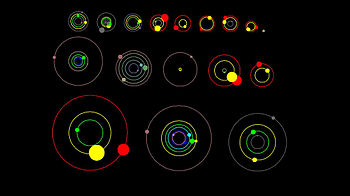
The orbits of different solar systems found by the Kelper telescope. Sources:
http://www.bbc.co.uk/news/science-environment-24549384
http://www.space.com/17383-kepler-planet-hunting-nasa-telescope-infographic.html
http://planetquest.jpl.nasa.gov/page/whatsTheDifference
http://en.wikipedia.org/wiki/Timeline_of_telescopes,_observatories,_and_observing_technology#1960s
http://messier.seds.org/more/mw.html
http://arxiv.org/abs/1310.6248
http://www.pnas.org/content/110/48/19273
https://wondergressive.com/life-its-all-over-the-place/
1000 exoplanet, astronomer, chile telescope, exoplanet, exoplanets, extrasolar planet, Galaxy, galaxy exoplanet, gemini, gemini planet imager, gemini south telescope, instrument, kepler, milky way, milky way galaxy, NASA, nasa kepler, nasa kepler telescope, observation, Orbit, periodic table exoplanets, planet orbit, pnas, sigma 5, similar solar system, solar system -
New Type of Hypervelocity Star Found: Just Passing Through


Hypervelocity stars come and go as they please. http://www.dailygalaxy.com/ A brand new type of star has been discovered by graduates at Vanderbilt University. It is a new type of hypervelocity star, one that may not be from our galaxy.
According to Vanderbilt University graduate student Lauren Palladino, lead author on the study,
These new hypervelocity stars are very different from the ones that have been discovered previously. The original hypervelocity stars are large blue stars and appear to have originated from the galactic center. Our new stars are relatively small – about the size of the sun – and the surprising part is that none of them appear to come from the galactic core.
Astrophycists have discovered hypervelocity stars before. They are stars that move fast enough (at least 1 million miles per hour relative to the motion of the galaxy) to escape the gravitational grip of the Milky Way. Usually the stars attain their incredible speed by passing close to the mega blackhole (massing approximately 4 million suns) at the center of our galaxy and being ejected out into the void. These new hypervelocity stars, however, are clearly not originating from the center of the galaxy. In fact, they appear to be originating from far outside it.
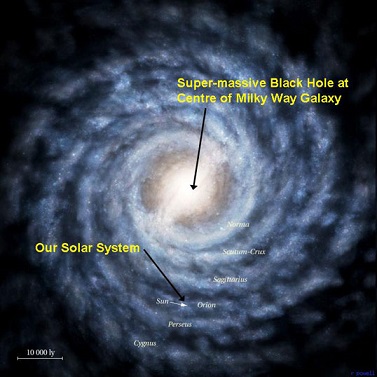
Our home sweet home. Related Article: A Planet Covered In Diamonds
By tracing a star’s trajectory and current position over the course of several weeks astrophysicists can construct a route that the star must have traveled on. The anomalous hypervelocity stars had a trajectory straight from nowhereville, Universe. So far 20 hypervelocity stars of the exotic variety have been spotted.
How did these particular stars pick up so much speed if not from the Milky Way’s central black hole? Where exactly are these stars coming from? Most importantly, can we eventually use rogue hypervelocity stars as a form of public interstellar transportation? This far from the galactic center, we would be waiting at the star-stop for an eon at least.
Related Article: NASA’s New Squad: A New Era of Space Travel
So, maybe using a hypervelocity celestial body as a form of high speed transportation is unrealistic, but what about living on one? According to one theory, the idea is totally plausible. Many rogue planets are just roaming around the galaxy, swayed this way and that by varying celestial mass and gravity. Ejected planets charging through the void of space could still retain an atmosphere, as well as heat and water with an adequate amount of pressure. It is perfectly possible that there is intelligent life whose lore and language does not contain a sun or moon, or night and day, just the ever-changing stars.
While Earth has a home in the outer reaches of an arbitrary arm of the Milky Way Galaxy, other stars and planets are just passing through. So long…
Sources:
http://news.vanderbilt.edu/2014/01/hypervelocity-stars/
http://www.nature.com/nature/journal/v400/n6739/full/400032a0.html
-
Watson, The Most Powerful Artificial Intelligence Goes Public

Watson is bringing humanity into the future. http://www.forbes.com IBM’s Watson, the most powerful artificial intelligence in the world, is the subject of a great amount of hype in the tech world. In November 2013 IBM announced that they would begin accepting independent partnership offers from individuals who believe they can apply the technology to their own applications. “Powered by IBM Watson” will become a term you will be hearing more often beginning this year.
The partnerships are just one part of a program IBM decided to launch called “The Watson Ecosystem.” IBM will recruit tech savvy entrepreneurs who have enough experience and motivation to take Watson’s power and share it with the world in the form of an app. The Ecosystem project has a budget of $1 billion dollars, with $100 million in venture funding available to accepted partnerships.
According to IBM,
Partners are building a community of organizations who share a vision for shaping the future of their industry through the power of cognitive computing. IBM’s cognitive computing cloud platform will help drive innovation and creative solutions to some of life’s most challenging problems. The ecosystem combines business partners’ experience, offerings, domain knowledge and presence with IBM’s technology, tools, brand, and marketing.
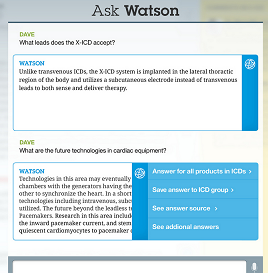
Ask Watson: Like Ask Jeeves, but awesome. With a price tag of $1 billion dollars and such incredible hype, it appears IBM is preparing for Watson to be their next tidal wave of innovation. In fact, they’ve already begun accepting partnerships, allowing the technology to begin learning and growing on a grand scale right at this very moment.
Related Article: Long Distance Quantum Teleportation is Reality
Absolutely anyone can become a partner. As long as you meet the required criteria, and after Watson agrees to become your friend of course, then you’re in. The companies that currently have a partnership under the Ecosystem are few, but they offer us an exciting future nonetheless. A sampling of Ecosystem Program participants include:
Fluid, inc. – Fluid uses IBM Watson technology to create the Fluid Expert Personal Shopper. This app takes advantage of Watson’s ability to understand human language and scan extremely large databases of data very quickly. This app is your own personal shopping assistant. It can speak to and understand you, and will give you shopping advice specific to what you are looking for. Want to buy a new flying car? Watson will scan the user reviews, prices, product background, safety information, past releases, and future releases from 1000’s of different website at the same time and calculate the best product for you.
MD Buyline, Inc – The Hippocrates app powered by IBM Watson provides users with a personal medical research assistant who researches all the possible evidence that exists before giving a calculated diagnosis. This can help doctors make a more educated decision, and help patients ensure that their doctors didn’t just coast through medical school.
Related Article: AI Prescribes Better Treatment than Doctors
Welltok, Inc. – Welltok is developing an app called CaféWell Concierge powered by IBM Watson that will create Intelligent Health Itineraries™ for consumers. These personalized itineraries will include tailored activities that encourage healthy behaviors for users. Also, by having conversations and sharing information about your health and how you feel, Watson becomes your personal health, nutrition, and overall well-being guru, suggesting the best course of action for you to ensure you always feel happy and satisfied.
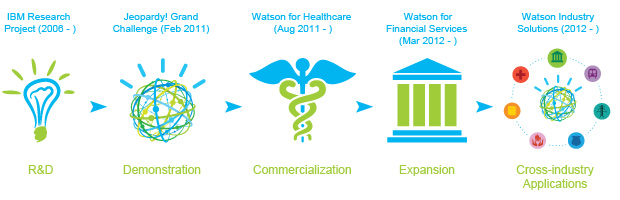
Watson has a game plan for its own birth! www-03.ibm.com This is only the beginning. Watson will become exponentially more efficient, more human-like, more adaptive, and more intelligent with each and every user interaction that occurs. Billions of people worldwide will be helping it learn, and the more it learns, the faster it will learn more, ad infnitum. As Watson benefits, so will humanity. We will be rewarded with near infinite and instantaneous ingenuity, information, calculations, hypothesis, and explanations on a daily basis. We are being granted a constantly improving, always expanding brain at our fingertips. This is only the beginning.
Related Article: The Singularity is Nigh Upon Us: The Merging of Humans with Technology
A particular program using Watson technology is so powerful that it has shown to be undeniably better than doctors at diagnosing illness and prescribing a cure due to its ability to scan, analyze, and cross reference libraries of personal and scholarly information all at the same time.
If you’re interested, you can read about the science behind Watson as well as how and why the technology was created. May as well start studying up on your robot overlord now and get into its good graces.

Watson made its debut on jeopardy. http://www.technobuffalo.com/ Sources:
https://wondergressive.com/ai-prescribes-better-treatment-than-doctors/
ask watson, expert personal shopper, fluid, fluid inc., fluid watson, hippocrates app, IBM, ibm watson, inc., inc. welltok inc., md builine inc., md buyline, watson app, watson ecosystem, watson history, watson innovation, watson jeapordy, watson ken jenning, watson partnership, watson public, watson smartphone app, watson word, welltok -
Speaking to Babies in ‘Parentese’ Yields Surprising Results

A recent study which examined twenty-six babies has found surprising results regarding the way babies learn and use new vocabulary when spoken to in ‘parentese.’ Scientists outfitted 1-year-olds with clothes containing audio recorders. They recorded every bit of sound happening around the children for eight hours a day and four days straight. This came to 4,075 30-second intervals of recorded speech for each child.
After examining each and every 30-second clip of sound with a nifty piece of software called LENA (“language environment analysis”), and waiting a whole year the scientists were ready to share the shocking news. Speaking to a baby in baby talk, or more specifically, ‘parentese,’ is more important than just saying as many words as possible when it comes to language development.
Related Article: Read for Pleasure to Significantly Boost Intelligence
Although new parents commonly receive the advice to say as many words to a baby as possible in order to encourage its language growth, this isn’t the most ideal advice. When the babies were two years old the scientists asked the parents of the 26 children to fill out a questionnaire asking how many words their children knew. The evidence is quite clear:
2-year olds in families who spoke the most baby talk [parentese] in a one-on-one social context knew 433 words, on average, compared with the 169 words recognized by 2-year olds in families who used the least babytalk in one-on-one situations. The relationship between baby talk [parentese] and language development persisted across socioeconomic status and despite there only being 26 families in the study.
Parentese is so easy anyone can do it! vimeo.com While baby talk is nonsensical noise, parentese is like a dialect of normal speech. While speaking in parentese you still use normal words, the difference is that you use a high pitch voice and stretch out the vowels. An example of parentese picking up a baby and saying, “who’s my li-i-ttle baybee? Are you my littlee baybee? Yes, yoooou are!” You’re not saying “ooga booga,” you’re just being animated.
Related Article: Why Humans Have the Unique Ability to Learn New Words
The research also revealed that one-on-one conversations, especially in parentese, are extremely important. Patricia Kuhl, co-author of the study and co-director of UW’s Institute for Learning & Brain Sciences confirms this point by explaining that,
what our analysis shows is that the prevalence of baby talk in one-on-one conversations with children is linked to better language development, both concurrent and future.
The reason parentese works so well is because of how well it engages babies. Parentese allows a parent to keep their child’s attention by speaking in a slow happy voice, while still using actual words. Most importantly, especially in the case of a one-on-one conversation, parentese encourages a response and the consequent attempt at language formation. It is this constant attempt at verbal speech in the form of babbling that leads to the most rapid language learning in infants. As Kuhl concludes,
It’s not just talk, talk, talk at the child. It’s more important to work toward interaction and engagement around language. You want to engage the infant and get the baby to babble back. The more you get that serve and volley going, the more language advances.
Additional recent studies in the same vein as the one above have found that engaging in non-verbal language and learning multiple languages at the same time are also solid methods for improving vocabulary and language development in infants.
Related Article: Epigenetics and Altering Your DNA
If you are planning on taking parentese classes and implementing some of these techniques in an attempt to boost your child’s vocabulary, remember to read to them. Reading to and with children is possibly the single biggest factor in language development. Not to mention, it teaches them to love and enjoy literature.
Sources:
http://news.stanford.edu/news/2013/september/toddler-language-gap-091213.html
http://www.pbs.org/parents/child-development/baby-and-toddler/baby-talk-speaking-parentese/
http://www.cal.org/resources/digest/earlychild.html
https://wondergressive.com/read-for-pleasure-to-significantly-boost-intelligence/
babble back, Babies, babies language, baby language, baby talk, baby vocabulary, baby vocabulary study, baby words, child bilingual, dialect, infant, infant babble, infant language, language development, learning and brain sciences, multiple languages, non verbal language child, parentese, parentese baby, parentese bilingual, parentese vocabulary, read to child, university of washington, volley -
The Flying Car Is Closer Than You Think

Is that the President landing? No its just Kevin, he got that new flying car!
http://laughingsquid.com/terrafugia-unveils-futuristic-tf-x-flying-car-concept/The future of flying cars is closer than you think, and Terrafugia is willing to take us there! Funny name you say? It is derived from Latin, meaning “escape the Earth.” Fitting to say the least.
Terrafugia is set to release a car-plane hybrid by the name of The Transition which will be a fuel efficient transforming plane. That is correct. You will be able to drive your Transition from your house to the nearest run-way and simply lift off into the the skies!
How you ask? The wings of the flying car fold up on the side, transforming the vehicle into a regular 23 gal, 35 mpg, 100 hp, compact automobile. And when you are ready to hit the skies you will be cruising at a steady speed of 100 mph with a flight range of 410 miles. All for the low price of $279,000. While that price may seem steep to some, it is as with all things that enter the market as a new technology: eventually the price of flying cars will come down to a more reasonable and affordable six figure price tag.

This Transition is cute as a button.
http://www.terrafugia.com/aircraft/transitionRelated Article: Blimps are the Future!
The great thing about Terrafugia is they also have a commercial flying car in the works. While the Transition is set to come out in 2015, they have planned another model flying car by the name of TF-X (released in 8-12 years). The TF-X will be a smaller, safer, road oriented version of the Transition. Not to mention it will have a sophisticated auto pilot:
- TF-X™ vehicles will be capable of automatically avoiding other air traffic, bad weather, and restricted and tower-controlled airspace.
- If the operator becomes unresponsive, TF-X™ will automatically implement an emergency auto-land at the nearest airport.
Related Article: Google’s Self Driving Car Initiative
There are however a couple of setbacks, as with any new invention. The flying car will likely run into road blocks (why not just fly over them…) from the political side of things; weight restrictions, flight allowance, zone restrictions, and licence requirements. Currently, with a petition already submitted, Terrafugia is still a long way away before getting government support and clearing all the speed bumps ahead (again… just fly why don’t you, you have a flying car!). Most of these policies and restrictions will be upheld with public safety in mind, but there will unfortunately be opposition from the greedy side of politics.
All shall be unveiled in the next couple of years, and if everything goes accordingly, we should be able to fly out of traffic jams in the next decade or so. Flying cars will guide us to a brave new world. Imagine: no more close calls with black ice (preaching to the choir of current weather hazard victims). No more long, windy roads up a mountain with no support in order to get to a camping spot in Virginia. No more dangerous flooded areas one might get stuck in after intense rainfalls. Flying cars have the potential to provide us with all of this in the near and plausible future too!
Cheers to the Jetsons, and to a world of flying cars!
Related Article: Car Warming: Debunking the Myth
Research:
Temporary Exemption for Terrafugia
Wondergressive: Blimps are the Future!
-
Triple Star System Paves Road to Understanding Gravity

Triple star systems could play a more important role than we first thought. http://www.bbc.co.uk/ A new study published in the scientific journal Nature documents the discovery of a very peculiar triple star system. Astronomers believe that observation and analyzation of this triple star system could potentially resolve lingering discrepancies in some of Einstein’s theories concerning gravity. In fact, this particular triple star system could eventually lead to unraveling the secrets of gravity.
Related Article: Our Special Time in the Universe
This triple star system is roughly 4200 light years from Earth and is composed of a pulsar and two white dwarfs orbiting each other within a space smaller than Earth’s orbit of the sun. The pulsar closely orbits a white dwarf star while a second white dwarf star orbits the pair from a distance. While a triple star system like this one has been found before, this is the first time such a strong interaction between the orbiting objects has been observed.
According to Scott Ransom of the US National Radio Astronomy Observatory (NRAO) in Charlottesville, VA:
This triple star system gives us a natural cosmic laboratory far better than anything found before for learning exactly how such three-body systems work and potentially for detecting problems with general relativity that physicists expect to see under extreme conditions. This is a fascinating system in many ways, including what must have been a completely crazy formation history, and we have much work to do to fully understand it.
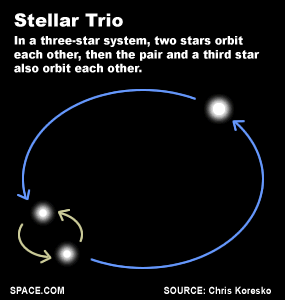
An easy way to imagine a stellar trio. http://www.miqel.com Pulsars are created in the presence of a supernova. Under the intensity of a supernova, burnt out stars can collapse and turn into a dense, highly magnetized ball of neutrons. A pulsar emits radio-waves in the same way a lighthouse emits light. Pulsars can only be seen when the beam of radio waves is pointing at the Earth. While pulsars all spin at different rates, the pulsar in the study spins at an extremely rapid rate of 366 times per second. Due to its incredible rotation speed, this type of pulsar is called a millisecond pulsar. Finding this millisecond pulsar triple star system is important because
This is the first millisecond pulsar found in such a system, and we immediately recognized that it provides us with a tremendous opportunity to study both the effects and nature of gravity. The gravitational perturbations imposed on each member of this system by the others are incredibly pure and strong.
Binary and triple star systems appear all over the galaxy. Even our sun is likely part of a larger binary solar system. While the systems can vary in formation, most are formed in a very similar fashion to the triple stellar system described in the study. Two of the stars form a binary system and the third star orbits the pair at a far greater orbit. If the system isn’t constructed this way it becomes unstable, leading to a star being ejected at high velocities away from the pair.
Related Article: New Type of Hypervelocity Star Found: Just Passing Through
So as is usual with cosmological physics, the hardest aspect of reading any study is figuring out why we should care about the discovery of a special triple star system. The thing is, gravity is a rascal when it comes to theories of the universe. It simply doesn’t fit into any modern quantum theories. The Einstein Equivalence Principle states:
The outcome of any local non-gravitational experiment in a freely falling laboratory is independent of the velocity of the laboratory and its location in spacetime.
This eventually led to the Strong Equivalence Principle, which states:
- The gravitational motion of a small test body depends only on its initial position in spacetime and velocity, and not on its constitution. The outcome of any local experiment (gravitational or not) in a freely falling laboratory is independent of the velocity of the laboratory and its location in spacetime.
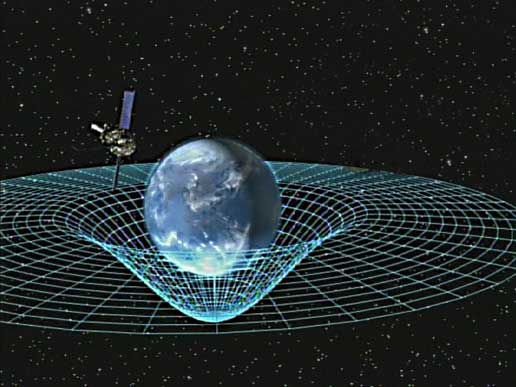
Gravity is stranger than you think. http://podaac.jpl.nasa.gov/ The equivalence principle holds true in most experiments, but in the quantum world it completely falls apart. Einstein’s theory of general relativity holds true for massive celestial bodies, but the miniscule world of quantum physics is a different realm entirely.
Related Article: Long Distance Quantum Teleportation is Reality
Countless attempts have been made to create a Grand Unified Theory of physics involving a single equation that would involve all forces currently known to man. The problem is that gravity constantly throws a wrench in the spokes of every unified theory physicists come up with. Simply put, the reason this study of a unique triple star system is so important is that by observing the activity of a triple system with such pure and strong gravitational interactions, it may shine light on how gravity functions at the quantum level. This could one day lead to a single unified theory of everything. Physics would no longer be a class, just a single equation you could plug and chug information into and get answers.
Sources:
http://www.nature.com/nature/journal/vaop/ncurrent/full/nature12917.html
http://www.bbc.co.uk/news/science-environment-25598051#FBM325422
http://adsabs.harvard.edu/abs/1994MNRAS.267..161K
http://adsabs.harvard.edu/abs/1968QJRAS…9..388E
http://en.wikipedia.org/wiki/Equivalence_principle#The_Einstein_equivalence_principle
http://hyperphysics.phy-astr.gsu.edu/hbase/forces/unigrav.html
http://en.wikipedia.org/wiki/Grand_Unified_Theory
binary star system, binary system, einstein equivalence principle, free falling, grand unified theory, gravity, light years, magnetized, millisecond pulsar, nature, neutrons, non gravitational, nrao, Orbit, physics, pulsar, pulsar orbit white dwarf, quantum universe, radio wave, Spacetime, supernova, triple star system, triple star system pulsar, triple stellar system, universe, white dwarf -
Ingredient in Pot Decreases the High: THC, Pot Shops and Lobbyists


Growing pot takes as much creativity as naming the crop. kwgn.com Excitement about New Years is still in the air, and in Colorado, so is a colossal amount of pot. New Years Day marked the opening of some 37 pot shops licensed to sell cannabis recreationally to people 21 and older. The first person ever to buy pot recreationally was an Iraq war veteran, and boy did he look happy about his big bag of legal herb. He, along with the other marijuana enthusiasts, are responsible for $1 million in sales on the first day.

I guarantee his 15 minutes of fame was celebrated by getting legally high. rt.com People are smoking so much that less than a week after New Years, the supply is already running out. Pot shortages are widespread despite the fact that recreational marijuana prices are more than double the price of medical marijuana prices, sometimes costing more than $400 per ounce before tax. Luckily for everyone’s stress levels, that price is projected to settle closer to $185 per ounce within the next few years.
With so much pot being smoked, everyday Colorodans, stoners and weekend warriors alike are sure to find the results of a recent study very interesting. Researchers have recently discovered that consumption of THC, the psychoactive component of cannabis that gets people high, boosts the production of a substance produced in the brain called pregnenolone. Pregnenolone inhibits cannabinoid receptors in the body from being activated by THC, creating a negative feedback loop: The more pot someone smokes, the more pregnenolone is produced, the less effective THC is, the more pot a person smokes. I suppose it wouldn’t be a stretch to tell a cop, “sorry officer, I was just smoking to sober up.”
Related Article: Smoking Pot Without Getting Higgh: But Why?

Here’s a mug shot of the brain’s buzzkill. http://www.marijuana.com The researchers believe this study may present an effective approach for treating people who have a harmful psychological dependence on pot. Administering pregnenolone, or encouraging pregnolone synthesis through some other means besides cannabis consumption may be the answer that pot ‘over-enthusiasts’ have been looking for. With up to 4.5 million Americans harmfully dependent (defined as having “difficulty controlling their drug use and cannot stop even though it interferes with many aspects of their lives.”), this is wonderful news to a great number of people.
So, should we start taking bets on whether this study will cause pot smokers to think twice before they roll that second joint? Seems like a risky bet since nothing appears to be stopping the insatiable hunger in Americans to take back their great national heritage. That won’t stop the DOJ from trying though.
The DOJ, under direction from President Obama, announced in August, 2013 that they would not interfere with the legalization of cannabis in Colorado. They assured Colorodans they would take a “trust but verify approach.” Apparently the DOJ’s idea of “trust but verify” comes in the form of raids and imprisonment.
Related Article: War on Drugs Farce Continues Unabated
About six weeks ago extensive raids on medical marijuana shops and growers took place in Denver. Jeff Dorschner, spokesman for the U.S. Department of Justice in Denver, told the Denver Post that,
No arrests were made in the raids, the raids were being conducted by the Drug Enforcement Administration, Internal Revenue Service criminal investigations unit, the Denver Police Department and state and local law enforcement.
More than 12 Denver metro area marijuana facilities and two homes were raided in total. What’s worse is that these locations were strictly medical marijuana dispensaries whose sole business is providing millions of Americans with a safe, effective, non-addictive, minimal side-effect involved cancer cure.

So glad police are saving the day from such dangerous criminals. nevergetbusted.com The raids in Denver have a powerful backing and voice in Washington. It comes in the form of billions of dollars in lobbying from countless industries. From the companies’ perspective I’d be afraid of pot legalization too seeing as how much people love their favorite weed. A recent survey administered to 404 medical marijuana patients in Canada revealed that,
Over 41% state that they use cannabis as a substitute for alcohol, 36.1% use cannabis as a substitute for illicit substances, and 67.8% use cannabis as a substitute for prescription drugs.
What a coincidence, the same companies that spend billions of dollars on lobbying against legalization happen to be the ones that would be hurt most by legalization. Theoretically, the lobbying shouldn’t make a difference anyway since nearly 2/3 of Americans believe that the government should keep its snout out of state marijuana laws.
Related Article: The Senate Is Useless and Should Be Dismanteled
Will our representatives ever listen to the will of the people again? Will the current, belligerent congressional activity continue for good? The Fed will have to make a move soon with states legalizing medical marijuana so often. New York is preparing to become the 21st state to legalize medical marijuana.
Sources:
http://www.huffingtonpost.com/2014/01/01/sean-azzariti-marijuana-colorado_n_4519539.html
http://www.cnn.com/2014/01/04/us/colorado-marijuana-legalization-store/
http://www.huffingtonpost.com/2014/01/03/pot-sales_n_4536780.html
http://business.time.com/2014/01/04/colorados-pot-shops-say-theyll-be-sold-out-any-day-now/
http://www.sciencemag.org/content/343/6166/94
http://www.drugabuse.gov/publications/marijuana-abuse/marijuana-addictive
https://wondergressive.com/the-history-and-legality-of-cannabis-use/
https://wondergressive.com/fed-allows-cannabis-legalization-police-unhappy/
http://www.huffingtonpost.com/2013/11/21/colorado-pot-raid_n_4317815.html
http://www.gallup.com/poll/159152/americans-federal-gov-state-marijuana-laws.aspx
http://www.cnn.com/2014/01/05/us/new-york-medical-marijuana/
http://informahealthcare.com/doi/abs/10.3109/16066359.2012.733465
37 pot shops, canada, cost of cannabis colorado, cost of marijuana colorado, cost of pot colorado, denver post, Department of Justice, doj, doj colorado, high, iraq war veteran pot, jeff dorschner, marijuana dependence, marijuana shop, New Years, new years colorado, new years day, new york cannabis, new york marijuana, new york pot, ounce pot, pot shops, pregnenolone, President Obama, THC, Washington
Wonder about your world…

Take the plunge down the rabbit hole of insanity and wonder in this fast-paced, nonstop psychological thriller that will leave you questioning the very nature of reality and beyond. Part thriller, part romance, part existential horror, A Dream of Waking Life delves into lucid dreaming, psychedelics, existential ontology, video games, the nature of love, the nature of reality, and more.

Mendel’s Ladder delivers an adrenaline-fueled journey set on a dystopian future Earth, brimming with high-stakes action, adventure, and mystery. This epic series opener plunges readers into a world filled with diverse cultures, heart-pounding battles, and characters who will captivate your heart and imagination.

“E.S. Fein is raising the bar for quality as it’s a very well-written and thought-provoking book…There are points and themes in the story that could be discussed for eons as people will have their own idea on where it leads. It’s a book I would highly recommend.” – Andy Whitaker, SFCrowsnest

 Wondergressive