-
Dolphins Exhibit Unending Compassion

http://babyanimalzoo.com Morality in animals is surprisingly common. Animals of all shapes and sizes have been documented exhibiting moral decision making and selflessness, even when faced with the prospect of pain or even death. As each day passes, studies continue to be released that reveal the profound intelligence and intuition of animals, and the fact that a multitude of species are just as conscious as human beings. While some species of animals are seen mourning their dead or protecting their young, others are seen desperately trying to save the life of other members of their species. Once such animal that exhibits this behavior is the dolphin.
There are dozens of documented cases of dolphins rescuing humans, but for the first time researchers have witnessed an entire group of dolphins attempting to save another dying dolphin. The observation documents a very unusual case of care giving behavior between bottleneck dolphins. Korean scientists saw the attempted rescue take place off the coast of Ulsan, South Korea and were amazed by what they witnessed.
While researchers were documenting a group of more than 500 dolphins they noticed a separate, smaller group of about 12 dolphins swimming very slowly and acting abnormally on the surface of the water. They realized that the group was attempting to save the life of one of their companions. The injured dolphin seemed to have paralyzed fins and red marks on its abdomen. Individual dolphins kept the injured dolphin afloat by pushing its body upwards while a group of 10 or so dolphins formed a living raft as support.
Five dolphins at a time lined up horizontally into a raft-like formation, maintaining it while the stricken dolphin moved on top and rode on their backs. One of the dolphins in the raft even flipped over its body to better support the ailing dolphin above, while another used its beak to try to keep the dying dolphin’s head up. A few minutes later the stricken dolphin appeared to die, its body hanging vertically in the water, with its head above the surface. It wasn’t breathing.
Even after the injured dolphin died its companions continued to blow bubbles into it as if attempting resuscitation. Other members of the group rubbed and touched the dead dolphin’s body in seeming distress.
It is well known that dolphins are an incredibly intelligent and self-aware species. Not only do they fully recognize themselves and make faces in the mirror, they have also been observed asking for help from human divers while injured. Dolphins have also been seen regularly using sponges as tools while foraging, which is believed to have originated from a single spontaneous innovation (their version of the wheel) and has spread to subsequent generations for the last 100 years or more. They are additionally a very community driven species, forming gangs, tribes, and alliances that guard females against other tribes. The varying tribes have frequently been seen persuading other tribes to end old alliances and form new ones. These groups form the social foundation of dolphin society.
One of the most incredible aspects of dolphin intelligence is that despite humans not understanding their complex language, dolphins have an unparalleled comprehension of human language, even our syntax. They are natural chatters, engaging in communication with several different species other than humans.
Dolphins are incredibly self aware beings that deserve greater recognition and compassion- they certainly don’t mind sharing their compassion with us.
Sources:
Wondergressive: Morality in Animals
Wondergressive: The Profound Intelligence and Intuition of Elephants
Wondergressive: Animals are Just as Conscious as Us
Wondergressive: Birds Mourn Their Dead
BBC Nature: Dolphins Try to Save Dying Companion
Marine Mammal Science: An Unusual Case of Care Giving Behavior
Understand Dolphin: Brain and Intelligence
Youtube: Dolphins Looking into Mirrors
Huffington Post: Divers Rescue Dolphin After it Asks for Help
io9: Biologists and Dolphins Have Created the First Interspecies Language
Science Direct: SETI Meets a Social Intelligence
Save The Whales: Cases of Dolphins Rescuing Humans
animal intelligence, animal kingdom, animal language, animal morality, animal society, animal using tools, animals selfless, BBC, bottleneck dolphins, climate effect ocean, community, community driven, cpr, dolphin compassion, dolphin gang, dolphin intelligence, dolphin language, dolphin raft, dolphin sponging, dolphins, dolphins save humans, dying dolphin, how to cpr, human compassion, Humans, intuition animals, intuition elephants, korea nuclear, life guard training, life saving, marine biologist, marine life, north korea, ocean, selfless, social hierarchy, south korea, ulsan -
Photographic Memory (Phase 2: Holy Shit)
http://newvaluestreams.com/wordpress/wp-content/uploads/2009/08/super-memory.jpg A few weeks ago, we posted a potentially paradigm altering question: Can the human mind be trained into photographic recollection? (This is a follow up, so maybe check out the link before reading on) Two sentences are more than enough build up. The results are in folks, and…
The short answer is “yes”.
The slightly longer answer is “FUCK YEAH!!!! WHEW!!!! (6 back-flips)”
For the last month, I’ve been religiously following this protocol, and it has worked. I have a photographic memory. No joke. After the power-lust erection and adrenaline jitters subsided, after a few hours of daydreaming plots to use this new ability for super-villainy, after a day of gazing at perfect recollections of stolen glances at cleavage, I feel I’ve calmed down enough to share with you eager readers the wonderful news… and you can totally have this too.
It’s incredibly easy. Do it. That’s really all you need to know. Do it now… but for the more curious, like I know you are, just a few things:
What’s happening in the brain that makes this work?

http://2.bp.blogspot.com/-gj-hEp5gzIU/T2CmZNhvS7I/AAAAAAAAAc4/5Hk-QBSKIk4/s1600/jesus-revealed.gif Well, there are 2 theories of how color vision works. Trichromatic theory says, essentially, that there are 3 types of cones (receptors) in the eye that sense specific pairs of colors; the occipital lobe then translates this information into what we call vision.
More interestingly, though, and what we’ll be looking at in detail, is the opponent-process theory of colored vision. With the opponent-process theory, whenever it suddenly shifts to dark, a perfect photo-negative image of whatever was just in the visual field gets transposed onto the retina. That’s the mechanism at work for the well-known illusion on the right (stare for ten seconds, then look away and blink fast) (or maybe it’s God talking to you. I don’t know). That negative image is what we utilize for super memory…
As long as the eyes are open, these negative images are constantly being processed and filtered by the brain. See, way too much is happening at once, though. Your eyes take in trillions and trillions of bits of visual information every instant, and almost none of it matters. So the occipital lobe, hard-worker that he is, weeds out what it doesn’t think is necessary. While you “see” everything around you, you only actually perceive an infinitesimal amount, the things that pertain to your safety/survival or what you’re focusing on in the moment. For example:
So, how does the occipital lobe know what’s important? Easy, you tell it. You do this all the time and don’t even think about it. A new parent will notice the “Diapers: Half Price” sign that the rest of us glazed over like it had neon lights, just like Alex Jones fans tend to see the chemtrails and “all-seeing eyes,” as though reality had been hit by a highlighter. Watch: right now, take a quick moment, without moving your eyes; notice all the things around you that are the color black…

http://media.tumblr.com/tumblr_ltw8hnYqea1qk1bhp.jpg Easy, of course, but did you notice that while you were doing that, everything else just sort of faded away? You could still see it, but it just wasn’t in focus, sort of. This is the process we hack…
The mind is plastic, flexible to our will, and if we know how it operates, we can train it to do just about anything. To develop a photographic memory; we need only develop a simple habit, so, real quick, let’s understand how habits work. It’s 30 days. That simple. If we do something every day, after 30 days, it no longer takes effort. The mind is retrained and the process is automatic (remember this for anything you want to do, because it’s universal, not just for memory training).
So with the dark-room process, we read words etched into our retinas, right. These negative images are always there and, usually, disregarded as irrelevant. What we’re doing is stepping into this process and saying, “Hey, don’t throw that out just yet. Let me take a look at that.” (You control your brain; your brain doesn’t control you, and never let anyone tell you otherwise), so the brain says “Oh, ok. Here it is. I didn’t realize you wanted that.” Your brain, however, is in the habit of tossing these negatives, so every day for a month we step in and say, “let me see that for a second.” after 30 days, the brain gets the point and will automatically save these images for you to look at whenever you want. Welcome to the club; you now have a photographically perfect memory.
Additional tips (in retrospect)
1.) Don’t read a book. The absolute best thing to attempt to read is not a book. What works much better is black background with bright and blocky white lettering. Far far easier to try to read.
2.) Wink. Part of the frustration you’ll come across with attempting to read your hindsight is overexposure. If you flash the lights before the image is totally dissolved, there is this overlap effect, like double exposed film (I’m not too ancient for remembering what film is, am I?). The solution: wink. Do it with one eye at a time; it has no effect on the process and allows one eye to recover as the other works. Doing this, my overall exercise got to as little as 3 minutes.
3.) Ask. Who knows how many little gimmicks and tricks I figured out? Feel free to write me at qwizx@wondergressive.com. I’ll get back to you as quick as my busy life will let me, and if there’re enough of the same questions, later, I’ll add an FAQ to the bottom here.
Finally, and most importantly, did I mention “fuck yeah” and “cleavage?”
Sources:
Experiments in Photographic Memory (Phase 1: Guinea Pig) (wondergressive.com)
What is the Trichromatic Theory of Color Vision (about.com)
What is the Opponent-Process Theory of Color Vision (about.com)
-
Smoking: A Pre-existing Condition Under Obamacare

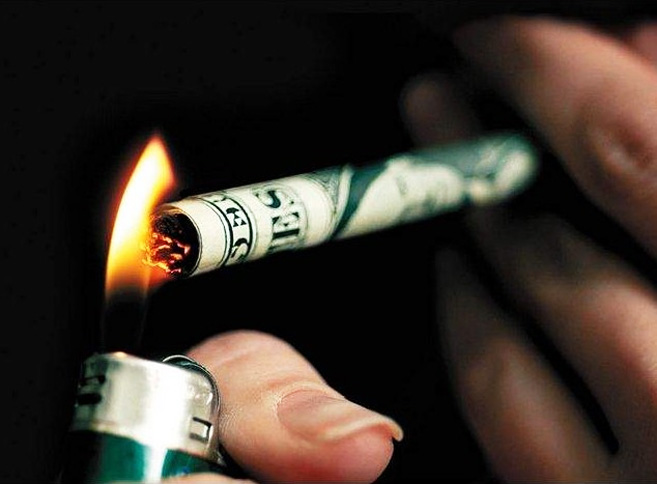
http://skeptikai.com/2012/02/09/rich-people-dont-smoke-the-simple-socioeconomics-of-tobacco-consumption/ I have written about the perils and predictable pitfalls of Obamacare before, and yet another example of the law’s asinine and unworkable structure has been revealed. One of the act’s most hyped lauded features is that it forbids insurance providers from charging more for people with pre-existing medical conditions. Stretching language to absurd, Joycean lengths, the medical exchange boards of Washington DC, California and Connecticut have decided that being a smoker is such a condition, and that smokers cannot by law be discriminated against. To cover the losses, non-smokers will be forced to make up the difference.
Mohammad N. Akhter, chair of the DC Health Benefit Exchange, stated that tobacco use is a “pre-existing medical condition” and that charging smokers more for their insurance would be “in direct conflict with our efforts to help people quit smoking.”
So there you have it. A risky and voluntary behavior—directly associated with the death of nearly a half million Americans a year—is now a medical condition. Americans should be prepared for more of this topsy-turvy nonsense as the Patient Protection Act is an absolute bureaucratic nightmare. As Nancy Pelosi famously said, Congress has “to pass the bill so [people] can find out what’s in it.” That prediction has has largely come true, though not in the way the former Speaker of the House intended. People don’t seem to be thrilled with Obamacare now that they see what a mess it will be. Three years after passing the controversial legislation, only 37% of Americans support the bill and 67% of the uninsured, the very people it was supposed to help, are unaware of how it will affect them.
This financial consideration from the government should come as a complete shock to smokers everywhere, as cigarette taxes have skyrocketed in recent years. The average state and federal tobacco excise taxes increased by 290% between 1995-2009, from $0.57 to $2.21 a pack. Obama is currently cheerleading for a further 94-cent increase.

http://www.cdc.gov/mmwr/preview/mmwrhtml/mm5819a2.htm So charging smokers more for medical insurance isn’t conducive to helping people quit, but charging them more than $3 a pack in taxes alone somehow is. Huh.
Bureaucratic weaseling like this is fraught with eminently foreseeable consequences. Kevin D. Williamson has a pretty stellar takedown at National Review:
Obamacare is designed to destroy the insurance market. Markets do not function without prices, and Obamacare ensures that prices will not be allowed to emerge. There is a medical price associated with smoking, but the District of Columbia has decided to suppress that price by law. Pretending that smoking has no relationship with health-care costs does not make it so — it is only a way to push costs around in a way that is agreeable to the likes of Barack Obama, converting a system that prices risk into a system of entitlements.
That leaves us with a system that is private in name only — which is the point.
It is meaningless to say that we have a private system in which private consumers buy insurance from private insurers when the insurers have been forbidden to price their products, and have instead been converted into something somewhere between a public utility company and a government contractor. Sure, you are free to buy any insurance you want — but if what you want is a lower rate for being a non-smoker, the point is moot, because it would be a crime for anybody to sell it to you.
Another unpleasant reality in this whole debate is how meaningless it actually is. The common conception is that smoking drives up the cost of medical care and that minimizing tobacco use would save millions or billions of dollars every year. The government is clearly torn between enacting sin taxes to punish smokers and giving them victimhood status by declaring their habit a pre-existing condition. However, it turns out that non-smokers actually cost health systems more than both smokers and the obese. Turns out that living longer and healthier is actually much more costly than dying younger.
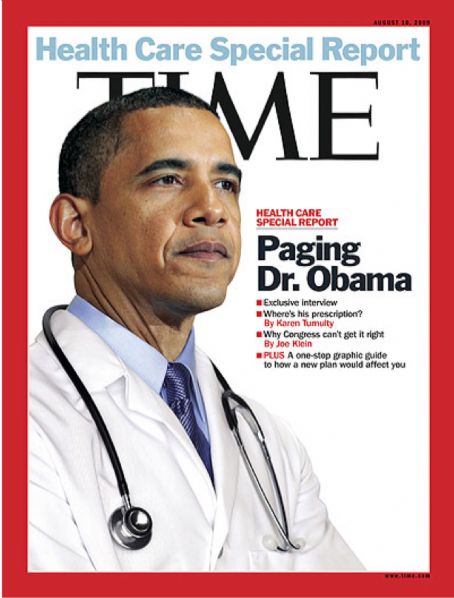
http://floridakeysteaparty.com/tag/president-obama/ One of the biggest problems with Obamacare is that it creates incredibly perverse incentives to interfere with the lives of adults. When people are forced to pay for others, they feel entitled to control behavior that may affect their tab. The rationale goes like this: Smoking is dangerous and seemingly costs money; therefore it’s an activity that needs to be controlled. The same reasoning justifies paternalistic efforts to curb obesity, leading to bans on sodas over 16 ounces and trans fats in Michael Bloomberg’s New York. Everyone should be terrified of following this rabbit hole towards its logical conclusion, where politicians can arbitrarily create laws to control seemingly any activity.
As dysfunctional as our current health care system is, Obamacare is the wrong prescription for change. It doubles down on bureaucracy and further diminishes individual choice. Barring repeal and a true injection of market forces, Americans should brace themselves for more schizophrenic and intrusive measures like this, where the government wants to both subsidize and tax the same activity, and the healthy are forced to pay for the lifestyles of the reckless.
Sources:
http://www.cdc.gov/tobacco/data_statistics/fact_sheets/health_effects/tobacco_related_mortality/
http://www.cbsnews.com/8301-250_162-57575720/obamacares-3rd-anniversary-by-the-numbers/
http://www.cdc.gov/mmwr/preview/mmwrhtml/mm5819a2.htm
http://money.cnn.com/2013/04/10/news/economy/cigarette-tax/
http://www.nationalreview.com/articles/345153/smoking-preexisting-condition-kevin-d-williamson?pg=1
http://www.nytimes.com/2008/02/05/health/05iht-obese.1.9748884.html?_r=2&
http://www.washingtonpost.com/blogs/the-fix/wp/2013/03/11/the-new-york-city-soda-ban-explained/
-
Aspartame…Miracle Sweetener or Deathly Toxin?
http://worldtruth.tv/aspartame-is-linked-to-leukemia-and-lymphoma-in-new-landmark-study-on-humans/
Diet soda has been prescribed by professionals for years as a healthier alternative to non-diet soda products, specifically due to the lower sugar intake. In fact, diet soda is almost always void of any grams of sugar due to the magic of artificial sweeteners like ASPARTAME! This replacement is a miracle for some and a disaster for others.Let’s start at the beginning. What is it? And why are we talking about it?
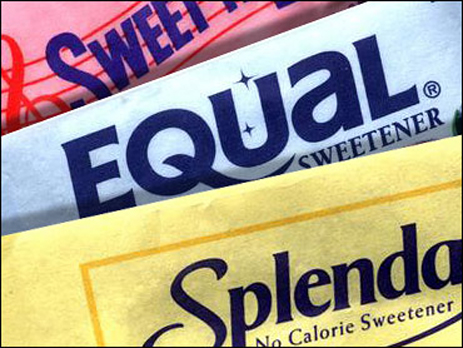
Aspartame is, according to the FDA, one of the most widely used artificial sweeteners since its inception in 1981. It is used in place of sugar in consumable products. The reason it is important is simple: it’s found in many different products that we consumers may or may not know about.
Here’s just a short (ha!) list of products that contain aspartame:
Breath Mints Cereal Chewing Gum Flavored Coffee Syrups Flavored Water Products Frozen Ice Frozen Ice Cream Novelties Fruit Spreads Gelatin, Sugar Free Hard Candies Ice Cream Toppings Ice Creams, No Sugar
or Sugar Free Iced Tea, Powder Iced Tea, Ready to Drink Instant Cocoa Mix Jams & Jellies Juice Blends Juice Drinks Maple Syrups Meal Replacements Mousse No Sugar Added Pies Non-Carbonated Diet Soft drinks Nutritional Bars Powdered Soft Drinks Protein Nutritional Drinks Pudding Soft Candy Chews Sugar Free Chocolate Syrup Sugar Free Cookies Sugar Free Ketchup Table Top Sweeteners Vegetable Drinks Yogurt, Drinkable Yogurt, Fat Free Yogurt, Sugar FreeDid you make it through all that? Great! Let’s continue!
The FDA’s stand on aspartame is:
Considering results from the large number of studies on aspartame’s safety, including five previously conducted negative chronic carcinogenicity studies, a recently reported large epidemiology study with negative associations between the use of aspartame and the occurrence of tumors, and negative findings from a series of three transgenic mouse assays, FDA finds no reason to alter its previous conclusion that aspartame is safe as a general purpose sweetener in food.
There is a pro-aspartame website that you can view and gather information on, but the basic claim it makes is:
The overwhelming body of scientific evidence clearly demonstrates that aspartame, even in amounts many times what people typically consume, is safe and not associated with adverse aspartame side effects.
Cancer.org also states that:
Complaints of various health issues have circulated since aspartame first appeared on the market in the 1980s. But for most people, no health problems have clearly been linked to aspartame use.
Andddddd! Now… LETS GET DANGEROUS!
For starters: Aspartame is linked to leukemia and lymphoma, Aspartame’s neurological side effects, other side effects of Aspartame, and Etc. One specific anti-aspartame rally crier is Mercola which states that:
Aspartate and glutamate act as neurotransmitters in the brain by facilitating the transmission of information from neuron to neuron. Too much aspartate or glutamate in the brain kills certain neurons by allowing the influx of too much calcium into the cells. This influx triggers excessive amounts of free radicals, which kill the cells. The neural cell damage that can be caused by excessive aspartate and glutamate is why they are referred to as “excitotoxins.” They “excite” or stimulate the neural cells to death.
What’s more, the different parts to aspartame are:
Aspartic Acid: as discussed by Dr. Russell Blaylock, in excess can cause serious chronic neurological disorders.
Phenylalanine: again discussed by Dr. Blaylock, in excessive can cause schizophrenia or make one more susceptible to seizures.
Finally, Methanol, which…is just poison.
One side says Aspartame is linked to brain tumors, the other side says Aspartame is completely harmless. In the end, it is all up to choice. Are you a believer or are you abashed by all the aspartame hate?
Research:
Pro-Aspartame information center
Anti-Aspartame Mercola website
Dr. Russell Blaylock on Excitotoxins
Darkwing Duck… Why? Best Childhood Memory Ever.
artificial, artificial sweetener, artificial sweetner, Aspartame, breath mints, chemical, coffee, diet, diet soda, doctor blaylock, equal, excitotoxins, fat free, flavored syrups, flavoring, frozen ice cream, fruit spreads, ice cream, iced tea, jam, juice, juice drinks, maple syrup, mercola, mousse, natural, natural news, no calorie sweetener, no sugar added, pie, powder, pudding, soda, soft candy, splenda, sugar, sugar free, sweet n low, sweetener, sweetner, toxin, vegetable drinks -
New Cancer Treatment Shows Promising Results in Leukemia Patients


http://www.redorbit.com/media/uploads/2012/02/health-021512-003-617×416.jpg New cancer treatment trials are shedding light on the ultimate solution for leukemia patients. Leukemia is a type of cancer found in blood cells which originates in the bone marrow that is inside every bone. When mainstream cancer treatments and institutions failed leukemia patents, a group of scientists from the Perelman School of Medicine at the University of Pennsylvania decided to take those patients in as a last resort. Using an altered form of the HIV virus, patients were given modified T-cells that directly annihilate cancer cells.
Here is a summary of how this particular cancer treatment works:
Patients’ cells are removed and then undergo the modification process. The T-cells found in the blood sample are reprogrammed to target tumor cells. This reprogramming works through gene modification using an altered form of the HIV virus. It is not deadly, and the only part used is the part that encodes a new protein, called a chimeric antigen receptor (CAR), into the T-cells’ surface. This protein then binds to another protein called CD19.
Related Read: Cannabis Cures Cancer and Everything Else
CD19 is a protein that is expressed in all tumor cells, as well as B cells, which are part of the immune system. The patients get a dose of B cells from the docs, so no worry there. The rest of the cells in the body do not have this CD19 protein shown on the surface, so they are ignored. The newly engineered T-cells are infused back into the patient, and start to kill off the tumors. Not to mention, the T-cells also multiply and stay present in the system.
Nine of twelve leukemia patients who received infusions of their own T cells after the cells had been genetically engineered to attack the patients’ tumors responded to the therapy. – http://www.uphs.upenn.edu/news/News_Releases/2012/12/tcell/
This seems really promising. On an even more promising note, there are more scientists tinkering with similar methods to specifically have T-cells target the CD19 protein found on tumor cells. Let us pray that one day this cancer treatment works not only on leukemia, but also on lymphoma, pancreatic cancer, and all other forms of cancer as well.
Related Read: Can Genetically Modified Corn Form Tumors in the Body?
Sources:
http://www.nature.com/news/2011/110810/full/news.2011.472.html
http://www.uphs.upenn.edu/news/News_Releases/2012/12/tcell/
-
Tattoo Quest (Part 1): Tattoos of Southeast Asia
As I’m considering getting a tattoo myself (sorry mom and grandma), I’ve decided to do a series of articles based on the various tattoo traditions of the world. This is the first article of a three article series on tattoos. I hope to inklighten you, our Wondergressive readers, as well as myself, in my attempt to understand the various meanings behind this ancient art and fulfill my quest of understanding why exactly people, myself and others, are drawn to display these potentially permanent designs on our bodies.
Related Read: Tattoo Quest (Part 2): The Spread of Tattoos
Related Read: Tattoo Quest (Part 3): Significance of Tattoos in the 20th and 21st CenturyPeople get tattoos for many-a-reason. These reasons vary from ceremonial rites of passage to proclamations such as “I really like to shop at 7/11 and this is the ONLY way that the world will know.” These days it seems that the reasons are unfortunately more inline with the latter though there are still a few traditions that hold the art of tattooing as sacred.
Traumatic tattoos are unintentional tattoos that happen as a result of injury. These are generally a colored scarring that happens when an outside element is introduced to open wounds. These tattoos are mostly unwanted and rarely resemble anything more than a painful event.
Historically, tattoos have been viewed both as a taboo and as an art form. The Ainu indigenous people of japan view tattoos as a matriarchal tradition where only the woman get inked.
“Until very recently (the last fully tattooed Ainu woman died in 1998), Ainu women retained a tradition of facial tattooing lending support to the argument that the ancient Jomon employed the custom in the distant past. For the Ainu, tattooing was exclusive to females, as was the profession of tattooist. According to mythological accounts, tattoo was brought to earth by the “ancestral mother” of the Ainu Okikurumi Turesh Machi who was the younger sister of the creator god Okikurumi.”
This tradition has been subject to much controversy in japan.
“As early as 1799, during the Edo Period, the Ezo Shogunate issued a ban on tattoos: “Regarding the rumored tattoos, those already done cannot be helped, but those still unborn are prohibited from being tattooed””
Looking at it now it seems awfully mean towards the woman in their culture. Go figure, subjecting women to various pains in order to get married. I am both irked by Japan’s deculturization of the Ainu people and accepting of it. On one had they are stripping an indigenous culture of their practices and beliefs. This is similar to the Romans outcasting pagan beliefs, the United State-ians completely degrading and embarrassing the Native Americans and every other instance of pseudo-westernization.
On the other hand- the left if you will, though it is not important- this practice of subjecting women to pain and permanent staining is both creepy and belittling. Through knife point art they are prepared to be wed.
Tattoos have rooted themselves into the dermis layer of many other southeast Asian cultures as well. In Cambodia, Laos, and Thailand Yantra tattooing (Sak Yant) is considered to be sacred and… magical!
Traditionally, a Yant is tattooed using a long bamboo stick with a split sharpened point like a quill called a Mai Sak or alternatively a long metal spike known as a Khem Sak. There are many designs of Yant available, each chosen to give either protective powers or good luck in business or in love. Many of the designs are universal but the Mantras may differ according to the Tattooer.
Sak Yant is an art done by Buddhist monks. Different powers are associated with different scripts. Many people believe that these tattoos have magical abilities. Ink seekers from all over the world travel to receive these magical works of body art. Unfortunately there are many people who get scammed out of a lot of money in search for the real thing. So if you’re about to start some crazy vision quest in search of magic, I’d tread lightly-as if on eggshells or spaghetti noodles- when dealing with some of these shady so-called “monks.”
Stay tuned for Part 2: The Spread of Tattoos and Part 3: Significance of Tattoos in the 20th and 21st Century!
Additional Information:
Video: The Process of Sak Yant
Related Wondergressive Articles:
A Breakthrough Futuristic Material: Silk
Dome Homes: Virtually IndestructableAinu, Americans, Ancient Art, Buddhist Monks, Cambodia, ceremony, Dermis, Fake Buddhist Monks, Getting Inked, Indigenous People, Ink, Japan, Laos, Matriarchal Tradition, Native Americans, Pagans, Permanent, Pseudo-Westernization, Rites of Passage, Romans, Sacred, Sak Yant, skin, Sorry Grandma, Sorry Mom, Tattoos, Thailand, Three Part Series, Traumatic Tattoos, wondergressive, Yantra Tattoos -
Augmented Reality Blows My Mind—Twice

http://www.thinkbym.com/wp-content/uploads/augmented_reality_iphone_plantronics.jpg Numerous studies have shown that Wondergressive readers are funnier, more attractive, likeable and intelligent than the average human being (links pending, but the science looks solid to me). This being the case, I’m sure many of you were already aware of futuristic-sounding, mind-blowing technology known as augmented reality. It even sounds very sci-fi. I’ve chanced upon this amazing bit of science twice (that I’m aware of) so far, and both times I’ve been left with my mouth hanging open.
The first time I ran into it was at Printing Arts, a print shop in Broadview, IL. They were printing baseball cards (which are apparently “in” again) as well as some other sports-related collateral when one of the guys showed me a card that was about an eighth of an inch thick. It had a cutout on the front through which you could feel the fabric of some player’s jersey. I think it was some football player’s, but honestly, I’m not a sports girl so I don’t remember exactly what game it was. Anyway, he told me to take out my phone, pull up the camera and wait for it to focus on the card from directly above it. Not sure what to expect, I played along. Holy shit—a video started to play on my camera screen! I was floored. Still am, actually.
Basically, the camera picks up on some code which wasn’t visible on the face of the card, accesses the corresponding video from the interwebs and streams it right onto your phone. This all happens in the space of seconds, not minutes, and is virtually transparent to the user.
The second instance was very recent. A work acquaintance showed me an app he had on his iPhone called SkyView by Terminal Eleven. Being something of an astronomy nut and long-time stargazer, I was again amazed by how far technology had come while I wasn’t looking.
StarView is an augmented reality app that shows you a view of the sky right on your iPhone. As you move your mobile device through the air, it seamless reveals the heavens in your little window. Stars, constellations, planets and even satellites all show up. You can further see the trajectory of celestial objects for a 24-hour period and even change the date to see the results of the past or the future.
While both those examples are great and awe-inspiring for sure, there are actually many practical uses for augmented reality, especially in our increasingly mobile lives. Educational apps like Science AR and Anatomy 4D turn posters and other printed materials into interactive pieces. Virtual History ROMA boasts about its “full-immersion panoramic experience.”
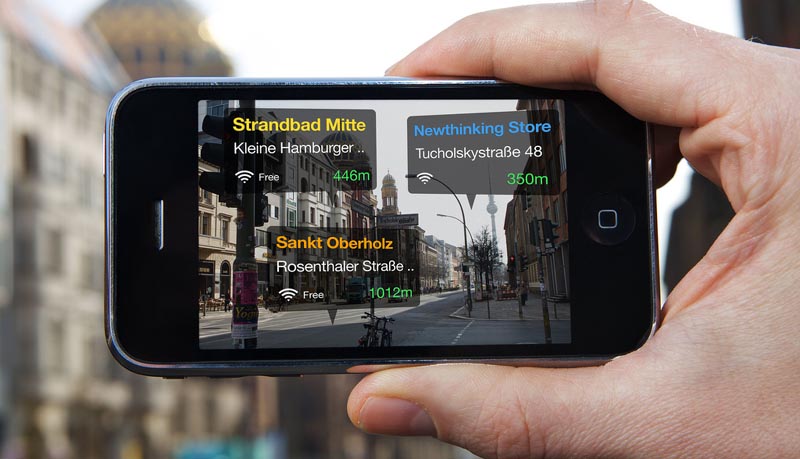
WorkSnug allows you to see where free WiFi is located and even has a decibel meter to gauge noise level so that you can work comfortably wherever you’re at. Speaking of cities, Acrossair tells Londoners where their nearest tube station is via their iPhone’s video function.
User “Mos D.” says of Yelp’s Monocle app:
I love monocle (sic). Stand on the street, point it around you 360 degrees, and it shows you nearby places. Imagine you are the Terminator and that’s how it works.
Is that what all this is coming to? We’ll all have Terminators in our pockets and will navigate the world through miniature screens? If it means not having to ask questionable, seedy-looking strangers where the subway is, I’m on board.
References
Printing Arts
SkyView
Terminal Eleven Twitter
Science AR app
Anatomy 4D app
Virtual History ROMA app
WorkSnug
Acrossair
Mos D. Yelp Monocle comment -
Memory, A Torch Pass: How the Brain Gathers and Encodes Information
Information and memory spans the human mind. http://www.warrelatedillness.va.gov/ Despite the vast amount of information that we know, there is a surprising lack of information regarding the brain and how it works. At the very least we can agree that it is widely accepted knowledge that the brain is the only organ to have named itself. That being said, we still have a very long way to go before we completely understand our think tanks. The study of memory is one of those intricacies of the brain which I expect we will all learn much more about in the very near future.
Memory is what humans use to hold on to information from the past. Important dates, ideas, and the number of surrounding cars around you while driving are all stored in either long, short, sensory or-as some are now saying-middle term memory.
Sensory memory is immediate.
This lasts for only a couple seconds at the most. Sensory memory acts a buffer between all information input from the senses. After making an impression the sensory information is carried to the short term memory for processing.
Short term (active) memory
The idea of short term memory simply means that you are retaining information for a short period of time without creating the neural mechanisms for later recall (e.g., obtaining and using a phone number from Directory Assistance.)
These memories are quick in and quick out. The brain decides whether or not remembering Jerry’s yellow bow tie is important information. If it isn’t important, it quickly forgets because the short term memory doesn’t really have a lot of room for holding information. If the brain decides “hey I like Jerry’s bow tie, I should take a second to remember that for later use,” then the brain’s long term memory will encode and store the memory.
Most adults can store between 5 and 9 items in their short-term memory. This idea was put forward by Miller (1956) and he called it the magic number 7. He though that short term memory could hold 7 (plus or minus 2 items) because it only had a certain number of “slots” in which items could be stored.
Short term memory is the ground floor for remembering any type of information. Another, more specific name for short term memory is ‘working memory.’ This puts more emphasis on its importance. Working memory does a lot more work than we are accustomed to giving it credit for. Here’s a nifty chart:
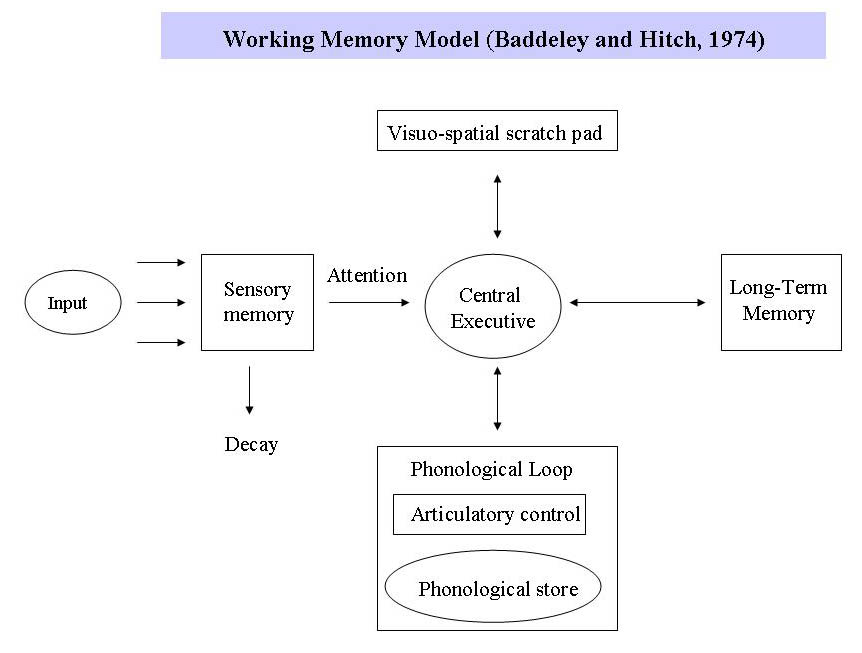
Working memory handles a surprising amount of information processing. The phonological loop is assumed to be responsible for the manipulation of speech based information, whereas the visuo–spatial sketchpad is assumed to by responsible for manipulating visual images.
In this model, the working memory is expanded to an active process which prioritizes information storage and retrieval. The central executive acts as the President of your memory. While you’re piloting your jet plane and having a conversation with your copilot about after-flight dinning plans, the central executive is prepared to switch your focus when turbulence rears its not-yet-existent face.
The central executive function works with the long term memory to encode and retrieve important memories. The long term memory can be broken down into three specific types of memory.
Episodic Memory
As its name suggests, this aspect of memory organizes information around episodes in our lives. When we try to recall the information, we attempt to reconstruct these episodes by picturing the events in our minds. Episodic memory enables us to recall not only events, but also information related to those events.
Think episodes of information. Remember that one time when you and your siblings…, the other time when one of your parents was chasing a…, or, my favorite, when your first grade teacher gave you a compliment on your haircut but you thought it was on your sweet Power Rangers sweater and you were mildly offended at her lack of taste which resulted in you never learning how to avoid a run-on sentence because, of course, that was what you were learning in class one day (deep breath).. Remember?!
Episodic memory stores information about images and events for later recall. These are the stories that you remember and can see in your mind.
Semantic Network Model
While episodic memory stores information as images, semantic memory stores information in networks or schemata. Information is most easily stored in semantic memory when it is meaningful – that is, easily related to existing, well-established schemata.
Semantic memory and episodic memory feed off of each other. You learn everything through experience so it would be silly to say that the two are independent. The primary difference between the two modes of information remembrance is that while episodic memory remembers the picture of events, semantic memory remembers the facts.
Semantic memory is a web of related memories. Try this: Think of a color. What do you immediately associate with that color?
I chose green. My immediate associations were: leaves, trees, grass, money, banks, pants, corporations, jail, and the presidential office. How these things are connected is the result of a lifetimes worth of associating different ideas with other different ideas. It really is a procedural sort of thing.
Procedural Memory
Procedural memory (“knowing how”) is the unconscious memory of skills and how to do things, particularly the use of objects or movements of the body, such as playing a guitar or riding a bike. It is composed of automatic sensorimotor behaviours that are so deeply embedded that we are no longer aware of them, and, once learned, these “body memories” allow us to carry out ordinary motor actions automatically.
Whether or not american children believe in the one true god, they-myself included- have been trained to know the pledge of allegiance. We have such a working knowledge of saying the pledge of allegiance that we could drone it in our sleep.
This is exactly what procedural memory is. It’s “muscle memory.” You do something so many times that you don’t think that you’re thinking about doing it anymore. (Try that one out, Bilbo).
How Sleep plays a role:
Sleep is vital to the process of storing memories. When you sleep, the amount of sensory input decreases dramatically. This decrease allows both your brain and your body to do a bit of house keeping. Memory, specifically, uses this time to protect and store as much information as possible.
We still understand very little of the brain’s inner workings. Entire philosophies, religions, cults, and other communities are designed in various ways to figure out and improve how the tock clicks- Maybe it’s the other way.
As this is a constantly developing field of research, this information will probably act as a stepping stone to further understanding how memory storage works.
If you have any links or information related to this post, we informationaholics at Wondergressive would love to read about it. You can comment, email, write a letter to your congress person, or even send a message in a bottle telling us what you know! Oh, and, without looking, can you remember what color the bow tie was?
Sources:
Lecture slides from Anoka Ramsey Community college
Other Wondergressive Links:
-
AI Prescribes Better Treatment than Doctors
http://www.cyberpunkreview.com As America stares down the needle of an empty syringe called Healthcare, we are realizing with more tangible worry everyday that something must be done quickly to solve our medical woes. President Obama has offered solutions such as the Patient Protection and Affordable Care Act, but we are all well aware now of the cracks in the already unsteady foundation of Obamacare. It doesn’t seem like any viable solution is available, so maybe the answer is to get creative, or even artificial.
In the spirit of bringing the singularity even closer to fruition, a study has found that artificial intelligence may be the answer to the issue at the forefront of political and social debate. Artificial intelligence (AI), aka the intelligence that will one day rule over us with the sweet aroma of logic and rationality (I choose to welcome our robotic overlords), has a history of impressing its human creators, even if one of the most powerful AIs in the world, IBM’s Watson, has a potty mouth.
Don’t let the word ‘artificial’ fool you: AI is smart, so smart that it has recently been shown to outperform doctors at their very job description; prescribing proper treatments. Using a combination of AI designs, namely Markov Decision Processes and Dynamic Decision Networks, researchers Casey Bennett and Kris Hauser from the Indiana University School of Informatics and Computing have revealed that AI can consistently prescribe better treatment than doctors and dramatically save on healthcare costs.
The study considered 6700 patients, and randomly chose 500 from the group. After comparing the results of AI doctors and human doctors, the researchers found that the AI improved patient outcomes by close to 50%, while reducing overall required healthcare costs from an average of $497 to $189, a difference of more than 50%. We are talking about a 50% improvement in care, and a 50% reduction in costs; these are revolutionary results.
The specific AI that the researchers used in their study was able to think like a doctor.
By using a new framework that employs sequential decision-making, the previous single-decision research can be expanded into models that simulate numerous alternative treatment paths out into the future; maintain beliefs about patient health status over time even when measurements are unavailable or uncertain; and continually plan/re-plan as new information becomes available.
singularityhub.com The AI can think exactly like a doctor, the difference being that it can do it faster, and can review a patient’s entire history in the blink of an eye. It can also instantaneously factor in new information and compare that information with known and potentially unknown variables. The AI is faster, smarter, has a better memory, costs less, and doesn’t ever yell at its wife. Moreover, while doctors must spend decades in school specializing in a specific field, AI is a highly trained doctor from birth, and does not require specialization to function optimally in all fields. Keep in mind, if new, relevant data becomes available, all it takes is a momentary upload and the AI has already integrated the new information into every aspect of its being.
Most medical decision made by doctors are based on individual, experience based-approaches, including using intuition. The researchers suggest that in the majority of cases, modeling, rather than case-by-case decision making, is a better solution in every way. The researchers not that:
Modeling lets us see more possibilities out to a further point, which is something that is hard for a doctor to do. They just don’t have all of that information available to them.
AI has a wealth of resources and computation speed at its disposal. The researchers believe that
using the growing availability of electronic health records, health information exchanges, large public biomedical databases and machine learning algorithms…the approach could serve as the basis for personalized treatment through integration of diverse, large-scale data passed along to clinicians at the time of decision-making for each patient.
Keep in mind that the researchers are not insinuating a total removal of humans from medical professions, rather
even with the development of new AI techniques that can approximate or even surpass human decision-making performance, we believe that the most effective long-term path could be combining artificial intelligence with human clinicians. Let humans do what they do well, and let machines do what they do well. In the end, we may maximize the potential of both.
We are talking about the seamless and lightning fast integration of all medical knowledge and inquiry around the globe. Instead of being treated by a single doctor, wouldn’t you rather be treated by the collective knowledge and understanding of every doctor that has ever existed?
If you are interested in additional reading regarding AI being used in healthcare, IBM has done extensive research into the matter using Watson. Using AI like Watson to improve healthcare is becoming an exponentially growing potential.
Sources:
Wondergressive: ObamaCare and the 49-Employee Company
Wondergressive: The Singularity is Nigh Upon Us
Fortune: Teaching IBM’s Watson the Meaning of OMG
affordable care act, AI doctor, AI healthcare, AI prescribe treatment, America, best health insurance, biomedical, brain, casey bennet, Congress, data, Decision making, dynamic decision networks, globe, government, healthcare, healthcare cost, healthcare options, IBM, ibm watson, indiana university, information, information sharing, intelligence, kris hauser, markov decision processes, medical industry, medical knowledge, ObamaCare, omg, patient protection, prsident obama, robot overlord, school of informatics and computing, thinking, worldwide -
Bitcoin’s Rise and the Cyprus Bailout


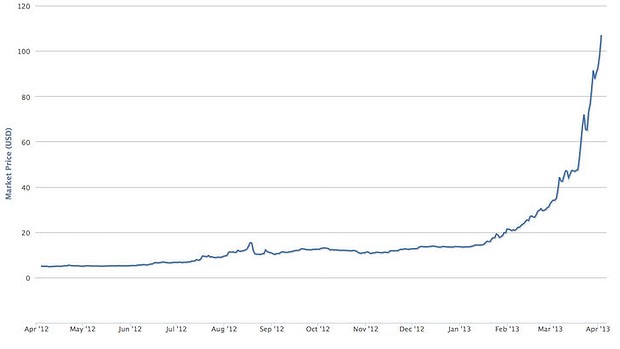
http://fofoa.blogspot.kr/2011/06/bitcoin-open-forum-part-3.html Nations around the world are flexing the powers of their central banks, from open-ended quantitative easing in the US, to Greek bailouts in the Eurozone. This top-down approach is stretching dangerously thin, both in scope and in effectiveness. One emerging contender to upend the locus of control is Bitcoin, which demonstrates a way to decentralize this authority by sidestepping the fiscal monopolies of individual governments. The demand for Bitcoins has risen dramatically in the past few months, currently trading at well over $100 per coin, as people see a potential escape hatch from traditional currencies. There is now more than $1 billion worth of Bitcoins globally, more than the entire currency stock of 20 countries.
Bitcoin is an online and anonymous currency that can be used to make global transactions. Unlike similar services such as PayPal, the servers that support Bitcoin are distributed across the world, which makes it impossible, or at least very difficult, for governments to shut down. Bitcoins can also be used to purchase traditional hard currencies like dollars, euros or yen. These advantages are making the service an attractive way for people to secure money – almost likened to a digital, mobile version of squirreling gold away in a shoebox.
People are becoming more interested in a monetary safe haven, especially considering the recent events in Cyprus. In mid-March, the European Union and the International Monetary Fund penned a deal that rightfully incensed Cypriots and sent ripples of fear throughout international markets. In exchange for a €10 billion economic flotation device, the agreement stipulated that accounts in the two largest banks in Cyprus would be given a haircut: a 6.75% confiscation of amounts under €100,000 and a whopping 9.9% for accounts holding more.

http://www.washingtonpost.com/blogs/wonkblog/wp/2013/03/30/cyprus-luxembourg-italy-or-malta-which-country-will-unravel-the-euro-zone/ The Cyprus legislature rejected the deal. However, on March 25, Cyprus President Nicos Anastasiades, along with Eurozone and IMF officials, announced a new plan (which didn’t require parliamentary approval) that would preserve the tax on amounts of more than €100,000 but not on those with less. An estimated 40-80% of the value of such top-tier accounts could be lost. As many of these are held by wealthy Russians who use Cypriot banks as a tax-haven, this compromise seems to be an example of shortsighted and naïve thinking: “Well, it’s not our money being stolen, so it’s OK this time!”
Upon hearing the news, many Cypriots wanted to withdraw their savings to avoid the automatic deductions. However, the government simply closed banks for 12 days, eliminating that avenue of escape. Upon opening them again, withdraws were limited to €300 a day per customer, with some locations lowering the maximum to €100. Anyone leaving the country may only take €1,000 in cash with them. There also restrictions for how much money can be sent overseas.
This is one example of why Bitcoin is becoming so popular. These drastic and draconian measures that hope to ensure solvency are likely attractive to myriad nations facing economic stressors, the US included. Bitcoins can’t (yet!) be confiscated or shut down and they can be used by anyone, anywhere, for any reason. The anonymity the service provides also helps ensure that itchy government fingers–jonesing for their next fiscal fix!–can’t simply swipe money from Bitcoin owners.
People like Charles Schumer (D-NY) and the Drug Enforcement Agency decry Bitcoin for its utility in circumventing federal laws. This is completely irrelevant, as regardless of its form, money has always and will always be used for funding of any kind, illicit or otherwise. Their outrage is based on the idea that somewhere there is activity that they cannot control. Anything that unnerves moral busybodies is a net positive and is further reason to support crypto-currency. People own the fruits of their labor and anything that helps keep the government from snatching it away is something to be lauded.
Bitcoin and other digital currencies are certainly nascent technologies prone to error. With the rapid increase in Bitcoin’s value, it has been speculated that the entire enterprise is a rapidly inflating bubble. The value has skyrocketed since early March, from $35 a coin to $145 on April 2. I wouldn’t be surprised if the theorized balloon eventually bursts, but I think the collapse would be due to its relatively recent emergence into the market rather than any inherent flaw in the currency. It takes time for new industries to fully adapt to its environment and clientele—just look at the Internet—but that doesn’t mean that the technology is unwanted or not revolutionary.
http://www.theage.com.au/digital-life/digital-life-news/bitcoin-boom-breakthrough-moment-or-billiondollar-bubble-20130403-2h68h.html More than just Bitcoin, I am enamored with the idea of state-less money and better, safer ways for people to preserve their labor free of government intervention. I welcome increased competition in the crypto-currency market, which would help weed out design flaws, increase stability and ensure that users are as satisfied as possible. It would help individuals retain autonomy over their money, which is considerably better than the current central bank system, which either directly taxes wealth away or decreases its value more subtly through inflation.
Anything that helps maximize individual liberty is a good unto itself, and the cynic in me derives otherworldly pleasure from helping to deprive governments of the unjust ability to impose their will upon the unwilling. Bitcoin may not be perfect, but it’s a step in the right direction towards financial autonomy.
That’s a fiscal revolution worth celebrating.
Sources:
http://www.bbc.co.uk/news/world-europe-21819990
http://www.guardian.co.uk/business/2013/mar/28/cyprus-reopen-banks-stock-market-closed
http://www.fincen.gov/statutes_regs/guidance/pdf/FIN-2013-G001.pdf
http://www.reuters.com/article/2011/06/08/us-financial-bitcoins-idUSTRE7573T320110608
http://www.businessinsider.com/im-raising-my-bitcoin-price-target-to-400-2013-4
Wonder about your world…

Take the plunge down the rabbit hole of insanity and wonder in this fast-paced, nonstop psychological thriller that will leave you questioning the very nature of reality and beyond. Part thriller, part romance, part existential horror, A Dream of Waking Life delves into lucid dreaming, psychedelics, existential ontology, video games, the nature of love, the nature of reality, and more.

Mendel’s Ladder delivers an adrenaline-fueled journey set on a dystopian future Earth, brimming with high-stakes action, adventure, and mystery. This epic series opener plunges readers into a world filled with diverse cultures, heart-pounding battles, and characters who will captivate your heart and imagination.

“E.S. Fein is raising the bar for quality as it’s a very well-written and thought-provoking book…There are points and themes in the story that could be discussed for eons as people will have their own idea on where it leads. It’s a book I would highly recommend.” – Andy Whitaker, SFCrowsnest

 Wondergressive