-
WWOOF and HelpX: Seeing the World One Farm at a Time


http://www.whereisamber.com The light filters through the branches of the plum tree, each leaf outlined in a brilliant yellow from the just risen sun. We are reaching up, stretching to pluck the abundant purple plums above us.
In about an hour, we’ll all join together for our first meal of the day; muesli, homemade yogurt, and fresh fruit salad, made with fruit we picked earlier in the week.

http://www.whereisamber.com I’m on an organic stone fruit orchard in Australia, volunteering with five other travelers from around the world. After breakfast, we gather in a shed for our next job. We laugh and tell stories around a table as we carefully slice fruit for the solar drier. Once our four hours of volunteering are over, we convene with the farmers and share a big communal lunch.
Related Article: The Power of Hempseeds: Behold Powerful Nutrition
The rest of the day we have free to explore – we can borrow bikes, go for a walk around the neighboring orchards, relax and read books, or talk and play games with our new friends. At dinnertime we reconvene for a group meal, which we take turns each night cooking. Tonight, the Japanese travelers are trying their hand at a quiche, and I overhear them asking the older couple from Switzerland for advice about how to make the perfect crust.
 Every day, I am learning new, practical skills for free. More importantly, though, I’m meeting like-minded travelers intent on learning from each other and giving back to the world. We are WWOOFers – Willing Workers on Organic Farms.
The minimum day requirement varies depending on the hosts. Most ask for at least one or two weeks, although its possible to arrange a shorter or longer stay. Some hosts will allow language learners or people interested in starting their own farm to stay for a long time, from 3 months to a year to forever! As a WWOOFer, though, if I really disliked or felt uncomfortable at a farm for any reason, I would be free to leave the next day.
Related Article: The Effect of Agriculture on the Planet
WWOOFing for the past two years in Australia, New Zealand, and Southeast Asia has changed my whole outlook on life. Before, I assumed that my life would be linear; I would go to graduate school, get a job, buy a house, and raise a family, like most people I have known. After WWOOFing, I have experienced first-hand the many alternatives there are to that path.
WWOOF was the first organized program of its kind, created in 1971 by a London secretary named Sue Coppard. Her aim was to bring busy city folk back to nature with weekend trips to farms in the country. More than 40 years later, there are now thousands of places to WW
 OOF in 99 countries all over the world. In Australia alone, there were 2287 host farmers looking for volunteers in 2010.
Since its creation, WWOOFing has evolved to keep up with the growing demand from both travelers and farmers. Other voluntourism programs have also sprung up to embrace this new form of travel, such as HelpX. This websiteexpands far beyond organic farms to hundreds of other volunteer opportunities. Through the HelpX program, I’ve painted the outside of a bed and breakfast in New Zealand and taught English to kids in Bali. Volunteer projects are rarely boring.
Related Article: Volunteering is Good for Your Health
Case in point, one of my projects involved building teepees and adobe houses in Australia. Don and Sue live in a straw bale house they made with their own hands on their 10 acre property outside of a small town in South Australia. Even though they are Australian, the couple is fascinated with Native American spirituality and lifestyle.
Inspired by the Lakota tribe, they lovingly create custom-built teepees of all sizes. One overwhelmed mother wanted a private retreat to escape from her boisterous children, while another man wanted a space where he could safely barbecu
 e in the backyard of his high-fire risk neighborhood. Sue and Don also have teepees with beds and firepits set up on their property for “glamping,” or glamorous camping.
When I first accompanied Don to the forest, he knelt on the ground and thanked the trees for their contribution to his art. Then we sawed down trees and stacked them on top of his old Honda, taking them back to his property to strip off the bark, and sand smooth. A few days later, after he had measured and sewn the canvas cover, we drove to a customer’s house and set up the 25-foot-wide teepee in the moonlight. It was a magical experience.
On that same trip, I spent my mornings chopping down thistles, feeling like a warrior from Lord of the Rings. With other WWOOFers from Canada and Finland I built a spiral herb garden. We also spread a sandy clay on the walls of a new straw-bale structure they were building. Sue and Don don’t count hours, they just told us what projects they needed help with on their expansive property nestled in a eucalyptus forest, where platypus swim in the stream and kangaroos gather in the pasture at sunset. I stayed in a straw-bale cabin there for two weeks.
Related Article: Permaculture Connection
Not all voluntourism experiences have been as ideal, though. I remember working for a commercial organic vegetable farmer who needed 3-8 WWOOFers to weed for 5 hours a day just to keep his business running. I only stayed there for a few days because I was unhappy with the way he treated us. He had been hosting WWOOFers for more than 10 years and was disillusioned by the whole scheme, not bothering to learn anyone’s names.

Paul Kretchner’s biodynamic stone fruit orchard has a completely different take. Thanks to a roster updated daily, I knew exactly what my duties were to be, hour for hour, every day I was there. I found this comforting, since I knew that I was giving exactly what they expected.
Over the past 13 years, Paul has happily hosted 315 volunteers on his orchard.
WWOOFers add a diversity and interest to our lives, which we would otherwise not have,
he says. After traveling for 3 years in the USA, Canada, and South America, Paul also knows the importance of having a safe respite from travel for a week or more.
WWOOFing gives volunteers a place to stay for a while in a family setting, and to have some ‘home life‘. It’s an opportunity to experience this part of Australia, and to learn new skills working on a fruit property. For non-English speakers, it’s a great opportunity to improve their English.
Related Article: Edible Landscapes
There are no age limits or requirements to volunteering. Many farms, including Paul’s, accept families with small children, and enjoy having older WWOOFers.
The oldest volunteer we had was 70, from Switzerland, and he did a fantastic job,

http://youngslug.blogspot.com said Paul. Likewise, the minimum stay varies from host to host. Most ask for at least one or two weeks, although its possible to arrange a shorter or longer stay. Some hosts will allow language learners
or people interested in starting their own farm to stay for a long time, from 3 months to a year to indefinitely. However, if WWOOFers felt uncomfortable a farm for any reason, they are free to leave the next day.
On the merits of voluntourism, James Nolting, a Californian who has volunteered on ten farms around Australia and New Zealand says:
Volunteering is the purest form of cultural exchange. There is no money changing hands, only the goodwill of travelers and hosts. I WWOOF because it’s a great way to get in touch with a new place. I get to meet the locals and dive into a different culture. It makes me feel more connected, less like a tourist and more like a member of the community.
Related Article: Biggest Wastes of Money (Part 5) Gadgets, Dining Out, Luxury Hotels, Gyms
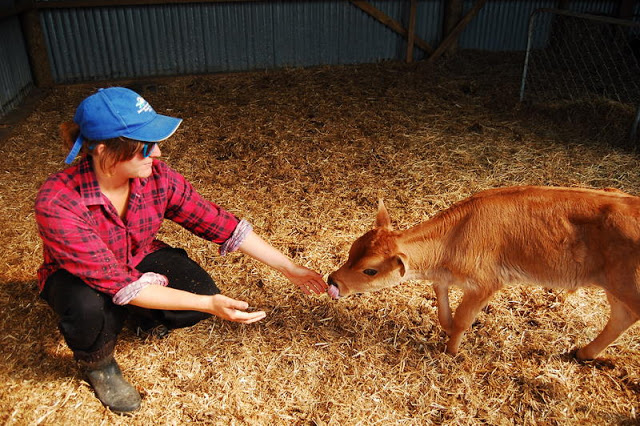
For me, WWOOFing has exposed me to new ways of life I never would have dreamed of. I am realizing that there are many other ways to live than those I have seen in my own country. These ongoing discoveries challenge me to redefine my life plan. Now, there are so many more options to choose from.
When I volunteer, my travel experience has a deeper meaning, transcending sightseeing and tourism. I feel fulfilled and powerful when I know that I’m helping someone.
Sources:
http://whereisamber.com/2013/02/22/taralee-orchard/
http://whereisamber.com/2013/02/26/gentle-earth-walking/
https://wondergressive.com/2012/11/14/skipping-breakfast-leads-to-unhealthy-food-consumption/
http://wwoofinternational.org/history-of-wwoof/
www.wwoof.net/fileadmin/documents/Press_kit_stats.pdf
https://wondergressive.com/2013/07/16/the-friends-of-the-indian-and-how-they-treated-their-friends/
http://youngslug.blogspot.com/2012/02/on-farm.html
acre, adobe house, animal collective, art, Australia, australia safety, australia visa, australia working holiday, bali, bark, bed and breakfast, best fruit, bike, biking, biodynamic, books, boredom, boring, canada, communal, commune, countries, country, don, esl, eucalyptus, farmers, finaland, fire rik, forever, fruit, fruit most nutrition, fruit salad, games, glamorous camping, glamping, herb garden, hiking, homemade, homemade yogurt, Honda, hour, Japan, japanese, kangaroos, lakota tribe, languge learners, london, lord of the rings, magical, mgmt, mimum requirements, moonlight, muesli, native american, New Zealand, new zealand helpx, new zealand wwoof, nutrition, oz, platypus, plum tree, quiche, recipe, solar drier, south australia, southeast asia, spirituality, straw bale house, sue coppard, swiss, switzerland, teaching english, teepee, the hobbit, The One Ring, thistles, time, travel, travelers, Trees, volunteer, volunteer projects, volunteering, voluntourism, warrior, willing workers on organic farms, wwoof, wwoofers, wwoofing -
Internment Camps, Ansel Adams Snaps and Fleeting Liberties
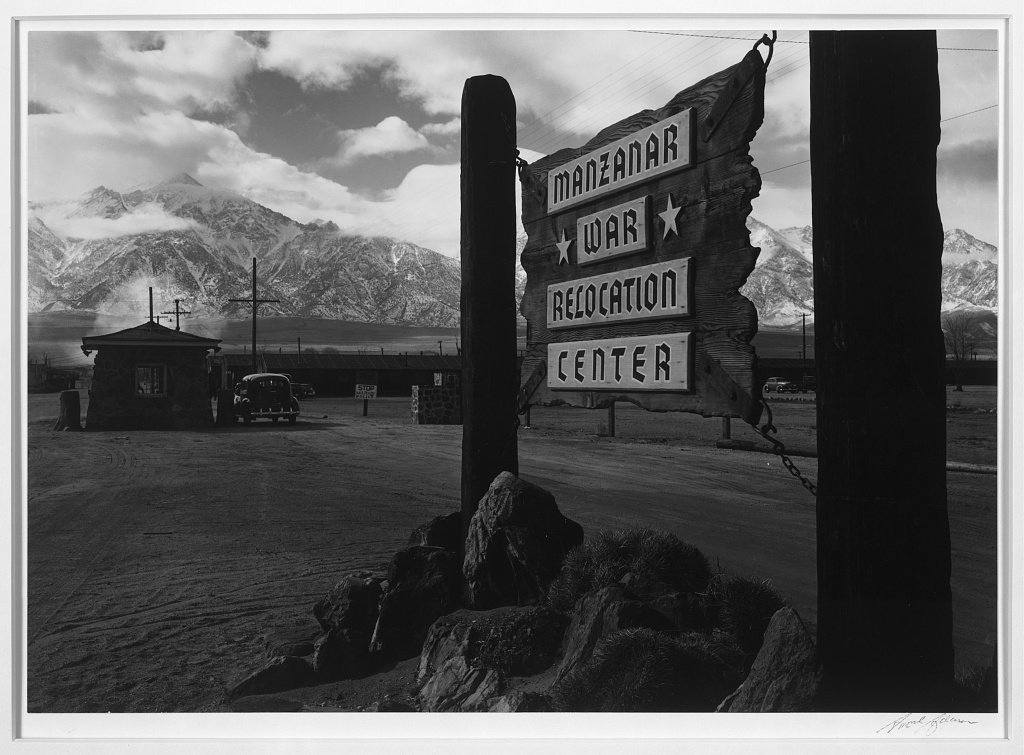
http://www.businessinsider.com/ansel-adams-internment-camp-photos-2013-8?op=1 “Rights for me, not for thee.”
The government habitually strips citizens of their rights whenever it suits them to do so. Currently, the Obama administration and the NSA have deemed that Americans are fair game when it comes to domestic surveillance, as we are certainly no longer
secure in [our] persons, houses, papers, and effects.
Related Article: Gossip Through the PRISM: the NSA’s Shenanigans
This is obviously not a new phenomenon. I find that people often forget, for example, that the Jim Crow laws in the South were indeed laws, not just social conventions. State and local governments codified the practice of segregation and indeed would punish businesses and organizations for daring to integrate—systematically disenfranchising blacks through legislative power.
The state will protect and respect individual rights as long as it suits their own interests. They have proven repeatedly that, when convenient, they will forget that the Bill of Rights even exists.
Related Article: The TSA’s Totalitarian Reign
In a famous and extremely disturbing example, the United States considered Japanese-Americans to be a threat to national security after the attack on Pearl Harbor. On February 19, 1942 FDR signed Executive Order 9066 which allowed the military to designate areas from which “any and all persons could be excluded.” As a result, over a hundred thousand American citizens with names like Richard Kobayashi and Catharine Yamaguchi were locked away in concentration camps. Without trial or cause, these people were forcefully removed from their homes and interned solely because of their ancestry.
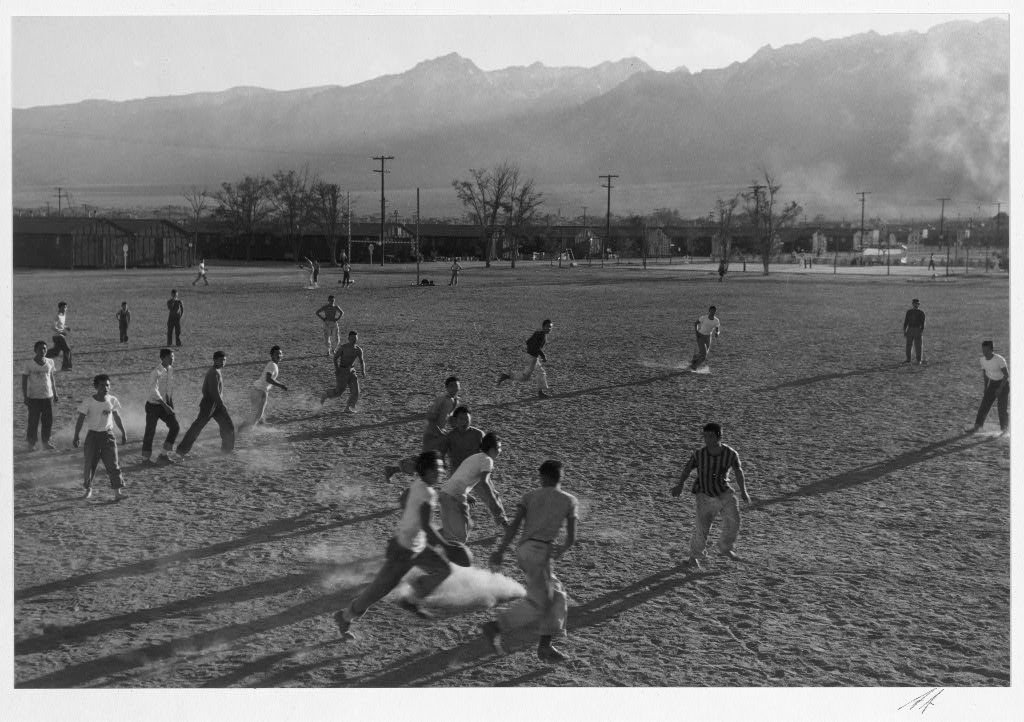
In 1943 famed American photographer Ansel Adams, renowned for his stunning shots of the American west, visited the Manzanar camp in California. Disturbed by the ramifications of FDR’s “relocation” policy, he took some poignant and beautiful snaps of life in Manzanar that are distressing reminders of how fragile our rights and liberties really are.
Related Article: Another Casualty of the Paramilitary State
Here are farmers toiling in front of snowcapped mountains:

http://www.businessinsider.com/ansel-adams-internment-camp-photos-2013-8?op=1 How much more American can you get than playing football, fixing tractors, and holding town hall meetings?
http://www.businessinsider.com/ansel-adams-internment-camp-photos-2013-8?op=1 
http://www.businessinsider.com/ansel-adams-internment-camp-photos-2013-8?op=1 
Even enlisted soldiers weren’t exempt from the camps.

Infants unknowingly took their first breaths there.

http://www.businessinsider.com/ansel-adams-internment-camp-photos-2013-8?op=1 The NSA’s extralegal invasions into our privacy should rightfully enrage every American. However, it should not be surprising to anyone with a pulse. The truth is simple and blunt: This is what governments do. Mendaciously, the state—dripping with patriotism and draped in red, white & blue—claims to protect the rights of Americans while simultaneously showing absolute disregard for their sanctity, and at best deigning to acknowledge their very existence. To politicians, civil liberties are mere talking points rather than the inalienable rights that this nation was founded upon.
Related Article: Team Red = Team Blue, The Syria Episode
Sadly, there really are no rights in this world. Most would agree that everyone has a right to food and shelter. How, then, are so many people starving and homeless? The Declaration of Independence champions the rights of life and liberty, however, both are so easily taken away. Our rights are better understood as glorious ideals, Vitruvian Men that we all need to aspire to achieve and maintain.
The problem now isn’t so much that governments are invading our privacy, as concerning and Orwellian as their encroachment is. That known entity is to be understood and expected. The most troublesome factor is the absolute apathetic ambivalence and—indeed!—endorsement of these policies from the American populace.
Related Article: War on Drugs Farce Continues Unabated
I am reminded of the famous poem attributed to Martin Niemöller:
First they came for the communists,
and I didn’t speak out because I wasn’t a communist.Then they came for the socialists,
and I didn’t speak out because I wasn’t a socialist.
Then they came for the trade unionists,
and I didn’t speak out because I wasn’t a trade unionist.Then they came for me,
and there was no one left to speak for me.The American citizenry is a frog being boiled slowly, and the rising heat gradually erodes their rights. When are they going to realize that when they’re the only ones left, no one will be there to speak for them?
Sources:
http://en.wikipedia.org/wiki/Jim_Crow_laws
constitution.findlaw.com/amendment4/amendment.html
http://www.ourdocuments.gov/doc.php?flash=false&doc=74&page=transcript
http://www.businessinsider.com/ansel-adams-internment-camp-photos-2013-8?op=1
http://leonardodavinci.stanford.edu/submissions/clabaugh/history/leonardo.html
america fascism, america freedom, american bill of rights, american loss rights examples, american rights, Ansel Adams, Bill of Rights, civil rights, Concentration Camp, fascism examples, FDR, fourth amendment right, Japanese-Americans, liberty, liberty and justice for all, liberty and justice for none, loss of libery, loss of rights, NSA, Pearl Harbor, Photography, pledge of alliegance, police, politicians, President Obama, surveillance, us constitution, us fascism, us fascism examples, World War II -
Biggest Wastes of Money (Part 5): Gadgets, Dining Out, Luxury Hotels, Gyms
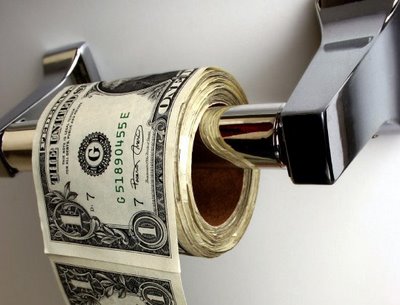
Waste of Money http://thebsreport.files.wordpress.com We all spend too much money on something out there. After all, money in and of itself is useless unless we are spending it. That being said though, some of the everyday things people spend their money on are an absolute waste and a downright scam. Over the course of five posts I will go over what I see as the 10 biggest wastes of money (including 10 (dis)honorable mentions) that people spend their hard earned cash on. I am not here to judge anyone in particular, just the human race as a whole that I am happily a part of. How many of these are you guilty of?
Part 1 of this series can be found here: Biggest Wastes of Money (Part 1): Cigarettes, Fashion, Lottery, New Cars
Part 2 of this series can be found here: Biggest Wastes of Money (Part 2): Bottled Water, Weddings, Jewelry, Paper Towels
Part 3 of this series can be found here: Biggest Wastes of Money (Part 3): Fast Food, University, Charity, Makeup
Part 4 of this series can be found here: Biggest Wastes of Money (Part 4): Wrapping Paper, Greeting Cards, Vitamins, Cleaning Products
Gadgets
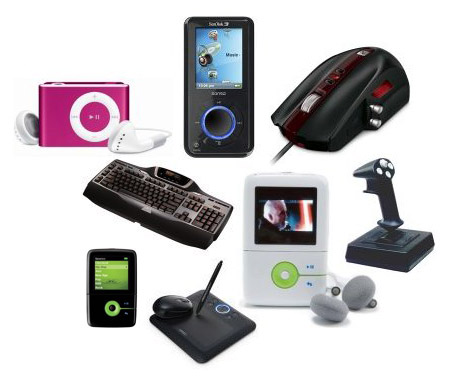
Give me 6 of everything please. http://tech.gaeatimes.com We love our gadgets! How could we not? With a single device that fits into our pocket we can put our lives on autopilot and have even more time for shopping, Jersey Shore re-runs, and fast food.
But, and I know I should walk on eggshells when I ask this, do we really need all our fancy gadgetry? Of course not, but it makes life so much better. So, let’s rephrase the question: Do we really need a new gadget so often? Do we really need to upgrade our phone every 6 – 12 months, get a new computer every 1-4 years, buy the latest, greatest, mind-bending fast machine the moment it is released?
Related Article: The Draw of Cellphones
We all know that technology changes rapidly; there is always something new. Weeks after buying state of the art technology it is rendered obsolete by the next best thing. It is simply impossible to keep up with every single generation of new gadgetry. And yet, in the face of impossibility, we humans persevere, and practically kill ourselves trying to keep up with society’s view of the Western dream:
A television in every room, a computer, a laptop, a tablet, a smartphone, printer, faster internet, a bigger television, a better computer, an external harddrive, faster laptop, new headphones, more advanced smartphone, faster internet, new camera, 3-D television, quad core computer…. you get the idea.
Related Article: 3D Printing: The Next Revolution in Creativity
Isn’t it incredible that the moment we hear rumours about the iPhone 5S, suddenly, our iPhone 5 seems like a drab toy barely capable of entertaining a Neanderthal? The tech industry, specifically the at-home-electronics industry, is a Yoda-level swindler when it comes to convincing you that what you need is the next greatest technological development NOW. The industry, like all big industries, is a master of constantly reigniting your desires for something new, and convincing you that what you have simply isn’t good enough.
Every 3 – 12 months Apple releases a new model of the iPhone, and its out with the old, in with the new. Their sales continue to rise, and the population continues to fork over their hard earned cash for something they pretty much already have. And that’s just the iPhone! Countless other gadgets, electronics, and gizmos attain the status of ‘necessary to our lives’ on a daily basis. How is it possible that a device that can do everything, including have a conversation with you, can bore us in less than a year? Our grandparents used to get a kick out of playing wall ball for half a day. Wall ball, a game so simple that you can describe the entire premise of the game with two syllables: wall, and ball. Try to do the same with Final Fantasy. And yet, More than 20 Final Fantasy games later, we need more, more, MORE!
Related Article: Oculus Rift and Omni Treadmill: Gaming of the Future
The hard truth is that in contemporary society, enough is simply never enough. Take a look at the graph below. It is evidence of the aforementioned truth.
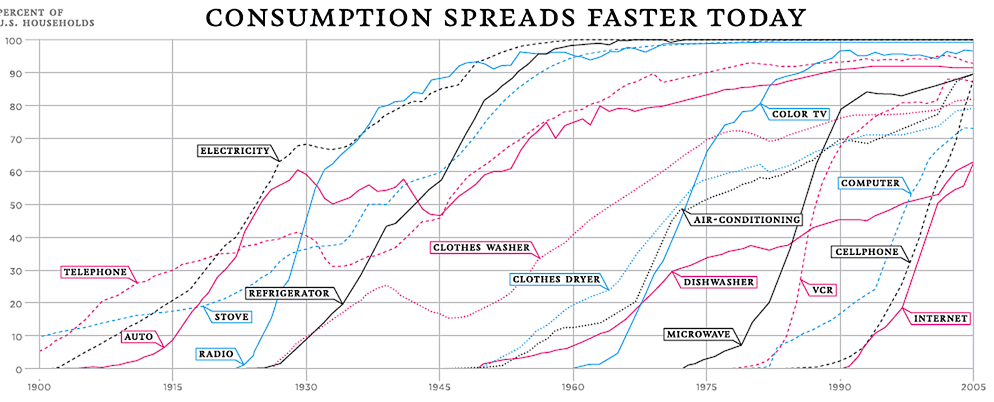
http://www.theatlantic.com/technology According to the graph:
— In 1900, <10% of families owned a stove, or had access to electricity or phones
— In 1915, <10% of families owned a car
— In 1930, <10% of families owned a refrigerator or clothes washer
— In 1945, <10% of families owned a clothes dryer or air-conditioning
— In 1960, <10% of families owned a dishwasher or color TV
— In 1975, <10% of families owned a microwave
— In 1990, <10% of families had a cell phone or access to the Internet
Today, at least 90% of the [U.S.] has a stove, electricity, car, fridge, clothes washer, air-conditioning, color TV, microwave, and cell phone. They make our lives better. They might even make us happier. But they are not enough.
Related Article: Income Inequality in America: Red Herrings and Wealth Envy
Compared to a single generation ago, everyone has everything, and yet, the majority of everyone is in debt and/or living paycheck to paycheck. So, is the only solution to become the fool on the hill and live gadget free? Not a chance. The answer is far less extreme.
Decrease your frequency of gadgetry/electronics purchases. That’s it. As long as you can still browse the internet, take pictures and video, call friends and family, play endless amounts of games, take notes, have conversations with AI, and pinpoint your exact latitude and longitude in the blink of an eye, you DON’T need a new gadget that performs the exact same functions with the sole added bonus of a fingerprint scanner for an additional $500 or more. Gadgets themselves are not a waste of money, far from it. It’s a waste of money to buy a brand new, redundant gadget so often. Let’s have a look at some solutions to your expensive gadget habbit:
Related Article: Your Old Android Phone Can Save the Rainforest
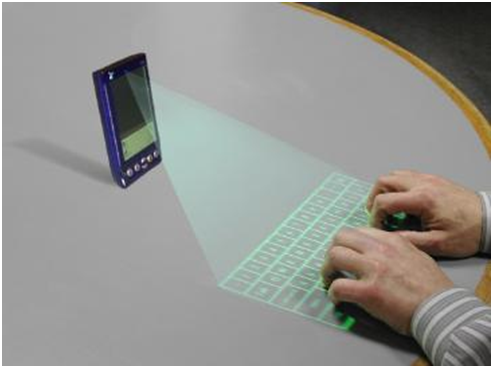
Is that a thing? I need that right now! new-gadgetstech.blogspot.com Be honest with yourself. Buy a single gadget that meets your needs. Don’t buy a new one until you TRULY need it. If you have a built in camera in your phone, do you really need a state of the art $2800 camera? Unless you are a professional photographer, the answer is no.
Look for sales. For many people, a sales price means that because the item is so cheap they have money left over to play “what’s the quickest way to empty my wallet?” This defeats the purpose of buying items on sale. Take advantage of sales prices, but don’t spend the money you save on something else you don’t need. Be patient. Some of the best sales can pop up at any time. Use sites like slickdeals.net to ensure that you are getting the best bargain price possible.
Upgrade instead of buying new. The next time your computer starts processing information in slow motion, consider upgrading its component parts rather than buying a whole new one. If you have 8gb of RAM, and your computer has a 16GB RAM capacity, just buy more RAM. Upgrades will not always be the better value, but they often are. Make sure to do a price comparison.
Related Article: Augmented Reality Blows My Mind Twice
Wait for the price to come down. Within as little as a few months after a product’s release the price will inevitably decrease. The truth is that technology companies have already developed the technology years before it is released, meaning that nothing is really state of the art. Everything you see on the market is technologically inferior to what actually exists. Simply put, you will never truly have ‘the best.’ So, is it really a big deal to just deal with your perfectly capable piece of tech for a few more months, or even years, in order to eventually buy a product at a fraction of its original price?
Watch out for gadget overlap. If you have a laptop that can do practically everything you don’t need a tablet for the sole fact that it has a touch screen. People have survived without touch screens since, well, forever, and you will too. If you have a $20 pair of headphones that work, unless you are Mark Zuckerberg and have a couple billion dollars to throw away, you do not need a $1200 pair of headphones. No, you don’t.
Related Article: TVs, Brains, and Zombies, Oh My
Be rational and reasonable. If you’re a man and you find a computer that is 10% of its normal price but only sold in pink, just be the guy that has a pink computer! You just saved 90% and are now able to eat food without charging your nutritional intake to a credit card.

You’ve already stared at Kitler’s moustache 14 times this week! Be satisfied with the incredible god-like gadgets you already own. Compared to a single generation ago, the capabilities of even our most basic gadgets make people living in the 21st century seem like Gods to the rest of former humanity. Keep this in mind the next time you find yourself perusing Amazon for something better. Buying new gadgets, like any type of shopping, is a drug and a status symbol, and you are wasting your cash trying to keep up with the Joneses for the sake of a slightly better screen resolution and larger harddrive space to look at even more high quality pictures of cats with Hitler moustaches.
Related Article: Cute Baby Animal Pictures Increase Productivity
What’s the rush anyway? Due to exponentially accelerated change, in the very near future we won’t be able to tell the difference between biology and technology.Cherish the time when you actually have the choice to be separate from your precious gadgets. The singularity is near.
Related Article: The Singularity is Nigh Upon Us
Eating/Drinking Out
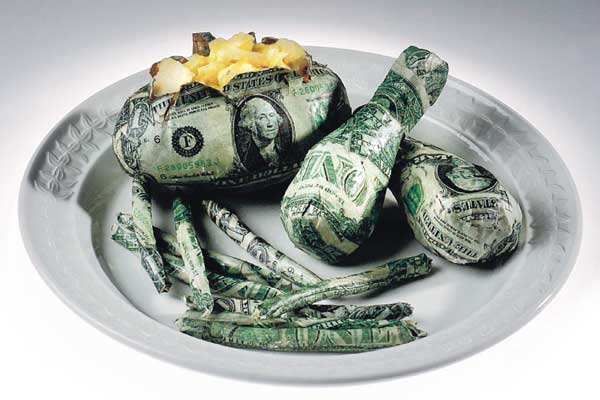
Eat up, this meal is going to cost you! angellebatten.com There’s nothing like a nice dinner out with a glass of wine to demolish your bank account. Society romanticises the notion of eating and drinking out, making us believe that going out for a meal or a drink should be the norm. Check your perceptions and you’ll come to see that there is nothing romantic about paying outlandishly high prices for something you can obtain at the market for a fraction of the price right down the street from the restaurant.
Sure, going out to wine and dine affords us a pleasant, stress free night, but in the same vein as gadgets, the problem comes in when we start wining and dining too often.
Related Article: Food Myth: Don’t Eat After a Certain Time
While America as a whole doesn’t spend the most on food and alcohol compared to other nations, food and alcohol still does some serious damage to our collective paycheck. The worst part is that more often than not, we choose to pay for outlandishly overpriced food and drinks at restaurants and bars.
In the last 30 years, from 1982 to 2011, alcohol at stores has decreased in price by 39%, while alcohol from bars and restaurants has increased by a whopping 79%.
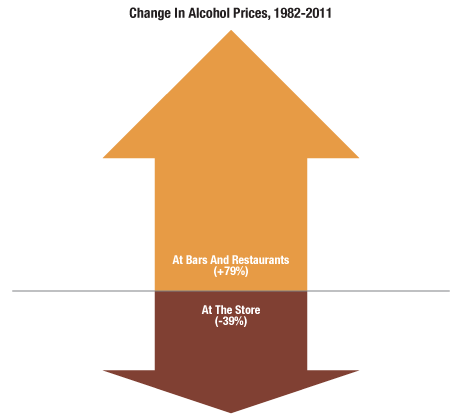
http://www.npr.org/ Despite these statistics, over the same 30 year period, Americans have increased the amount of alcohol they buy from restaurants and bars by 14%, and have decreased the amount they buy from stores by 16%.
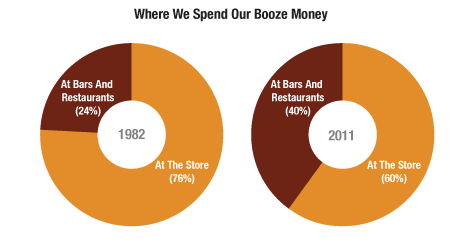
http://www.npr.org/ This means that as Americans, we have consciously chosen to spend drastically more money on booze than we have to. Why would we choose to spend nearly double the amount for a product, despite having the clear option of a cheaper deal on the same product right down the street. Must be the booze.
Related Article: The Life Changing and Life Lengthening World of Fasting
What about restaurants? Are we more rational with our restaurant spending? Surely there’s some financial rationality left in the human race.
The good news is that in 2012, a survey from Gallup reported that 77% of Americans were eating at home the day before the survey, which is a fantastic number compared to the 10% who reported they had eaten at a restaurant. The bad news is that when it comes to money, percentages can’t hide the fact that we are throwing it all away on eating out.
61% of Americans say that they want to cut back on their restaurant habit. Clearly we are feeling guilty for the amount of time spent hassling waiters and gorging ourselves in public.
Related Article: Burning Fat App on Your Phone
How much a person dines out is dependant on numerous factors, including gender, age, income, and region. Writers at Mother Jones used information acquired by Bundle.com, a company that analyzes credit card data from Citigroup, to create a food spending chart of major cities around the United States. They found drastically different spending behaviors across the country. For example, the average person in Austin, Texas spends $420 a month on dining out, whereas the average person living in Detroit, Michigan only spends $69 dollars each month on dining out. People living in Austin spend nearly 6 times as much on dining out compared to people in Detroit. According to Mother Jones:
Austin, Texas, spends almost twice the national average for dining out; five Detroit households could eat for a year on an average Austinite’s food budget.

http://www.motherearthnews.com How is it that we are spending so much on food? Don’t these amounts seem drastic? A large part of the reason, as we all know, is that restaurants overcharge us. The only reason restaurants exist in the first place, like any business, is to fill a niche and ultimately make a profit. The only way to make a profit is to charge you more than they paid for the food and drinks. Much, much more, especially since they buy everything in bulk.
Related Article: Why Don’t We Eat Insects?
Barring very special occasions, your best option is to just not eat out all. Even in instances where your family or friends invite you out, invite them to your place and let them know why you would rather make a meal at home. What are some reasons it is better to make food at home?
- It’s cheaper. This is probably obvious to you, but what might not be so obvious is just how much you can save by not eating or drinking out. For example, Crystal Brothers from Servingjoyfully.com saved her family over $50 per week, or $2600 each year by simply not eating out. Think of all the iPhones you could buy with those savings! Also, if you have some self control, make sure to buy your alcohol in bulk. For example, buy cases of wine instead of a single bottle at a time. You could save 40% or more using this method.
- It’s more fun. Cooking is an art form that combines all 5 of your senses. The texture of the foods involved, the smell and taste, the colors and presentation, as well as the sounds of preparation all play pivotal roles in the experience of cooking. It is also a great chance to experiment. Buy foods at a foreign supermarket you’ve never even heard of and look up a recipe for them. You might find a new favorite. Take a traditional recipe and spice it up or down. Cooking at home can be a journey of culinary self discovery. You can even get the kids involved or, throw on some tunes, pour a glass of wine and make it into a healthy and delectable date night.
- It’s healthy. Cooking at home is mentally, emotionally, financially, and physically satisfying. Choosing ingredients and preparing a meal provides mental stimulation. Cooking with a partner gives you more time together to develop a stronger emotional bond. Being in control of the sodium content, fat, cholesterol, etc. in your meal makes it a healthier alternative to eating out. Lastly, your budget will love you for choosing the economical path.
- You’re in control. You are in control of the ingredients so it can be healthier. You can also control the portion sizes, which is one of the major reasons we in the West take up so much space. Drinking at home can also be more fun as it provides a more intimate scene. Instead of shouting across a noisy bar you will actually be able to hear and engage in proper conversation. Most importantly, being in control can lessen the chance that you will drink industrial amounts and/or drive drunk.
- Better for the environment. Eating at home is better for the environment for various reasons. Each year America wastes about 40% of all the food it produces. This frightening percentage means that a family of four loses nearly $2,275 per year solely due to food waste. Studies have shown that one of the major reasons for such extreme levels of food waste in America is due to portion sizes, especially those served in restaurants and bars. And, if portion sizes are too big, what do you do? You take your meal home in a plastic container, inside of a plastic bag. Waste upon waste upon waste.
Related Article: The Obese Shall Inherit the Earth
If you’re going to cook at home and aren’t the experimental type, you’ll need some solid recipe sites to inspire you with cooking ideas. Below is a list of some of my favorite recipe sites:
Really though, the internet is full of great ideas for at-home cooking. Take a look in your refrigerator and do a Google search of the ingredients. A delicious recipe is bound to pop up. Or, you can use Recipe Key to find recipes based on what’s in your refrigerator and pantry. You can even make your own baby food. The possibilities are endless.
Related Article: The Power of Hemp Seeds
You know why you shouldn’t eat out, and why it is so much better to eat at home, but what about those uncontrollable urges? How can they be avoided? Here are some tips for avoiding the urge to eat out:
- Don’t run errands around mealtime
- Bring your own snacks and lunch to work
- Grow your own food
- Plan a menu
**Note about tipping: Do not go out to eat or drink unless you are also willing to tip. Not tipping is not a way to save money. Waiters, waitresses, bartenders, busboys, and other members of the hospitality service are paid well below minimum wage all across America, (usually between $2.13 and $4.95 per hour) nearly all of which goes to paying taxes. By not tipping a server, you are effectively telling them that you don’t care whether they are alive or not. Even worse, if you don’t tip a server, they are literally PAYING FOR YOU to eat at the restaurant. A percentage of what a server is tipped is given to bartenders, busboys, and other restaurant workers whether a server is tipped or not. If you tip a server 18%, 14% goes to the server, and 4% goes to other employees. This tip-share is different for each restaurant, but the large majority of restaurants have a tip-share.
Related Article: Volunteering is Good for Your Health
If you don’t know how to tip or how much you should tip, read this tipping guide carefully.
Dishonorable Mentions
Luxury Hotels
How cool would it be to stay in a hotel with a private pool, a grand piano, 12 rooms, and ivory furniture? Even if you had the money, it would still be an utter waste.

Who cares about a mortgage payment, look at all the lanterns we have in our luxurious abode!! http://www.doonbeglodge.com Sure, you could stay in some of the most expensive hotels in the world and talk to your personal, hotel provided butler all day, but what’s the point of paying top dollar for a luxurious nights sleep. Why bother traveling in the first place?
Related Article: Breathe Deep to Relieve Stress
The most meaningful and memorable vacations are those in which you can truly step outside of your normal day to day life and experience something new and exciting. Sleeping on a super comfy bed in an air conditioned room after ordering room service does not fall into that category.
When my partner and I were traveling through Laos we had the option of staying at a $26 per night hotel, or a $3 per night hostel. While both of these options are incredibly cheap by Western standards, we opted for the $3 hostel. We met another couple who opted for the $26 per night hotel. After exchanging descriptions of our respective accommodation we realized that both places had the exact same amenities. The only difference was that the hotel room had a slightly better view and a larger room. Too bad the only time they went back to the room was to go to sleep, at which point the expensive view they had been enjoying all day outside of the hotel was too dark to see.
Related Article: Money: Designed to Fail

Classic example of a kitchen in a cheap hostel. http://www.realadventures.com Keep in mind also that hostels almost always have a public kitchen where you can cook your own meals. This saves even more on food, and gives you the opportunity to shop at a supermarket and live like a local.
Instead of spending so much money on the hotel room, spend the money on a dish you’ve never tried, an unforgettable experience, or something else you come across unexpectedly. Traveling, if done right, will provide you with a truly enriching cultural experience, a cultural education, endless fun, a chance to meet new people, and most of all, an opportunity to get out of your shell and grow into an even more broad minded, well rounded you.
Experience the world, not a hotel room.
Related Article: Fun Fact: You’re the Cause of Boredom
Some great sites to use for finding reviewed hotels, hostels, and guest houses for very cheap can be found below:
For those of you looking for a truly unique experience along with FREE accommodation, even in your own country, check out the following sites:
World Wide Opportunities on Organic Farms (WWOOF)
Gyms
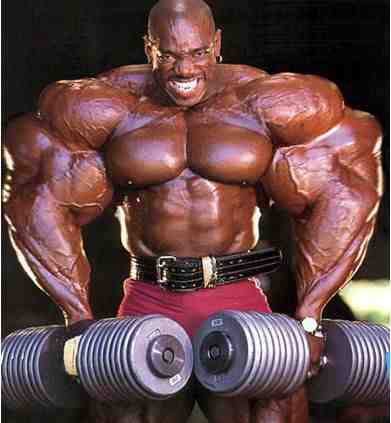
“Why bother buddy, you’ll never be this big!” http://www.skyhdwallpapers.com Gyms; the place most of us go to force ourselves to do exercises we hate, exercises that we could be doing for free. What a waste of time and money. Unless you are a professional body builder you have no business giving a gym a single penny.
Related Article: 7 Minute Workout to Burn Fat
Any given gym, like most places we waste our money at, is part of a multi-billion dollar industry worth nearly $20 billion as of 2008. The average gym membership costs $55 per month, and yet, on average, people only go to the gym 2 times per week. Steven Levitt, the author of Freakonomics, stated in the New York Times that
people who buy annual gym memberships often overestimate how much they’ll actually use the facilities by 70%.
In fact, 67% of people with gym memberships never even use them.
Who are we kidding? That’s right, ourselves.
Related Article: Awareness and Dealing with Rejection
Before gyms, did exercise simply not exist? Of course not. Why are you running on a treadmill when it is free to run outside? Or, if you want to run inside, go to your local park district and run around the track for free. Why are you lifting finely sculpted pieces of heavy metal? Just go lift any heavy object that exists on planet Earth, the results will be the same. Oh, you enjoy swimming as a form of exercise? Well, is the $40 gym really the only place with a body of water?
Going to the gym has become a status symbol and social soiree. The gym has more to do with conversation than it does with fitness. Why are you spending any money at all, no matter how little, to stand around talking? And if you are actually exercising, you need to start thinking outside the box gyms have trapped you in.
Related Article: Obesity Has More to Do With Diet Than Exercise

You’ve been going to the gym for years and you still can’t lift your whole body onto your hands? Try yoga! yogacollectivehoboken.wordpress.com Instead of wasting your money at a gym try doing exercises you can do at home, in a park, or in other places that are free. Try out yoga, callisthenics, a jog around the block, the full body 7 minute workout, maxalding, or even just going for a walk.
You can even incorporate your workout into everyday life. While at the supermarket do a few more laps around the store once your cart is fully loaded. Sprint to the bus stop instead of walking. Do jumping jacks during a commercial break. You can even make a game out of it; for every 30 minutes of GTA V that you play, do 10 push-ups. Or, every time you catch yourself logging into Facebook, do 15 lunges.
Related Article: Salamba Sirsasana: It’s Time to Do a Headstand!
If you’re still not convinced and want to continue pretending you go to the gym far more than you actually do, at least take advantage of tried and true techniques for slashing the cost of gym memberships.
- Pay month to month
- Check with your health insurance to see if they will give you a discount for having a gym membership
- Look for sales and promotions, especially on sites like Groupon
- Try out a free trial memberships at multiple gyms before committing
The fact remains… unless you are a professional or a highly disciplined individual, a gym is almost always an unnecessary, utterly wasteful expenditure.
Just so you are fully aware, this is the only form of human that can claim his or her money is well spent at the gym:
Sources:
https://wondergressive.com/2013/08/04/biggest-wastes-of-money-part-1/
http://en.wikipedia.org/wiki/List_of_iOS_devices#iPhone
http://en.wikipedia.org/wiki/Final_Fantasy
http://en.wikipedia.org/wiki/Siri
http://en.wikipedia.org/wiki/Accelerating_change
https://wondergressive.com/2013/02/11/the-singularity-is-nigh-upon-us-2/
http://www.bankrate.com/finance/frugal/how-long-wait-for-price-drops.aspx
http://travel.cnn.com/explorations/escape/worlds-15-most-expensive-hotel-suites-747256
http://www.statisticbrain.com/gym-membership-statistics/
http://online.wsj.com/article/SB10001424052748703436504574640651941267992.html
http://www.moneysavingexpert.com/deals/cheap-gym-membership
https://wondergressive.com/2013/05/16/seven-minute-workout-to-burn-fat/
http://www.military.com/military-fitness/workouts/avoid-gym-by-using-calisthenics
http://newsfeed.time.com/2013/09/09/10-countries-that-spend-the-most-on-food-alcohol-and-tobacco/
http://www.npr.org/blogs/money/2012/06/19/155366716/what-america-spends-on-booze
http://www.gallup.com/poll/156416/americans-spend-151-week-food-high-income-180.aspx
http://nrn.com/corporate/consumers-cut-back-restaurant-spending
https://docs.google.com/spreadsheet/ccc?key=0AuHOPshyxQGGdFY1SzVrNzZoYnN5clV1b0NrejAtVEE#gid=0
http://www.motherjones.com/environment/2012/01/calculator-food-spending-budget-frugal
https://docs.google.com/spreadsheet/ccc?key=0AuHOPshyxQGGdEowT21KN0ZobWQxUHFQcVcxN1Naemc#gid=0
http://www.servingjoyfully.com/
http://moneysavingmom.com/2012/06/how-we-are-saving-over-2600-per-year-by-not-eating-out.html
http://eatdrinkbetter.com/2013/06/11/american-food-waste-facts/
http://sustainablereview.net/portion-size-key-restaurant-food-waste-research-finds/
http://wholesomebabyfood.momtastic.com/
http://www.itipping.com/tip-guide-restaurant.htm
http://allrecipes.com/my/menus/planner.aspx?e3=TB_3.0.0_Menu-Planner
http://www.moneysavingexpert.com/deals/cheap-wine-deals/
wondergressive.com/2012/08/15/edible-landscapes/
https://wondergressive.com/2013/03/07/income-inequality-in-america-whats-the-big-deal/
3d television, accelerated change, agoda, AI, all recipes, american dream, Americans, americans food waste, amount americans spend, Apple, artificial intelligence, asia hostels, austin texas food, baby food, bar run, barboy, bars, bartender, best alcohal, best buy, best gadgets, best hotel, best keyboard, best laptop, best phone, best recipe, best recipe site, best smartphone, best workout, biggest waste of money, biggest wastes of money, blah blah car, body builder, bonzai aphrodite, booking, bose, burn fat, busboy, callisthenics, Cambodia, camera, cheap gym membership, cheap laptop, cheap wine, cheaper, cheapest mouse, citigroup, cooking art, cosnumption spread faster today, couch surfing, country most alcohal, country most food and alcohal, cuisine, cyrstal brothers, date night, decrease price, detroit michigan, dining out, dishonorable mention, doggie bag, doggy bag, dre beat, drinking out, drinks, drive, drunk, drunk driving, eating out, electronics, enough is not enough, environment, errands, everydaylife, expenditure, expense, experiment, Facebook, family and friends, Fast food, fingerprint scanner, food spending chart, freakonomics, full body workout, gadgets, Galaxy, galaxy s4, gallup, gaming device, gigabit, gigabite, gigabyte, God, google internet, gourmet, grand theft atuo, grand theft auto 5, grand theft auto v, greenback, groupon, gta 5, gta v, gta5, guru, gym membership, gyms, healhty, health, help exchange, helpx, hitelr moustache, hitler, hooters, hostel, hostel prices, hostel world, hostelworld, hotel, household, household electronics, how much should i tip, how much to tip, how to save money, indonesia, industry, internet, iphone, iphone 5c, iphone 5s, jersey shore, jog, jumping jacks, kill yourself, kitler, kriya, language, Laos, laptop, laptop deals, learn language, luxury hotel, Lyft, lynfred winery, Mark Zuckerberg, market, maxalding, meditation, menu, micro mouse, mind bending, money, money expert, money saver, month to month, motel, mother jones, motivation, mr olympia, mr universe, neanderthal, new camaera, new phone, new star wars, new york times, newegg, night out, no tips, palstic bag, payment, portion size, pub, quad core, ram, reciep site, recipe, restaurant, ronnie coleman, samsung, satyananda, save your money, server, shopping, single device, single generation, singularity is near, siri, siri iphone, Sleep, slickdeals, smarphone, smartphone, social activity, star wars, star wars jj abrams, status symbol, steven levitt, Suicide, supermarket, survey, swami, taste, technology, technology generation, television, terabite, terabyte, Thailand, tigerdirect, tip ettiquete, tipping, tipping by country, tipping calculator, tipping guide, tipping rude, travelling, travl, TV, upgrade, vegan, vegeterian, videocard, Vietnam, waitress, walk, walk on eggshells, walking on eggshells, waste money, waste of money, watier, western dream, wine case, world wide oppurtunities on organic farms, worst hotel, wwoof, yoda, Yoga, yogananda -
Tethers Unlimited and the Space Spider

From http://www.tethers.com/SpiderFab.html The United States National Aeronautics and Space Administration has recently awarded a grant of half a million dollars to Tethers Unlimited. The grant was given to encourage the development of an orbiting mechanical spider capable of 3-dimensional printing on a grand scale. From the Tethers Unlimited Website:
TUI is developing an architecture and a suite of technologies for automated on-orbit construction of very large structures and multifunctional space system components, such as kilometer-scale antenna reflectors. This process will enable space systems to be launched in a compact and durable ‘embryonic’ state.
The development of these sorts of technologies allows for a new method of building in space. Tethers has taken the recent 3D printing technology to the next level. The idea is to send the printer to space and then send the “ink” instead of launching a gigantic rocket filled with a project already printed, stapled, collated, and spiral bound.
Wonky analogies aside, this robotics seem strikingly similar to nano technologies. Instead of pushing around platelets in the blood stream, these extraterrestrial spiders will be manufacturing gigantic solar panels, antennae, and other orbiting satellites.
Related Article: 3D Printing: The Next Revolution in CreativityOnce on orbit, these systems will use techniques evolved from emerging additive manufacturing and automated assembly technologies to fabricate and integrate components such as antennas, shrouds, booms, concentrators, and optics.
The primary benefit of this on-orbit fabrication capability will be order-of-magnitude improvements in packing efficiency and system mass, which will enable NASA to use small, low-cost launch vehicles to deploy systems dramatically larger than possible with current state-of-the-art technologies.
Right now NASA pays approximately $10,000 to put just one pound into orbit. One single pound. According to the CDC, the average human weighs about 195 pounds. With some quick math we can see that it costs about $1,950,000 to send a person into orbit. Not to mention that this math is the simple math. It is no medium sized wonder that NASA is investing in technologies such as the Space Spider.
The net payoff will be to enable NASA to acquire and distribute a variety of forms of data at higher resolution, higher bandwidth, higher signal-to-noise, and lower life-cycle cost.
The future for NASA seems to be rich with this sort of innovation. With plans as grandiose as settlements on mars, NASA is upping the technological ante. I really hope that they finance a company whose sole mission is to make Thunder Cats a reality.
Related Article: Mars, The First Frontier?!Sources:
http://www.nasa.gov/centers/marshall/news/background/facts/astp.html_prt.htm
http://en.wikipedia.org/wiki/Tethers_Unlimited,_Inc.
http://www.wired.co.uk/news/archive/2013-09/10/spiderfab-tethers-unlimited
-
Butterflies Drink Turtle Tears

http://i.livescience.com Researchers from the Tambopata Research Center in Peru have recently observed butterflies in the Amazon swarming the heads of turtles to drink their tears. The reasons for the butterflies’ seemingly strange behavior is to attain the precious salts found in the turtles’ tears and eye balls.
Sodium is so precious in the rainforest because it is over 1,000 miles from the Atlantic Ocean, a major source of salt in the region.
Related Article: Surprises of the Amazon
Interestingly, butterflies in the eyes doesn’t seem to be all that bad of a situation. Although it may temporarily hinder the turtles’ vision, an eye ball feeding frenzy does little to no direct harm to them. Phil Torres, one of the lead researchers of the study, explains that:
The turtles have enough tears to feed the butterflies simply because the butterflies are taking so little. They simply uptake salts through a process similar to absorption by placing the proboscis on the salt-laden and passively ‘feed.’
Torres explained that he has also seen bees attempt the same sodium harnessing technique, but that butterflies are a walk in the jungle compared to the annoyance of bees. He believes this is largely due to the annoying wing buzzing taking place, you know, on the turtles eyeball!
Related Article: The Profound Intelligence and Intuition of Elephants
Surprisingly, tear sucking isn’t that strange of an activity for butterflies, as they have also been observed obtaining sodium from
animal urine, muddy river banks, puddles, sweaty clothes and sweating people[.]
The weirdest part is that in other areas of the world where butterflies and turtles coexist in the same environment this behavior does not take place. It seems to be an anomaly of the rainforest, a phenomenon of the Amazon.
Richard C. Vogt, a researcher at the National Institute of Amazonian Research in Manaus, Brazil remarks that
I have been studying turtles in the wild — from the northern U.S., Mexico and Amazonas — for over 50 years and have never seen butterflies drinking tears of turtles[.]
Simply awesome. Turtles secrete excess sodium through their tears, and the butterflies are somehow able to detect this surplus of sodium, latch on to what must seem to them a gigantic, terrifying creature, and lap up their sweet,or rather salty cry juice.
Here’s a video, the only video, from Perunature.com, of butterflies drinking turtle tears:
Related Article: Dolphins Show Unending Compassion
Is it possible that the relationship is a symbiotic one? Could it be that the butterflies are providing a beneficial enzyme or chemical to the turtles, or that the decrease in eye sodium, however minute, is a relief to the turtles?
Maybe the simple answer is that turtles cry for the world, and butterflies only want to mop up the sadness.
Go nature!
Related Article: A Group of Prominent Scientists Agree: Animals are Just as Conscious as Us
Sources:
http://news.discovery.com/animals/insects/amazonian-butterflies-drink-turtle-tears-130912.htm
http://www.livescience.com/39558-butterflies-drink-turtle-tears.html
amazon rain forest, amazonian research, animal urine, atlantic ocean, bees turtle eyes, Brazil, butterfly turtle, butterfly turtle tear, buzzing, cry juice, eye juice, manaus, Mexico, nature, Peru, phil torres, probiscis, research, salt, sodium, tambopata research center, torres, turtle, turtle tears, U.S. usa, vision, vogt -
The Bright Side To ObamaCare?

Paging… Dr. Obama?
http://intellihub.com/2013/07/18/five-most-absurd-ways-governments-will-promote-obamacare/ For everyone that is either groaning or that is pleased with the way ObamaCare is slowly panning out, there may be a bright side that hasn’t been considered before!
A new study claims that our medical device market will continue to climb to an estimated $10 billion because of ObamaCare! Why is that good news? Economic stimulation from the medical side. The only way our economy booms is if money changes hands. Everyone wants to continue to invest in preventative electronics: pedometers, scales, blood meters, etc. That in itself is great news. People want to stay healthy and want to prevent themselves from getting sick. A major reason for this preventative approach for health is due to rising costs of medicine and doctor’s visits. So yes, we are all money conscious, but why would that be a bad thing?
This brings me to the second bright side; the cost of our future ObamaCare. It may be cheaper and better than your current insurance program. In fact, Forbes has recently posted an article explaining that insurers’ have guaranteed and promised ObamaCare will be competitively priced. That is good news, as affordable healthcare is in everyone’s best interest, especially those that are often sick and cannot afford a quality health care plan.
Related: ObamaCare and the 49-Employee Company
A couple more positive points to take away from ObamaCare:
1 in 2 Americans have a “pre-existing” condition they could be denied health insurance for. ObamaCare chips away at pre-existing conditions until 2017 when there are no more pre-existing conditions for anyone, including high-risk customers.
ObamaCare requires that all insurance plans cover preventive services and stops insurance companies from dropping you when you are sick, as well as offering a number of other reforms and protections.
Not to mention, it may help balance the ever increasing and outrageous medical costs of hospitals and health services. Because, lets face it, if something doesn’t start harassing the medical/healthcare world, we may as well start taking out loans to help with the ER visits and the yearly health checkups.
Related: A Case Against Gun Control
Along with the good, why not a couple bad speculative points apparent from where I stand:
- Most likely it will make private insurance go up and cover less to account for the “competitive” price of ObamaCare.
- It most likely will cause a huge hit on the government’s budget and spending.
- Lower middle class and middle class will be most heavily affected out of all the classes, but when isn’t this the case?
All of the above is pure speculation on good and bad points, I suppose, as it is not 100% clear how everything will unravel yet. Uncertainty is especially present with constant updates and changes being made before that January 1st deadline when everyone in America will have to have insurance or an exemption of some sort to avoid fees. But what about those illegally staying in America, those that have not yet become citizens, or those that are vacationing in our country? Will we turn away dying people from hospitals? Will uninsured people involved in life threatening incidents be refused? Let’s not forget our morals people.
Cheers to long healthy lives!
Research:
Forbes: New Study Says ObamaCare Will Boost Consumer Medical Device Market to $10 Billion
Forbes: ObamaCare Will Be Price Competitive To What’s On The Market, Insurers Say
Wondergressive: ObamaCare and the 49-Employee Company
Wondergressive: A Case Against Gun Control
For those that want extra research for themselves here is an extended Obama Care Summary: http://obamacarefacts.com/obamahealthcare-summary.php
-
Biggest Wastes of Money (Part 4): Giftwrap, Greeting Cards, Vitamins, Cleaning Products

Waste of Money http://tx.english-ch.com We all spend too much money on something out there. After all, money in and of itself is useless unless we are spending it. That being said though, some of the everyday things people spend their money on are an absolute waste and a downright scam. Over the course of five posts I will go over what I see as the 10 biggest wastes of money (including 10 (dis)honorable mentions) that people spend their hard earned cash on. I am not here to judge anyone in particular, just the human race as a whole that I am happily a part of. How many of these are you guilty of?
Part 1 of this series can be found here: Biggest Wastes of Money (Part 1): Cigarettes, Fashion, Lottery, New Cars
Part 2 of this series can be found here: Biggest Wastes of Money (Part 2): Bottled Water, Weddings, Jewelry, Paper Towels
Part 3 of this series can be found here: Biggest Wastes of Money (Part 3): Fast Food, University, Charity, Makeup
Part 5 of this series can be found here: Biggest Wastes of Money (Part 5): Gadgets, Dining Out, Luxury Hotels, Gyms
Greeting Cards
Whether it is for birthdays, anniversaries, religious holidays or just to say thank you, giving greeting cards is a staple tradition of society. It is subsequently a mindless waste of money. As Pretired Nick excellently describes:
At the local stores, the customer plays his or her role, flipping through the cards as quickly as possible until one is found that will “work” — not perfect, just “good enough.” The card is mindlessly purchased, a name is unemotionally signed and the card sits until it’s time to hand it over to the receiver. That moment is funny, too, with the giver anxiously waiting while the receiver opens the card, fakes a chuckle at the joke and says a heartfelt “thank you.” If it’s a group setting, the card is then passed around so everyone can enjoy the hilarious joke. And, then, of course, after the journey from forest to factory to store to lucky recipient, the card is usually recycled [or thrown away].
Related Article: Fooling People into Passionate Belief
The greeting card has become an object we now take for granted. We may as well pretend to open a card, say “blah, blah, blah” out loud, and then mock throw the card away; it will yield the same results only with less waste. Giving a greeting card is equivalent to giving a person a clump of dirt and saying “look, I picked this clump of dirt for you rather than any of the other clumps, how great is that!?”
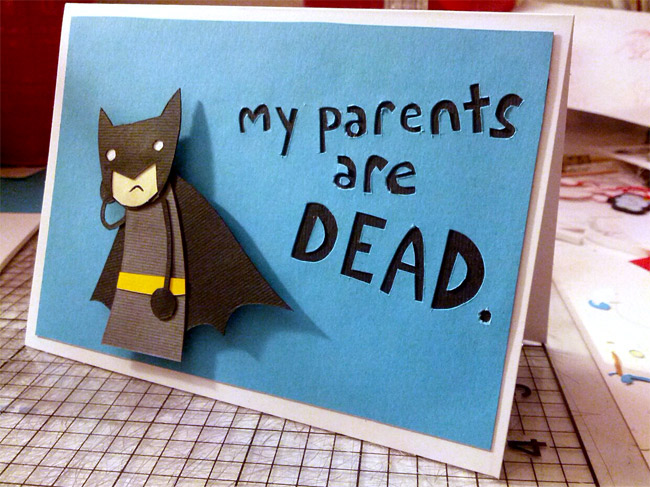
They are a drain on the environment, a social stressor, and most of all, a sink-hole in your wallet. Americans spend between $7 billion to $8 billion each year on over 6.5 billion greeting cards.Birthdays are by far the most popular card sending occasion. And listen up ladies; you are responsible for a whopping 80% of all greeting card sales!
Related Article: A How To: Behavior Changes and Breaking Habits
The average price of a greeting card falls between $2 -$4. If you buy greeting cards for a modest 10 people, on 4 different days out of the year, you are spending $80 to $160 per year on something that is glanced at, thrown away, and never thought of again. If you are buying cards for more than 10 people, well… you may as well just burn your money and leave out the middle man.
I know, I know, you still don’t want to break the societal mold and just stop giving greeting cards, so what can you do? Luckily for you, technology!
You can always send your friends and family an e-card and save the environment, money, and your time. The best part about sending an e-card is that they are usually free. Even Hallmark, the almighty Baron of Greeting Cards, offers unlimited e-cards for only $1 per month! E-cards will also reach the recipient instantaneously. Goodbye snail-mail, hello 21st century!
Related Article: Go Go Gadget: Wearable Tech
Another major reason for not buying greeting cards is that picking a piece of paper from amongst other pieces of paper requires zero creativity. The same applies to ready made e-cards. If you truly want to show someone that you care about them, make your own greeting card or e-card. There is endless amounts of greeting card software available for those that are not creatively inclined.
For those with even a minute semblance of creativity, get a piece of paper, put a writing instrument in your hand, and make your own. Simple, yet surprisingly not so obvious.
Wrapping Paper
Wrapping paper may be the single most belligerent thing humans have ever conjured up. It’s single, solitary function is to be ripped apart and thrown away. That’s right, not recycled, but thrown away, because the dyes and chemicals in wrapping paper make it non-recyclable.
Here are some disgusting facts about wrapping paper and its evil cousin, ribbon:
-
2 pounds of gift wrap per American: Every year, Americans use at least 40 million tons of paper products for wrapping, packaging, and decorating gifts during Christmas, birthdays, and other holidays. That’s two pounds of gift wrapping paper annually.
-
4 million tons of gift wrap and shopping bags: The trash generated from gift wrapping paper and shopping bags for special occasions in the US totals 4 million tons.
-
Enough ribbon to wrap the earth: 38,000 miles of ribbon is discarded every year, which is enough to tie a bow around the entire earth.
Related Article: Unprecedented Changes and Extinctions Occuring in Marine Life
The environment is just one consideration. Think about how much time you spend wrapping each and every gift. I’ve seen people set aside entire nights devoted solely to wrapping with paper that will be immediately disregarded in lieu of what is inside of it. Waste of time, waste of resources, burden to the environment, and an utter waste of money.
Let’s assume a naked gift is simply going to far. You’re modest and have a sense of dignity, and you want your gifts to reflect your top notch moral values. I understand. Here are some cheap, eco-friendly alternatives to wrapping paper:
- Recycled paper
- Make your own wrapping paper
- Reusable gift wraps and bags
- Tree free paper
- Plantable Paper
- Old comics
- Newspaper
Related Article: A Product That Will Turn You into a Tree After Death
More often than not, wrapping paper is dyed and laminated. It can also contain non-paper additives, such as gold and silver coloring, glitter and plastics. Additionally, it can be very thin and contains few good quality fibers for recycling. To make matters worse, it usually has tape on it from gift wrapping. Recognizing that those pretty words at the beginning of this paragraph probably distracted a few pro-wrapping paper fiends out there, if you do receive a gift covered in it, make sure to reuse it and not just throw it in the garbage.
The way I see it, giving unwrapped gifts can be a great gauge of a person’s personality. If they seem irritated, angry, or disappointed that you didn’t wrap their gift, then they missed the whole point of your giving them a gift in the first place. They are short-sighted and ungrateful. Pat them on the back, leave them alone for the time being, and send them over to this article for some perception restructuring. We’ll have them back to you good as new in no time.
Related Article: Sweden is Running Out of Trash
Dishonorable Mentions:
Vitamins
Many of us took Flintstone vitamins as kids, take vitamin supplements as adults, and will continue taking vitamins well into the winter of our lives. You probably already know this, but I’ll remind you anyway: food, that natural stuff that grows out of the Earth and comes in various shapes and colors, contains the same vitamins and nutrients found in all the pills you’re popping!
Just because vitamin supplements contain nutritious elements doesn’t mean they’re your best option for attaining nutrients. In fact, the only reason ANYONE takes vitamins is due to a single Nobel prize winner named Linus Pauling, who despite decades of clear scientific data showing the opposite, claimed that taking multivitamins would eradicate the common cold, cure cancer, and
 amongst other miracles, extend life expectancy to 150 years. In case you weren’t sure, Linus was dead wrong.
Related Article: Cannabis Cures Cancer and Everything Else
Although just about the entire global scientific community agrees that multivitamins/ nutrient supplements do more harm than good in the long run, over half of the American population still takes their daily multivitamins. This is largely due to age old hype and unfounded propaganda convincing people that money spent on vitamins equates to years of elongated, healthy life.
Even a glance at the tip of the research iceberg regarding the effects of multivitamins makes it clear that they are incredibly dangerous and in fact detrimental to health. They are a waste of money in the same way that cigarettes are. The vitamin and supplement industry combined is worth nearly $90 billion, despite the fact that according to Steven Nissen, chairman of cardiology at the Cleveland Clinic, it is clear that:
The concept of multivitamins was sold to Americans by an eager nutraceutical industry to generate profits. There was never any scientific data supporting their usage.
Studies repeatedly make it clear that this multi billion dollar market is pure quackery, and yet:
On October 25 [2011], a headline in the Wall Street Journal asked, “Is This the End of Popping Vitamins?” Studies haven’t hurt sales. In 2010, the vitamin industry grossed $28 billion, up 4.4 percent from the year before. “The thing to do with [these reports] is just ride them out,” said Joseph Fortunato, chief executive of General Nutrition Centers. “We see no impact on our business.”
 Related Article: Starve Cancer by Eating
 Just eat food! As long as its not a money waster like fast food. It borders on impossible to consume too many vitamins or other nutrients from actual food.
If you do have certain allergies or restrictive diets, your choices may be slim, but there are SO many options out there. Be creative and do your research. You don’t need pills to be healthy, quite the opposite!
Cleaning Products
How many households including your own do you know of that have a cabinet filled with cleaning products? I’m willing to bet there’s bottles you didn’t even know you had sitting under your sink, filled with chemical names you can’t pronounce or even begin to know the danger of. The truth is that all of those bottles of biological/environmental poison can be replaced by a few simple, s
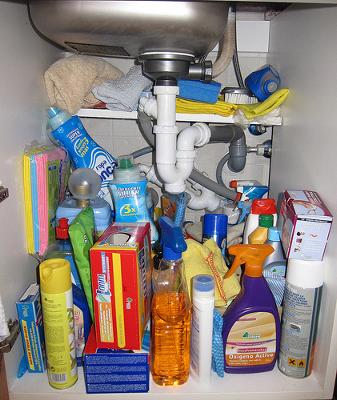 afe substances/solutions that you can make yourself in moments for a fraction of the cost.
Related Article: For Humanity’s Sake Wash Your Hands!
Websites abound with various options for creating your own cheap household cleaning products. These cleaning products often involve white vinegar, lemon zest, certain essential oils, and the legendary baking soda! I consider it legendary because baking soda can save you money by being used in literally hundreds of different ways, from deodorizing smells, to cleaning produce, to putting out fires!
A mixture of baking soda and white vinegar mixed with a solution of water can take care of just about any area in the home that needs some cleaning and disinfecting. If you’re looking to kill mold, instead of bleach, use clove oil, which in my experience works just as well.Need to cut grease? Use lemon juice, it’s that simple!
Related Article: pH Levels and Your Scalp
In no time, by making a few simple changes, you can clean your home non-toxically and on the cheap. Not to mention, think of all the cabinet space your cans of Febreeze and Oxy had been hoarding that is now ripe for the filling! For 1000’s of cheap, alternative cleaning ideas, check out the following links:
Non-Toxic Home Cleaning Solutions
1001 Uses for White Distilled Vinegar
Sources:
http://www.ehow.com/how_6945763_clean-clove-oil.html
http://eartheasy.com/live_nontoxic_solutions.htm
http://www.moneycrashers.com/how-to-save-money-with-baking-soda/
https://www.ecocycle.org/hazwaste/ecofriendly-cleaning
http://www.forbes.com/sites/daviddisalvo/2012/10/19/vitamins-good-for-you-bad-for-you-or-what/
http://www.reportlinker.com/ci02037/Vitamin-and-Supplement.html
http://www.webmd.com/food-recipes/features/effects-of-taking-too-many-vitamins
http://pretired.org/saving-money/greeting-card-tyranny/
http://www.greetingcard.org/AbouttheIndustry/tabid/58/Default.aspx
http://rubberstamping.about.com/od/opportunities/a/GreetingCardFactsandFigures.htm
http://www.hearts.com/ecolife/sustainable-giftwrap-reusable-gift-bags-boxes/#_edn1
http://earth911.com/recycling/paper/wrapping-paper/facts-about-recycling-wrapping-paper/
http://www.environmentreport.org/story.php?story_id=4795
http://www.recycleworks.org/resident/holiday_facts.html
http://www.thedailygreen.com/going-green/tips/recycled-paper-gift-wrap-461207
http://earth911.com/news/2012/12/18/eco-friendly-wrapping-paper/
alternative cleaning products, alternative wrapping paper, America, american population, anniversary, baking soda, best greeting card software, best software, best wrapping paper, biggest waste of money, birthday, burn money, cancer, cardiology, cash, cheap greeting card, cheap vitamins, cleaning products, cleaning solution, Cleveland Clinic, clove oil, commonn cold, cost, customers, diy cleaning products, diy greeting card, diy paper, diy wrapping paper, e-card, earth, eco friendly, end of popping vitamins, environment, eucalyptus oil, expensive, febreeze, flinstone vitamins, food, giftwrap., green, greeting card sofware, greeting cards, hallmark, holiday, home cleaning solutions, how to make money, how to save money, Humans, humans evil, joseph fortunato, kill mold, life extention, linus pauling, milew, mold, money, money evil, money good, money saving tips, nobel prize, non toxic, oxy, pill, pill popper, popping pills, pretired nick, propaganda, ribbon, ribbon waste, steven nissen, supplement, thank you, vitamin supplements, vitamins, vitamins linus pauling, wall street journal, wallet, waste money, waste of money, white vinegar, wrapping paper, wrapping paper waste -
-
Google’s Self Driving Car Initiative

http://betanews.com/2013/05/02/googles-self-driving-cars-gather-nearly-1gb-of-sensor-data-every-second-would-you-trust-them/ The self driving car is Google’s initiative, but what drives the giant to complete it?
Google has yet to NOT surprise me. From balloon wifi to free internet to Google glasses. I mean, Google finds ways to incorporate itself into everyone’s daily lives one way or another. If you have an android phone, the Play Store where you get all your apps? Google. How about your web browser Chrome? Google. (Mind you if you don’t have it, it is quite possibly the best browser out there, at least from what I have tested.) I mean who doesn’t use Google.com for their daily searches. How about YouTube; now I know for a FACT ya’ll use YouTube. And yes, Google owns that too. Here is a diagram of stuff Google owns and invests in, just for fun.
Related Article: The Road Rage is Strong With This One
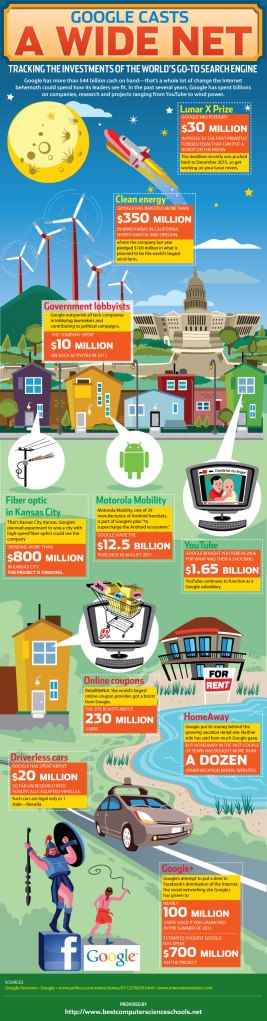
http://www.bestcomputerscienceschools.net/google/ It seems that Google is once again taking things further, this time in the form of a self driving car. As it is, Google has been working on self driving cars for a long time now, but most recently they decided to roll out their idea into the world around us. Google’s self driving car initiative is taking to the public streets for tests and trials as they move forward to a promised public release date of 2017. But of course, that consumer friendly release of a self driving car is all speculation, and critics such as Dan Flores, from General Motors’ advanced technology group, say very hurtful things:
We do not think someone will have a fully autonomous production vehicle that soon, vehicles that can drive themselves are years — maybe decades — away. The technology will develop in steps to allow the vehicle to do more and act incrementally as sensors get more robust and costs come down.
Leave it to a big auto company like GM to put us down. And yet, Google perseveres. Already 3 states have legalized public testing of the self driving cars; Nevada, California, and Florida have made changes to laws to help Google’s plans for driver-less cars to move forward. Already we are seeing companies work on transport grids that would warn drivers of upcoming hazards and instant traffic details. With technology like this in the works, it wouldn’t be too unrealistic to expect driver-less cars sometime very soon.
Google’s future in car transportation seems to point to a Google taxi service, a Robo Taxi of sorts. With the newly introduced, and fairly popular Lyft driving services, it would only make sense for Google to move in the direction of replacing conventional taxis. As this idea is only speculative, it does somewhat make sense. A search engine giant that has a taxi service to inspire more search engine time goodness? Focusing on creating self driving cars to allow for more YouTubing and Google+ing? Why else is Google Maps so popular and updated so frequently?
Related Article: Blimps are the Future!
Who knows what is in store for driver-less cars from Google. With the way things are panning out I wouldn’t be surprised if Google’s driveless cars featured solar panels and some sort of wind turbine to gather energy throughout the daily drives. Then again, (deep breath) I wouldn’t be surprised if Google turned out to be run by a self aware computer that was looking to entwine itself into everything and anything living on Earth only to have the human race rise against it and fight nearly to extinction but through a last ditch effort survive and beat the main computer that the AI started from because of course the computer wouldn’t think to make a lot of central hubs that it can reside in. Boy wouldn’t that be a sci-fi movie cliche. Cheers to artificial intelligence!
Research:
CNET: How Google’s robo-cars mean the end of driving as we know it
CNET: First Smart Cars, Next Smart Transport Grids
USA Today: States take the wheel on drive-less cars
Wondergressive: A Non-Loony Google Project Called Loon
Wondergressive: Free Internet, Help Yourself
AI, artificial intelligence, balloon, balloon wifi, BMW, Buick, Cadillac, California, car, chrome, driveless, driver-less cars, Florida, ford, free internet, GM, google, google cast, google maps, Honda, Infinity, internet giant, Lexus, Loon, Lyft, matrix, Mercedes, Nevada, Robo Taxi, Scion, self driving car, Sensor, Smart Car, Taxi, Toyota, transport grids, transportation, Trial, Wind Power, wondergressive -
Amazon Rainforest Holds Many Surprises

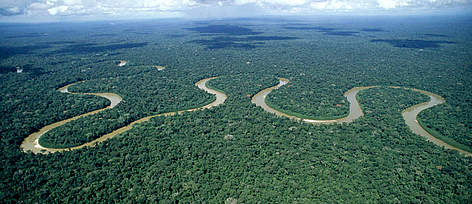
Welcome to the Amazon rainforest! wwf.panda.org The Amazon Rainforest…
…is perhaps one the most remarkable places on the planet. It is teeming with such a vast multitude of various life forms. Many of these different species remain undiscovered and are buried deep within the forest. This not-quite-half-full understanding the the world’s largest forests leaves the door open to explorers and animal scientists to really learn something new.
The Amazon is teeming with life. It is a birders paradise containing more species than any other ecosystem, and there are more than 4,000 species of butterflies. The lush forests of the [Amazon rainforest] basin are home to reptiles, amphibians, primates, tapirs, capybaras, even jaguars. The river itself contains freshwater dolphins, manatee and more than 2,000 species of fish which incidentally is more species than has been recorded for the entire Atlantic Ocean!
With all the various coexisting lifeforms in the amazon rainforest, evolution itself has evolved into an art. Species are forced to specialize and that has caused all sorts of gnarly adaptations. To display an example of this extreme evolution, one needs only to look at the candiru fish. This infamous creature:
… parasitizes the waste ducts of aquatic animals, and apparently finds human orifices irresistible.
Which, you know, is horribly terrifying.
Related Article: Costly Climate Changes.… Is Home to the Capybara
I’ll take all of ’em, every single capybara in the Amazon rainforest. One of my favorite animals living in the Amazon rainforest is the capybara. It appears to be the result of genetically fusing a dog and a guinea pig and then mating its offspring with an otter. The spawn of that mythical creature would likely look similar to a capybara. Officially the worlds largest rodent–with the obvious exception of R.U.O.S.— the capybara roams in herds which range from 10-100 rodent- monsters in size.
In true Amazon rainforest fashion, capybaras are talented on both land and water and can hold their breath for five minutes if they need to escape predators. They are herbivores and extremely picky at that. You’ve got to be picky if you’re going to eat the same food more than once. Capybaras are coprophagous. This means that they eat their own waste in order to maintain a healthy amount of bacteria used for digestion. Yum.
Related Article: Climate Changes Too Fast, Evolution Can’t Keep Up.… Has Many Different Types of Electric Fish!
There Amazon rainforest is teeming with different aquatic life. Electric eels have held–or provided energy for– the spotlight for some time. Science has studied their ways and has made at least one attempt to inform the public that these “eels” are actually knife fish. These swimming knives with electric capabilities are able to put out about 600 volts. The Electrophorus is interesting and all but there’s some new fish in the stream.
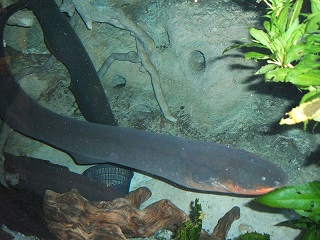 Some folks from Cornell University recently discovered two new electric fish in the Amazon rainforest. Brachyhypopomus bennetti and Brachyhypopomus walteri The weird thing is that these fish are electric in different ways.
the most significant difference between the two is the type of electric signals they generate. Most electric fish, including B. walteri, produce electric signals with both a positive and negative phase: an alternating current signal. (See a picture of another species of electric knifefish.) But B. bennetti is different. Its electric signals are more like direct current in that they have one phase rather than two, according to the study, led by John Sullivan of Cornell University.
Unlike the voltage of their phoney-eel river mates, the Brachyhypopomus school puts out significantly lower levels of electricity. The B. benneti and B. walteri fish can be found most often in Amazonian Floating Meadows.
This only scratches the surface of the marvels that lurk, slither, and fly within the Amazon rainforest. For more information about the Amazon rainforest, please visit the WWF Amazon rainforest page.
Related Article: Conservation Efforts of Earth’s Seven ContinentsSource List:
http://rainforests.mongabay.com/0605.htm
http://listverse.com/2012/09/16/10-bizarre-creatures-of-the-amazon-rainforest/
http://www.wcupa.edu/aceer/amigos/cd/rainforest.htm
https://wondergressive.com/2013/07/25/costly-climate-changes/
http://en.wikipedia.org/wiki/Capybara
http://web.archive.org/web/20050930231549/http://nationalzoo.si.edu/Animals/Amazonia/Facts/capybarafacts.cfm
http://en.wikipedia.org/wiki/Coprophagous
http://en.wikipedia.org/wiki/Electric_eel
http://newswatch.nationalgeographic.com/2013/08/30/new-electric-fish-found-are-wired-differently/
http://news.nationalgeographic.com/news/2010/10/photogalleries/101027-amazon-species-wwf-bluetooth-tarantula-science-rainforest-pictures/#/amazon-ten-years-new-species-fish_27896_600x450.jpg -
Computer Chips Modeled After the Human Brain

I dare you to look at contemporary computer chips and not admire their abilities. The most impressive example may be the realized dream of hand-sized smart-phones, pieces of technology we already tend to take for granted. And yet – with all their condensed might packed into a few square centimetres, those chips are nearing their developmental boundaries.
Try to open your computer case and have a look. Ignore the dust! See all those messy cables inside? Modern computer architecture is crippled by the fact that data has to flow between the different parts of the computer: The CPU (central processing unit), hard-drive, the RAM, the video card, etc. (namely – those green cards that you see inside the computer case). Although tremendous efforts have been made to accelerate those transitions, the data flow between those parts still poses a serious bottleneck on the performance of computers since software commands have to be executed sequentially.
Related Article: Electronic Brain Implants Increase Intelligence
A new study from Boise State University suggests a better solution to the problem: computer chip architecture modeled after the human brain. Instead of a central processing unit overwhelmed by data flow fr
 om different computer parts, the new architecture will be based on the way the human brain functions. Multiple areas – each one processing it’s own part, contribute together to create the bigger picture. This kind of architecture eliminates the need for the major processing and memory units. Instead of a hard-drive, the RAM, the video-card and most probably the CPU itself, a new kind of universal electronic chip will process and store the data on its own.
According to the principal investigator of the research grant, Elisa Barney Smith,
By mimicking the brain’s billions of interconnections and pattern recognition capabilities, we may ultimately introduce a new paradigm in speed and power, and potentially enable systems that include the ability to learn, adapt and respond to their environment.
Related Article: Newcortex: How Human Memory Works and How We Learn
 The neural approach is now becoming practical thanks to the on-going development of a new type of resistor: the memristor. Memristors can be tweaked to new resistance levels by applying and removing electric currents. Memristors “remember” the last resistance applied to them even after the power is removed. In simple words – a storage effect appears. An idea first conceived in 1971, for many years memristors puzzled physicist and engineers as a theoretical missing link component until recent developments finally made them practical. Although not yet commercially used, memristors are already taking active parts in research.
Dexter Johnson from The Nanoclast goes into greater detail regarding memristors:
The memristor has been on a rapid development track ever since and has been promised to be commercially available as early as 2014, enabling 10 times greater embedded memory for mobile devices than currently available.
The obsolescence of flash memory at the hands of the latest nanotechnology has been predicted for longer than the commercial introduction of the memristor. But just at the moment it appears it’s going to reach its limits in storage capacity along comes a new way to push its capabilities to new heights, sometimes thanks to a nanomaterial like graphene.
Using memristors, the team hopes to apply algorithms inspired by the interaction between the neural synapses of the human brain. The effect should follow the intricate patterns our brain implements to process and store data.
Related Article: Of Cyborg Monkeys and New Hope for Amputees
Apart from sounding super-cool (in a geek-ish way), this new approach harbors multiple advantages. First – a tremendously increased processing power. Thanks to mother nature (or depending on what you believe), our brain proves to be quite efficient in processing data. The new generation of computers will benefit from that very same system. Second – the new chips will be considerably more power efficient, suggesting they may be used in places where power support is an issue. We may expect an additional decrease in electronic-chip sizes as well.
And lastly… did I already mention that this new architecture sounds super cool?
Sources:
http://en.wikipedia.org/wiki/Memristor
https://twitter.com/thenanoclast
http://www.sciencedaily.com/releases/2013/08/130814144705.htm
https://wondergressive.com/2013/06/16/of-cyborg-monkeys-and-new-hope-for-amputees/
https://wondergressive.com/2013/06/12/neocortex-how-human-memory-works/
https://wondergressive.com/2012/10/13/electronic-brain-implants-increase-intelligence/
acer, algorithm, alternative energy, Apple, architecture, asus, best computer, best hard drive, best power saving, boise state university, boise university, bottle neck, cables, computer, computer chip, computer chip human brain, computer parts, cpu, dexter johnson, elisa barney smith, Facebook, fastest computer, geek, graphics card, hard disk, hard drive, human brain, iphone, mac, memristor, meristors, messy, nanoclast, neural computer chip, physicist, physics, power efficient, power saving techniques, quantum computer, ram, samsung, smartphone, super cool, university, video card
Wonder about your world…

Take the plunge down the rabbit hole of insanity and wonder in this fast-paced, nonstop psychological thriller that will leave you questioning the very nature of reality and beyond. Part thriller, part romance, part existential horror, A Dream of Waking Life delves into lucid dreaming, psychedelics, existential ontology, video games, the nature of love, the nature of reality, and more.

Mendel’s Ladder delivers an adrenaline-fueled journey set on a dystopian future Earth, brimming with high-stakes action, adventure, and mystery. This epic series opener plunges readers into a world filled with diverse cultures, heart-pounding battles, and characters who will captivate your heart and imagination.

“E.S. Fein is raising the bar for quality as it’s a very well-written and thought-provoking book…There are points and themes in the story that could be discussed for eons as people will have their own idea on where it leads. It’s a book I would highly recommend.” – Andy Whitaker, SFCrowsnest

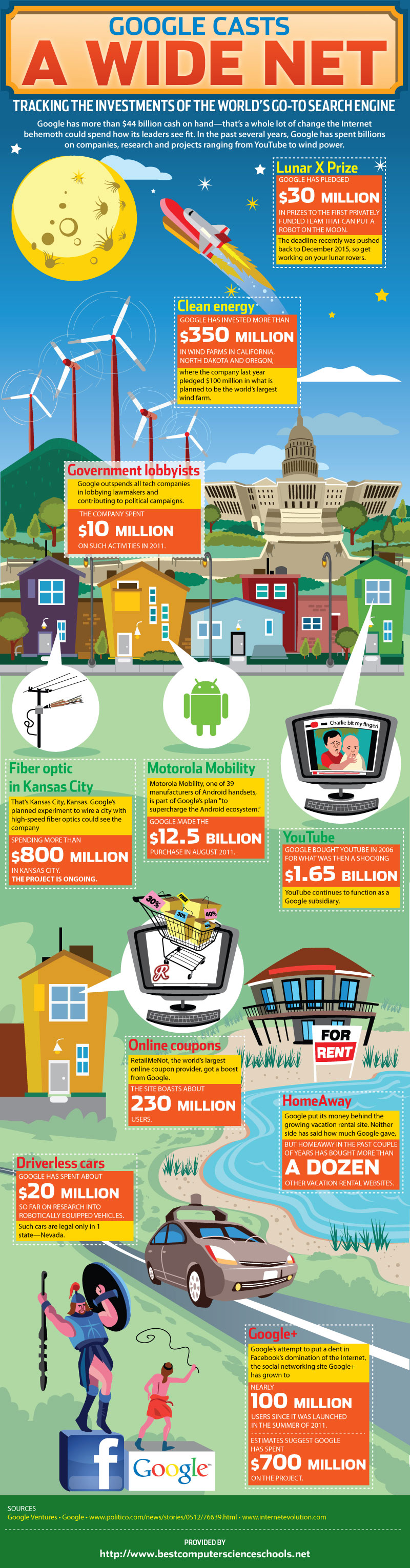
 Wondergressive
