
-
Bionic Hand That Can Feel
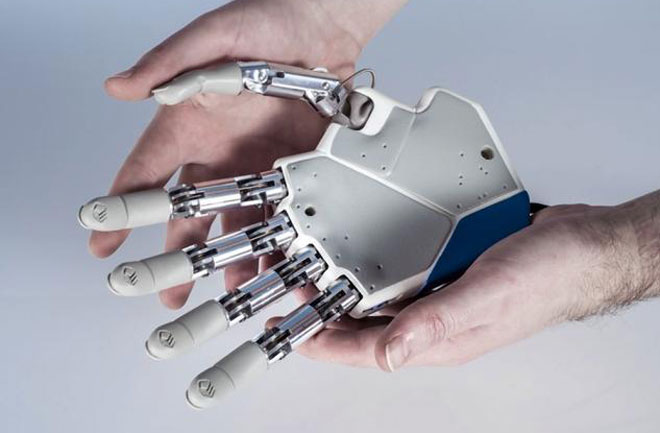
http://news.discovery.com/tech/robotics/touchy-feeling-bionic-hand-130221.htm In 2006 the first bionic arm, a robotic arm controlled by the amputee’s brain, was successfully connected to a woman, giving her a limb she could once again engage the world with. The only disadvantage of the arm was that she was still unable to feel, unable to tell that there was an arm that her mind was moving in the first place. Now, the world of robotics is changing once again.
Later this year, the first bionic hand that can feel and transmit that sense of touch to the amputee will be connected to a young man’s arm in Rome. This is an absolute breakthrough in science, signaling that the singularity is closer than we’d imagined.
The hand will be attached directly to the nervous system, making the bionic hand a true extension of the man’s body and subsequently fostering an additional troop into the global cyborg army. No kidding, there is even a foundation dedicated to turning people into cyborgs, and promotion cybernetic rights.
The new bionic hand will
allow the man to control the hand by his thoughts, as well as receiving sensory signals to his brain from the hand’s sensors. It will effectively provide a fast, bidirectional flow of information between the man’s nervous system and the prosthetic hand.
Earlier models of the bionic hand provided very limited sensation, whereas the new model provides a range of sensations to allow the amputee to recognize differences in touch.
The idea would be that it could deliver two or more sensations. You could have a pinch and receive information from three fingers, or feel movement in the hand and wrist. We have refined the interface [connecting the hand to the patient], so we hope to see much more detailed movement and control of the hand.
This is obviously only the beginning, so there is no telling what further advancements into bionics and cybernetics will bring.
No more days of hook hands and dead weight. This hand will likely one day be just as functional as a real limb with the added benefit of knowing the difference between a lover’s caress and the crushing force of a Buick parked on top of it. It might even eventually have the capability for heat seeking missiles that can be installed into the fingertips that reward the amputee with pleasure when they launch. Sounds far-fetched, but as usual, you know the military will get this first.
Will this technology, paired with an artificial nervous system, eventually be implemented into robotics, enabling our future overlords to feel the world just like us? It’s a slippery slope, that’s for sure.

http://www.karlanellenbach.com/2011_10_01_archive.html For more information regarding how technology has altered and/or improved biology follow the links below.
Sources:
Washington Post: First Bionic Arm
The Independent: First Bionic Hand
Wondergressive: The Singularity is Night Upon Us
Additional Resources:
Wondergressive: First True Cybernetic Tissue Created
Wondergressive: Robotic Legs Controlled by Your Brain
Wondergressive: Electronic Brain Implant Increases Intelligence
Wondergressive: Implantable Telescope Restores Vision
Wondergressive: Kid Allergic to Everything Goes to School as a Robot
amputee, bionics, brain implant intelligence, captain hook, cybernetics, cyborg army, cyborg foundation, feel bionic hand, full metal alchemist, health, hook hand, kid allergic robot, lostlimb, mendica, nervous system, robotic arm, robotic hand feel, robotic leg, robotic overlord, Robotics, technology, telescope eye, terminator, the matrix -
The Almighty Escapism: Creating Distraction

http://sl.nmc.org/wp-content/uploads/2007/08/creativity-slide_01.jpg Contention 1: Life is suffering.
Sword makers of old understood that the more they heated the steel, the stronger the blade would become. The mightiest tools have always been forged in the fiercest fires, and, likewise, the trials of man’s life sharpen the tenacious ones into razor-edged forces that shape the annals of civilization. To the initiated, life’s sufferings are turned to purpose, and this is why the greatest achievements in history are often preceded by the greatest defeats, because life, like the aged swordsmith, knows to test the metal it’s forged with before setting it to its Herculean tasks. Whether one defiantly taunts adversity or nestles into safety, life is suffering, and suffering is abound on life’s road to enlightenment.
Contention 2: Enlightenment is the purpose of life; we are all already enlightened.
Among the countless teachers professing to be enlightened, one of the most common yet ironically dualistic claims is that each of us is enlightened already. Christ, Mohamed, Zoroaster, Osho, David Icke and even Scientology’s L Ron Hubbard all pointed out that divine wisdom is our true nature. Yet, simultaneously, they say reaching for enlightenment is our reason for being, the so called great answer to life. Wait what! Become what I already am? Not being enlightened (or rather, aware of the inherent enlightenment ever-present) we struggle to wrap ourselves around how this double-talk isn’t some cosmic catch-22. If reaching for enlightenment is the highest purpose, then survey a thousand pedestrians on what they want more than anything and how many would say “divine understanding?” Not many.
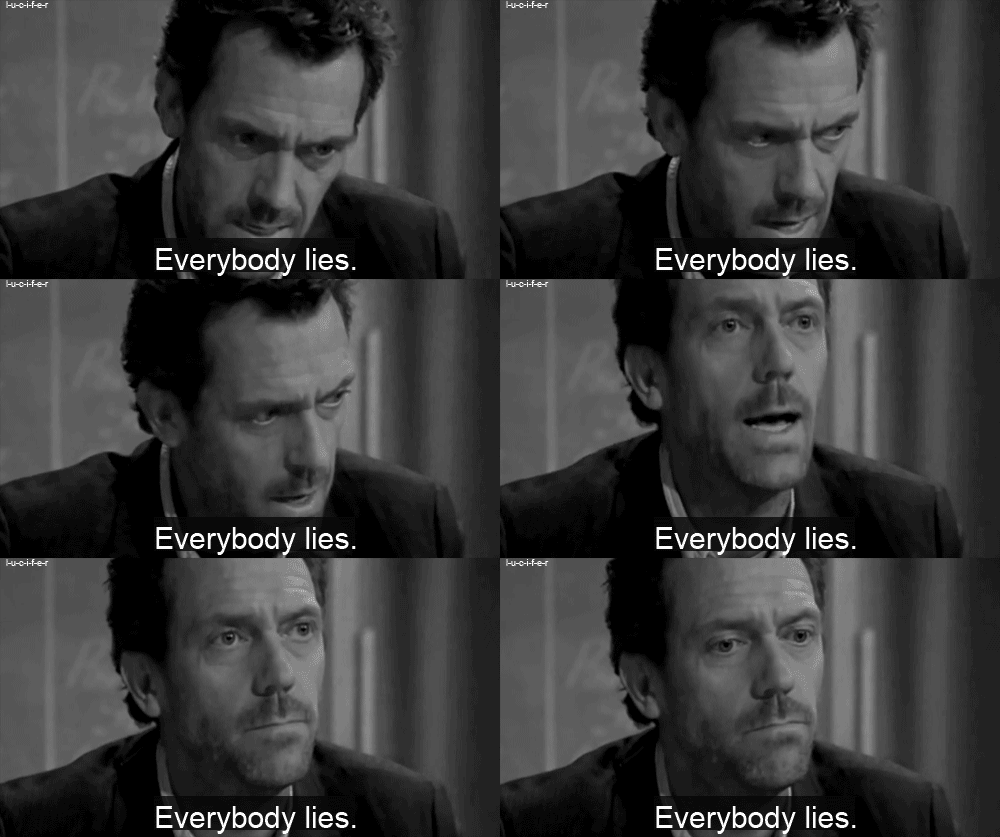
http://25.media.tumblr.com/tumblr_ly7g52b4sg1r2mytio1_500.gif There is a calculated purpose, though, behind why countless methods of realizing our divine nature within a single lifetime have been known to humanity for millennia, such as Kriya Yoga or sun-gazing, yet go widely unheard-of in general. Delusion is mandatory for existence. Yes, the transcending of mind, a necessary step, is often misunderstood to mean forfeiture of critical thought, and this is one of many pitfalls, but the harder pill to swallow and the reason for epidemic ignorance is this: Without deception, without lies, there is no meaning to anything.
Contention 3: There IS a soul; the soul DOES reincarnate.
Imagine the soul this way: energy, the pulsating power rippling through existence, the animating essence behind your beating heart and thinking mind, is inherently incapable of being either created or destroyed, according to the first law of thermodynamics; this power that drives you is absolutely eternal. This notion, for many, is proof positive of the immortal soul and its propensity for reincarnation. For the “seeing is believing” mind of western understanding, there is Dr. Ian Stephenson’s Expansive study into reincarnation back in 1975, lauded by the Journal of the American Medical Association as a “painstaking and unemotional” collection of cases that were “difficult to explain on any assumption other than reincarnation.” This study has been a vital resource in the tipping of the collective scales toward acceptance of this ancient belief structure. European Cases of the Reincarnation Type is the title but the study continues.
Ok, so what are you getting at?
So on the pretenses here that enlightenment is the ultimate purpose of life, reincarnation is an absolute, and this life cycle will continue indefinitely until the soul realizes its oneness with all existence, let’s take this train of presumptions one step further. When Hunter S. Thompson took his life after the end of the 2005 football season, perhaps it was because he understood this great truth: like water and breath, entertainment and distraction are a finite resource. Man’s inability to sit with himself in a quiet room can be seen as the root of all modern man’s problems in a perfect way, because distraction itself serves only one enormous overarching purpose: delaying pain. And pain, further still, is what we feel when we fear what we’ll realize when there is nothing left to worry about. When there is nothing left to consider, you are simply a human “being” (not a human ‘doing’ or a human ‘having’), just being, or, in other words, enlightened. Entertainment, therefore, is our barrier to enlightenment.

http://4.bp.blogspot.com/-opxtpM7fgU4/UCLL5XU-HII/AAAAAAAAELU/2Pzrgl9kF5I/s1600/distraction.jpg Contention 4: Life is but a dream.
Because we are all enlightened by default, all of civilization and its achievements can be seen as a massive distraction from this state of is-ness. When we are enlightened, the cyclical cosmic ride is over and we merge with the almighty oneness of existence, the Godhead. Here is the point. In order to perpetuate existence, collectively we must be distracted from the truth, because the truth is there is no existence (Descartes said, “I think, therefore, I am,” but I only think I am, therefore, I am what I think). If it seems at times that everything is a lie or too crazy to be true, that is because it is… Everything the senses perceive and interpret is a fabricated dream we are collectively creating to allow the Godhead (us) to experience itself as the illusion of less than everything. That old stoner question of “if God is so powerful, can he make a stone that not even He can lift,” has an answer: You are God, and you have told yourself the stone is too big so you can experience your only limitation, lack of limitation. Without believing the illusion that you are separate from the mountain, moving mountains makes no difference.
So what does any of this have to do with creation?
Creation, in every conceivable form, from writing a novel, doodling a stick-figure, building a desk, or amassing an empire, all expand the Godhead. Here’s how. Your unique experiential wisdom, through what you create, is transformed into a vessel for others to divine new relative wisdom, previously unexperienced.
When we consume escapism and distraction (TV, drugs, games, work, sex, anything at all), it eventually leads to boredom (“I’ve already seen this movie, heard this story, been here, done that a million times”). The boredom, in its beautiful necessity, drives us to create (a new game, new idea, new records and feats), adding to the collection of consumable distraction from is-ness for the hive. Rinse. Repeat. But every creation is meaningful in its own way, as a portal to move another into your same state of consciousness. This is why the greatest art wells up the strongest emotional charge.
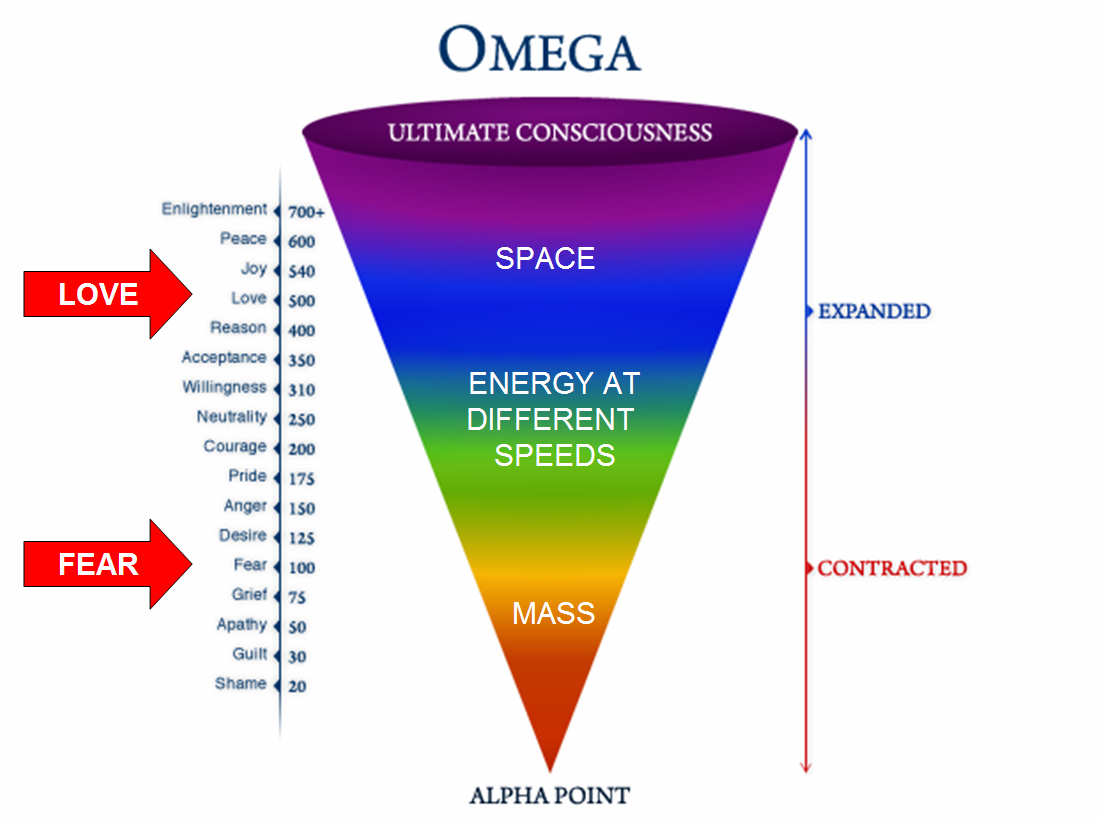
http://www.the-tao-of-flow.com/everything-is-easier-in-flow/ Starting in the mid-60’s, Dr. David Hawkins lead a 40 year global kinesiological study on levels of human consciousness, with hundreds of thousands of subject. His findings systematically proved man’s divinity. His map of levels of consciousness (above), on a graded scale, showed how even the most ignorant of racist rants (terrible) holds value, because there is wisdom to be found for an audience of child-rapists (more terrible).
When we create, we activate a higher level of our minds, advancing ourselves. But through advancing ourselves, we contribute to the advancement of humanity as a whole via the ones we affect and the ripple effect. When Roger Bannister became the first in history to run a mile in under 4 minutes, he lifted a veil of possibilities that 36 others, in only the subsequent year, followed him beyond. When you create, the realm of the possible expands.
When you learn you have the power to move mountains, you’ll know you were already the one who put them there.
Sources:
Greatest Achievements of Human History (rationalwiki.org)
50 Famously Successful People Who Failed at First (onlinecollege.org)
Jesus Christ Quotes and Dying Statements (free-spiritual-guidance.com)
10 Prophet Muhammad Quotes: A Taste of Honey (islamicrenaissance.com)
Zoroastrianism (heritageinstitute.com)
Osho on Enlightenment, Osho Enlightenment Quotes (oshoteachings.com)
Remember Who You Are – David Icke (youtube.com)
My Philosophy By L. Ron Hubbard (lronhubbard.org)
In 1610, God Was a Binary, Fractal, Self-Replicating Algorithm (wondergressive.com)
Europe PubMed Central (europepmc.org)
Living of Light Research (home.iae.nl)
Meditation – Pitfalls on the Path (lifepositive.com)
First Law of Thermodynamics (grc.nasa.gov)
European Cases of the Reincarnation Type (amazon.com)
The Last Words of Hunter S. Thompson (phrases.org.uk)
Veritas Publishing (veritaspub.com)
Gold Eluded Banister, But Track Immortality Did Not (nytimes.com)
Elizabeth Gilbert: The Elusive Creative Genius (youtube.com)
almighty, beleif, Belief, boredom, christ, contention, creat, create, creation, david hawkins, david icke, distract, distraction, divine, energy, enlightenment, escape, escapism, faith, finite, history, house, hrm, ian stevenson, ignorance, intelligence, kriya, lies, life, meaning, Mental Health, mohamed, NASA, omega, one, oneness, osho, purpose, reincarnation, religion, research, Scientology, smart, soul, stupid, suffering, Sun, sun gazing, sword, teacher, TED, test, trials, truth, understand -
Voyager 1: The Final Frontier?
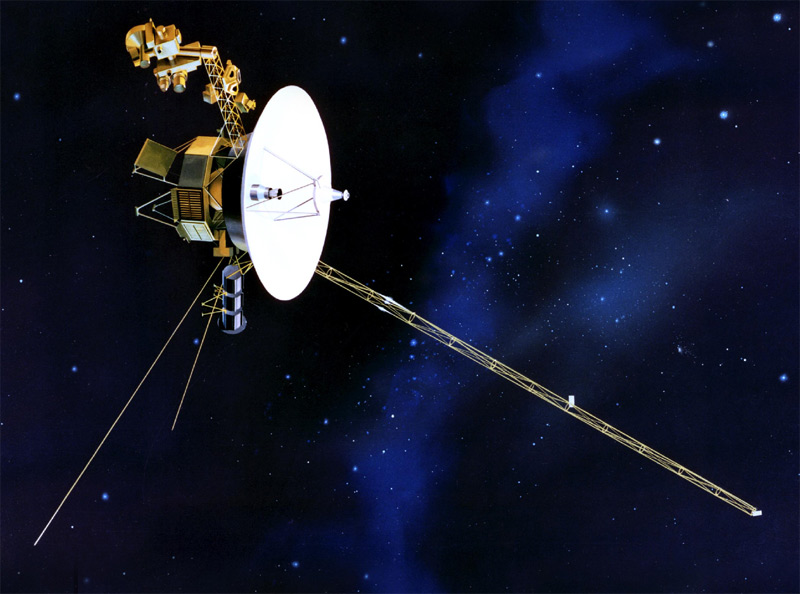
http://www.agu.org/news/press/pr_archives/2013/2013-11.shtml The American Geophysical Union (AGU) issued a press release on March 20 indicating that the Voyager 1 space probe may have travelled beyond the influence of the Sun and become the first man-made object to exit the Solar System. There is considerable discrepancy on whether or not that statement is accurate, however, as there is no real consensus on what constitutes the actual end of our Solar System. For now, though, let’s ignore the specifics of the debate and simply respect and reflect on the enormity of the accomplishment.
The AGU reported that the probe appears to have traversed past the heliosphere:
“The heliosphere is a region of space dominated by the Sun and its wind of energetic particles, and which is thought to be enclosed, bubble-like, in the surrounding interstellar medium of gas and dust that pervades the Milky Way galaxy. On August 25, 2012, NASA’s Voyager 1 spacecraft measured drastic changes in radiation levels, more than 11 billion miles from the Sun. Anomalous cosmic rays, which are cosmic rays trapped in the outer heliosphere all but vanished, dropping to less than 1 percent of previous amounts. At the same time, galactic cosmic rays–cosmic radiation from outside of the solar system–spiked to levels not seen since Voyager’s launch, with intensities as much as twice previous levels.”In a scientific journal for the AGU, Geophysical Research Letters, authors W.R. Webber and F.B. MacDonald state:
“It appears that [Voyager 1] has exited the main solar modulation region, revealing [hydrogen] and [helium] spectra characteristic of those to be expected in the local interstellar medium.”
However, Webber notes, scientists are continuing to debate whether Voyager 1 has reached interstellar space or entered a separate, undefined region beyond the solar system.”
NASA scientists also attempt to dampen the celebratory moment of man first dipping his big toe into the interstellar pool of the final frontier:
“It is the consensus of the Voyager science team that Voyager 1 has not yet left the solar system or reached interstellar space. In December 2012, the Voyager science team reported that Voyager 1 is within a new region called ‘the magnetic highway’ where energetic particles changed dramatically. A change in the direction of the magnetic field is the last critical indicator of reaching interstellar space and that change of direction has not yet been observed.”
None of that matters to me. I’m in it for the science, man. And for its historical significance.
Launched in 1977, Voyager 1 was designed to investigate the outer gas giants. After collecting data on Jupiter and Saturn and the latter’s largest moon, Titan, the probe was sent out into the interplanetary medium to explore the boundaries of space. The probe is estimated to have enough juice in it to be able to send messages back to Earth until 2025.
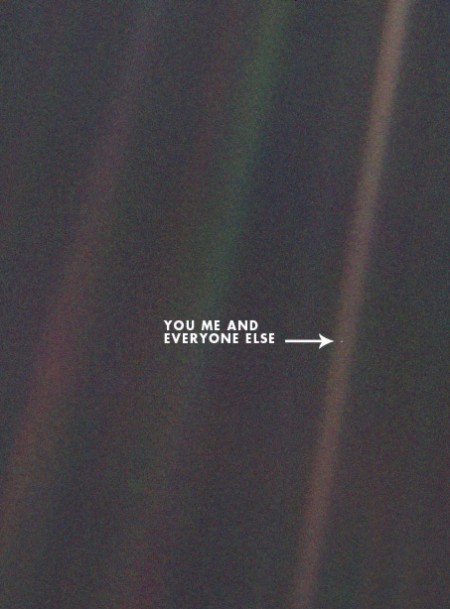
To me, the most illustrious accomplishment of the spacecraft was championed by the legendary Carl Sagan. At his urging, the space probe was directed to take a picture of Earth from about 6 billion kilometers away. This picture is called the Pale Blue Dot and it remains one of the most mesmerizing and resonating images of our teal, Goldilocks planet.
http://myhigherdrive.com/pale-blue-dot-2/ The space probe also contains the Voyager Golden Record, a copper time-capsule of man’s scientific and artistic achievements, meant to demonstrate homo sapiens status as intelligent life. Among other things, it records our understanding of DNA and mathematical concepts, spoken greetings in 55 languages and a musical selection that ranges from Beethoven to Chuck Berry. Although these inclusions are unlikely to ever find themselves in an extra-terrestrial iPod, it’s the beauty behind the thought that counts.
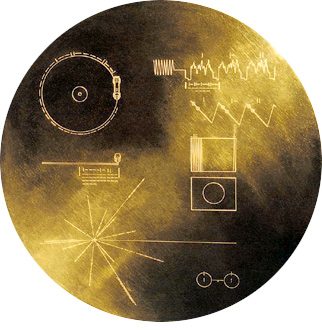
http://voyager.jpl.nasa.gov/spacecraft/goldenrec.html We’ll have plenty of time later to determine when Voyager 1 definitively escaped the influence of the Sun. The specifics don’t seem too important right now, though. At 123.5 astronomical units away from our parental star, it is certainly the farthest we’ve ever roamed from our pale blue dot. For now, let us revel in the gorgeous reality that it is (arguably) the first man-made object to be on the outside looking in, our first child to leave the solar roost.
Sources:
http://www.agu.org/news/press/pr_archives/2013/2013-11.shtmlhttp://www.jpl.nasa.gov/news/news.php?release=2013-107
http://www.wired.co.uk/news/archive/2013-03/20/voyager-1-leaves-solar-system
http://visibleearth.nasa.gov/view.php?id=52392
-
Fly Away Home: How Birds Evolve with Automobile Traffic


http://www.operationmigration.org/images/photo%20journal%2003/FAH/anna-igor.jpg Those that learn, earn their place. It seems that even birds are taking this survival of the fittest motto to heart in a new unique way. A study has recently yielded that birds may be learning from each other about our speed demon tendencies. The truth is, I vaguely remember the last time I saw roadkill on the highway during my commute to work. Even so, reportedly:
An estimated 80 million birds are killed by colliding with vehicles on U. S. roads each year, and millions more die annually in Europe and elsewhere.
Yes, those numbers do seem ridiculously high, but there may be hope for our little companions that fly near our speedy death machines. Researchers Charles R. Brown and Mary Bomberger Brown in Nebraska found that although the swallow population increased over their 30 year study period, the death by vehicle fatality of swallows sharply decreased from 1983 to 2012. Swallows tend to learn from their neighbors, which is a trait shared by many animals, and natural instinct may be evolving in species to guide them away from human dangers.
The study also mentions that the birds living near highways have, through a possible natural selection, evolved to have smaller wingspans for quicker movements vertically in the air allowing for a zippy escape from oncoming traffic. If a bird with a larger wingspan decided to fly into traffic, it would have a harder time flying directly up and away from danger than its smaller counterpart because of the lower wing loading of longer wings.
What does it all mean? Is mother nature preparing against human interaction? Have we affected our animal neighbors so much that they have to develop an internal mechanism to evolve with our advancing technology? What happens when we start hovering from place to place? Will the animals adapt to our flight? Or will we simply find more animals mourning each other’s deaths as humans continue to evolve?
At least it is nice to know that humans get the respect they deserve. I wonder what else we can passively bend to our will!
Research:
Wondergressive – Cannabis Cures Cancer
Wondergressive – Birds Mourn Death
-
Autophagy: The Unsung Hero in Slowing Down Aging
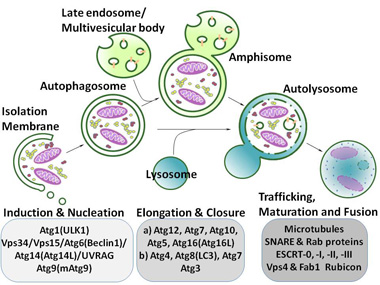

http://icahn.mssm.edu We’ve been told that antioxidants and resveratrol are the way towards fighting age related diseases, but most people know little about the autophagy process and how beneficial it is to sustaining healthy cells and increasing their survival. Autophagy is the cell repair mechanism that recycles unused or damaged cell components. Here is a better explanation from PubMed:
Autophagy is a self-degradative process that is important for balancing sources of energy at critical times in development and in response to nutrient stress. Autophagy also plays a housekeeping role in removing misfolded or aggregated proteins, clearing damaged organelles, such as mitochondria, endoplasmic reticulum and peroxisomes, as well as eliminating intracellular pathogens. Thus, autophagy is generally thought of as a survival mechanism.
What this means is autophagy plays a crucial role in maintaining healthy cells, and down regulating it is thought to be one of the main reasons for cell damage and AGING. The truth is that we are just a walking hunk of cells that are sewn together into a four limbed oddity.
The most common form of autophagy is called macroautophagy. The way that this autophagy process works is as follows:
The most well-known mechanism of autophagy involves the formation of a membrane around a targeted region of the cell, separating the contents from the rest of the cytoplasm. The resultant vesicle then fuses with a lysosome and subsequently degrades the contents.
So in the process of macroautophagy your cells are protected and cleaned, leaving them healthy and toxin free. If you want to learn more about this amazing gem in the constant search for anti-aging methods, please look into these related reads:
Autophagy: cellular and molecular mechanisms
Autophagy and Aging: The Importance of Maintaining “Clean” Cells
Sources:
Wondergressive: Anti-aging Articles
-
The Power of Wind Farms

http://windpowerdirectory.net Yesterday, my day both began and ended with the California sun moving through a horizon speckled with wind turbines. As humans we have only to thank Sol for our existence. We’ve come a long way in terms of mechanized energy efficiency. Seeing these two great power sources together lead me to wonder: How much power do we get from wind farms? How much power does one wind turbine produce?
To understand the energy intake of wind turbines we should take a closer look as to what is actually happening inside to harness this electricity. An anemometer gauges the speed and the direction of the wind. The wind speed information is then passed through to a controller. This device turns the turbines on, points the turbine’s blades in the most fortuitous direction, and when the wind speed is too high (over 55 mph) or too low (under 8-16 depending) it adjusts accordingly.
The turbine blades are directly connected to an electrical generator which creates electricity. A simple generator does this by spinning a magnet inside of copper wiring. The generators used in wind turbines are obviously more sophisticated though they have the same effect.
So how much electricity can one wind turbine create? Wind Energy America states that
Typically modern turbines range in size from 660 kilowatts to over 3 megawatts of capacity. They are placed in fairly windy locations with minimum wind speeds in the range of six meters per second (around 13 miles per hour). Wind turbines generally run at 30 to 40 percent capacity, so a 1 MW turbine could produce around 3 million KWh of electricity in a year.
The amount of wind in an area plays a huge role in how much energy is produced. So if you’re in a windy part of the country it is time to ask yourself: Is this a viable option for me?
Sources:
-
Belly Buttons: Bacteria Wonderland!

Petri dishes of belly button bacteria
Photo Credit: Neil McCoyA recent study published in PLOS ONE has guided us to a greater knowledge of which bacteria are commonly found in belly buttons. The Smithsonian article on the study sums it up pretty well, saying:
A team of researchers dug into 60 different people’s belly buttons and turned up bacterial diversity and microbial mystery. All in all, they identified more than 2,000 species of bacteria as well as two species of archaea, the ancient predecessors of bacteria. Some of the species frequently occurred in multiple belly buttons, while others were confined to just a few participants.
Microbe World, a website dedicated to promoting awareness and understanding of key microbiological issues, gives a little insight as to where archaea are normally found stating that:
Archaea comes from the Greek word meaning “ancient.” An appropriate name, because many archaea thrive in conditions mimicking those found more than 3.5 billion years ago. Back then, the earth was still covered by oceans that regularly reached the boiling point — an extreme condition not unlike the hydrothermal vents and sulfuric waters where archaea are found today.
Some scientists consider archaea living fossils that may provide hints about what the earliest life forms on Earth were like, and how life evolved on our planet.
So, various bacteria, including previously unknown bacteria, and two archaea were found in a small range of North American belly buttons. But the researchers aren’t finished yet. In a guest blog on Scientific American, Rob Dunn, the study’s lead author, talks of a future research plan saying:
Instead of the 66 samples we included in our first paper, or the 300 we have now, we will soon have over 600 samples of people processed, people from all over North America. With this variety, we may well begin to explain the differences among people in terms of the intimate forests of their umbilicus. On the other hand, we may still be unable to account for our differences; it may be that part of what determines who lives on you is stochastic, a fancy scientific word for what happens when fate and the universe’s contingencies come together in your navel.
Carl Zimmer, another scientist working with the project talks of his results in a blog post on the Discover website. He had a very diverse spread of bacteria in his belly button and 17 bacteria that were not found in any of the other subjects.
I know that diversity can make ecosystems work better. One of the most important services that our microbial ecosystem performs for us is protecting us from pathogens. They can outcompete invaders, kill them with poisons, and otherwise ward them off. Scientists have run experiments to test the effect of diversity on infections. They manipulated mice so that some had no resident bacteria, and others had low levels of diversity. The researchers found that pathogens did a better job of invading low-diversity mice than high-diversity ones.
Several of the bacteria found in people’s navels had never been found on humans before and Zimmer discusses some of the bacteria found in his navel in his blog post saying:
Several species I’ve got, such as Marimonas, have only been found in the ocean before. I am particular baffled that I carry a species called Georgenia. Before me, scientists had only found it living in the soil.
In Japan.
Belly buttons aren’t the only place where thriving biomes are being discovered. Scientists have discovered a mobile ecosystem that lives in freezing temperatures. The world is so intriguing! Life is everywhere!
Sources and Extra Reading for the Curious:
PLOS ONE- A Jungle in There: Bacteria in Belly Buttons are Highly Diverse, but Predictable
The Smithsonian- A Flourishing Microbial Community Dwells Within Your Belly Button
Discover- Discovering my microbiome: “You, my friend, are a wonderland”
Wondergressive- The Secret World of Bacteria
Wondergressive- New Ecosystem Discovered: Glacier Mice
Wondergressive- Life, It’s All Over the Place
Wondergressive- 2800 Year Old Lake Life Survives in Complete Isolation
-
Awareness and Dealing with Rejection
Raise Your Awareness
You are a buddha. Well… maybe not, but then again maybe we’re all on our way. In We Can Be Buddhas a TED talk by Bob Thurman he discusses how individuals can change their awareness. We must stop looking inward at our miseries and grow to understand others through compassion. He argues that in this way we can help to make ourselves happier too.
This is the strange paradox of life: when you’re no longer locked in yourself, and the wisdom or the intelligence, or the scientific knowledge, or the nature of the world, that enables you to let your mind spread out and empathize and enhance the basic human ability of empathizing and realizing that you are the other being. Somehow by that opening you can see the deeper nature of life…”
So let’s take a few minutes and raise our awareness about the world around us. I’ll give you a little fodder to help you along, but please take the time to explore your own feelings about this.
Human Interaction and Rejection
Everyone reading this article interacts with at least one other person everyday. Human interaction is an essential part of all our lives. We need each other, but how often do we think about the other person and what they’re going through? Human connections are important and through our desire for them we often reach out in unappreciated ways. On her blog a woman from LA talks about how men are constantly approaching her and though she politely turns them down she is constantly being called a variety of insulting names for it. And of course getting rejected, even in a polite way, is upsetting for anyone, but a negative reaction isn’t going to make it better. Unwanted advances and negative reactions to rejection are such a common occurrence that rejection hotlines (phone numbers you can give out to unwanted suitors) exist to help ease the awkwardness of the situation.
While this is definitely one way to handle situations like these, maybe we should start learning how to handle rejection without taking it so personally. Rejection is a healthy part of a successful life. Successful people experience more rejection than unsuccessful people. Many people who are successful don’t succeed on the first try, but they don’t stop at the first rejection. Rejection is natural and needed to grow.
How to Deal with Rejection
conservativeread.com Johns Hopkins University says “Don’t get mad, get creative.” A recent study at the university shows that rejection breeds creativity. It also strengthens independence. So when you get rejected take that energy and do something creative with it. Rejection will continue to happen no matter what. In 100 Days of Rejection, a TED talk by Jia Jiang, he talks about what rejection is and how we can learn from it. He says:
The higher you go the more you will get rejected.”
According to Jiang there is no way to avoid rejection and if you really want to get out there and do something great; rejection will be a part of your journey to greatness. So Jiang’s solution is to practice a real life game called Rejection Therapy™.
Rejection Therapy™ is the real life game with one rule. The game is designed for anyone who wants to build confidence and overcome fear of rejection.
The game is designed to have the players practice getting rejected to help overcome the emotions that go along with it. Jiang decided to try 100 days of the game and has had some interesting experiences so far. He’s been creative about what he’s trying to get rejected for and has been surprised at the things people have said yes to. For instance he once asked to play some soccer in a stranger’s back yard. The stranger was pretty enthusiastic about it and invited him in. Another great example happened at a Krispy Kreme donut. He asked the woman to make some donuts in the shape of the Olympic rings. She did it, and even gave the donuts to him on the house.
The game has limitless possibilities and can be played in any situation. After you are accustomed to being rejected about issues that matter less it’s not as hard to approach more personal matters. The game is a great way to practice rejection and the more you practice the more comfortable you’ll feel with it. Be careful, if you don’t get rejected it doesn’t count as playing the game. So, aim high and learn to deal with your rejections gracefully.
And if you want more advice head over to reddit to check out AlexanderTheCool’s advice on How to Handle Rejection like James Bond.
Rejection is always going to happen, but it’s not always personal. Use it, learn from it, grow from it; make yourself better.
Sources:
TED Talk Bob Thurman We Can Be Buddhas
UNWINONA: I Debated Whether Or Not to Share This Story
US Health News: Why Loneliness Is Bad for Your Health
American Psychological Association: The Pain of Social Rejection
Online College: 50 Famously Successful People Who Failed at First
WikiHow: How to Handle Rejection
99u: How Rejection Breeds Creativity
TED Talk: Jia Jiang 100 Days of Rejection
Johns Hopkins Don’t Get Mad, Get Creative: Social Rejection Can Fuel Imagination, JHUCarey Researcher Finds
-
Experiments in Photographic Memory (Phase 1: Guinea Pig)
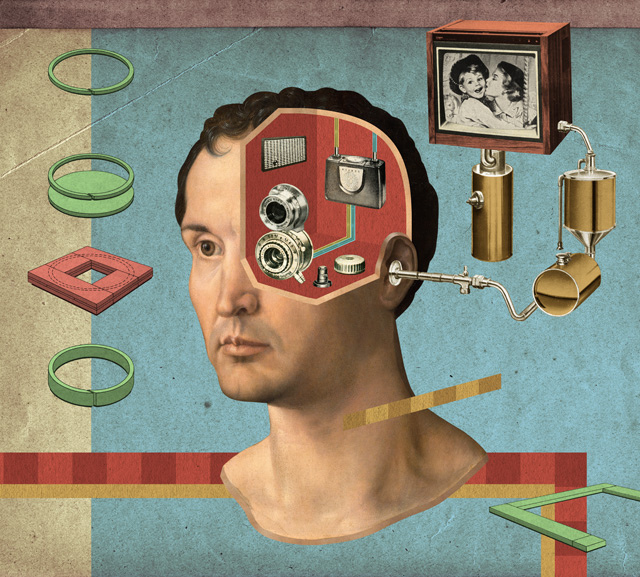

The results of a powerful photographic memory. http://www.stephenwiltshire.co.uk/art_gallery.aspx?Id=5935 Oh, you’ve heard of photographic memory before? Than perhaps you’ve already heard of Stephen Wiltshire, a.k.a’ed as “the Human Camera.” He is the artist responsible for the picture above, aptly titled “Monte Carlo.” I’m no art critic, but the tremendous accomplishment in this work is almost unparalleled in human history, not because the painting is especially brilliant in form or technique, but because the image depicted is photographically perfect to what you would see in a helicopter ride over Monte Carlo. For only a brief few minutes, a helicopter ride is just what Stephen went on; then he went on to paint this work entirely from memory.
Stephen is an autistic savant who sketches perfect skylines, down to the minutest of details, directly from his briefly-glimpsed photographic memories. Much has been said about this incredible young man already, and a full length documentary can be seen here, but this article is not about Stephen. It is about you. It is about you and your ability to do the exact same thing: develop a photographic memory.
The Photographic Memory
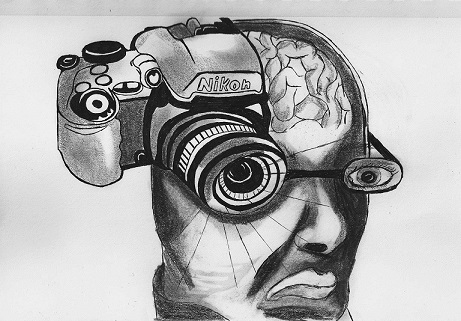
Photographic memory, yeah, just like that. darozz.tumblr.com Lauded across civilization as one of the ultimate powers of mankind, the photographic memory has long resided in the realms of mythos, ambiguously skating the lines between reality and legend. The possibilities of attaining such a superhero ability, being nearly limitless, fill one’s mind with a power-high from just imagining it. Yet, as it currently stands, our general understandings widely boil down to hearsay and urban legend, dismissed the way of alchemy, until now…
On ehow.com, there is a tutorial on how to develop a photographic memory using only household appliances, within the span of a mere 30 days. Outrageous! Wild claims are nothing new to the internet and bullshit alarms should sound pretty quick. This method, however, seems to keep showing up over and over and over all across the internet like a foul rumor that just won’t die. While repetition hardly grants the premise credence, it does bring to light an intriguing question. Why can’t we find anyone who’s actually done it?
For such a simple training program with such amazing benefits, it seems no one is willing to put in the effort, or if they are, they are unwilling to share their newfound photographic memory with the world. So this is where we come in…
As of the publication of this article, I am 7 days into my own regimen, and I can tell you I’ve glimpsed victory (more on that shortly). This is, though, the 4th attempt I’ve made in the last 6 months, for reasons we’ll look at in a moment. Our focus here is to validate or discredit this idea by self experimentation, posting results, and looking for feedback/others interested in training their brains to be more.
The Photographic Memory Method (basic)
Instructions - 1. This system will take 1 month for you to develop a photographic memory, you must take 15 minutes every day and dedicate it to this training. For the first month, your eyes will take about 5 minutes time to adjust to daylight reading.
- 2. Find a dark room in your house, free of distractions for 15 minutes. I use the bathroom. The room must have a bright lamp or ceiling lamp.
- 3. Sit down next to the light switch with your book and paper that has a rectangular hole cut out of it the size of a paragraph.
- 4. Cover the page, exposing only one paragraph and hold the book out in front of you. Close your eyes and open, adjust distance so that your eyes focus instantly with ease on the writing.
- 5. Turn off light. You will see an after glow as your eyes adjust to the dark. Flip light on for a split second and then off again.
- 6. You will have a visual imprint in your eyes of the material that was in front of you. When this imprint fades, flip the light on again for a split second, again staring at the material.
- 7. Repeat this process until you can recall every word in the paragraph in order. You will be able to actually see the paragraph and read it from the imprint in your mind.
Tips & Warnings
- Do not get discouraged, it will work. It has been working for the military for 70 years.
- You will be developing this technique to a point where you will be able to execute this during the day, all day.
- Rate this article with the stars by my screen name.
- Omitting even one day, can prolong training by as much as a week.
As I’ve said, I’ve tried and failed 4 times now, but I’ve learned a few secrets along the way that I’d like to share, because I have seen this work.
But why did you fail the last 4 times?
Well, it’s pretty simple actually. It’s boring. Actually putting in the effort to get a photographic memory is boring and tedious but mostly there was no feedback or reassurance because no one else (as far as we know) has done this yet. So, sitting in a dark bathroom every morning, frankly, I felt like a lunatic and quit. Congratulations to you, then. I’m here at your disposal (qwizx@wondergressive.com) and with enough traffic, we’ll be starting a forum as well, so you have just gotten past the biggest obstacle of attaining a photographic memory, no support, and haven’t even done anything yet. All that said, let’s break this down step by step, so you can know what to expect.

Photographic memoy, or eidetic memoryhttp://www.tumblr.com/tagged/eidetic%20memory 1. This system will take 1 month for you to develop. You must take 15 minutes every day and dedicate it to this training. For the first month, your eyes will take about 5 minute’s time to adjust to daylight reading.
The first few days are really interesting, because the sensations are just spectacular. You’ll literally be able to see into the past through peripheral images burned into your retina. As for 15 minutes, this isn’t quite right. For the first several days, it will be more like 30-45; then you’ll develop a system and be able to pull back to 15. When it says “5 minutes to adjust,” this means don’t start the process until you’ve been in the dark for at least 5 minutes. After the novelty wears off, this routine will get tedious, so I highly recommend using this few minutes wisely: turn on some music for a reference to how much time has passed and brush your teeth or any other bits of your morning routine that don’t require light. I go so far as to take a waterproof flashlight into my cold shower (you can get flash images of individual droplets hovering in midair).
2. Find a dark room in your house, free of distractions for 15 minutes. I use the bathroom. The room must have a bright lamp or ceiling lamp.
The bathroom works well, but it must be pitch black. Be sure to shove a towel under the crack in the door and unplug any appliances with even a tiny light. “Dark” just won’t cut it; it needs to be complete blackness. Also, if you’re using a bathroom (closet works great too), be sure to let anyone living with you know you’ll be in there for a while, cause it’s really frustrating to be 12 minutes in and get an “I gotta pee” knock, only to have to start all over.
3. Sit down next to the light switch with a book and a paper that has a rectangular hole cut out of it the size of a paragraph.
Light switch is great, but flashlight is better so you won’t have to stand uncomfortably the whole time. The type of bulb is important as well; it can’t be one that emits residual light, cooling down gradually, as it needs to be a quick flash and nothing more or the effect is ruined. LED is excellent. As far as the book goes, forget it for the first few days. Just play around with the process until you can see a fair amount of detail in various objects in the room. After a few days, incorporate a book, but a child’s book with very large print (or print off anything you’d like, but with at least 20 sized font). Don’t be discouraged, because on the first day you won’t be able to read a paragraph, just get a vague shape of the page. it improves over time.
4. Cover the page, exposing only one paragraph and hold the book out in front of you. Close your eyes and open, adjust distance so that your eyes focus instantly with ease on the writing.
The concept here is fascinating: you’ll be training yourself to be able to read a paragraph only from a brief glance. After 30 days, the amount of time it takes to establish a habit, you’re mind will essentially be on autopilot, doing this automatically. How cool! Over time use smaller and smaller font to train your eyes.
5. Turn off light. You will see an afterglow as your eyes adjust to the dark. Flip light on for a split second and then off again.

http://www.commongrounds.co.uk/?attachment_id=4533 Have fun playing around with the length of the flash, because the difference of a few milliseconds makes a huge difference, especially if there is any motion going on. Eyes work like cameras, and we want to avoid time-lapse photography (right).
6. You will have a visual imprint in your eyes of the material that was in front of you. When this imprint fades, flip the light on again for a split second, again staring at the material.
You’ll be able to see everything, as though the lights were still on. It’s a dizzying experience (can be scary and mind-blowing).
7. Repeat this process until you can recall every word of the paragraph in order. You will be able to actually see the paragraph and read it from the imprint in your mind.
Just start with details around the room and work up to this. Count tiles, trace wood-grain lines, anything. The memory itself is exactly “photographic;” an image is at your mind’s disposal. In the end, if you asked me what was the third word of the second paragraph on page 327 of Moby -Dick, I’d know it was blubber, not because I have it all memorized but because I can bring up the image of that page perfectly to my mind’s eye. It works on this same idea: currently, do you know what the fourth word in this paragraph is? Probably not. But you can find out easily enough because it’s only an inch or two up.
A photographic memory is possible, but find out for yourself. http://www.mishes.com/inspiracion/collage-illustrations-randy-mora Two weeks into my first attempt, my mind made a leap. I was spinning in revelry at the notion that soon I’d have the super power of photographic memory and I wanted to test it, so I went to the shelf with all the movies and tried it out. I wasn’t really sure what to do or how to “take a picture” so I looked at a shelf with 200 or so videos and just thought “click,” looking at the shelf for only a second or so, being careful not to consciously read the titles. I closed my eyes and tried to imagine, not remember, the shelf. ‘Imagine’ isn’t quite right either; maybe see is the best word. Once you experiment you’ll understand what I mean. The experience is like perfectly looking into the past with a camera with resolution as detailed as your eyesight and clipping out a perfect 3 dimensional frame of reality. you can go back and look at these images the same way you look at a photo album except… it’s more like if time suddenly stopped, but you can’t perceive beyond whatever you’re focused on this exact moment. I imagined the shelf and could see every bit of it, even details I’d never noticed before, like little cracks in the wood or tiny things that would normally elude or not interest me. Most importantly, I could read every title. Today, 4 months later, I still can.
One man’s speculations and lunatic claims are hardly proof of anything, so let’s try this together. What have you got to lose besides your mind?
Sources:
alchemy, art, artist, autistim, big bang, biology, blachness, blackness, brain, bullshit, change, dark, documentary, draw, ehow, experiment, flash, forum, habit, how, how to, human camera, imagine, intelligence, internet, learn, legend, light, memory, Mental Health, method, monte carlo, paint, photograph, photographic memory, read, research, savant, science, sheldon, simple, skyline, stephen, support, technique, Time-lapse photography, understanding, wiltshire, work -
Public School Failure in America


http://www.cato.org/publications/congressional-testimony/impact-federal-involvement-americas-classrooms After my controversial post last week on income inequality in America, I became involved in a conversation about how the government actually helps foster these disparities. One of the main contributors to these dismal scores are the remarkably inept and dysfunctional public schools which trap the poor while the wealthy, as Barack Obama has elected to do, can afford to send their kids to superior private schools.
Other than the empirical failures of public schools, the government education system serves to infantilize children and indoctrinate them to unflinchingly accept the state and its omnipresence and presumed omniscience.
The abject state of US public schools is not in question. The Organization for Economic Cooperation & Development (OECD) tests hundreds of thousands of international students from 65 participating nations. America was ranked 23rd in science, 17th in reading and a woeful 31st in math. Americans are also bad at actually completing high school. The US has a graduation rate of about 78%, good for 22nd out of 27 countries. Not too bad for government work?
South Korean students are routinely at the top of the global rankings. Having taught in Korea for three years and counting—and having been subjugated to the US school system for almost 18 years—I can say firsthand that the American system is a complete joke. After public school is over, Korean students are sent to two or three private schools every day to learn English, science or math. For high school students, a typical day of instruction begins at 8am and doesn’t end until 10pm, when homework time begins. I hardly remember doing any homework in high school; a day with 30 minutes worth was certainly rare. In Korea students routinely have 3-4 hours every night and often don’t go to sleep until after 2am. (Sleep is a precious commodity for Koreans. They have a special talent for being able to fall asleep on a dime, a technique often attempted in my classroom.) Students back home have a three month break during which they can forget half of the previous year’s lessons. Students in Korea have two months “vacation,” during which their parents send them to additional private schools. Education is religion in the Republic of Korea.
The Korean system is far too draconian and soul-crushing to possibly want to emulate. I have had students not understand the concept of free time. I tried to explain to one girl further: “What do you do when you’re not at school or doing homework?” She looked confused before she answered “I sleep!” There is absolutely no way American students can compete with fervor like that on a global scale unless there is a dramatic overhaul in the way the United States educates its children, and we don’t have to turn our schools into gulags to do so.
Not only do US schools fail their charges educationally, they have also become a place where logic and sanity have been eradicated and replaced with mindless procedures and an astounding disregard for the welfare of students. Zero tolerance policies for guns and drugs are a large part of the insanity. Schools and guns certainly don’t mix and never have, but the Sandy Hook massacre has intensified the animistic, knee-jerk reactions of school officials to “incidents” that aren’t.
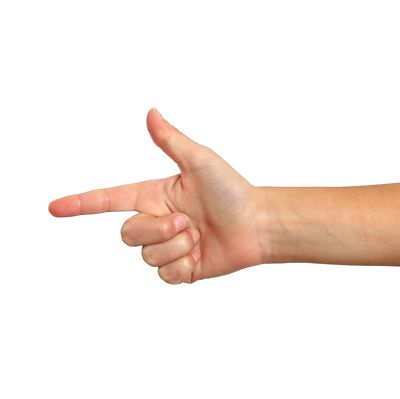
http://1withabullet.wordpress.com/2013/03/13/show-me-your-pop-tart-gun/ Examples of this detached-from-reality thinking are not hard to come by. Earlier this month a 7-year-old boy in Baltimore was suspended for biting a Pop-Tart into the shape of a gun. Colorado second grader Alex Evans was suspended in February for throwing an imaginary grenade while playing soldier at recess. In January, a 5-year-old boy at Hyannis West Elementary School in Massachusetts was threatened with suspension for making a gun-like shape out of Legos. Most absurdly, first grader Rodney Lynch was actually suspended for making a gun gesture with his hand, pointing it at a fellow classmate and saying “pow.” Seriously.
http://www.barstoolsports.com/m/nyc/super-page/6-year-old-boy-suspended-from-school-for-making-gun-gesture-with-his-hand/ Zero tolerance hysteria also extends to the disastrous and failed War on Drugs. Honor student Savanna Redding was strip-searched by school officials under suspicion of concealing illicit substances. The catch is that Redding was being accused of holding prescription-strength ibuprofen, when another student caught with contraband fingered Redding as their source. The 13-year-old girl was forced to disrobe and to pull out her underwear, shake out her bra and expose herself. No drugs were found. The girl was so humiliated that she never returned to the school.
Redding’s parents took the issue to the courts, where the case eventually found its way to the Supreme Court. In a 8-1 decision, with Justice Thomas dissenting, the court decided that Redding’s constitutional rights had, indeed, been violated by stripping her down in the vain quest to uncover the equivalent of a couple tablets of Advil.
The buffoons who sign off on these searches and suspensions don’t belong anywhere near children, let alone be entrusted with teaching them critical thinking skills that the teachers and administrators clearly lack.
One of the biggest problems with public schools is that they are inescapable. Poor Americans can’t afford to Super Size their children’s future through privatized education the way that wealthier families can. People are forced to send their children to the public school in the district that they live in, regardless of quality. In fact, it’s illegal to fudge the truth about your place of residence in order to gerrymander your child into a better school. Kelly Williams-Bolar of Akron, OH learned this the hard way when she registered her children at her father’s house in an attempt to get them into a better school district. Even though the father claimed that the children did indeed live with him, Williams-Bolar was nonetheless sentenced to five years in prison. Although the judge suspended all but 10 days of that sentence, she still had to serve 80 hours of community service and was put on probation for three years. All for the crime of having her children’s best interests at heart.
The overarching and negative issues with public schools largely stem from the fact that they are centrally controlled and they disallow competition. Schools aren’t in a position to customize their curriculum or to innovate in ways that might benefit parents or their children’s education. The most glaring example of this is the disastrous 2001 No Child Left Behind policy, which mandates that schools won’t receive federal funding unless their students demonstrate proficiency in standardized tests. This misguided top-down control is one thing that helps foster substandard public schools: Rather than be able to adapt and adjust to the needs of the students and their parents, schools are forced to play by bureaucratic rules created by Washington that try to create a one-size-fits-all method of education. Private schools, able to exist without federal aid, are largely able to eschew these demands of conformity.
It’s important to note that the problems public schools face cannot be solved by continuing to throw money at them. According to numbers from the National Assessment of Educational Progress, the amount of money spent per pupil has tripled since 1970 (see the chart at the top of this post), with absolutely nothing to show for it. Students’ scores in reading, math and science have flatlined. It’s clear that the problems with the system are not financial. The institution itself and the philosophy behind it is rotten. The supposed Tree of Knowledge can no longer bear fruit.
Public schools can be fixed if competition and choice are again injected into the system, allowing parents to freely choose schools that provide the best education to their children. Good schools would flourish and flagging ones would disappear from the market like a restaurant that has horrific service and serves rancid food.
Charter schools and programs like the Washington DC Opportunity Based Scholarship Program demonstrate how these principles can work in practice. Rather than forcing parents to send their children to the nearest public school, parents could be issued vouchers backed by tax-payer money. This voucher would represent the amount of money a state spends on each student per year for schooling, which averages about $11,500 although the figure varies between states. Schools that attract students are rewarded with the money allotted to that student. If a school fails to deliver the service it promises, then the parents are free to find a school that will, just like in any healthy business-customer relationship.
It’s time to completely revamp education in America. It’s a failed system that has been allowed to stagnate and fester like a bad case of trench foot. Institutional monopolies are uniquely capable of being massive while also providing piss-poor service, a reality that is readily admitted when it occurs outside of the public sector. After all, how happy would you be if you were forced to continually pay for a substandard computer that refused to upgrade and respond to market demand, year after year?
Inane bureaucracy and lack of choice are two driving factors to the inadequacies of public school systems in America. By allowing individuals to customize their children’s educational experience, we can dramatically improve their future by dismantling the idea that their place of residence shackles them to the school of nearest geographical convenience.
Sources:
http://news.blogs.cnn.com/2011/01/26/mom-jailed-for-enrolling-kids-in-wrong-school-district/
http://www.dcscholarships.org/
http://datacenter.kidscount.org/data/acrossstates/Rankings.aspx?ind=5199
http://www.oecd.org/pisa/46643496.pdf
http://abcnews.go.com/US/maryland-grader-suspended-pointing-finger-shape-gun/story?id=18123294
http://www.oecd.org/education/skills-beyond-school/48630687.pdf
http://online.wsj.com/article/SB10001424127887323301104578256142504828724.html
Wonder about your world…

Take the plunge down the rabbit hole of insanity and wonder in this fast-paced, nonstop psychological thriller that will leave you questioning the very nature of reality and beyond. Part thriller, part romance, part existential horror, A Dream of Waking Life delves into lucid dreaming, psychedelics, existential ontology, video games, the nature of love, the nature of reality, and more.

Mendel’s Ladder delivers an adrenaline-fueled journey set on a dystopian future Earth, brimming with high-stakes action, adventure, and mystery. This epic series opener plunges readers into a world filled with diverse cultures, heart-pounding battles, and characters who will captivate your heart and imagination.

“E.S. Fein is raising the bar for quality as it’s a very well-written and thought-provoking book…There are points and themes in the story that could be discussed for eons as people will have their own idea on where it leads. It’s a book I would highly recommend.” – Andy Whitaker, SFCrowsnest
 Wondergressive


